
If you are looking for the best decentralized exchange, you are no longer limited to clunky interfaces, massive slippage, and ridiculous network fees. The 2026 market offers lightning-fast execution, deep liquidity, and innovative cross-chain solutions that rival the speed of centralized platforms.
In this comprehensive guide, we will break down the absolute top decentralized exchanges across the spot, derivative, and cross-chain sectors, helping you choose the perfect gateway for your trading strategy.
The Evolution of Decentralized Trading
Let’s be completely honest: the days of relying on massive, centralized exchanges to hold your keys, lock your accounts, and demand your passport just to trade a few tokens are rapidly drawing to a close. Over the last few years, the decentralized finance (DeFi) space has matured from an experimental playground into a highly sophisticated, institutional-grade trading ecosystem.
The decentralized trading world has undergone a quiet revolution. We’ve moved far past the era of waiting ten minutes for an Ethereum mainnet swap to settle. Today, efficiency is everything.
How the DEX Landscape Shifted
When the concept of a decentralized exchange first gained traction, it was simple: you connected a wallet, interacted with a smart contract on Ethereum, and swapped Token A for Token B. Today, the best DEX architectures have outgrown shared blockchains. To escape the congestion and unpredictable gas fees of general-purpose networks, leading DEX platforms have transitioned into “Appchains” blockchains built solely to run a specific exchange. This shift has unlocked high-frequency trading speeds and gas-free order matching that were previously impossible on-chain.
Key Metrics to Evaluate a DEX
If you are looking through a list of decentralized exchanges trying to figure out where to park your capital, do not just look at Total Value Locked (TVL). TVL is a vanity metric. Instead, focus on the Volume-to-Liquidity (V/L) ratio. A platform with $100 million in TVL processing $200 million in daily volume is incredibly capital-efficient, whereas a ghost-town platform with $1 billion in locked assets and $5 million in volume is a liquidity trap. Additionally, evaluate their dynamic slip-fee models, which automatically adjust trading costs based on real-time market volatility.
The Great Layer-2 Migration
Ethereum Layer 1 has officially become the settlement layer for institutions. For retail traders, the playground has shifted entirely to Layer-2 (L2) rollups like Base, Arbitrum, and Optimism, alongside ultra-fast monolithic chains like Solana. By processing transactions off the main Ethereum road and bundling them together, these environments have brought the cost of a trade down to fractions of a penny, making high-volume trading accessible to everyone.
The Best Spot DEXs
Spot trading remains the bedrock of DeFi. If you want to buy and hold a token, these are the best decentralized exchanges in the world right now.
Uniswap (v4 / Unichain)
No top DEX conversation can start without Uniswap. With the launch of Uniswap v4 and the deployment of its own custom L2 network, Unichain, the platform has redefined how liquidity functions.
The secret to Uniswap’s modern dominance is “Hooks.” Hooks are custom smart contracts that allow developers to execute specific logic at any point in a transaction’s lifecycle. Think of it as programmable liquidity: a pool can now automatically execute limit orders, adjust fees based on volatility, or execute dynamic tax models without needing a separate protocol. It remains the undisputed best decentralized crypto exchange for sheer asset diversity and innovation.
PancakeSwap (v4)
What started as a fork of Uniswap on the BNB Chain has evolved into a multi-chain powerhouse. PancakeSwap v4 brings its own version of hooks (called “Active Pool Managers”) to networks like Arbitrum, Base, and Ethereum. What sets PancakeSwap apart is its user-friendly, gamified environment. Beyond simple token swaps, it integrates prediction markets, lottery pools, and direct play-to-earn gaming integrations. If you are looking for a good decentralized exchange that combines low fees with a highly engaging user interface, PancakeSwap is a staple.
Curve Finance
If you want to trade stablecoins or pegged assets (like swapping USDC for USDT, or wrapped Bitcoin for native Bitcoin), Curve is the undisputed king. Curve’s unique mathematical formula ensures that “like-kind” assets can be traded with virtually zero price slippage, even for multi-million dollar transactions. Its complex “veToken” mechanics also allow other projects to compete for its deep liquidity, making Curve the silent economic engine behind a massive chunk of the entire DeFi sector.
Raydium & Meteora
If you want to trade on Solana, Raydium and Meteora are mandatory stops. Raydium acts as the central liquidity hub, plugging directly into Solana’s high-speed architecture to facilitate instant trades. Meteora, on the other hand, specializes in dynamic liquidity pools that automatically yield-farm unused assets, maximizing the returns for liquidity providers. Together, these two have captured a massive share of the retail trading volume, fueling the high-velocity Solana ecosystem with unparalleled speed.
Top Perp & Derivative DEXs
The fastest-growing sector of decentralized trading is derivatives. You no longer need a centralized account to trade with 50x or 100x leverage.
Hyperliquid
Hyperliquid is currently the fastest-growing best DEX crypto platform for perpetual futures. Built as a custom, high-throughput Layer-1 Appchain, Hyperliquid operates completely on-chain while offering an interface that looks and feels exactly like a centralized exchange. It handles thousands of transactions per second, features a gas-free order book, and allows you to trade a massive variety of synthetic inDEX assets and perpetuals with deep, institutional liquidity.
dYdX Chain
As one of the pioneers of decentralized leverage, dYdX took a massive leap forward by migrating to its own dedicated Cosmos-based blockchain. The dYdX Chain provides professional traders with a fully decentralized, off-chain order matching engine paired with on-chain settlement. If you are an algorithmic trader or a professional portfolio manager requiring API integrations, sub-second execution, and highly customizable order types, this is the premier top decentralized crypto exchange for derivatives.
GMX v2
Running primarily on Arbitrum and Avalanche, GMX v2 uses an innovative multi-asset pool model (called the GM pool). Instead of trading against an order book, traders execute positions against a pool of blue-chip crypto assets and stablecoins. GMX v2 introduces segregated markets, meaning a sudden price crash in a volatile altcoin won’t affect the liquidity of the main Bitcoin or Ethereum pools. It is a masterclass in risk management and capital efficiency for leverage traders.
Best Cross-Chain DEX Aggregators
With liquidity fragmented across dozens of different blockchains, how do you know you are actually getting the best price? You don’t browse individual pools; you use an aggregator.
Jupiter (JUP)
Jupiter is the golden standard of top DEX aggregation. If you want to execute a trade on Solana, Jupiter is the tool you use. It doesn’t hold its own liquidity; instead, its routing algorithm instantly scans every single pool on the Solana network to find the absolute best path for your transaction. If swapping directly from Token A to Token B is too expensive, Jupiter will automatically split your order and route it through intermediate assets (A to USDC, USDC to B) to guarantee you get the maximum token output.
SushiSwap (SushiXSwap)
SushiSwap‘s cross-chain routing engine, SushiXSwap, solves one of the biggest headaches in crypto: moving assets between different blockchains. Instead of using a clunky centralized bridge, paying multiple gas fees, and risking your funds, SushiXSwap allows you to execute a native cross-chain swap in a single transaction. You can swap native Ethereum on Arbitrum for native USDC on Solana seamlessly, with the routing math handled completely behind the scenes.
1inch Network
1inch is the pioneer of multi-chain aggregation. Its Pathfinder algorithm searches across Ethereum, BNB Chain, Polygon, Arbitrum, and dozens of other EVM networks to find the most cost-effective path. What makes 1inch a standout in the list of decentralized exchanges is its “Fusion Mode.” Fusion Mode allows users to place gasless limit orders, where specialized professional market makers fill your order and cover the transaction fees on your behalf.
L2-Native Liquidity Hubs
As Layer-2 networks have exploded in popularity, a new breed of native trading engines has emerged, powered by the complex “ve(3,3)” voting and bribing model.
Aerodrome Finance
Aerodrome has rapidly ascended to become the absolute liquidity heart of Coinbase’s Base network. It uses a ve(3,3) economic model, which aligns the incentives of liquidity providers and governance token holders. If you are looking to trade or provide liquidity on Base, Aerodrome is the undisputed best DEX for depth, stability, and token variety, capturing the majority of the network’s on-chain volume.
Velodrome Finance
As the sister protocol to Aerodrome, Velodrome serves as the primary utility and liquidity hub for the Optimism ecosystem. By offering deep, low-slippage pools for both stable and volatile digital assets, Velodrome has made Optimism one of the most cost-effective networks for large-scale DeFi transactions.
Native DEXs vs. Instant No-KYC Swaps
While trading natively on a DEX offers absolute decentralization, the user experience can sometimes be incredibly daunting for beginners.
The Friction of Web3 Trading
Let’s face it: using a native DEX requires a steep learning curve. You have to download a Web3 wallet, keep track of your 12-word recovery phrase, make sure you hold the exact native token needed to pay for gas (like holding ETH on Base or SOL on Solana), adjust your slippage tolerance, and pray the transaction doesn’t fail due to network congestion. For many users who just want to make a quick trade, this friction is simply too high.
Quickex: Combining CEX Simplicity with DEX Privacy
This complexity is exactly why hybrid, privacy-first service providers are dominating the market. Platforms like Quickex serve as the ultimate bridge.
Quickex offers the absolute best of both worlds. It gives you the full privacy of a DEX (no accounts, no KYC checks, no identity verification) with the clean, friction-free simplicity of a centralized interface. You don’t have to worry about managing gas tokens on three different Layer-2 networks or setting slippage tolerances.
Quickex also supports DEX exchanges through a widget. You simply send your starting asset, like BTC to XMR, and Quickex’s smart routing engine automatically bounces the desired token straight back to your private, self-custody wallet. Most importantly, it is entirely non-custodial, meaning you never surrender control of your keys.
When to Use a Native DEX vs. an Instant Exchange Platform
- Use a Native DEX if you are actively yield farming, participating in on-chain governance voting, trading highly speculative, micro-cap tokens on launchpads, or executing complex leverage positions.
- Use an Instant Exchange if you want to quickly swap large amounts of capital between different blockchains, acquire assets anonymously with a card, or simply want to trade without dealing with the hassle of managing gas fees, network RPC settings, and bridging risks.
How to Trade Safely on a Decentralized Exchange
Sovereignty comes with responsibility. Because there is no customer support team to call, protecting your funds is entirely in your hands.
Protecting Your Assets
Scammers frequently launch carbon copies of popular DEX platforms to steal your keys. They bid on Google search ads, placing malicious links at the very top of search results. Always bookmark official URLs (like Uniswap or Jupiter) and verify the domain name before connecting your wallet. Furthermore, never type your 12-word seed phrase into a website; a real DEX will only ever ask you to sign a transaction, never to reveal your keys.
Managing Smart Contract Risk
When you trade on a DEX, you have to grant the smart contract permission to interact with the tokens in your wallet. Over time, these permissions accumulate. If a protocol you used three years ago gets hacked today, the attackers can drain your wallet through those old open approvals. Make it a monthly habit to visit Revoke.cash, connect your wallet, and revoke any unnecessary token spend permissions.
Avoiding Slippage Traps and MEV Attacks
Because the blockchain is a public ledger, specialized trading bots (MEV bots) monitor the transaction waiting room (the mempool). If they see you are about to make a massive purchase with high slippage tolerance, they will bribe the validator to buy the token right before you, push the price up, and instantly sell it back to you at a profit. This is a “sandwich attack.” To prevent this, always set your slippage tolerance to a low percentage (usually 0.5% or less) or use “private RPCs” like Flashbots Protect to hide your trades from these predatory bots.
The Future of DeFi Trading
The landscape is shifting faster than ever. As we look toward the end of the decade, the line between decentralized and centralized trading is beginning to blur.
Account Abstraction
The biggest friction point in DeFi is gas management. Account Abstraction (ERC-4337) is fixing this. In the near future, your Web3 wallet will be a smart contract itself. You will be able to recover your wallet via a simple biometric scan, and decentralized applications will be able to sponsor your gas fees. You will be able to swap tokens on a DEX without ever needing to hold native gas tokens like ETH or SOL. It will feel exactly like using a standard Web2 banking application.
Institutional DEXs:
To attract trillions of dollars from Wall Street, the industry is building “Permissioned DEXs.” These platforms utilize zero-knowledge proofs to verify that every wallet trading in a pool belongs to a legally compliant, non-sanctioned entity, all without revealing the user’s private data to the public ledger. It allows institutions to enjoy the algorithmic efficiency of a DEX while remaining fully compliant with global financial regulators.
Conclusion
Finding the best decentralized exchange for your portfolio requires moving past the hype and focusing on the underlying architecture. Whether you choose the deep liquidity and custom programmable hooks of Uniswap v4, the ultra-fast appchain infrastructure of Hyperliquid, or the frictionless, privacy-preserving simplicity of instant non-custodial bridges like Quickex.io, the power to manage your own wealth is finally back where it belongs: entirely in your own hands.
FAQ: Decentralized Exchanges (DEX) — Everything You Need to Know
What is a decentralized exchange (DEX)?
A decentralized exchange (DEX) is a crypto trading platform that runs entirely on blockchain smart contracts — allowing users to swap tokens directly from their own wallets without depositing funds into a company’s custody. There is no central operator, no order book server, and typically no KYC requirement.
- How it works: Instead of matching buyers and sellers through a centralised order book, a DEX uses one of two primary mechanisms:
- AMM (Automated Market Maker): Users trade against liquidity pools funded by other users. Price is determined by a mathematical formula (e.g. x × y = k). Examples: Uniswap, Raydium, Orca, PancakeSwap.
- CLOB (Central Limit Order Book): Buy and sell orders are matched on-chain, similar to a traditional exchange but fully transparent. Examples: Phoenix (Solana), dYdX, Hyperliquid.
- Key properties of every DEX:
- Non-custodial — you never give up control of your private keys.
- Permissionless — anyone can list a token or provide liquidity.
- Transparent — every trade is verifiable on the public blockchain.
- Censorship-resistant — no central authority can freeze accounts.
- Limitation: A DEX operates on a single blockchain. Uniswap only swaps Ethereum tokens; Jupiter only swaps Solana tokens. For cross-chain swaps (e.g. BTC → SOL, ETH → XMR), you need a cross-chain service like QuickEx.
Need cross-chain swaps a DEX can’t do? Exchange any crypto on QuickEx →
What are the best decentralized exchanges in 2026?
The best DEX for you depends on which blockchain you’re trading on. Here are the top decentralized exchanges across major ecosystems in 2026:
- Best overall (Ethereum): Uniswap v4 — largest DEX by volume globally, deployed across 15+ chains.
- Best overall (Solana): Jupiter — aggregates all Solana DEXs for optimal execution; “the Google of Solana swaps.”
- Best for stablecoins: Curve Finance — optimised for minimal-slippage swaps between USDT, USDC, DAI, and other pegged assets.
- Best for perpetual futures: Hyperliquid — on-chain CLOB with sub-second execution and no gas fees.
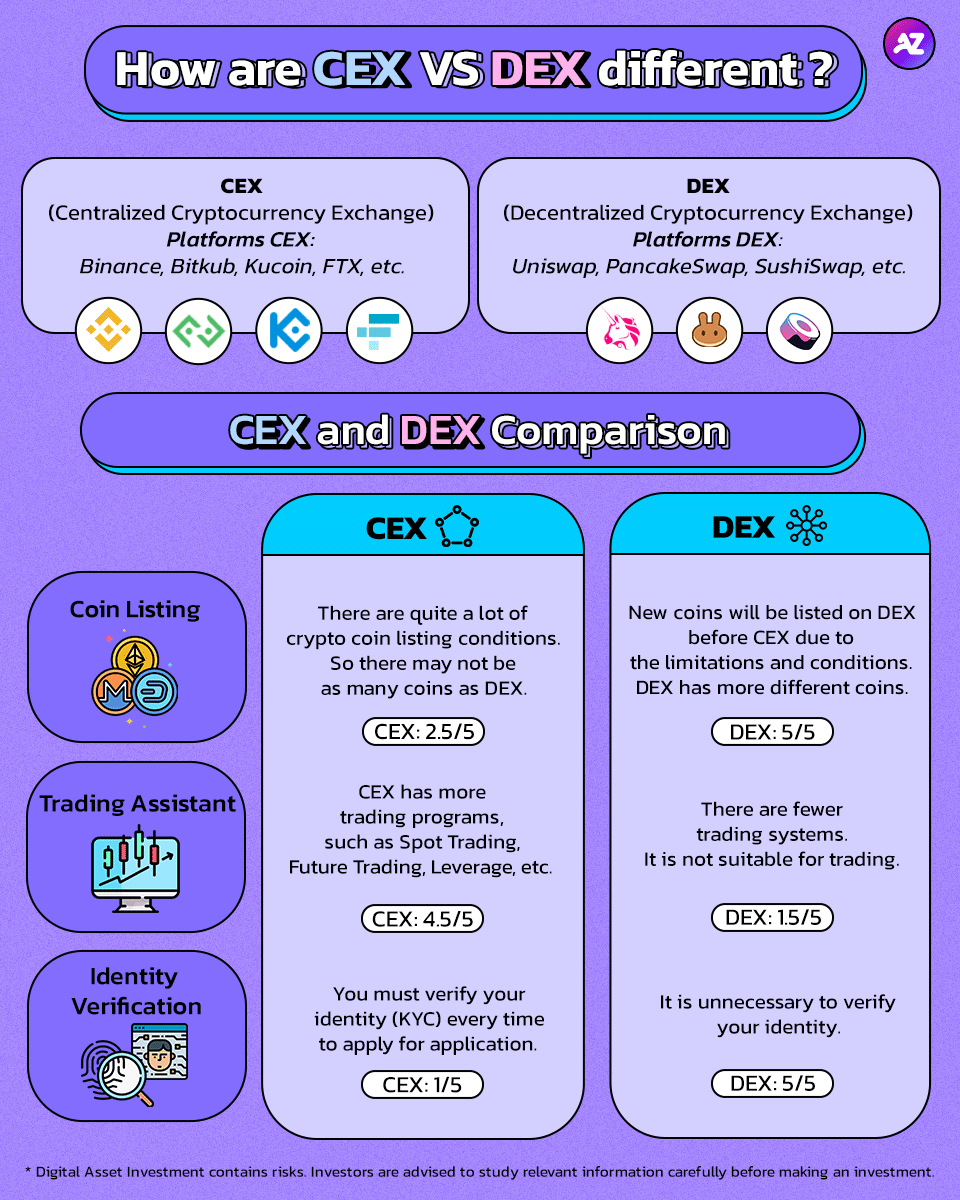
Centralized vs decentralized exchanges: what’s the difference?
Understanding the difference between centralized vs decentralized exchanges is the most important decision any crypto trader makes — it determines who controls your funds, your privacy, and your risk exposure.
What are the risks of using a crypto decentralized exchange?
While a crypto decentralized exchange removes custodial risk, it introduces a different set of risks that every user should understand:
- Smart contract risk: DEXs run on smart contracts — bugs or vulnerabilities can be exploited to drain liquidity pools. Major exploits include Euler Finance ($197M, 2023) and Curve Finance ($70M, 2023). Always check whether the DEX has been audited by reputable firms (Trail of Bits, OpenZeppelin, Halborn).
- Impermanent loss (LPs): If you provide liquidity to an AMM pool, price divergence between the paired tokens can cause you to end up with less total value than if you had simply held — this is called impermanent loss. It’s permanent if you withdraw at a diverged price.
- Rug pulls & scam tokens: Because DEX listing is permissionless, anyone can create a token and add liquidity. Rug pulls — where the creator drains liquidity or mints unlimited tokens — are common on Uniswap, PancakeSwap, and Raydium. Always verify the contract address on the project’s official channels.
- Slippage & MEV: Large trades on low-liquidity pools suffer price impact (slippage). Additionally, MEV bots can front-run or sandwich your transaction on Ethereum, extracting value at your expense. Use slippage protection and MEV-resistant features where available (Flashbots Protect, Jupiter’s MEV guard).
- Wallet approval exploits: Connecting your wallet to a DEX grants token spending approvals. A compromised or malicious dApp can use unlimited approvals to drain your tokens. Audit and revoke approvals regularly using revoke.cash.
- No customer support: If you make a mistake (wrong address, wrong network, wrong token), there is no support team to reverse the transaction. DEX trades are final and irreversible.
- Single-chain limitation: You can’t swap BTC for SOL or ETH for XMR on any single DEX — they only support tokens on their native blockchain. For cross-chain needs, use a bridge (higher risk) or a non-custodial swap service like QuickEx (lower risk, no smart contract interaction).
How to use a DEX exchange for crypto: step-by-step
Using a DEX exchange for crypto is straightforward once you have tokens in a compatible wallet. Here’s a universal guide:
- Set up a wallet for the target blockchain:
- Ethereum / L2s: MetaMask, Rabby, Coinbase Wallet
- Solana: Phantom, Solflare, Backpack
- BNB Chain: MetaMask (add BSC network), Trust Wallet
- TON: Tonkeeper, TON Space
- Fund your wallet with the native gas token (ETH for Ethereum, SOL for Solana, BNB for BSC) plus the token you want to trade. If you don’t have gas tokens yet, swap any crypto for them on QuickEx — output goes directly to your wallet.
- Go to the DEX website — e.g. app.uniswap.org, jup.ag, pancakeswap.finance.
- Connect your wallet — click “Connect Wallet” and approve the connection popup. The DEX gets read-only access; it cannot move funds without per-transaction approval.
- Select the token pair — e.g. ETH → USDC, SOL → JUP. Always verify the token contract address to avoid scam tokens with similar names.
- Set slippage tolerance — default is 0.5–1%. For volatile or low-liquidity tokens, you may need 2–5%.
- Review and confirm — check output amount, price impact, and fee. Approve the transaction in your wallet.
- Transaction confirms on-chain — Solana: ~1 second; Ethereum: ~15–60 seconds; BNB Chain: ~3 seconds. New tokens appear in your wallet immediately.
Disclaimer: The material in this article is not financial or investment advice. Everything stated here reflects the author's personal view and should not be treated as a recommendation to trade or invest. We make no warranties regarding the accuracy, reliability or completeness of the information presented. Cryptocurrency markets are highly volatile and can move unpredictably. Before committing any funds, every investor, trader or crypto user should study several independent sources and check the regulations that apply in their own jurisdiction.