

Privacy coins have always lived in crypto’s “complicated” corner: loved by people who want financial privacy, side-eyed by regulators, and periodically yanked off big exchanges. In 2026, that push-and-pull is sharper than ever. On one hand, surveillance fears and data leaks keep making the case for private transactions. On the other hand, rulebooks are increasingly explicit about restricting Anonymity Enhanced Coins (AECs) and “inbuilt anonymisation” features.
This guide breaks down privacy coins in plain language: the tech, the trade-offs, the regulatory reality, and how the top privacy coins compare in 2026.
What are privacy coins?
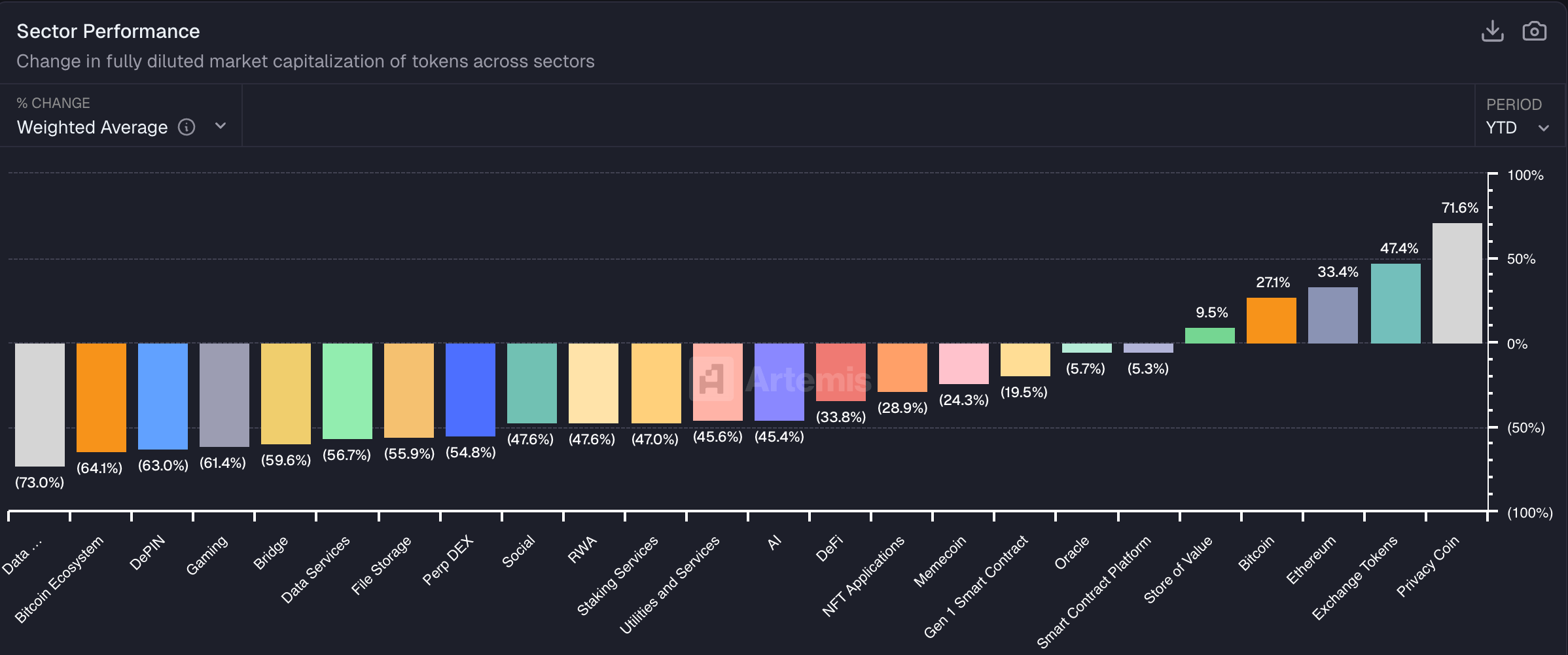
Source: Coinstats
Privacy coins (often labeled AECs) are cryptocurrencies designed to conceal transaction details—typically the sender, receiver, and/or the amount—using cryptographic techniques that make transfers difficult to trace.
These assets intentionally obscure transaction information (including addresses and amounts), which improves user privacy and fungibility—but also creates compliance headaches.
Privacy-by-default vs opt-in privacy
In 2026, most privacy projects fall into two buckets:
- Privacy-by-default: privacy features are always on (Monero / XMR).
- Opt-in / selective privacy: users can choose private or transparent activity (classic example: Zcash with shielded vs transparent addresses and “view keys” for selective disclosure).
How do privacy coins work?
If you’ve ever Googled “how do privacy coins work” and bounced off a wall of jargon, here’s the simpler model: privacy tech tries to hide who paid, who got paid, and how much—sometimes also hiding network metadata like IP clues.
1) Hiding the sender
A common approach is blending the real sender with decoys.
- Ring signatures let a transaction be “signed by one of many possible signers,” making it computationally difficult to prove which key actually authorized it. Monero uses ring signatures to make outputs untraceable.
2) Hiding the receiver
Even if you can’t identify the sender, a public receiver address can still give the game away.
- Stealth addresses generate one-time destination addresses so the recipient’s public address doesn’t appear on-chain.
3) Hiding the amount
Amounts are a huge leakage point. If you can see “Alice sent 37.42 coins,” you can do a lot of detective work.
- RingCT (Ring Confidential Transactions) is how Monero hides transaction amounts (and has been mandatory for all transactions since 2017).
4) Zero-knowledge privacy (Zcash-style)
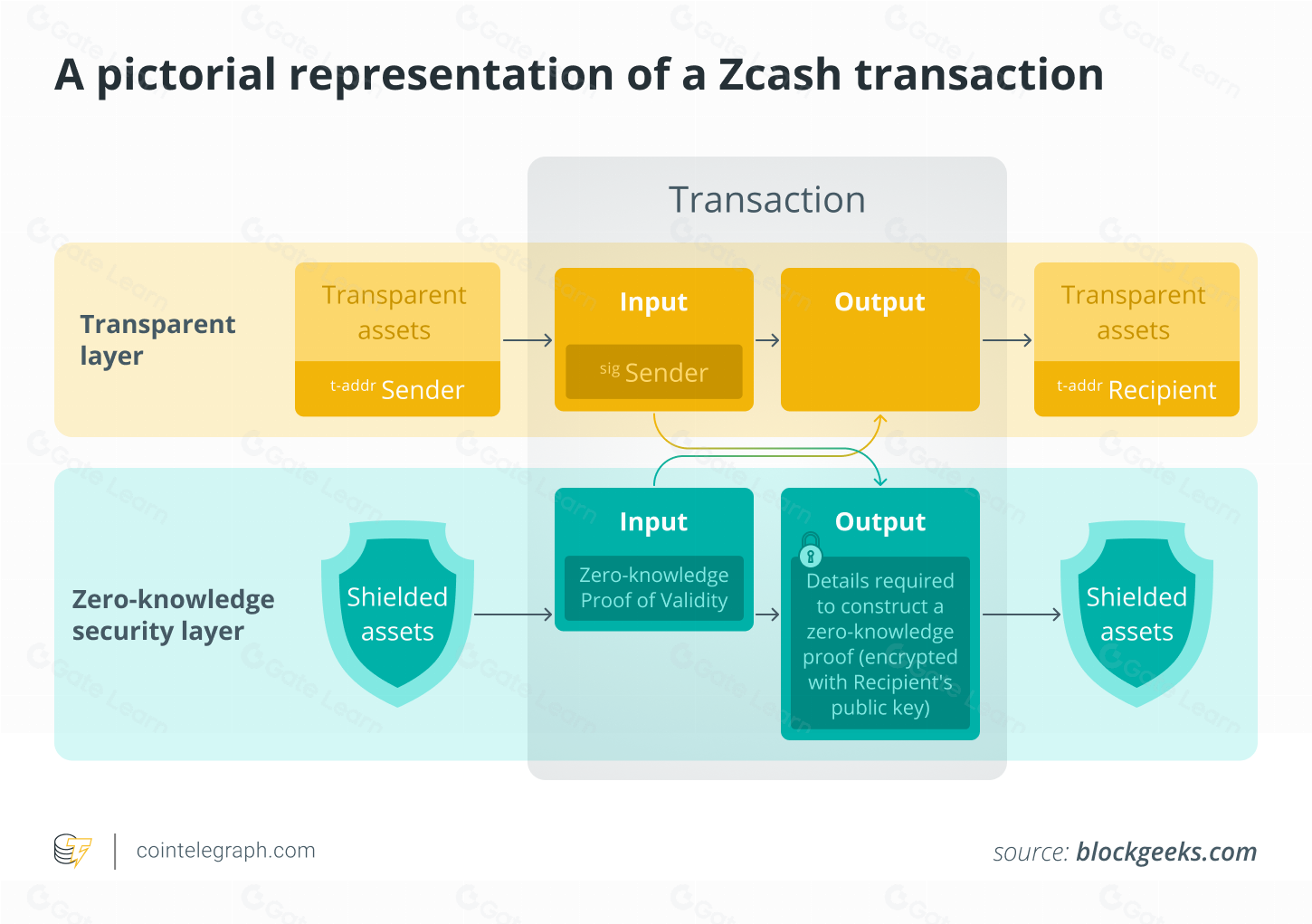
Source: Gate
Zcash’s flagship idea is proving a transaction is valid without revealing the sensitive details.
- Zcash supports shielded transactions where sender, receiver, and amount are encrypted, and it includes view keys that allow read-only disclosure for audit/tax/AML needs without giving spending power.
5) MimbleWimble-style privacy
The Mimblewimble family takes a different route: it aims to remove visible addresses and keep amounts hidden at the protocol level.
- Explainers often summarize it as: no addresses, amounts hidden via commitments, and transactions verifiable as balance equations.
- The MWC project itself highlights the “no addresses” + “encrypted amounts” model as core to MimbleWimble-based chains.
Regulation, delistings, and liquidity in 2026
The biggest mistake people make with privacy assets in 2026 is treating them like “just another altcoin sector.” They aren’t. Policy language now explicitly targets anonymity features.
Dubai/UAE: “Anonymity-enhanced” restrictions
Dubai’s Virtual Assets Regulatory Authority (VARA) has rules that prohibit or restrict “Anonymity Enhanced Cryptocurrencies,” alongside other privacy-enabling activity, as part of its market product and service framework.
Separately, DIFC/DFSA materials also discuss restrictions around privacy-focused tokens in their crypto token regime updates.
Europe: MiCA’s “inbuilt anonymisation” clause
Under the EU’s Markets in Crypto-Assets framework, trading platforms are expected to prevent admission to trading of crypto-assets with inbuilt anonymisation functions unless the holder and transaction history can be identified.
Big-exchange delistings: the liquidity tax
Even before 2026, major exchanges have delisted privacy assets, which matters because liquidity is oxygen.
- Binance announced it would delist Monero (XMR) spot pairs in February 2024, citing its periodic review standards (and listing factors like liquidity, network safety, and regulatory requirements).
- Earlier delistings (e.g., Bittrex removing Monero, Dash, and Zcash markets in 2021) show this trend isn’t new—it’s just accelerating in places.
- Coverage around Europe’s compliance environment and exchange actions has also framed privacy-coin removals as a likely outcome of tightening rules.
Net effect: privacy coins often trade with extra volatility because access can change fast—especially if you’re relying on one region or one venue.
Top privacy coins to watch in 2026
Below are the usual suspects—and a couple of “privacy tooling” add-ons.
Monero (XMR)
Monero’s pitch is straightforward: privacy is the default, not a feature toggle. It uses ring signatures for sender ambiguity and RingCT for hidden amounts.
Zcash (ZEC)
Zcash lets users choose between transparent and shielded transactions and supports view keys for selective disclosure—useful in a world where regulators increasingly demand auditability.
Dash (DASH)
Dash offers an optional privacy feature (historically branded PrivateSend), built around transaction mixing concepts.
Firo Coin (FIRO)
Firo has focused on privacy research and introduced Spark addresses designed to be non-searchable on-chain, with incoming/outgoing view key support mentioned in its research materials.
MimbleWimbleCoin (MWC) and the MimbleWimble family
MWC is commonly grouped with privacy coins because MimbleWimble hides amounts and avoids readable address trails—but even the project has described itself as “more than a privacy coin,” framing MimbleWimble as a broader protocol upgrade (privacy + fungibility + scalability).
0x0 and “privacy tooling” tokens
Some newer projects focus less on being a standalone privacy currency and more on privacy infrastructure. For example, 0x0’s documentation describes a “privacy mixer” that pools and redistributes funds to make tracing harder.
Privacy coins compared in 2026
| Asset | Privacy model | What it hides | Notable mechanism | Audit / disclosure option | Biggest 2026 trade-off |
| Monero (XMR) | Default-on | Sender, receiver, amount | Ring signatures + RingCT | Limited (privacy is the point) | Exchange access can shrink quickly |
| Zcash (ZEC) | Opt-in | Sender/receiver/amount when shielded | zk-based shielded transactions | View keys (“selective disclosure”) | Many venues still support mostly transparent usage |
| Dash (DASH) | Optional | Transaction graph obfuscation (when used) | CoinJoin-style mixing | N/A (depends on usage) | “Optional” privacy can be misused or misunderstood |
| FIRO | Default + privacy addresses | Amounts + address observability | Spark addresses, high anonymity set | Incoming/outgoing view key support | Smaller liquidity vs the big two |
| MWC | Protocol-level confidentiality | Amounts + address trails | MimbleWimble commitments / cut-through | Limited | Access + ecosystem depth vary widely |
| 0x0 | Tooling token (not a classic privacy L1) | Transaction traceability (via mixing tool) | “Privacy mixer” concept | N/A | Elevated regulatory risk in many regions |
Practical tips: using privacy the right way
Privacy doesn’t have to mean “sketchy.” In fact, a lot of legitimate use cases (business confidentiality, protection from surveillance, personal safety) are explicitly listed by compliance-focused researchers.
A few grounded rules in 2026:
- Assume access can change. Even if an asset is listed today, it might not be tomorrow in your region.
- Prefer selective disclosure when possible. Zcash-style view keys are one example of privacy that can still support auditing/tax needs.
- Treat “privacy tools” as higher risk. Mixers and similar services can carry heightened compliance scrutiny.
How to buy and swap privacy coins in 2026
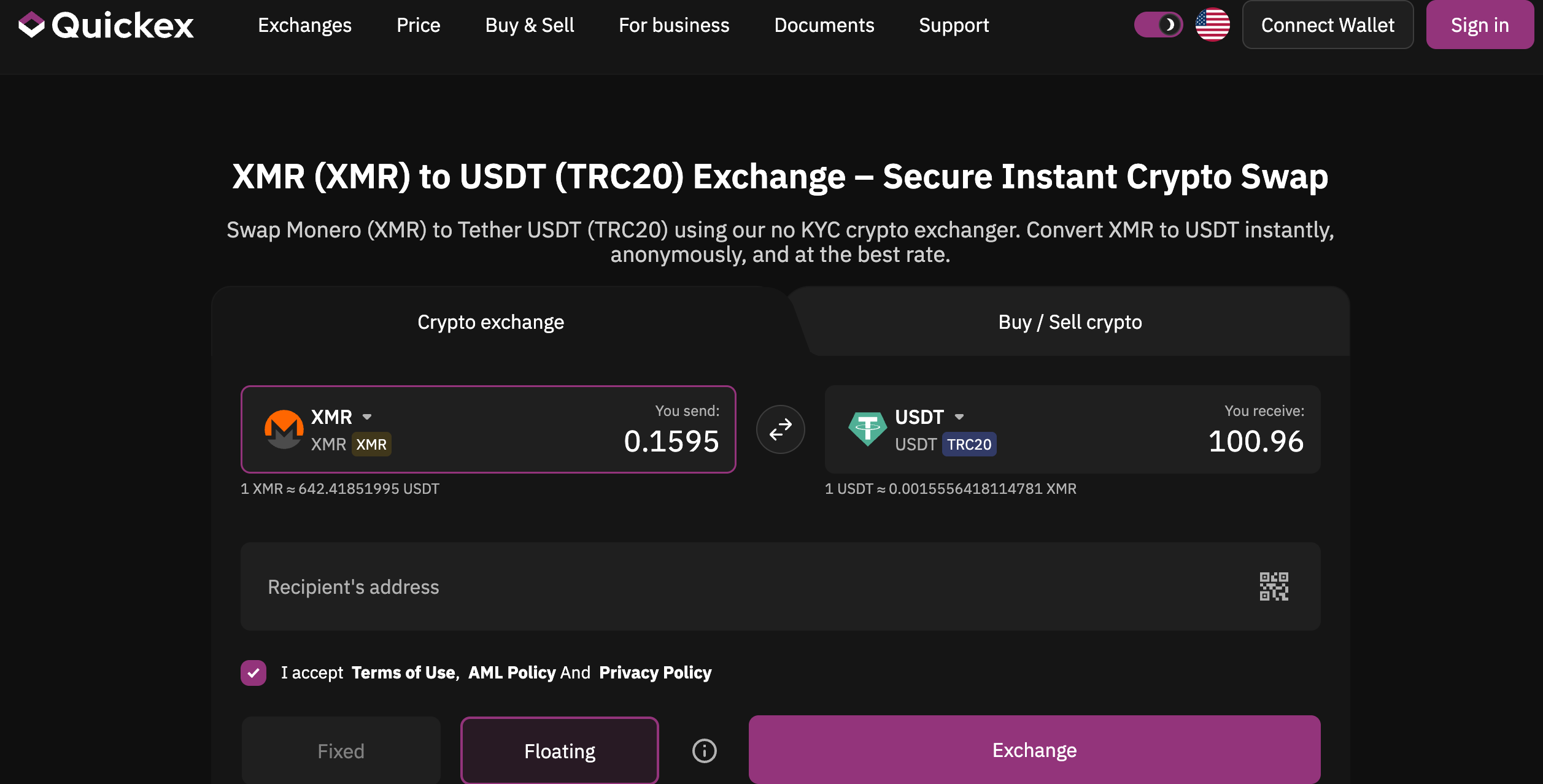
This is where searches like exchange Monero online can get messy, because availability is fragmented and jurisdiction-dependent. Major venues have delisted XMR in the past, and policy frameworks like MiCA and VARA explicitly target anonymity features.
While some big centralized exchanges have pulled back from privacy coins, Quickex still lists Monero (XMR) as available for swaps: for example, it currently offers an XMR to USDT exchange flow.
If you’re going to exchange crypto involving privacy assets, a safer checklist is:
- Check local rules first (especially EU/UK/UAE jurisdictions where anonymity language is explicit).
- Verify venue status and withdrawal timelines (delisting announcements often include cut-off dates).
- Prioritize reputable custody practices (withdraw to a wallet you control where appropriate, and keep backup phrases offline).
- Expect higher spreads and faster swings—especially around listings, delistings, or enforcement headlines (this is where XMR price volatility often shows up).
What’s next for privacy coins?
The direction of travel looks like this: regulators keep demanding traceability, while users keep demanding confidentiality. The middle ground—already visible in tech like Zcash view keys and research into “auditable privacy”—is privacy with controlled disclosure rather than total opacity.
That doesn’t mean fully private systems disappear. It means 2026 rewards people who understand the trade-offs: tech strength, liquidity access, and legal reality all matter—sometimes more than “number go up.”
FAQ
Are privacy coins illegal in 2026?
It depends on where you live. Some jurisdictions explicitly restrict anonymity-enhanced assets, while others allow them with compliance controls.
Is Monero more private than Zcash?
They’re private in different ways: Monero is privacy-by-default (ring signatures + RingCT), while Zcash offers shielded privacy with optional transparency and view keys.
Why do exchanges delist privacy coins?
Common reasons include regulatory pressure, compliance monitoring challenges, and internal listing standards. Binance’s delisting notice is a clear example of how exchanges frame these decisions.
What’s the main risk for privacy coin investors in 2026?
Access risk: delistings and policy shifts can affect liquidity and pricing quickly, even if the underlying tech hasn’t changed.
Disclaimer: The material in this article is not financial or investment advice. Everything stated here reflects the author's personal view and should not be treated as a recommendation to trade or invest. We make no warranties regarding the accuracy, reliability or completeness of the information presented. Cryptocurrency markets are highly volatile and can move unpredictably. Before committing any funds, every investor, trader or crypto user should study several independent sources and check the regulations that apply in their own jurisdiction.