
If you’re exploring how to use AI for crypto trading without drowning in buzzwords, start with small, testable steps. When your model flags a trade and you need fast execution between majors, a non-custodial swap helps keep things nimble — for example, exchange ETH to BTC to rebalance exposure without opening a new account.

Source: AI Signals
TradingView 2-hour chart of Gold CFDs (USD/OZ) from July to August, showing candlestick prices ~2,300-2,550 with AI-signals V3, TP markers, volume bars, and current close at 2,459.06 (-0.10%).
This guide is educational, not financial advice. Always manage risk and comply with your local regulations.
What is AI crypto trading?
In short, it’s the use of algorithms, often machine learning — to turn market data into trading decisions. You’ll see terms like AI crypto trading, cryptocurrency AI trading, and artificial intelligence cryptocurrency trading used interchangeably. At its best, AI finds patterns your eyes miss; at its worst, it overfits past data and fails to live. The real edge comes from disciplined testing, sizing, and execution — not black-box magic.
Using AI for crypto trading vs. traditional rules
Using AI for crypto trading doesn’t replace a plan; it accelerates research. Classic rule systems (trend + momentum + risk stops) are transparent and robust. AI adds signal discovery: e.g., a classifier that predicts “trend continuation vs. mean reversion” next hour. Many traders blend both — an AI “gate” to decide the regime, and simple rules to enter/exit.
Core building blocks
Before you touch code, define the minimum viable stack: data you trust, a clear prediction target, a simple model, and a way to measure results. You can get 80% of the benefit from straightforward methods long before deep learning becomes necessary. Keep scope tight, iterate fast, and document every choice.
- Data you trust: OHLCV, funding, order-book snapshots (if available), and derived features (returns, volatility, RSI, moving averages).
- Labeling: Predict a clear target (e.g., probability that price in the next N bars exceeds entry by X%).
- Models: Start with linear/logistic regression or tree-based learners before neural nets.
- Validation: Walk-forward or time-series split; never shuffle!
- Risk/Execution: Position sizing, max loss per trade/day, and realistic slippage assumptions.
Quick price check while you test? Keep a tab with Bitcoin price today to sanity-check fills and model triggers in real time.
A 7-step mini-workflow to get live (safely)
Think of this as a safety-first pipeline from idea to small live size. Each step reduces the chance of fooling yourself and helps separate real edge from backtest noise. Reuse the checklist every time you change features, models, or markets.
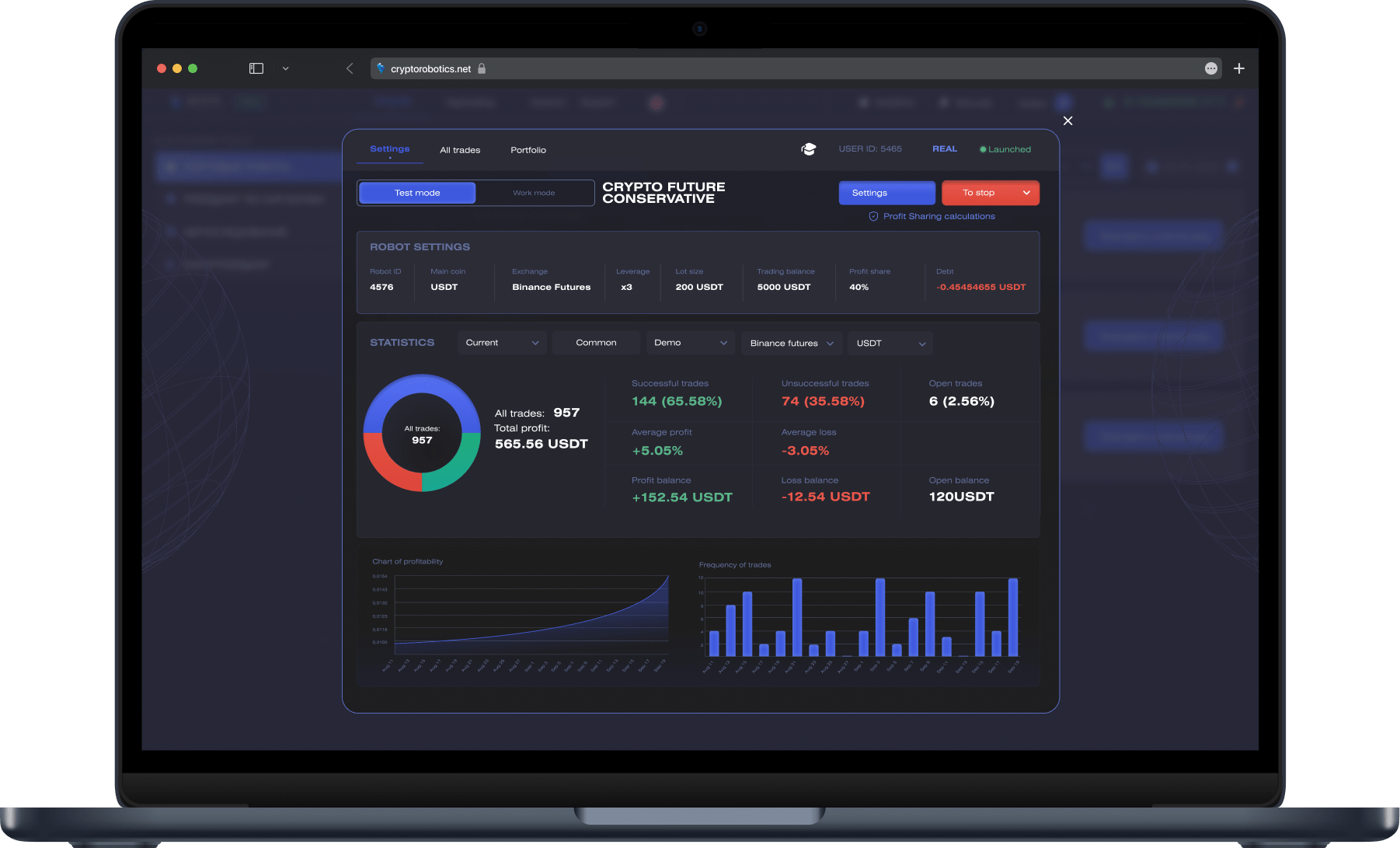
Source: Сryptorobotics
Screenshot of cryptorobot.com dashboard for Crypto Future Conservative robot in test mode, showing settings (ID 4578, Binance Futures, x3 leverage, 200 USDT lot), statistics (957 trades, 65.58% success, +565.58 USDT profit), pie chart, profitability line graph, and trade frequency bar chart.
- Define the decision. Example: “Go long BTC if up-move probability > 60% for the next 4 hours.”
- Collect features you understand. Price returns, rolling volatility, trend strength, funding, simple order-flow proxies.
- Baseline first. Beat a naive strategy (buy-and-hold or moving-average cross) before calling it “AI.”
- Train two simple models. A linear model (interpretable) and a tree model (non-linear). Compare them.
- Backtest with frictions. Include fees, spreads, and slippage typical for your venue.
- Paper trade. Log signals vs. actual market moves for 2–4 weeks.
- Go small live. Start tiny, scale only after stable performance and low error rates.
Tooling and setup: from signal to swap
A lightweight stack beats a fragile “everything machine.” Your goal is reliable signal to decision to execution with minimal moving parts. Start with notebooks for research, a simple scheduler for live signals, and straightforward wallet-based execution — add complexity only when it pays for itself.
- Research notebook: for feature engineering and charts.
- Signal server (optional): pushes trade intents to your phone or terminal.
- Execution: when a signal fires and you need to rotate majors quickly, a self-custodial swap keeps you agile.
- See it in action: a quick visual on wallet-to-wallet flow: “How Quickex Works” — useful context when wiring your “AI to execution” pipeline.
Model ideas you can actually test
You don’t need deep learning to start. These models are interpretable, quick to validate, and manageable for solo traders. Prove each one on out-of-sample data before combining them.
- Regime classifier: Predict whether current conditions favor momentum or mean reversion, then route to the corresponding ruleset.
- Volatility gate: Trade only when predicted realized volatility sits in your “sweet spot.”
- Event filter: Use an AI score to avoid low-liquidity hours or high-risk prints.
- Spread/impact estimator: A small model that predicts execution cost; skip trades when expected edge < cost.
Cost control: fees, slippage, and confirmations
Even a great predictor loses to poor execution. Before placing a trade in AI bitcoin trading or broader artificial intelligence crypto trading, run this mental checklist:
- Fees: Know your all-in cost per round trip. A 0.20–0.40% swing can erase the model’s edge.
- Slippage: Set a max slippage or use limit orders where practical. If you must market-hit, shrink size.
- Confirmations: On chain, more confirmations increase safety but slow redeployments — plan around this if your AI for bitcoin trading rebalances frequently.
Risk management for AI strategies
AI can amplify both profits and mistakes. Treat risk rules as non-negotiable constraints, not suggestions. Think in distributions, not certainties: every prediction has error bars, and tail events can and do happen.
- Cap daily drawdown. Stop trading after a preset loss.
- Position sizing: Volatility-scaled sizing keeps risk steady across regimes.
- Model drift checks: If live accuracy falls outside backtest bands, pause and review.
- Clear exits: AI opens the door; rules decide the exit. For practical exit rules and playbooks, see: “Best Crypto Trading Strategies to Maximize Profit”.
Compliance and record-keeping
AI crypto trading is still trading. Keep logs of signals, trades, and rationale. Export transaction hashes and CSVs — this helps with audits and taxes. Avoid over-automation: human-in-the-loop reviews catch most errors before they get expensive.
Common pitfalls
Most blown-up accounts fail because of process errors, not model choice. Slow down, verify assumptions, and keep feedback loops tight. Here are traps to sidestep:
- Overfitting: If the equity curve looks “too good,” it probably is. Use walk-forward tests.
- Data leakage: Make sure future info never bleeds into your features.
- Ignoring costs: Backtests without fees/slippage are fiction.
- Chasing headlines: Let the model decide; you supervise.
- One-coin tunnel vision: Even if your focus is AI for bitcoin trading, test on multiple pairs; robust signals generalize.
FAQ
What is AI crypto trading?
Using algorithms to generate or filter trade decisions across digital assets.
Do I need coding skills to start with AI crypto trading?
They help, but you can begin with low-code tools, spreadsheet backtests, and simple AutoML services; move to Python/Notebooks as you outgrow templates.
Does it guarantee profit?
No. It’s a research accelerator, not a money printer.
Can beginners use it?
Yes — start with simple models, tiny position sizes, and strict risk caps.
Best first step?
Build a baseline, then add AI only if it improves risk-adjusted returns.
Final thoughts
Artificial intelligence crypto trading works when it’s boring, testable, and repeatable. Keep the pipeline lean: data you trust to simple models to disciplined risk to clean execution. When signals call for a quick rotation between majors, a direct, self-custodial swap such as exchange ETH to BTC keeps the process streamlined.
Disclaimer: The material in this article is not financial or investment advice. Everything stated here reflects the author's personal view and should not be treated as a recommendation to trade or invest. We make no warranties regarding the accuracy, reliability or completeness of the information presented. Cryptocurrency markets are highly volatile and can move unpredictably. Before committing any funds, every investor, trader or crypto user should study several independent sources and check the regulations that apply in their own jurisdiction.