
Many people want to exchange cryptocurrency quickly and without unnecessary formalities. For that you need a service that is simple, reliable, and does not require the user to disclose extra data. There are many such platforms on the market, but far from all openly publish data about every stage of their operations.
Quickex is an example of an anonymous exchanger whose team has emphasized transparent processing of transactions. Using it as an example, we explain exactly how a fully confidential crypto swap works.
Track the cryptocurrency rate on Quickex so you don’t miss opportunities for profitable exchanges.
How the exchanger works
Quickex operates fully automatically. To make a trade, you need to choose a currency pair, specify a receiving address, and send funds to a unique address that the system creates for your order. After the transfer is confirmed on the network, the exchange is executed and the cryptocurrency is sent to the specified address.
Key features of Quickex:
- the service does not store clients’ funds and does not require topping up deposits;
- the process is simple and transparent, with no hidden conditions;
- you can choose a fixed or floating rate;
- processing an order usually takes from 1 to 20 minutes;
- the platform operates without weekends or breaks.
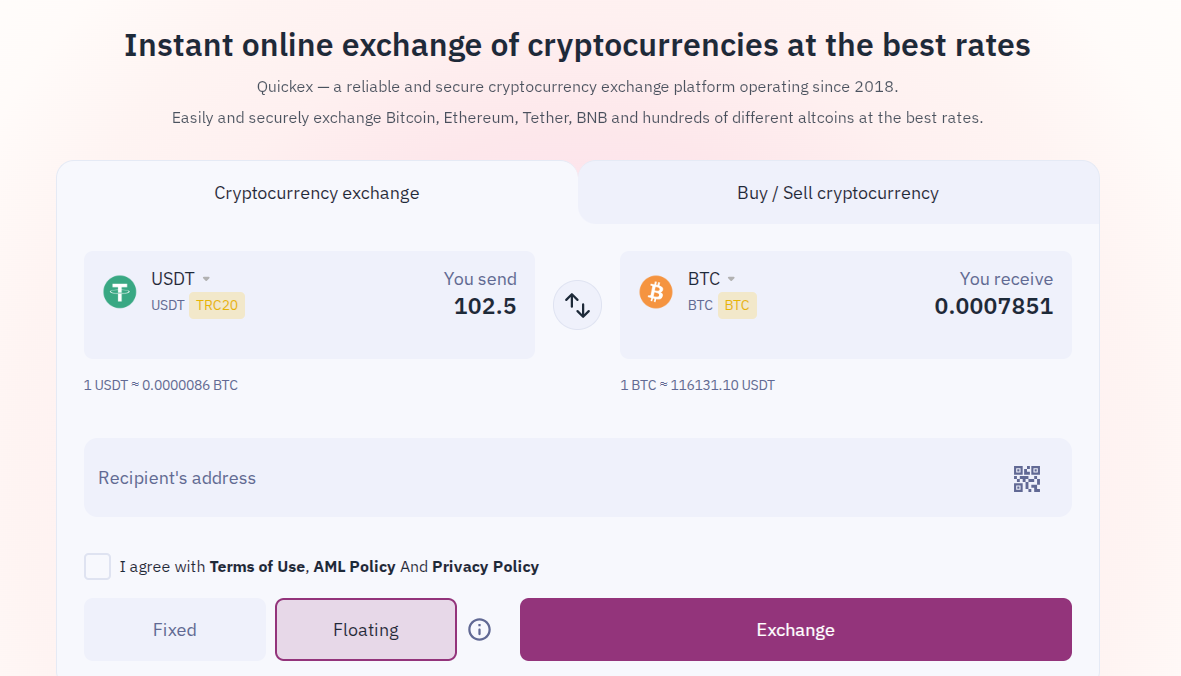
Quickex interface
And the website always provides statistics on transfers.
Another highlight of Quickex is the large audience the exchanger has built since its launch in 2018. Regular users consistently raise the platform to top positions in various rankings.
Anonymity
No registration is required to exchange cryptocurrency. You can check the status of an order right on the website or receive a notification by email. If a user creates a personal account, the history of operations is stored there as well. Quickex’s refusal to store user funds increases security.
Important! Suspicious transactions are an exception to the rule. If security systems are triggered or a request from regulators is received, the platform’s representatives may request documents for verification.
Exchange modes
A fixed rate is locked for a limited time—from 12 to 15 minutes. If during this time the rate changes by more than 1.3% before the transfer is made, the user is offered to have the funds returned or to recalculate the exchange at the market rate. Recalculation is also possible in the following cases:
- funds were sent late;
- the amount does not match the one specified;
- multiple transfers were sent to the same address.
With a floating rate, the final amount is determined at the moment the funds are received. It depends on market conditions and may end up either higher or lower than the estimate. Recalculation is allowed only downward.
The service shows the estimated exchange rate. This is an indicative quote that factors in network fees and may change due to market volatility.
Timing
You have 15 minutes to create an order. If the exchange has not been started within this time, the order is canceled. After funds are received, the exchange usually takes from 1 to 20 minutes. Sometimes delays are possible due to additional checks.
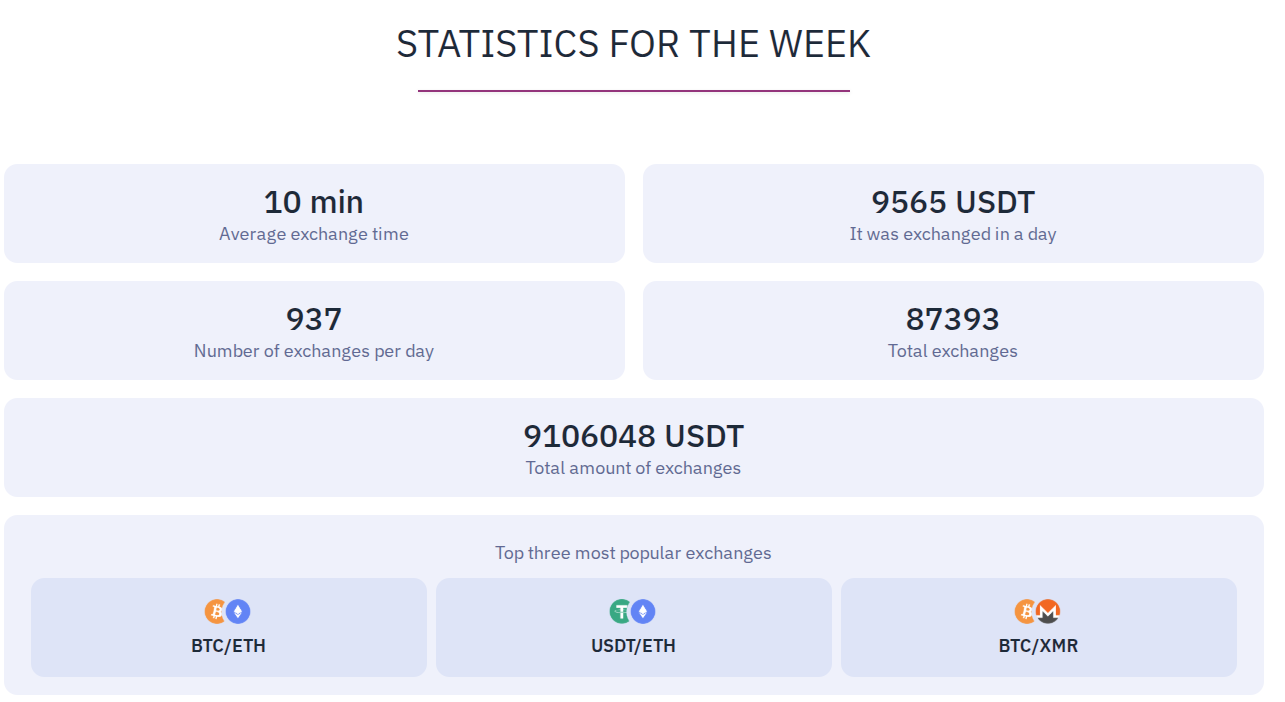
Quickex statistics
How AML and KYC work
- AML is a set of anti–money laundering measures aimed at identifying and blocking suspicious transactions.
- KYC is the “know your customer” principle: verifying a user’s identity and the source of their funds to reduce the risks of unlawful operations.
If a transaction raises doubts, the service has the right to suspend it and request documents: a passport, a photo with the document, or a confirmation of the source of funds. A refund is made after verification.
Takeaways
Quickex is an example of an anonymous exchanger that allows members of the crypto community to transact confidentially. In an environment where regulators are pressuring the crypto industry, refusing to pass personal information to third parties and platforms is an important component of security.
Over the years, Quickex has proved that anonymous cryptocurrency exchange is safe, fast, and convenient.
Try anonymous cryptocurrency exchange on Quickex and see that you don’t have to disclose personal information to make profitable crypto transactions.
FAQ: Anonymous Crypto — Wallets, Exchanges & Sending Money Privately
Is crypto anonymous?
Most cryptocurrencies are pseudonymous, not anonymous. This is one of the most misunderstood aspects of crypto — understanding the difference is critical for anyone who values financial privacy.
- Pseudonymous (most crypto): Bitcoin, Ethereum, Solana, and most tokens record every transaction on a public blockchain. Your wallet address is visible to everyone — but it’s not directly linked to your real name. However, once your address is tied to your identity (e.g. via a KYC exchange, IP tracking, or social media disclosure), your entire transaction history becomes traceable by chain analysis firms like Chainalysis, Elliptic, and TRM Labs.
- Private (privacy coins): Monero (XMR), Zcash (ZEC), and Decred (DCR) use cryptographic techniques to hide sender, receiver, and amount by default or optionally. Monero is considered the most private cryptocurrency — ring signatures, stealth addresses, and RingCT make transactions virtually untraceable.
- The KYC link: The moment you buy crypto on a KYC exchange (Coinbase, Kraken, Binance) and withdraw to your wallet, the exchange knows that address belongs to you. All subsequent transactions from that address can be tracked. This is why how you acquire crypto matters as much as which crypto you use.
- To achieve real anonymity you need:
- ✅ A no-KYC acquisition method (QuickEx, P2P, ATM, mining)
- ✅ An anonymous wallet (no email/phone/ID to set up)
- ✅ A privacy coin (XMR) or privacy techniques (CoinJoin for BTC)
- ✅ Network privacy (Tor/VPN to hide your IP)
Swap crypto without KYC on QuickEx — no account, no identity →
What is the best anonymous crypto wallet?
An anonymous crypto wallet requires zero personal information to set up — no name, no email, no phone, no ID. Your identity is never linked to the wallet at the software level. Here are the best anonymous crypto wallets in 2026, categorised by use case:
| Wallet | Type | Coins Supported | Privacy Features | Best For |
|---|---|---|---|---|
| Sparrow Wallet | Desktop | BTC only | Full UTXO control, coin selection, Tor, own node, Whirlpool CoinJoin | Maximum Bitcoin privacy |
| Monero GUI / Feather | Desktop | XMR only | Ring signatures, stealth addresses, RingCT — private by default | Untraceable transactions |
| Cake Wallet | Mobile | XMR, BTC, LTC, ETH + more | Built-in XMR ↔ BTC swap, Tor support, no KYC | Mobile privacy + multi-coin |
| Electrum | Desktop / mobile | BTC only | Tor routing, custom server/node, hardware wallet, multisig | Advanced BTC, multisig setups |
| Blue Wallet | Mobile | BTC + Lightning | Watch-only vaults, coin control, Lightning, connect own node | Mobile BTC + Lightning privacy |
| Coldcard | Hardware | BTC only | Air-gapped (microSD, never connects to internet), duress PIN, brick PIN | Cold storage, maximum hardware security |
| Trust Wallet | Mobile | Multi-chain (BTC, ETH, SOL, etc.) | No email/phone required, non-custodial, dApp browser | Multi-coin users wanting basic anonymity |
Anonymity best practices
- Run your own node: Connect Sparrow or Electrum to your own Bitcoin node (Umbrel, myNode) — prevents third-party servers from seeing your addresses.
- Use Tor: Route wallet traffic through Tor to mask your IP address from surveillance companies.
- Never reuse addresses: All good wallets generate a new receive address for each transaction.
- Acquire crypto via no-KYC: The most private wallet is useless if you buy crypto on a KYC exchange and withdraw to it. Use QuickEx for no-KYC crypto-to-crypto swaps — send directly to your anonymous wallet.
How to send money to someone anonymously?
Sending money anonymously in 2026 is possible through crypto — but the level of anonymity depends on the coin you use, the wallet you choose, and how you acquired the crypto in the first place.
Method 1: Monero (XMR) — strongest anonymity
- Acquire XMR via a no-KYC method — swap any crypto for XMR on QuickEx (no account, no ID).
- Receive XMR in your Monero wallet (Monero GUI, Feather, or Cake Wallet).
- Send XMR to the recipient’s Monero address — ring signatures, stealth addresses, and RingCT hide the sender, receiver, and amount by default.
- Neither party’s identity is linked to the transaction. No chain analysis can trace it.
Method 2: Bitcoin with CoinJoin — good anonymity
- Acquire BTC via no-KYC (QuickEx, P2P, ATM).
- Receive BTC in Sparrow Wallet connected to your own node over Tor.
- Mix your BTC using Whirlpool CoinJoin — this breaks the on-chain link between your input and output coins.
- Send the mixed BTC to the recipient from a post-mix address.
Method 3: Lightning Network — fast + private
- Acquire BTC and open a Lightning channel via Blue Wallet, Phoenix, or Breez.
- Send a Lightning payment to the recipient’s invoice — Lightning transactions are off-chain, encrypted, and onion-routed (similar to Tor).
- On-chain footprint: only the channel open/close is visible; individual payments within the channel are not publicly recorded.
What does NOT provide anonymity
- ❌ Sending BTC or ETH directly from a KYC exchange: The exchange knows your identity and the recipient’s address. Chain analysis firms can trace the entire flow.
- ❌ Using a “privacy” wallet with KYC-acquired coins: The origin is already compromised — mixing can help but doesn’t erase the exchange’s record of your withdrawal.
- ❌ Sending via PayPal, Venmo, or bank transfer: Fully identified, fully surveilled, fully reversible.
How to send cash anonymously — crypto vs. traditional methods?
Sending cash anonymously through traditional finance is increasingly difficult in 2026 — KYC regulations, digital surveillance, and anti-money laundering laws have closed most fiat-based anonymous channels. Cryptocurrency remains the most accessible option for private value transfer.
| Method | Anonymity Level | Speed | Cost | Limitations |
|---|---|---|---|---|
| Monero (XMR) via QuickEx | 🟢 Very high | 10–30 min | ~0.5–1% swap + ~$0.01 XMR fee | Recipient needs an XMR wallet |
| Bitcoin + CoinJoin | 🟡 High (with proper UTXO management) | 30–60 min (mixing + send) | ~0.5–1% swap + mining fee + mixing fee | Requires Sparrow + own node + Tor; learning curve |
| Lightning Network | 🟡 Moderate–High | Instant (~1 sec) | ~$0.01 | Recipient needs Lightning wallet; channel management |
| Physical cash (in person) | 🟢 High | Instant | Free | Requires physical proximity; not digital |
| Prepaid gift card | 🟡 Moderate | Instant | $3–$10 activation fee | Limited acceptance; cameras at purchase point |
| Money order (cash-paid) | 🟡 Moderate | 1–5 days (mail) | $1–$5 | Paper trail at issuing location; physical mail |
| Bank / PayPal / Venmo | 🔴 None | Instant – 3 days | 0–3% | Full KYC, fully monitored, fully reversible |
- Most anonymous digital method: Monero (XMR) acquired via QuickEx — swap any crypto for XMR without KYC, then send to recipient. The transaction is private by design.
- Most anonymous physical method: Cash in person — but impractical for remote transfers.
- Key principle: True anonymity requires breaking the link between your identity and the money at every step — acquisition, storage, and transfer. Using a KYC on-ramp at any stage compromises the chain.
How to exchange crypto anonymously on QuickEx: step-by-step
QuickEx is a non-custodial instant exchange built for privacy — no account, no email, no phone, no ID, no KYC. Here’s how to swap any cryptocurrency anonymously:
- Set up an anonymous wallet — choose a wallet that requires zero personal information:
- For BTC: Sparrow, Electrum, Blue Wallet, Coldcard
- For XMR: Monero GUI, Feather, Cake Wallet
- For multi-coin: Trust Wallet, Exodus
No email, no phone number, no ID needed for any of these.
- Go to QuickEx.io — no account creation, no registration form, no KYC.
- Select your exchange pair — e.g. BTC → XMR, ETH → BTC, USDT → SOL, LTC → ETH, or any of 500+ supported combinations.
- Enter the amount and choose your rate type:
- Fixed rate — output amount guaranteed, no slippage.
- Floating rate — tracks live market, slightly lower fee.
- Paste your destination wallet address — a fresh, unused address from your anonymous wallet.
- Send your crypto from your wallet to the QuickEx deposit address shown on screen.
- Receive your coin directly in your anonymous wallet — typically within 5–30 minutes. No funds are ever held by QuickEx.
What QuickEx does NOT collect?
- ❌ No name, email, or phone number
- ❌ No ID document or selfie
- ❌ No account or registration
- ❌ No wallet connection (no dApp approval risk)
- ❌ No IP logging linked to your swap (use Tor/VPN for additional protection)
Is anonymous crypto legal? What you need to know
Using crypto anonymously is legal in most countries in 2026 — but the regulatory landscape continues to tighten. Here’s the key distinction: privacy is legal; evading tax obligations is not.
- US: No federal law prohibits using anonymous wallets, privacy coins (XMR, ZEC), or no-KYC swap services. KYC requirements apply to exchanges operating as MSBs, not to end users. However, all crypto gains must be reported to the IRS regardless of how you acquired them. Using privacy tools is legal; failing to report taxable events is not.
- EU: MiCA and the Transfer of Funds Regulation (TFR) mandate KYC for custodial service providers. Non-custodial wallets and P2P transfers are not directly covered. Some EU exchanges have delisted privacy coins (XMR, ZEC) pre-emptively, but holding and using them remains legal.
- UK: FCA requires KYC for registered crypto businesses. Using anonymous wallets or no-KYC swaps is not prohibited. HMRC requires capital gains reporting on all crypto disposals.
- Privacy coins (XMR, ZEC): Legal to own in the US, UK, Switzerland, and most of Asia. Delisted from some exchanges due to compliance decisions (not government bans). Japan and Dubai have restricted privacy coins more aggressively.
- Non-custodial services (QuickEx model): Non-custodial swap services that don’t hold user funds or collect personal data operate in a different regulatory category than custodial exchanges. QuickEx never holds your funds — crypto passes through briefly and is sent to your wallet address.