
The Aster crypto exchange has found itself in the spotlight. The project was presented to the market as an innovative decentralized trading platform (DEX) that offers users spot and derivatives trading in a non-custodial format.
Behind the Aster team stands the largest crypto exchange, Binance. Many believe that with the new DEX, Binance founder Changpeng (CZ) Zhao is trying to get even with the Hyperliquid trading platform. Here’s whether Aster is really that good—and whether it can defeat its famed competitor.
Track how the Hyperliquid cryptocurrency reacts to the Aster hype with Quickex.
What Aster is and who is behind the project
Aster is a decentralized trading platform focused on perpetual contracts and spot trades. The exchange positions itself as non-custodial. This means funds are stored in the user’s own wallet, not on the platform itself.
The project has the backing of Binance Labs as well as YZi Labs, a venture fund associated with the exchange. The latter invests in Web3, artificial intelligence, and biotechnology projects, prioritizing those with strong fundamentals.
Support from such players enhances trust in Aster and expands the project’s growth prospects.
Platform overview
Aster offers a comprehensive approach to trading: a modern website, a convenient terminal, a rewards system, and additional services for traders. Below we review the platform’s main sections and interface.
Website interface
The exchange’s homepage is minimalist, with an emphasis on convenience and fast navigation. The top menu features the main sections: Perpetual, 1001x, Spot, Portfolio, Referral, Rewards, and More. On the right, there’s an Airdrop button and social media icons.
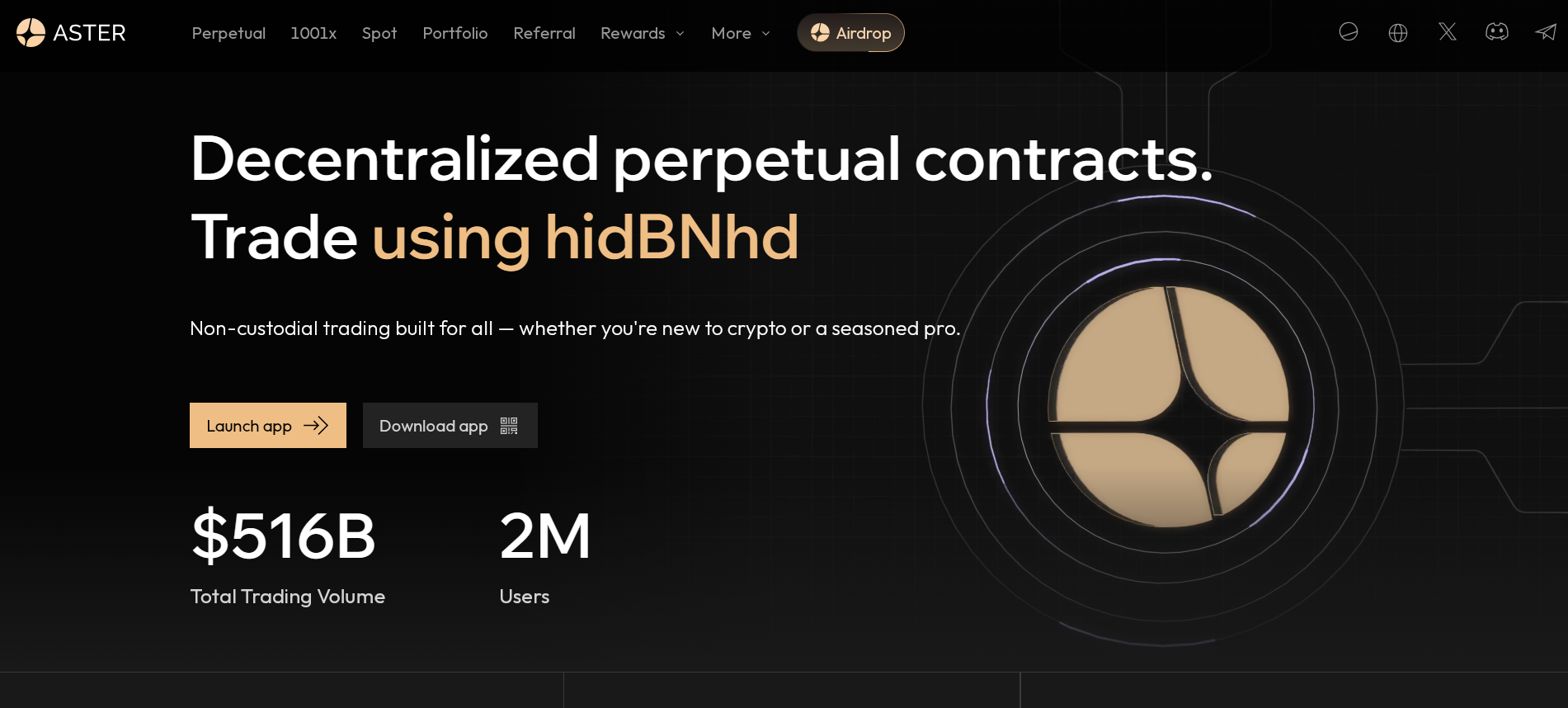
Aster exchange website
Key metrics stand out on the homepage: total trading volume, number of users, TVL, and open interest.
Trading terminal interface
The Aster terminal combines the familiar tools of professional platforms with simplicity for beginners. Center stage is the TradingView chart, with various timeframes and indicators. The top panel shows the asset price, funding rates, trading volumes, open interest data, and other useful information.
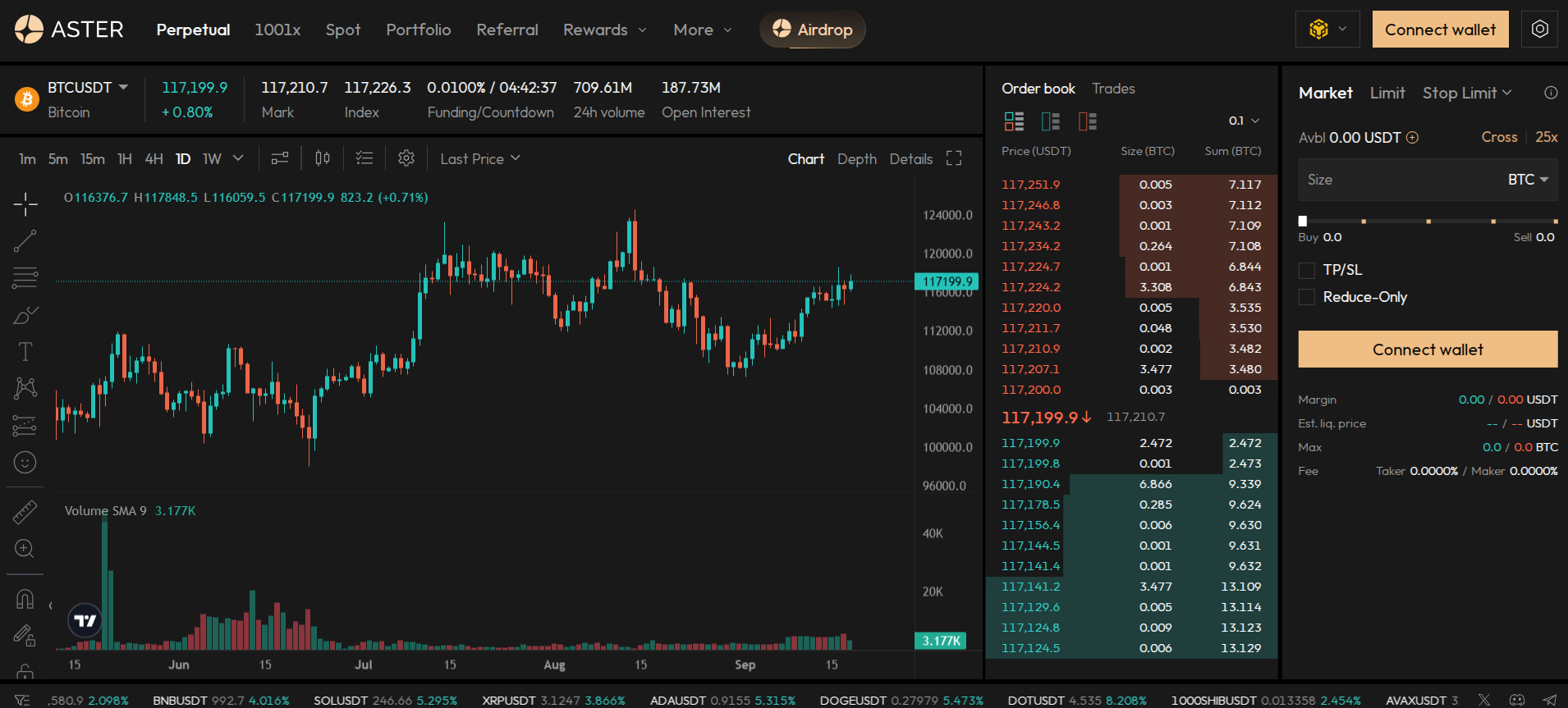
Aster trading terminal interface
On the right are the order book and the trading panel. The user can choose between market, limit, and stop-limit orders. Take-profit and stop-loss are available, as well as a Reduce-Only mode for advanced risk management.
Connecting a wallet is required, since trading is non-custodial. This means the user retains full control over their assets.
Rewards section
The platform implements a rewards system that incentivizes user activity. The Rewards section offers three tracks:
- Points let you earn points that are later converted into ASTER token airdrops.
- Trade & Earn allows you to earn yield on collateral while you trade.
- Rewards Hub invites you to complete tasks and challenges for additional bonuses.
More section
Through the More menu, users access extended functionality. The Products section features Grid Trade, API Management, USDF, Earn, Leaderboard, Copy Trading by Hyperbot, and Feedback. These are tools for automating trading, earning through staking, tracking trader rankings, and connecting third-party services.
The Resources section gathers educational materials, documentation, Dune analytics, as well as trading terms and market data.
Supported networks
At the time of writing, Aster works with four popular blockchains:
- BNB Chain.
- Ethereum.
- Arbitrum.
- Solana.
This choice gives flexibility when balancing speed, low fees, and deep liquidity. The absence of a need to bridge assets makes the trading process simpler and safer.
Platform statistics
As of September 18, 2025, the exchange can already boast outstanding figures.
- Total trading volume amounts to $516 billion.
- The number of users has reached 2 million.
- Open interest exceeds $255 million.
- TVL is $404 million.
- There are 101 trading instruments available on the platform.
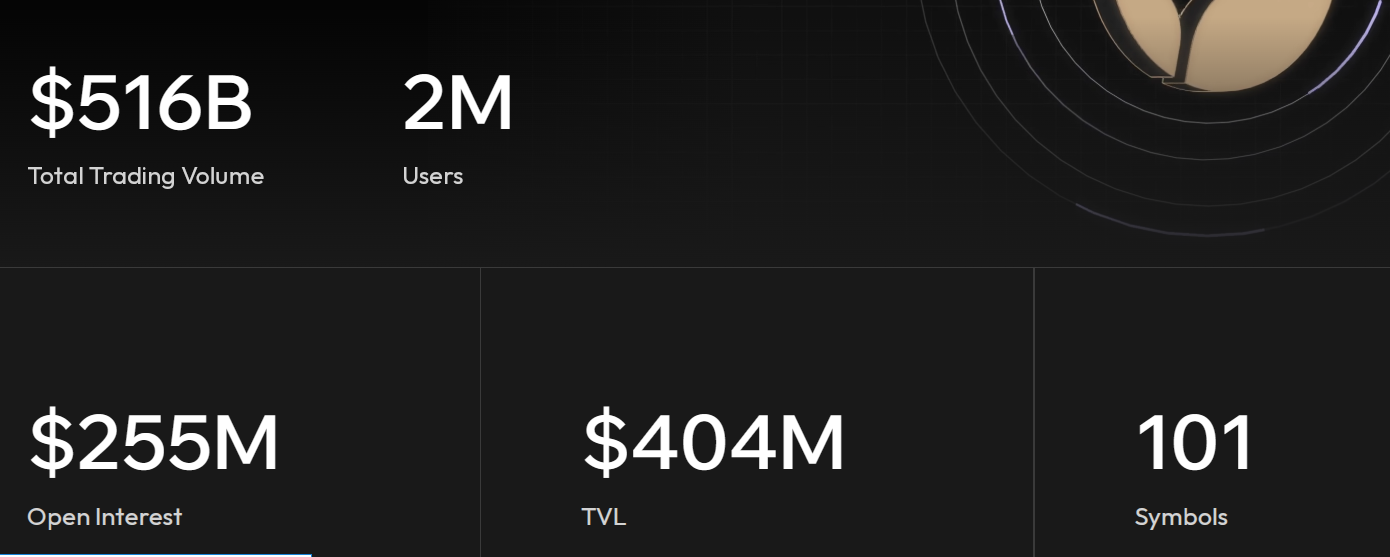
Aster statistics
Advantages of Aster
The exchange highlights four key advantages:
- Cross-chain trading lets you trade across different networks without bridges or switching.
- High liquidity ensures the execution of large trades without slippage.
- Advanced tools, including hidden orders, give traders flexibility and an edge.
- Confidence in every trade is achieved thanks to a thoughtful interface and transparent mechanics.
How to get started on Aster
To start trading, go to the official Aster website and click Launch app. Then choose your sign-in method: email address or by connecting one of the wallets—WalletConnect, Binance Wallet, or MetaMask.
After you sign in, the system will prompt you to sign a message. The signature is used to confirm ownership of the address and to check wallet compatibility. New users receive two signature requests.
At this stage, an Aster Key is created, which is required to work with the platform. Signing messages is free and does not initiate transactions.
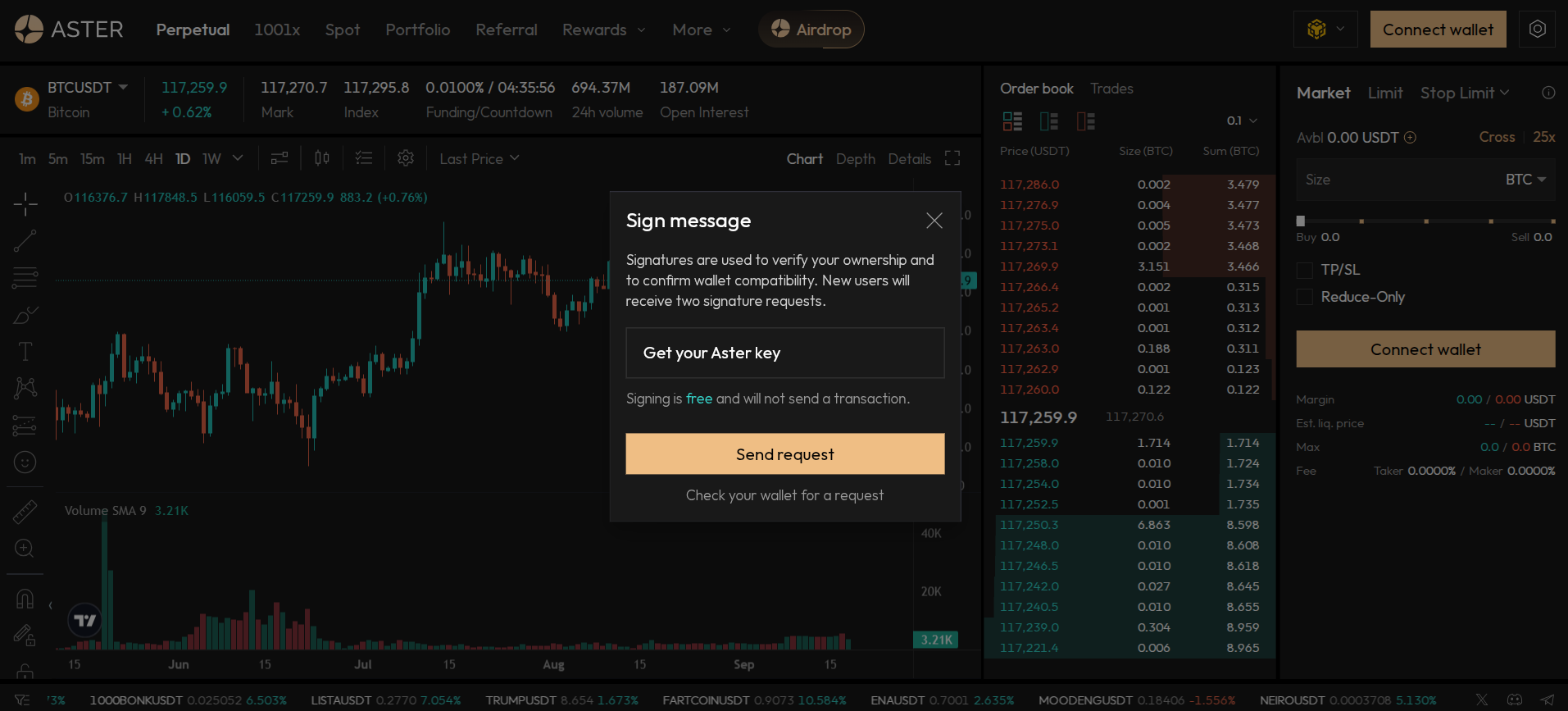
Creating the Aster Key
If there are insufficient funds in your wallet, a warning will appear that BNB assets are less than 0.00010. In this case, you need to top up your balance to complete the connection. These assets are used only for verification and are not debited.
Aster mobile app
At the time of writing, Aster only has a mobile app for Android. iOS users can use the web version or wait for a dedicated app release.
Aster—the Hyperliquid killer
Many in the crypto community believe that Aster is not just a new decentralized derivatives market but a potential competitor to Hyperliquid. The main reason for the project’s attention is that it is backed by Binance founder Changpeng Zhao—one of the most influential figures in the industry.
Many market participants believe that the launch of Aster can be seen as Zhao’s strategic attempt to grab market share from Hyperliquid. He previously tried to gain a foothold in the DEX market, but that attempt failed.
CZ’s support makes the project stand out and significantly increases its chances of success. In the crypto space, it is often emphasized that Zhao has already influenced the fate of major players such as FTX and LUNA—and Hyperliquid may now be his next target.
Conclusion
Aster is a promising decentralized exchange that combines the experience of centralized platforms with the advantages of Web3. Support from Binance Labs and YZi Labs, a focus on multi-chain trading, unique tools like hidden orders, and an active community make the project a notable player in the market. Although the app is currently available only on Android, the platform is already showing significant volumes and growing rapidly.
The Quickex editorial team will be watching to see whether Zhao can make Aster the “Hyperliquid killer.”
You can quickly and at an attractive rate exchange bitcoin for USDT or another cryptocurrency with Quickex.