
Bitcoin processes hundreds of thousands of transactions daily. To use it confidently, it’s important to understand how transfers work, how long confirmation takes, and why the fee may change.
If you need not only to send funds but also buy, sell, or exchange them for another currency, Quickex is a convenient service where you can make a profitable exchange without unnecessary steps.
How Bitcoin transfers are structured
A transaction is not recorded on the blockchain instantly. First, it goes to the waiting queue called the mempool. Then miners select transactions and build a new block. Blocks appear regularly, on average about every 10 minutes. Therefore, the confirmation speed depends on how quickly a particular transaction enters one of these blocks. Smaller transfers usually need 1–2 confirmations; larger amounts often require more.
Key benchmarks:
- average block time — about 9 minutes 40 seconds;
- around 140–150 blocks are created per day.
Network load: how many transactions pass now
The network steadily processes a large volume of operations:
- transactions per day — 446,683;
- average per hour — 18,612;
- daily transfer volume — 319,128 BTC (around $28B);
- average transaction — 0.7144 BTC (~$62,900);
- median transaction — 0.0011 BTC (~$98).
Where the fee comes from
There is no fixed tariff. The fee is formed by market principles: transactions with a higher fee receive higher priority for inclusion in a block.
Important to know:
- the fee does not depend on the transfer amount;
- it is determined by network load and transaction “weight”;
- miners prioritize operations with more profitable fees.
Current values:
- average fee — about 0.0000058 BTC (~$0.51), ~2.7 sat/vbyte;
- median fee — about 0.0000018 BTC (~$0.16), ~0.8 sat/vbyte.

Average Bitcoin network fees over 24 hours. Source: bitinfocharts
In practice, not only the fee matters but also the exchange rate. It’s easiest to track the price and instantly exchange the asset if needed via Quickex — you can monitor the rate and quickly complete a deal without complications.
Why fees change
The reasons are straightforward:
- the number of transactions in the queue increases;
- market activity rises or falls;
- additional loads appear on the network.
When the network is overloaded, users raise the fee to avoid waiting. When the load decreases, the fee goes down.
Network economy in numbers
To understand the scale of the network:
- total mined — 19,959,608 BTC;
- market capitalization — about $1.76T;
- average BTC price — around $88,000;
- block reward — 3.125 BTC + fees;
- fee share in the reward — around 0.6%.
Network activity:
- active addresses per day — 144,177;
- top 100 transaction volume per day — ~329,510 BTC.
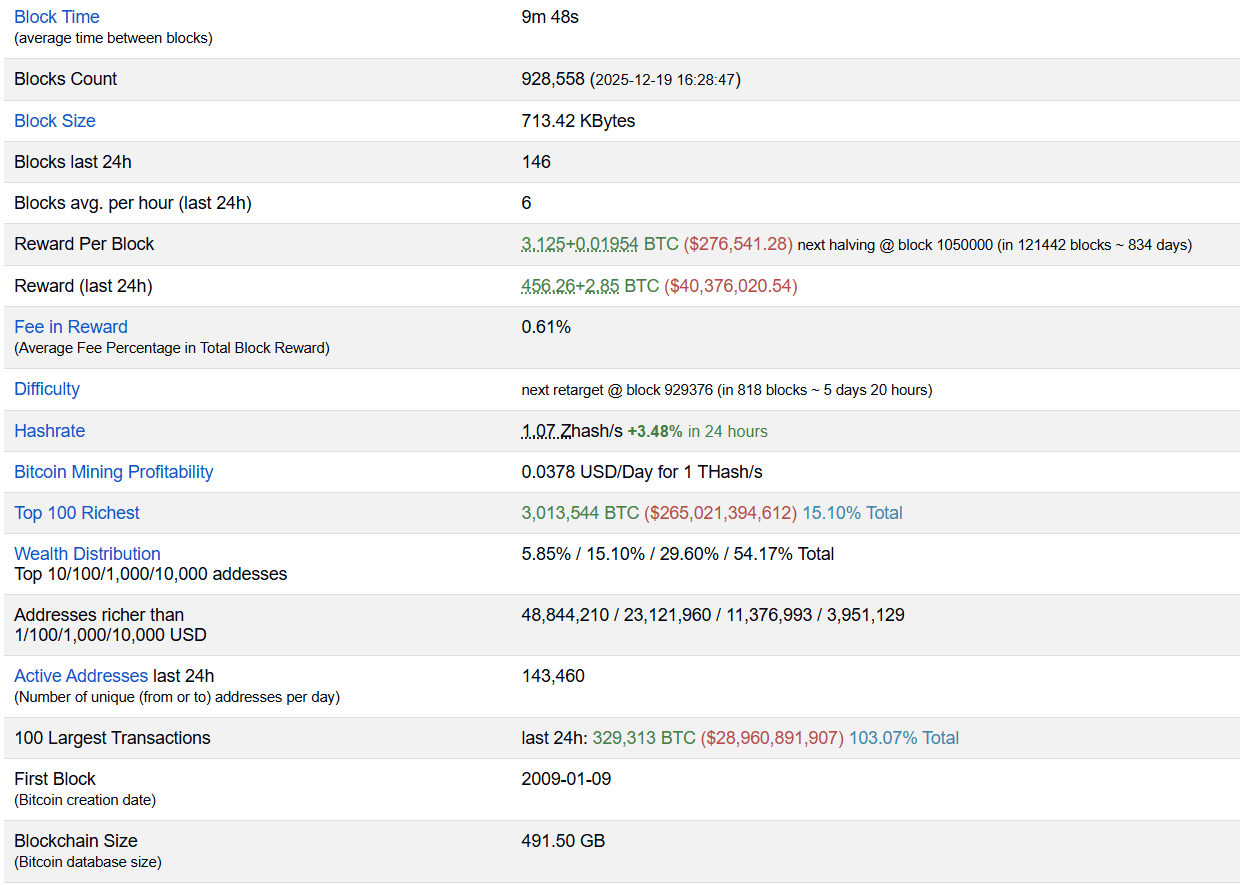
Basic Bitcoin network status information. Source: bitinfocharts
Lightning Network: fast and cheap payments
Lightning Network is used when speed and minimal fees matter. It is an additional layer built on top of the main network.
How it works in practice:
- a payment channel is opened;
- transfers inside it are instant and nearly free;
- when the channel closes, the result is written to the blockchain.
Lightning is convenient for frequent and small payments. Large transfers are usually processed on the main chain — it offers higher predictability and reliability.
Practical points that matter
- Transactions are irreversible; an address error means funds can only be returned with the receiver’s consent.
- The fee does not depend on the amount; small and large transfers may cost the same in fees.
- A low fee may mean waiting; if needed, it can be increased in modern wallets.
Conclusion
Bitcoin steadily processes hundreds of thousands of transactions per day, creates a block roughly every 10 minutes, and maintains moderate fee levels. Lightning is suitable for fast payments. The main chain is best for reliable and large transfers.
FAQ on Bitcoin transaction speed and fees
How long does a Bitcoin transaction take?
On average, one confirmation is about 10 minutes. For full reliability, users usually wait from 1 to 6 confirmations.
What affects confirmation speed?
Network load, fee level, and transaction structure.
Why is the fee sometimes low and sometimes high?
Because it’s a market-based indicator: during network congestion the fee rises, during calm periods it decreases.
Does the fee depend on the transfer amount?
No. It depends on the transaction size in bytes and its priority, not on how much money is being sent.
Can a stuck transaction be accelerated?
Yes. Increasing the fee using mechanisms like RBF or CPFP can help, if supported by the wallet.
Where can I profitably exchange Bitcoin to fiat?
You can use Quickex: there you can conveniently make an exchange, choose the direction, track the rate, and get favorable conditions without unnecessary steps.