
This guide explains how to pick a crypto exchange Philippines users can rely on, what licenses matter, how fees add up, and the safest way to move from PHP to crypto and back. It’s written for beginners and busy traders alike, with a quick checklist, a pricing tip, and a short video walkthrough — and it also covers how to exchange ETH to BTC efficiently once you’re set up.
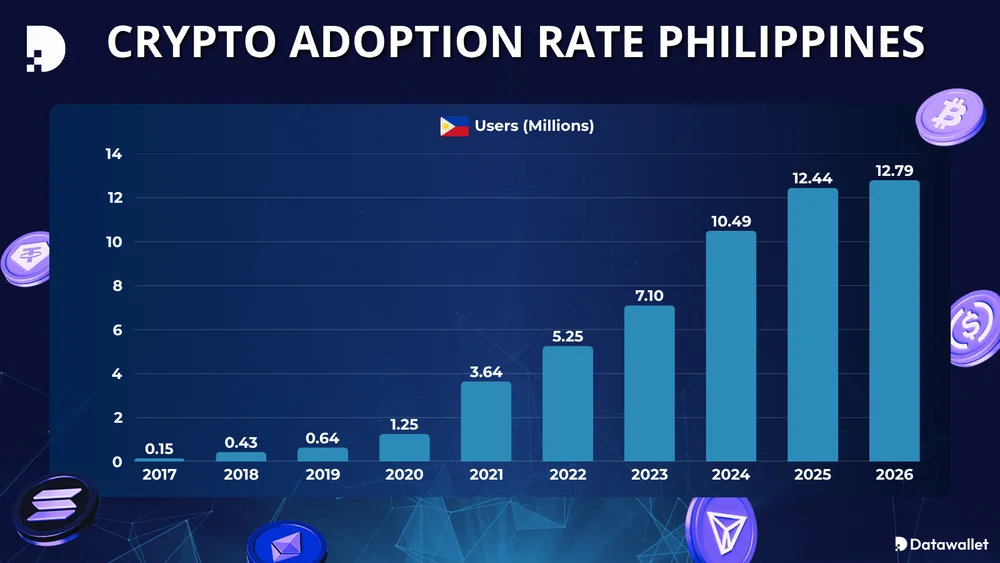
Bar chart of cryptocurrency adoption in the Philippines from 2017 to 2025.
Source: Datawallet
What “best” means for a cryptocurrency exchange in the Philippines
“Best” is context. A cryptocurrency exchange Philippines residents love for low fees might not be the fastest for big orders, and a super-fast desk may not support your preferred PHP wallet. Think in trade-offs: licensing and safety, payment rails, true fees, asset coverage, and UX. If an option checks four out of five for your needs, it’s already a top pick.
If you’re new to exchanges, this plain-English primer — “What Are Crypto Exchanges and How Do They Work” — explains order books, custody, and maker/taker fees so you can compare platforms confidently.
Licensing 101: how to read “licensed cryptocurrency exchanges Philippines”
The safest starting point is to ask whether an exchange is authorized to operate locally or explicitly serves the Philippines with proper compliance. Licenses don’t make an app perfect, but they raise the bar for custody, audits, and dispute handling. When researching licensed cryptocurrency exchanges Philippines, look for clear disclosures about legal entity names, compliance pages, and how client assets are stored. If those basics are missing, skip it.
Tip: If you only need to swap crypto-to-crypto and don’t want an account, non-custodial swap services can be faster. They’re not a replacement for a PHP on-ramp but are handy once you already hold coins elsewhere.
Payment rails: PHP deposits, e-wallets, and bank transfers
Your life gets easier if the best crypto exchange Philippines for you supports the wallet you already use. Bank transfers are common for larger amounts. E-wallets are great for quick buys, but limits can be tight. Always test with a small amount first, then scale. If you’re doing repeated purchases (for DCA), confirm whether standing orders or scheduled buys are available.
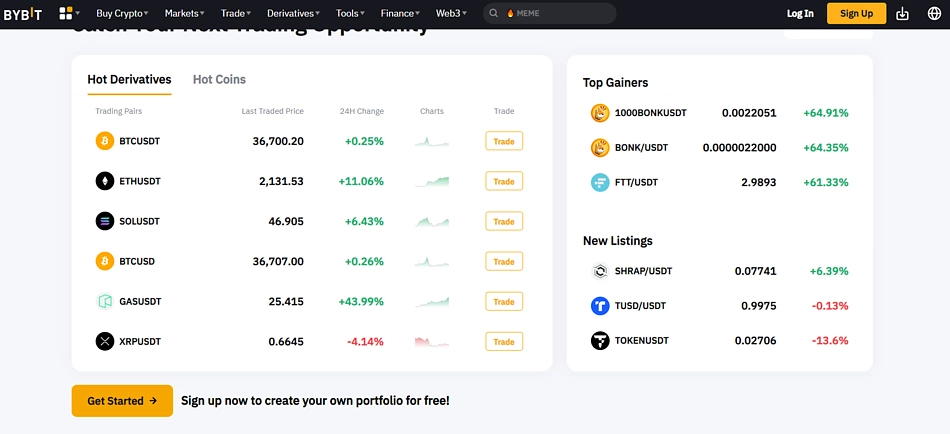
Hot derivatives, top gainers, and new cryptocurrency listings with their prices and 24-hour percentage changes.
Source: Coingecko
Security features you should insist on
A bitcoin exchange in Philippines should offer at least: 2FA, withdrawal whitelists, device management, and clear “proof of reserves” or custody info. For mobile-first buyers, check how well the app handles address books and network selection. If you plan to move funds to self-custody, confirm that the app shows full TX details and supports common networks (BTC, ERC-20, TRC-20, etc.).
Fees: the real price you pay
Fees show up in more than one place. There’s the visible trading fee, the spread (the gap between buy/sell quotes), funding/withdrawal fees, and sometimes a PHP processing fee. The best bitcoin exchange Philippines users choose is usually the one that’s predictable. If an app is “free” but the spread is wide, you still pay. For large orders, compare the all-in price; for small orders, convenience might be worth a slightly higher cost.
BTC exchange Philippines: a simple starter workflow
If your goal is to buy BTC quickly and safely, this 5-step routine keeps things tidy:
- Create/verify your account with your chosen exchange; enable 2FA at once.
- Deposit PHP via your preferred rail (bank/e-wallet). Start small to confirm timings and fees.
- Buy BTC using a market or limit order. Limit orders can reduce fees and slippage on volatile days.
- Decide custody. If you’ll hold for months, consider moving to your own wallet; otherwise keep a trading balance only.
- Record basics: date, amount, fees, and TX hash. Good records save time later.
If you’re swapping coins (not entering/exiting PHP), keep a non-custodial option bookmarked so you can move quickly when spreads are tight.
Prefer a quick visual? Watch this short video: “Full overview of crypto exchange”
Live pricing: sanity-check before every trade
Even if you’re buying a stable amount in PHP each week, peek at the live chart first. A quick look at Bitcoin price today helps you spot unusual volatility and decide between a market order now or a limit order a bit lower. In 24/7 markets, 60 seconds of context can save you from chasing spikes.
Comparing platforms: a checklist for 2025
If you’re screening the best crypto exchanges Philippines 2025, run each candidate through the same lens so the winner is obvious:
- Regulatory clarity: Is there a public legal entity and clear compliance info?
- Payment fit: Does it support your PHP rail with reasonable limits and settlement times?
- Asset coverage: BTC, ETH, stablecoins, and any niche coins you actually use.
- True cost: Trading fee + spread + fiat processing + withdrawal fee.
- Performance: Order execution under stress, not just on quiet days.
- Support quality: Response times and real resolutions for PHP/withdrawal issues.
- Exit plan: Easy cash-out to PHP and clear withdrawal rules.
If two options tie, pick the one that makes mistakes harder (address whitelists, network confirmations, warnings on memo-tag coins, etc.).
When a swap service is the better tool
Once you already hold crypto, a non-custodial swap can be the fastest path from one asset to another — no account balances, just a one-off exchange. That’s particularly useful when you spot an opportunity and don’t want to move fiat first. For example, if you need to rotate from ETH to BTC, a direct swap keeps the flow short and reduces custody risk windows.
Common mistakes to avoid
New users in the cryptocurrency exchange Philippines scene often trip on the same issues. Avoid these and you’ll be ahead of most:
- Ignoring networks. Sending USDT on the wrong chain is the #1 headache. Always match chain and address.
- Going off-platform to chat/pay. Stay inside the platform for P2P trades so escrow and dispute tools protect you.
- Chasing the “lowest fee.” The widest spread often hides behind “zero fee” marketing.
- Skipping small test orders. A $5–$10 trial prevents big-ticket mistakes with new rails or wallets.
- Poor record-keeping. Screenshots and TX hashes are your friend during audits or support tickets.
Conclusion
There’s no single winner for everyone, but the right choice is easy when you measure what matters: licensing, rails, true cost, security, and support. Start with small PHP deposits, practice one clean buy-and-withdraw flow, and only then scale. If you need fast coin-to-coin moves along the way, keep a trusted swap page handy so you don’t miss the moment.
FAQ: Crypto Exchange in the Philippines
What is GCash Philippines?
GCash is the Philippines’ largest mobile wallet and financial super-app, operated by Mynt (Globe Fintech Innovations) — a subsidiary of Globe Telecom. With over 90+ million registered users (in a country of ~115 million), GCash is the de facto digital payment infrastructure of the Philippines.
- Core functions: Mobile payments, money transfers, bill payments, QR code payments at 3+ million merchant locations, savings (GSave with CIMB), micro-loans (GLoan), insurance (GInsure), and investment (GInvest — mutual funds and UITFs).
- Cash-in / Cash-out: GCash can be funded via bank transfer (BPI, BDO, UnionBank, Metrobank), over-the-counter at 7-Eleven, SM, Ministop, Bayad Centers, and via salary crediting. Cash-out to bank accounts or Palawan Express, Cebuana Lhuillier, and ML networks.
- GCash and crypto: GCash itself does not support direct cryptocurrency trading — you cannot buy BTC, ETH, or USDT inside the GCash app. However, GCash serves as a critical fiat on-ramp and off-ramp for Filipino crypto users:
- Fund your Coins.ph, PDAX, or Binance P2P account by sending PHP from GCash.
- Cash out crypto profits to GCash by selling on a local exchange and transferring PHP to your GCash wallet.
- GCash → bank → exchange is the most common PHP-to-crypto flow in the Philippines.
- Regulation: GCash is regulated by the Bangko Sentral ng Pilipinas (BSP) as an Electronic Money Issuer (EMI).
- GCrypto (former feature): GCash previously offered “GCrypto” — a pilot crypto trading feature within the app. However, this feature was discontinued / significantly limited due to BSP regulatory guidance on separating e-money services from crypto trading. Filipino users now rely on dedicated crypto exchanges instead.
What is the best crypto trading platform in the Philippines?
The best crypto trading platform in the Philippines depends on whether you need a PHP on-ramp, want the lowest fees, or prefer a no-KYC option. Here’s a comparison of the top platforms available to Filipino traders in 2026:
| Platform | Type | BSP Licensed | PHP On-ramp | Fees | Best For |
|---|---|---|---|---|---|
| Coins.ph | Local exchange + wallet | ✅ Yes (VASP) | ✅ GCash, bank, 7-Eleven, Cebuana, Palawan | Spread-based (~1–2.5%) | Beginners, easiest PHP on-ramp, bill payments with crypto |
| PDAX | Local exchange | ✅ Yes (VASP) | ✅ Bank transfer, GCash, Maya, InstaPay, PESONet | 0.25–0.50% | Spot trading with order book, lower fees than Coins.ph |
| Binance | Global CEX | ❌ Not BSP-licensed | ⚠️ P2P only (PHP via GCash, bank, Maya) | 0.10% | Deepest global liquidity, 600+ altcoins, futures |
| Bybit | Global CEX | ❌ Not BSP-licensed | ⚠️ P2P (PHP) | 0.10% | Derivatives, copy trading, PHP P2P |
| OKX | Global CEX | ❌ Not BSP-licensed | ⚠️ P2P (PHP) | 0.10% | Web3 wallet integration, wide token selection |
| QuickEx | Non-custodial swap | N/A | ❌ Crypto-to-crypto only | ~0.5–1% | No-KYC cross-chain swap, 500+ pairs |
- Best PHP on-ramp (beginners): Coins.ph — the most popular crypto wallet in the Philippines with the widest cash-in network (GCash, banks, 7-Eleven, remittance centres). Ideal for first-time buyers converting PHP to BTC, ETH, or USDT.
- Best PHP on-ramp (traders): PDAX — lower fees than Coins.ph with a proper order book. BSP-licensed, supports InstaPay and PESONet for fast PHP deposits.
- Best for altcoins & advanced trading: Binance — 600+ tokens, 0.10% spot fee, futures and margin. PHP via P2P only. Not BSP-licensed, so exercise caution on regulatory risk.
- Best no-KYC option: QuickEx — swap any crypto for any crypto in minutes, no account, no Philippine ID, no BSP compliance required on the user’s end.
How to buy crypto in the Philippines with GCash or bank transfer?
The standard workflow for Filipino crypto buyers in 2026 is: PHP (via GCash or bank) → local exchange → crypto in your wallet. Here’s the step-by-step:
- Choose a BSP-licensed exchange — Coins.ph or PDAX for the safest, most compliant PHP on-ramp experience.
- Create an account & complete KYC — register with email/phone, then verify your identity using a valid Philippine ID (National ID, passport, driver’s licence, PhilSys, UMID, or voter’s ID). Typical approval: instant – 24 hours.
- Deposit PHP — fund your exchange account:
- GCash: Send PHP directly to your Coins.ph or PDAX account via GCash transfer — typically instant, fee ₱0–₱15.
- Bank transfer: BDO, BPI, UnionBank, Metrobank, RCBC via InstaPay (instant, up to ₱50,000) or PESONet (1 business day, up to ₱200,000+).
- Over-the-counter: 7-Eleven, SM, Bayad Center, Cebuana Lhuillier, Palawan Express — cash deposit to your exchange account.
- Maya: PDAX supports Maya (formerly PayMaya) for instant PHP funding.
- Buy crypto — select BTC/PHP, ETH/PHP, USDT/PHP, or other available pairs. Place a market order (instant) or limit order (at your target price).
- Withdraw to your wallet — transfer your crypto to a personal non-custodial wallet (Trust Wallet, MetaMask, Phantom, Ledger) for self-custody.
Alternative: PHP → Coins.ph → QuickEx (for altcoins)
- Coins.ph and PDAX have limited altcoin selection. If you want SOL, DOT, AVAX, XMR, or any of 500+ other coins:
- Buy USDT or BTC on Coins.ph/PDAX with PHP → withdraw to your wallet → swap to any coin on QuickEx (no additional KYC needed for the swap step).
Is crypto legal in the Philippines? Regulations in 2026
Yes — cryptocurrency is legal in the Philippines and regulated by the Bangko Sentral ng Pilipinas (BSP) as a Virtual Asset (VA). The Philippines has one of the most developed crypto regulatory frameworks in Southeast Asia.
- BSP Circular No. 1108 (2021): Established the licensing framework for Virtual Asset Service Providers (VASPs). All crypto exchanges operating in the Philippines must register with the BSP and comply with AML/CFT requirements.
- Licensed VASPs: As of 2026, the BSP has approved approximately 20+ VASPs including Coins.ph, PDAX, BloomX, PogoX, and others. Only BSP-licensed exchanges can legally offer PHP-to-crypto conversion services.
- Global exchanges (Binance, Bybit, OKX): Not BSP-licensed — they operate in a grey area. Filipino users can access them (not blocked), but these platforms lack local regulatory protection. The BSP has issued advisories warning consumers about using unregistered VASPs.
- Crypto as payment: Virtual assets are recognised as a legitimate medium of exchange in the Philippines — unlike many countries that restrict crypto to investment use only. However, the Philippine Peso remains the sole legal tender.
- Tax treatment: Under the TRAIN Law and BIR guidance, crypto gains are subject to income tax. Trading profits are treated as ordinary income (graduated rates up to 35%) or capital gains depending on classification. The BIR has been working on clearer crypto-specific tax guidelines.
- Axie Infinity precedent: The Philippines became a major crypto economy partly due to the Axie Infinity play-to-earn boom (2021–2022), during which the BIR specifically addressed tax obligations for crypto gaming earnings — setting a precedent for broader crypto tax enforcement.
- Anti-Money Laundering: The Anti-Money Laundering Council (AMLC) oversees VASPs alongside the BSP. All licensed exchanges must implement KYC, transaction monitoring, and suspicious activity reporting.
How to cash out crypto to PHP (GCash or bank) in the Philippines?
Cashing out crypto to Philippine Pesos (PHP) follows the reverse of the buying process. Here are the best methods in 2026:
Method 1: CEX → GCash / bank (most common)
- Deposit your crypto (BTC, ETH, USDT) to Coins.ph or PDAX.
- Sell crypto for PHP on the exchange’s spot market.
- Withdraw PHP to GCash, Maya, or your bank account:
- Coins.ph → GCash: Instant, fee ₱0–₱15.
- Coins.ph → bank (InstaPay): Instant, up to ₱50,000, fee ₱0–₱25.
- PDAX → bank (PESONet): 1 business day, fee ₱0–₱50.
- Coins.ph → cash (OTC): Withdraw at 7-Eleven, Cebuana, Palawan, SM.
Method 2: P2P → GCash / bank (flexible)
- Sell USDT or BTC on Binance P2P, Bybit P2P, or Paxful → buyers send PHP directly to your GCash, Maya, or bank account. Escrow protects both parties.
- Real cost: 0–2% platform fee + 1–3% buyer discount (buyers typically pay 1–3% below market rate for PHP convenience).
Method 3: QuickEx → Coins.ph → GCash (for altcoins)
- If you hold altcoins (SOL, DOT, XMR, AVAX, etc.) not supported on Coins.ph/PDAX, swap them to BTC or USDT on QuickEx first (no KYC).
- Send the BTC/USDT to your Coins.ph or PDAX account.
- Sell for PHP → withdraw to GCash or bank.
Precautions for Philippine cash-outs
- Network mismatch: When depositing USDT to Coins.ph or PDAX, confirm which network they support (ERC-20, TRC-20, or both). Sending on the wrong network = permanent loss.
- GCash limits: GCash has daily/monthly transaction limits depending on your verification level — fully verified users can receive up to ₱100,000/month. For larger cash-outs, use bank transfer.
- Tax: Crypto-to-PHP conversion is a taxable event. Keep records for BIR filing.
How to swap crypto on QuickEx for Philippine users: step-by-step
Filipino crypto users often use a dual-platform approach: a local BSP-licensed exchange (Coins.ph, PDAX) for PHP on/off-ramp, and QuickEx for accessing 500+ altcoins with no additional KYC. Here’s the complete workflow:
Buy altcoins (PHP → USDT → any coin)
- Buy USDT or BTC on Coins.ph or PDAX with PHP (GCash, bank transfer, or OTC cash-in).
- Withdraw USDT/BTC to your personal non-custodial wallet (Trust Wallet, MetaMask, Phantom).
- Go to QuickEx.io — no account, no email, no KYC required.
- Select your pair — e.g. USDT → SOL, BTC → DOT, USDT → AVAX, BTC → XMR, or any of 500+ supported coins.
- Enter the amount and choose your rate type:
- Fixed rate — output amount guaranteed, no slippage.
- Floating rate — follows live market rate, slightly lower fee.
- Paste your destination wallet address.
- Send your crypto to the QuickEx deposit address.
- Receive your coin directly in your wallet — typically within 5–30 minutes.
Sell altcoins (any coin → USDT → PHP)
- Swap your altcoin → USDT (or BTC) on QuickEx.
- Send USDT/BTC to your Coins.ph or PDAX account.
- Sell for PHP → withdraw to GCash or bank.