
Imagine: you save money for years, cut expenses, try hard—and then realize that everything is getting more expensive and the purchasing power of your savings is falling. In other words, you have a stash, but it keeps getting cheaper. That’s inflation—a silent thief that doesn’t take from you directly but devalues what you’ve already earned.
Banks and governments explain rising prices by “objective” reasons—supply disruptions, higher costs, geopolitics. But if you dig deeper, the essence is simple: the more money is printed, the less it’s worth. When the amount of fiat on the market grows faster than the volume of goods and services, each note becomes slightly cheaper. Fortunately, there is a solution to this problem—cryptocurrency. Here’s how digital assets help people against inflation.
Track the prices of your favorite cryptocurrencies on Quickex.
Why inflation isn’t a bug of the system but a feature
Fiat money—i.e., regular government-issued currencies—can be printed in any quantity. Central banks do it regularly under the pretext of “stimulating” the economy. Here is how the number of U.S. dollars in circulation has changed, for example:
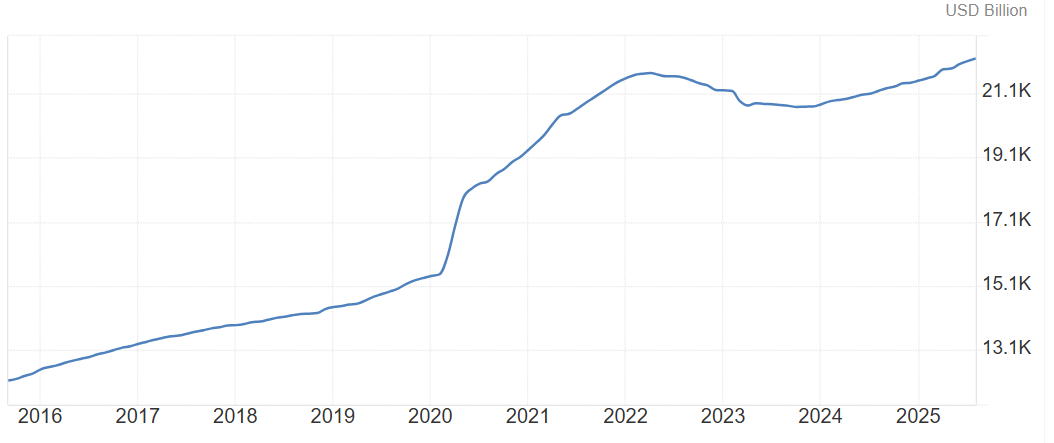
U.S. money supply. Source: tradingeconomics
Note that over the last nine years only the period from 2022 to 2023 saw a slight decline in money in the economy. The rest of the time the curve has been rising continuously. At times the rise was parabolic.
That much-talked-about “inflation target” we hear about on TV isn’t a law of nature but a political decision made once upon a time that became tradition. And even then, many don’t manage to hit it, and not always.
From an ordinary person’s perspective, this means one thing: your savings will lose purchasing power every year—only the speed differs. It’s therefore logical to look for assets that appreciate along with the expansion of the money supply.
Why investors flee fiat
Historically, hard assets—gold, real estate, commodities—have served as a hedge against inflation. They can’t be “artificially multiplied.” Gold has preserved value for centuries: an ounce bought about the same amount of land today as a hundred years ago.
But the world has gone digital. Shipping gold bars across borders is inconvenient, you can’t sell real estate in a second, and markets now run 24/7. This is where Bitcoin steps in—the first digital form of hard money in history.
Bitcoin: digital gold of the 21st century
Bitcoin has a key property fiat lacks: a hard-capped supply. There will only ever be 21 million coins—no more. No one, not even the network’s creator, can “print” extra. This principle is hard-coded and enforced by millions of participants around the world.
A second advantage is independence from authority. Neither a government nor a bank can freeze your wallet, cancel a transfer, or change the rules of the game. That’s why in countries where inflation gets out of control—Turkey, Argentina, Venezuela—Bitcoin becomes a real lifeline. People use it to preserve savings and move money across borders, bypassing collapsed banks.
Cryptocurrency and the dollar: who wins
If you look at charts from recent years, you can see an interesting relationship: when the dollar strengthens (the DXY index rises), Bitcoin usually falls. And vice versa—when confidence in the dollar wanes, investors increasingly turn to Bitcoin as an alternative.
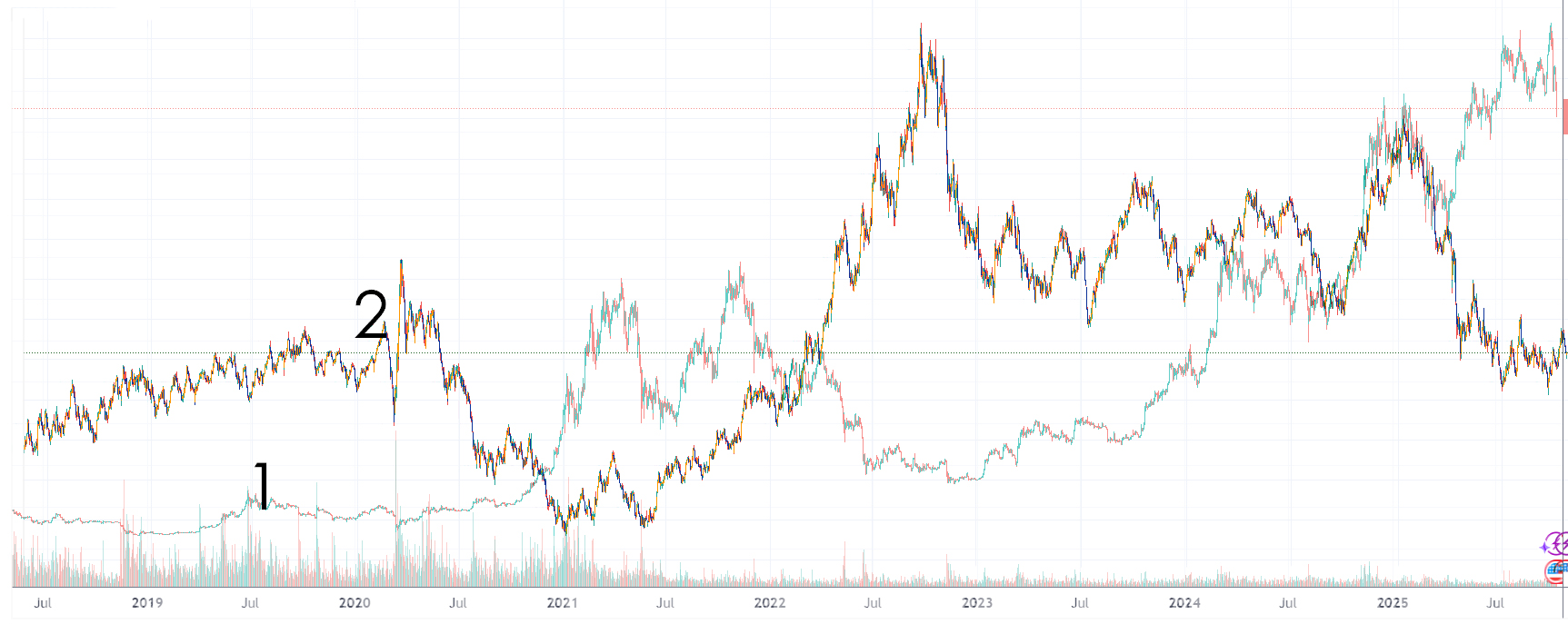
Comparison of Bitcoin (1) and the U.S. dollar index (2). Source: TradingView
This behavior looks like a pendulum swinging between “old” and “new” money. When the traditional system creaks—under the weight of debt, crises, or political risk—demand for decentralized assets grows. It’s not a coincidence; it’s trust in a principle rather than an issuer.
Why volatility isn’t an enemy but a side effect of growth
Yes, Bitcoin’s price fluctuates. It can drop 30% in a month and then double. But that doesn’t change the main point: over the long term, Bitcoin outpaces inflation. Over the past decade it has risen hundreds of times, surviving every crisis and bear cycle.
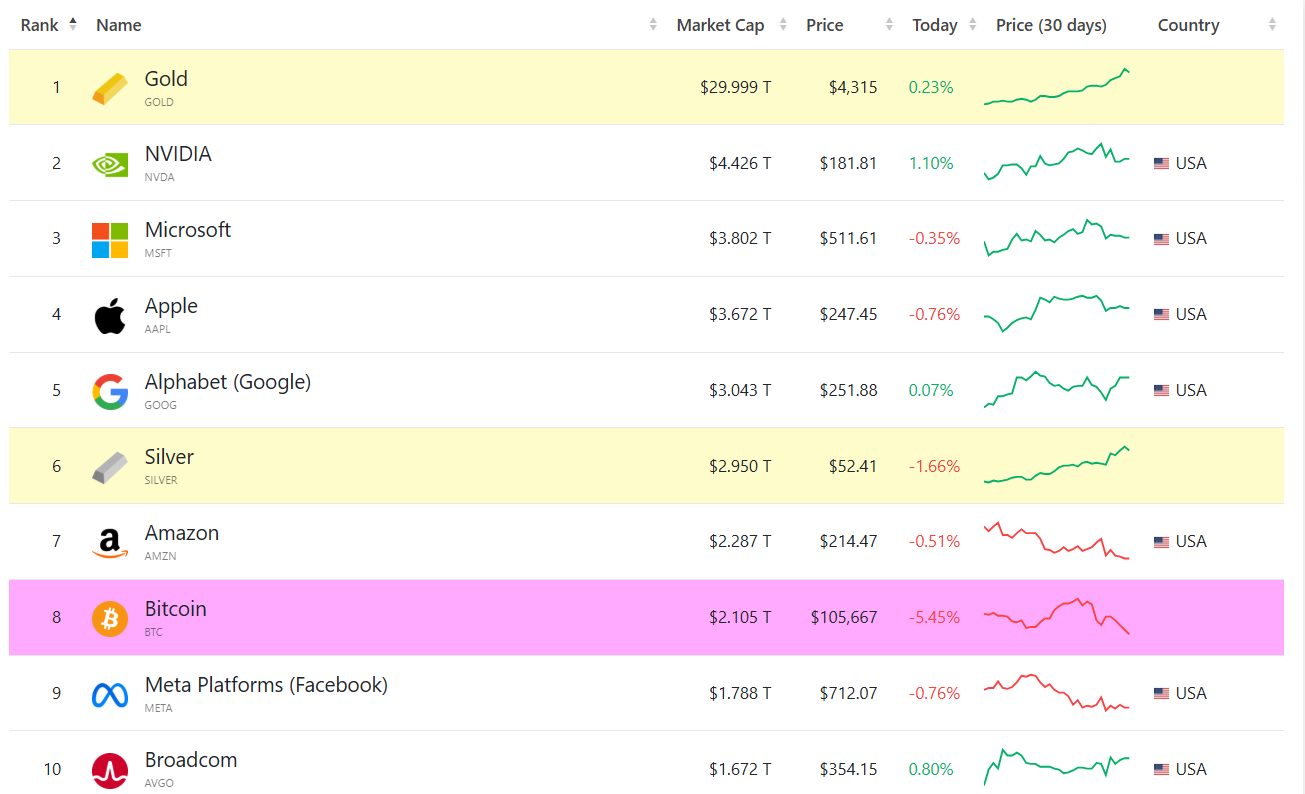
Bitcoin in the top 10 most valuable assets in the world by market cap. Source: companiesmarketcap
Its volatility is a by-product of a young market and limited liquidity. But unlike fiat—where the loss of purchasing power is a built-in feature—Bitcoin doesn’t lose value because someone decided to “support the economy” by turning on the printing press.
Institutional recognition: crypto is growing up
Big investors no longer see cryptocurrency as a toy for enthusiasts. With the arrival of Bitcoin ETFs and interest from players like BlackRock, Fidelity, and BNY Mellon, crypto has entered the same arena as gold, bonds, and stocks.
This isn’t just a fad—it’s a signal: the world is looking for a way to preserve capital outside the politics of central banks. The more institutional money flows into Bitcoin, the lower its volatility and the more firmly it takes hold as a long-term protection tool.
Crypto isn’t a panacea, but an alternative
Of course, cryptocurrencies carry risks. They are volatile, depend on regulation, and working with them requires digital literacy. But in a world where governments can freeze accounts or devalue a currency with a single decision, holding part of your capital in an independent asset isn’t a luxury—it’s common sense.
For some, crypto is a way to diversify a portfolio. For others, it’s the only chance to preserve savings. The principle remains the same: the higher the inflation and the greater the political instability, the more relevant digital assets become.
Bottom line
Inflation is inevitable. It’s built into the modern economy like taxes—or death. But for the first time in history, we have an alternative: money that doesn’t answer to the printing press.
Bitcoin, despite its swings, has already proved it can play the role of digital gold—especially where paper currencies lose their meaning. It may not be perfect, but it’s arguably the most honest way to preserve the freedom and value of your money in an era of endless money creation.
You can quickly exchange cryptocurrency while preserving anonymity on Quickex.