

If you’ve been tracking stablecoins this year, you’ve likely seen headlines about USD1 (USD One)—a dollar-pegged token launched by World Liberty Financial. This guide translates the marketing claims and the fine print into plain words: what is USD1 stablecoin, how the peg is designed to hold, where to follow the USD1 stablecoin price, the main stablecoin news so far, and practical tips when you exchange crypto.
What is USD1 stablecoin?
USD1 is a U.S. dollar–pegged stablecoin issued for the World Liberty Financial ecosystem. The issuer describes USD1 as redeemable 1:1 for U.S. dollars, backed by cash and U.S. Government Money Market Funds, and available across multiple blockchain networks. In short: it aims to behave like on-chain dollars you can move 24/7, with monthly reserve disclosures.
USD1 debuted in March 2025, with the company saying it would start on Ethereum and BNB Smart Chain and expand over time. The launch messaging emphasized a dollar peg supported by cash, Treasuries, and other cash equivalents.
How the peg is designed to work
Two pieces matter for a fiat-backed stablecoin: the assets backing each token and periodic reports that show assets line up with tokens outstanding.
- Backing & redemption. USD1’s own materials say it is fully backed by dollar cash and government money market funds, and redeemable at $1. Reserve reports are posted monthly.
- Attestation. In April 2025, accounting firm Crowe LLP examined BitGo’s “USD1 Reserve Report” (BitGo provides the trust/custody setup). The report shows redeemable USD1 outstanding and “redemption assets” (cash and a U.S. Government Money Market Fund), with figures matched 1:1 at the test dates and notes that issuance/redemption then occurred exclusively on Ethereum and BNB Smart Chain.
What this means in practice: if the reserve portfolio remains liquid and properly ring-fenced, USD1 should trade close to $1 because holders expect they can redeem at $1 and market makers can arbitrage deviations.
The state of play: key USD1 stablecoin news
The big news hook was the launch and early integrations, plus a high-profile deal in the Middle East. In May 2025, Abu Dhabi-backed MGX said it would use USD1 to close a $2 billion investment in Binance, one of the world’s largest exchanges—an announcement made on stage by World Liberty co-founder Zach Witkoff. The headline underscored USD1’s ambition to be more than a DeFi play: it wants to sit in large, cross-border transactions.
Separately, earlier launch coverage noted the token’s stated backing (cash and Treasuries), the multichain plan, and that WLFI—the World Liberty Financial coin—was sold to help fund the ecosystem. (WLFI is a separate token used for community and governance features.)
USD1 stablecoin price: how to track it
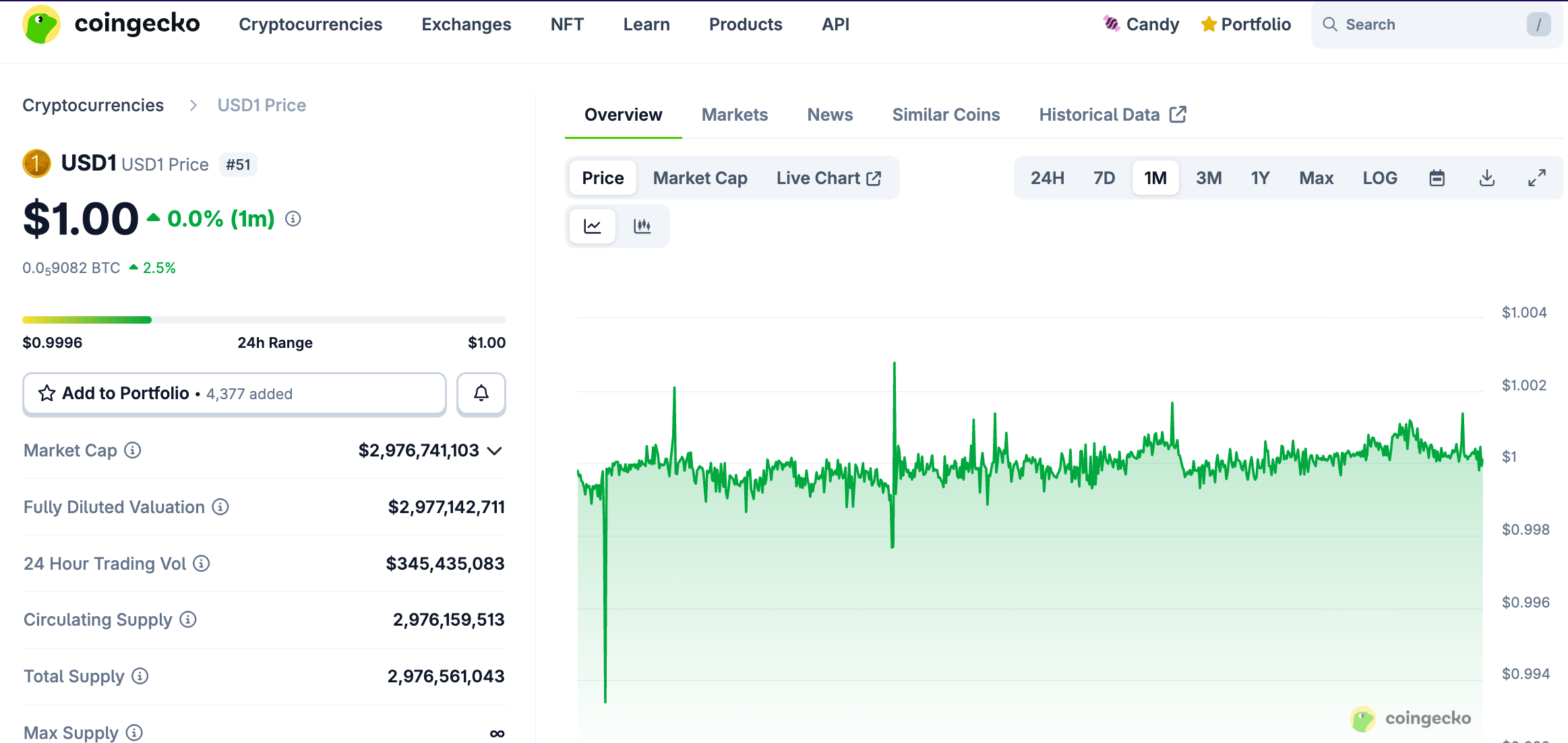
Source: CoinGecko
Stablecoins aren’t about “going up”—they’re about staying put. You’ll typically see the USD1 stablecoin price fluctuate by a fraction of a cent around $1 as liquidity and order books shift. For live data, check reputable aggregators; at the time of writing, price trackers show USD1 hovering very near $1, with multi-hundred-million-dollar daily turnover and multibillion circulating supply (numbers move, so always check fresh data).
A few things to watch as you follow the price:
- Spread and venue. The quote you see on an aggregator reflects specific markets; thin venues can trade a hair away from $1.
- Network choice. USD1 exists on multiple chains; fees and speed vary by chain and can influence where most liquidity sits. The issuer’s site lists current integrations and bridges.
Where to exchange USD1
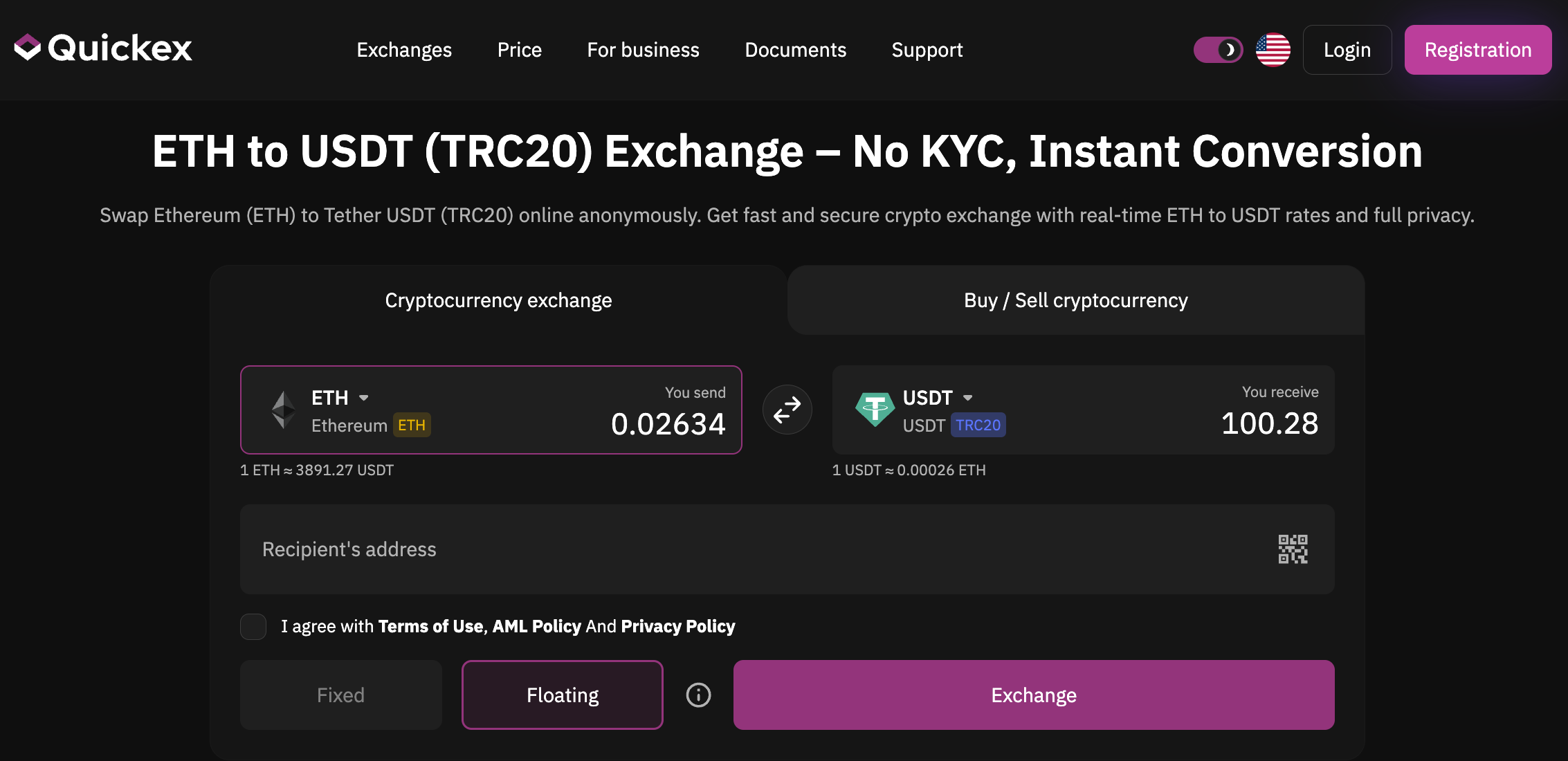
You can exchange USD1 on leading centralized exchanges or swap it on DEXs. The most popular are: Quickex, Binance, Bybit, Bitget, Gate, and DeFi venues like Uniswap and PancakeSwap.
A simple, safer workflow when you exchange crypto into or out of USD1:
- Confirm the network first. If your wallet holds USD1 on BNB Smart Chain, don’t try to deposit it to an Ethereum-only USD1 address (and vice versa). Bridges exist, but each hop adds risk. The attestation shows issuance/redemption began on ETH and BNB; check the issuer page for current networks.
- Verify the contract address. Use the official links or the reserve report footnotes (they list the smart-contract addresses), then cross-check on block explorers.
- Mind fees and timing. Fixed-fee centralized routes can be cheaper for large amounts; DEX swaps add pool fee + chain gas.
- Start with a test transaction. Send $5–$10 first, then the rest.
- Keep receipts. Exchange confirmations and tx hashes make troubleshooting far easier.
How USD1 compares with other stablecoins
All fiat-backed stablecoins share the same promise—$1 in reserves for each token. The real differences are in governance, custody and attestations, concentration of holdings, and where liquidity lives.
- Reserves & disclosure cadence. USD1 posts monthly reserve reports and features an attestation by Crowe LLP of BitGo’s reserve presentation. When comparing, look for frequency (monthly vs. quarterly), who performs the attestation, and the exact asset mix (e.g., government MMFs vs. commercial paper).
- Liquidity footprint. Where is the deepest market? Early USD1 activity has been prominent on BNB Smart Chain and centralized venues; check your venue’s order books before placing size. Issuer pages list supported partners.
- Concentration risk. Media reporting has noted that a large share of USD1 supply sits with a single exchange group; concentration can be a double-edged sword (deep liquidity but exposure to one venue’s risk). Treat such reports as context and monitor on-chain data yourself.
The broader story: why USD1 exists
Stablecoins are increasingly used for cross-border settlement and as crypto’s “cash leg.” The launch narrative for USD1 explicitly targeted institutional flows, with the company highlighting sovereign and large investor use cases and multichain movement for settlement. The MGX–Binance announcement reinforced that pitch.
At the same time, 2025 research from major banks and wire services points out that stablecoin growth could meaningfully affect dollar demand and short-term Treasury markets—useful framing for anyone evaluating new issuers.
Practical risks to keep in mind
Even with strong marketing, stablecoins carry real-world risks:
- Issuer & governance risk. Understand who controls minting/redemption and what happens in stress. USD1’s site points to monthly reports and BitGo-administered reserve structures; read the disclosures, not just headlines.
- Regulatory risk. Rules are evolving globally. Headlines around large cross-border deals often invite scrutiny, which can change how and where tokens trade. Keep up with reputable reporting before moving large sums.
- Venue risk. If most liquidity clusters on a single exchange or chain, outages there can widen spreads. Independent reporting has highlighted concentration dynamics; diversify your routes.
- Operational risk. Wrong network, wrong address, or interacting with spoofed contracts can result in permanent loss. Always verify contract addresses from official sources or attested documents.
How USD1 and WLFI fit together
WLFI is a separate token tied to the World Liberty Financial ecosystem (branding, community, and governance-style features). Coverage of the 2025 launch noted WLFI sales raising significant funds to build out products like USD1 and its app. If you’re simply looking to hold dollar exposure, WLFI is not the same thing as USD1. Research each separately.
The conclusion
USD1 stablecoin aims to be a fully backed, multichain digital dollar you can use in DeFi and for cross-border settlement. The issuer posts monthly reserve materials and points to 1:1 redeemability, while reputable outlets have covered its launch and early, high-profile transactions (notably the MGX–Binance deal). Track USD1 stablecoin price on established aggregators, follow USD1 stablecoin news from mainstream sources, and take standard operational precautions whenever you exchange crypto—especially contract/venue verification and network checks. If you decide to exchange USD1, treat it like any cash equivalent in crypto: useful, but only as strong as its reserves, governance, liquidity, and the rails you rely on.