

Crypto doesn’t move for one reason—it moves for many reasons that pile up, overlap, and sometimes contradict each other. If you’ve watched the Bitcoin price rip on a Tuesday and slump by Thursday, you’ve seen these forces collide in real time. This guide maps the big levers that push and pull the market—and wraps with a simple way to execute a swap when your analysis says go.
Macro tides: interest rates, the dollar, and gold
The first layer is classic macro. When real yields fall and liquidity expands, risk assets (including BTC and major altcoins) usually breathe easier. A stronger U.S. dollar and hawkish policy, by contrast, can weigh on the Bitcoin price as global risk appetite cools. Macro also sets the tone for cross-asset rotations: in 2025, gold’s record run has served as a magnet for “safety” flows, leaving crypto to grind through volatility pockets before trend resumption. Credible sell-side notes increasingly treat BTC as a macro-sensitive asset, not an island.
Structural demand: spot ETFs, fund flows, and custody rails
In 2024–2025, U.S. spot Bitcoin ETFs changed the market’s plumbing by funneling traditional capital directly into BTC. That’s why you’ll see headlines tying Bitcoin price bursts to ETF net inflows—and slow weeks to chop. Citi, for example, framed ETF demand as a major explanatory variable for price action this year and sketched base/bull cases that depend on those flows persisting. The takeaway: ETF rails don’t guarantee upside, but they do concentrate demand into visible pipes that can swing prices quickly.
Supply & issuance: halvings, long-term holders, and unlocks
Crypto supply isn’t just “21 million.” It’s issuance now (e.g., Bitcoin’s block rewards after the 2024 halving), liquid float (how much actually trades), and behavior (how miners, treasuries, and long-term holders react). When issuance falls and more coins sit in cold storage, small bursts of demand can move Bitcoin price more—both up and down. On the altcoin side, vesting schedules and token unlocks matter; a wall of new supply can temporarily overpower even good news if buyers aren’t ready.
On-chain activity & network effects
For smart-contract networks, usage is the closest thing to “revenue.” Rising active addresses, fees, and value settled are fundamentals that can support a higher crypto market analysis view even when day-to-day Bitcoin prices wobble. That’s why analysts watch metrics like transfer volume and cost-to-transact to gauge genuine demand—and compare them to valuation proxies (for Bitcoin, tools like NVT look at market cap versus value transferred). Fundamentals don’t time entries, but they strengthen conviction about why an asset should matter long term.
Market microstructure: derivatives, depth, and weekend liquidity
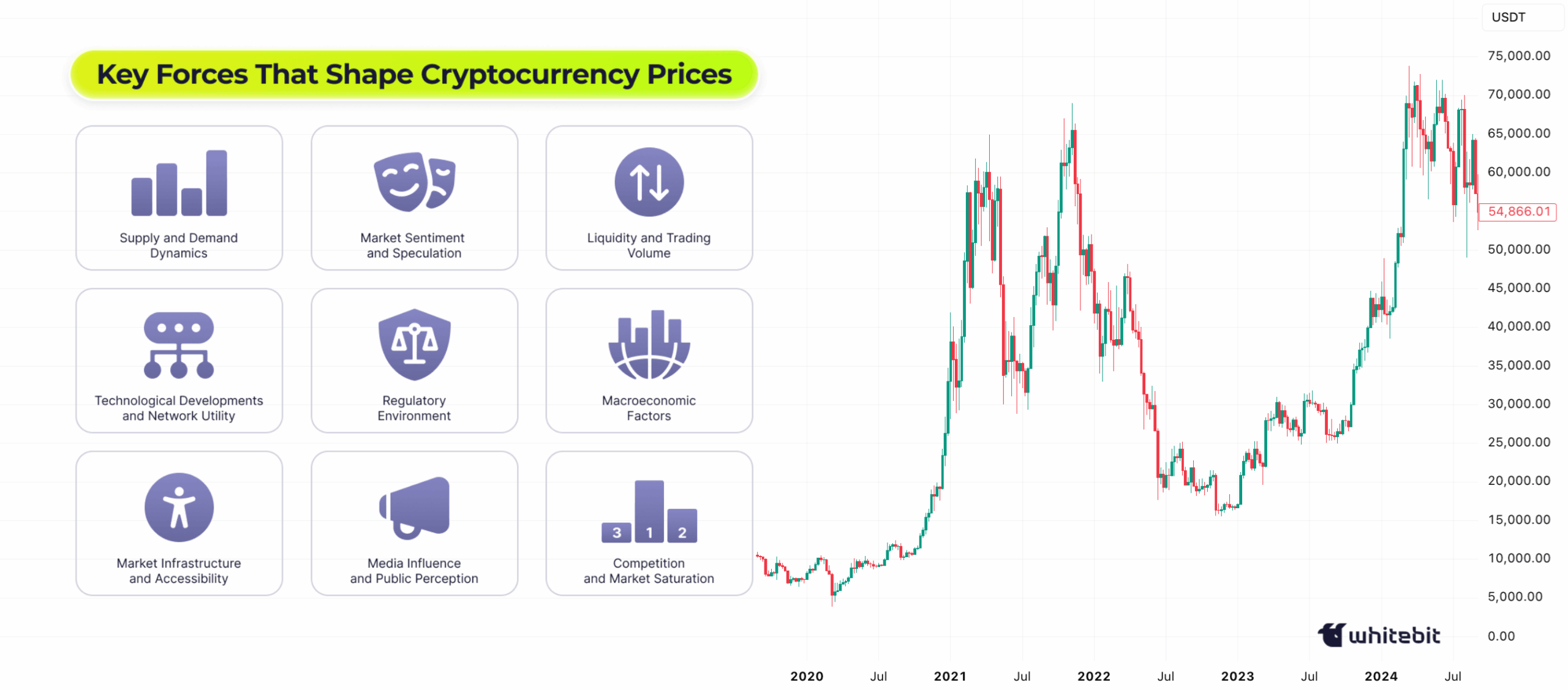
Source: TradingView
Crypto trades 24/7 across fragmented venues. That means order-book depth can thin out during hand-off hours (U.S. to Asia, weekends), and derivatives positioning can accelerate moves. Options “gamma” flows and forced liquidations routinely turn a normal dip into a fast slide—or a breakout into a sprint. The practical lesson for technical analysis crypto users: trust your levels, but check liquidity (spreads, depth) before sending a market order.
Regulation & narrative risk
Regulatory clarity fuels participation; confusion scares it. A favorable license, a green-lit product, or a clear tax rule can unlock new cohorts of buyers. Conversely, enforcement actions or banking frictions can stall adoption in a hurry. Headlines don’t always change fundamentals, but they change behavior—and Bitcoin prices trade on behavior.
What reputable sources predict for the 2025 Bitcoin price
No forecast is gospel, but knowing the range that serious desks and data outlets discuss can anchor expectations:
- JPMorgan: On a volatility-adjusted basis relative to gold, the bank recently mapped room for BTC to rise about 40% from early-October levels, implying roughly $165,000 as a fair upside marker if gold leadership persists.
- Citi: Base case $135,000 by year-end 2025; bull case $199,000, bear case $64,000—with ETF demand singled out as a key driver of price variance.
- Standard Chartered (earlier in the cycle): Raised its forecast to $150,000 for 2024 and saw a cycle high of $250,000 in 2025 before settling lower—useful context for how banks framed the upside as ETF adoption ramped.
- CoinDesk (cycle studies): Recent analysis argued that a sustained break above on-chain “realized” thresholds could set the stage for $200,000 by end-2025, linking price paths to prior cycle patterns.
- Consensus snapshots: Aggregators summarizing bank and fund views often show a 2025 cluster around the $145k–$200k band, while pushing extreme cases far above. Treat these as sentiment thermometers, not trade signals.
If you stitch these together, a realistic conversation range for 2025 sits roughly between $100k and $200k with large error bars—tightening or widening as macro, flows, and policy evolve.
Simple analysis flow
- Start with macro: Where are real yields, the dollar, and gold? If gold is surging and liquidity is tightening, size conservatively.
- Check flows: Are ETF net creations rising this week? Strong inflows tend to support trend continuation.
- Validate on-chain: Is usage growing or stalling? Rising activity justifies patience during dips; fading activity argues for caution.
- Time the entry: Use charts for levels and momentum, but confirm order-book depth before executing.
Exchanging crypto after analysis
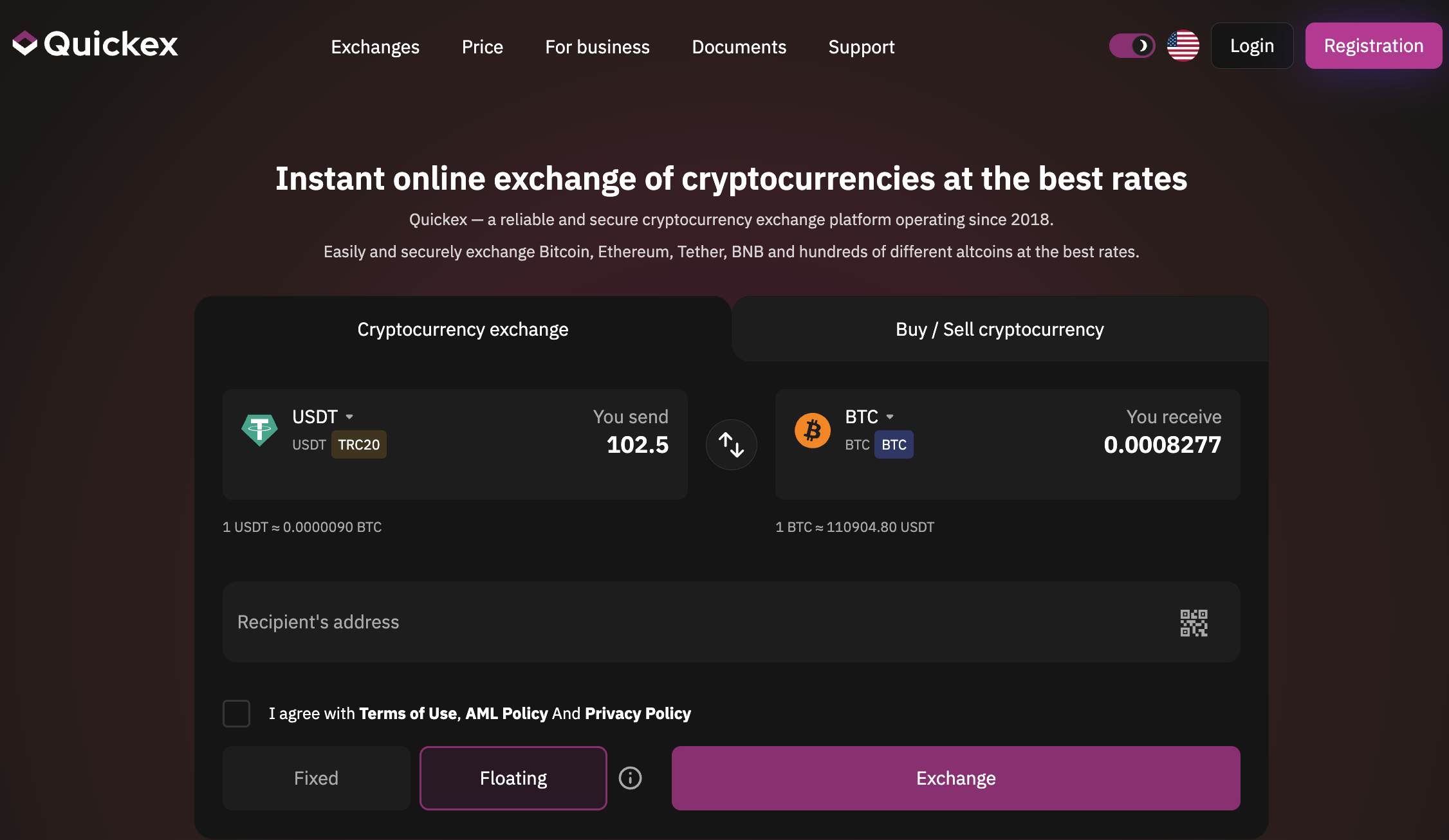
When your plan is set, you need a clean way to exchange cryptocurrency—say, to rotate BTC profits into USDT, or to move from one coin to another. Many traders use centralized exchanges with order books; others prefer instant, non-custodial swap services for speed.
Quickex is in the latter camp: a centralized, no-registration swap service where you select a pair (e.g., swap XRP to USDT or convert BTC to USDT), paste a receiving address, send the input coin, and receive the output directly in your wallet. There’s no account balance held at Quickex; it is centralized and lays out a three-step flow on its homepage. That makes it handy when you want to execute after your research, without opening an exchange account.
How a Quickex swap works:
- Choose the pair (e.g., BTC → USDT) and pick floating or fixed rate.
- Paste the correct destination address (and the correct network for tokens like USDT).
- Send the exact amount of your input coin to a one-time deposit address.
- Track the order (awaiting deposit → exchanging → sending out) until the funds land.
Risk checklist you can actually use
- Position sizing beats prediction. Bank targets are guideposts, not guarantees. Let sizing reflect uncertainty—even when you’re convinced.
- Watch the calendar. ETF rebalance windows, macro prints, and major unlocks often coincide with bigger moves.
- Confirm the tape. Oversold/overbought conditions can persist; wait for structure (higher lows, reclaimed moving averages) before scaling up.
- Operational hygiene. On swaps, verify the token network (e.g., ERC-20 vs. TRC-20). Start with a small test—then send the full amount.
Conclusion
Cryptocurrency prices respond to layers—macro liquidity, ETF flows, supply dynamics, genuine on-chain usage, derivatives positioning, and regulation. The Bitcoin price in 2025 is being handicapped by serious institutions in a broad $100k–$200k band, with upside/bear cases anchored to those same drivers. Use forecasts to frame risk, not to replace thinking. Build a simple routine—macro → flows → fundamentals → timing—and when it’s time to act, choose an execution path that fits your needs. If you want a quick wallet-to-wallet exchange after the analysis is done, Quickex.io gives you a straightforward way to swap without opening an account; if you need complex order types, a traditional CEX is the better tool. Either way, the edge isn’t a single indicator or a single prediction—it’s a repeatable process you can run week after week.