

For millions of people, Coinbase was their first stop in the world of crypto. It’s more than a place to trade Bitcoin — it’s a doorway into a new kind of finance.
The company appeared in 2012, when crypto was still a curiosity for enthusiasts. More than a decade later, Coinbase has turned from a niche project into one of the cornerstones of digital finance.
Let’s unpack what makes it work, why it earned so much trust, and how you can use it yourself.
Track the prices of your favorite cryptocurrencies anytime in the simple, fast Quickex exchanger.
What Makes Coinbase Special
Coinbase was built around one straightforward idea: people should have real control over their money. No banks to get in the way, no borders, no red tape.
Everything here revolves around two things — transparency and security. You can buy, sell, or store your crypto, earn staking rewards, and take part in on-chain projects — all within a single ecosystem.
But the real ambition behind Coinbase goes beyond trading. The company wants to make crypto understandable — to show that finance on the blockchain doesn’t have to be mysterious or intimidating. It supports developers, talks openly with regulators, and helps users learn the ropes. In short, it bridges the gap between innovation and everyday life.
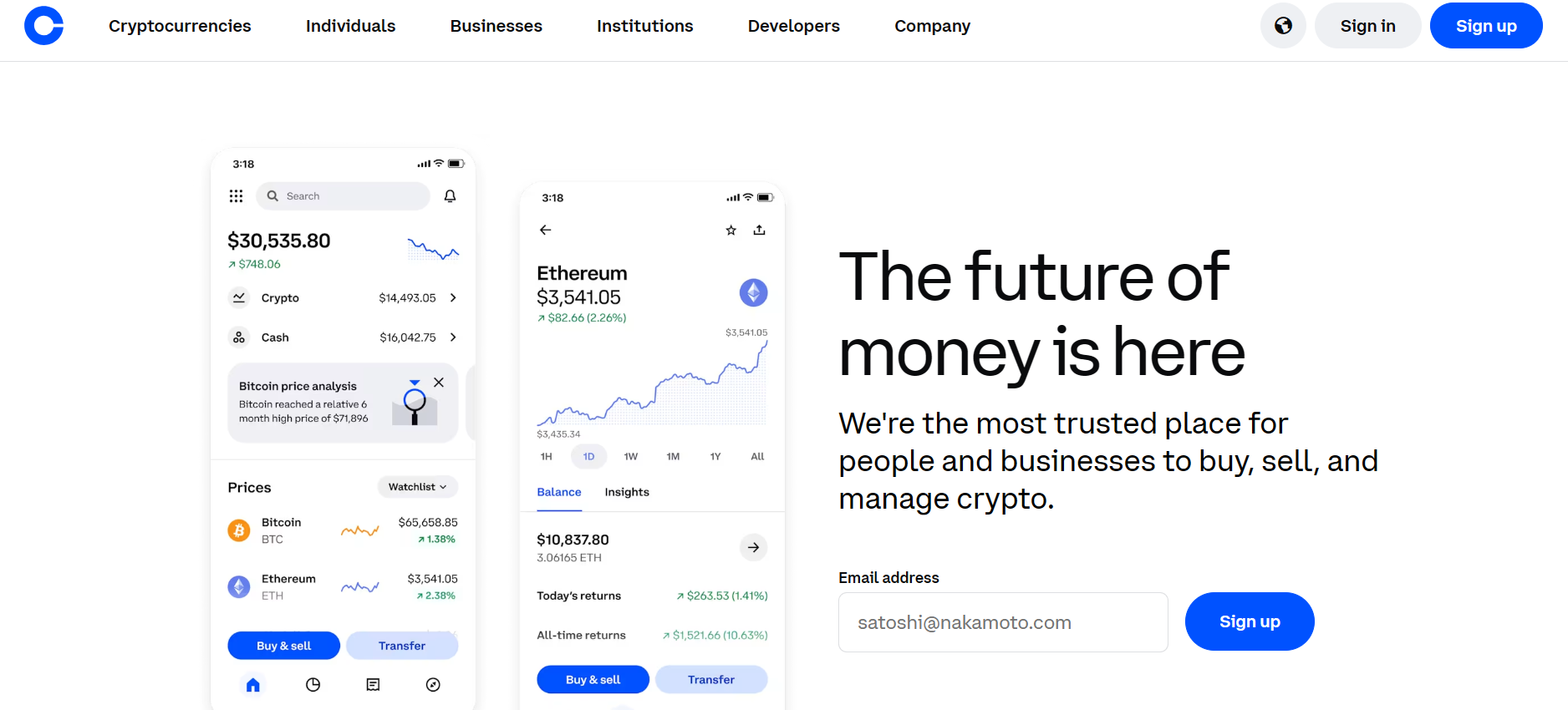
Screenshot of the Coinbase website
Scale And Reach
The scale of Coinbase today is hard to overstate.
- $237 billion — quarterly trading volume
- $425 billion — user assets under management
- 4,200+ employees
- Clients in more than 100 countries
It regularly sits among the world’s top three exchanges by trading volume and supports over 60 fiat currencies — from USD and EUR to CAD and SGD.
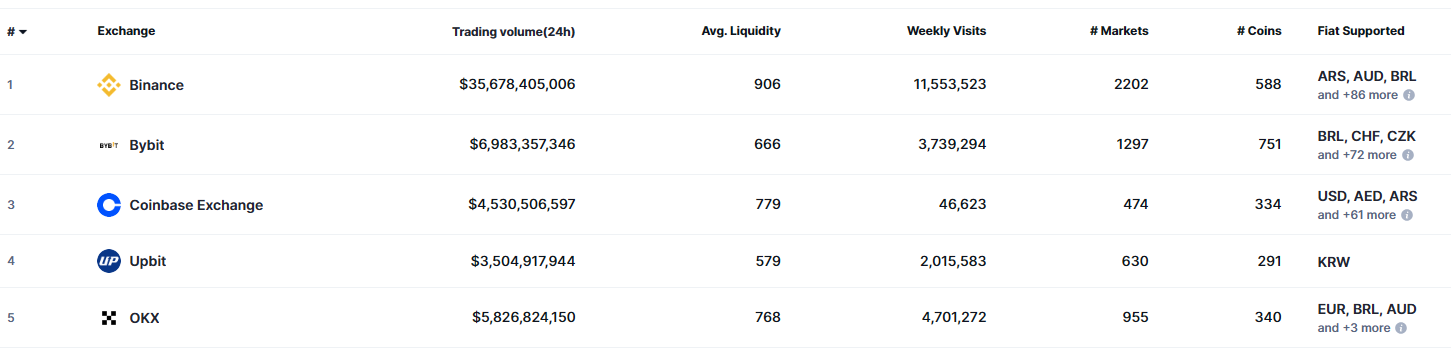
Coinbase is also one of the five largest centralized exchanges globally. Source: CoinMarketCap
The exchange operates across nearly every major market — the United States, Canada, Brazil, the UK, Germany, France, Italy, Spain, Portugal, the Netherlands, Turkey, India, Vietnam, Pakistan, Singapore, Australia, and many others.
Some places, though — like Russia, Kazakhstan, North Korea, and Iran — restrict access because of local regulations.
Fun fact: Coinbase doesn’t have a traditional headquarters. Since day one, it’s been a remote-first company. Its team is scattered across the world — officially registered in Delaware, but with many employees based in San Francisco and New York.
Going Public
April 14, 2021, became a milestone not just for Coinbase but for the entire crypto industry. On that day, the company went public on Nasdaq — the first major crypto firm to do so — and was valued at more than $100 billion.
Shares opened at $381 each. Considering the company had once been dismissed as a risky experiment, the moment felt almost unreal. Early investors like Andreessen Horowitz and Union Square Ventures, who had bought in back in 2013 for $0.20 a share, suddenly found themselves sitting on astronomical gains.
That day marked a turning point: crypto stopped being a fringe idea and stepped into mainstream finance.
Share Price Today
As of October 14, 2025, Coinbase stock trades between $343 and $365. Over the past year, prices have ranged from $142 to $445, and its market cap hovers near $91.7 billion.
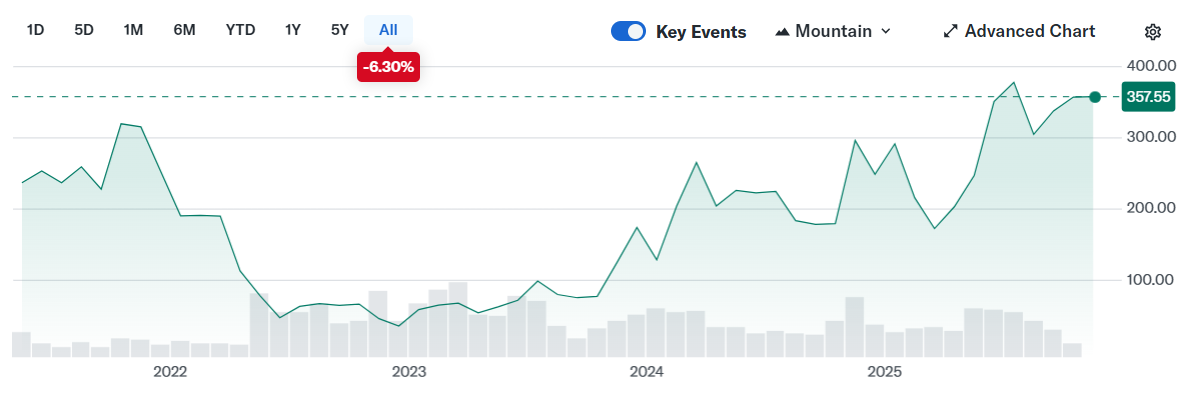
How Coinbase’s share price has changed. Source: finance.yahoo
For a company living in such a volatile market, that’s impressive stability. Even now, many investors see Coinbase as one of the safest names in crypto.
Who Runs Coinbase
Behind Coinbase stands a team that knows both tech and finance inside out:
- Brian Armstrong — Co-founder & CEO
- Emilie Choi — President & COO
- Alesia Haas — CFO
- L.J. Brock — Chief People Officer
- Paul Grewal — Chief Legal Officer
- Gregory Tusar — VP of Institutional Products
Security And Trust
Coinbase’s reputation rests on how seriously it treats security and compliance. For them, regulation isn’t a burden — it’s part of the brand.
Before any token gets listed, the team reviews it inside out, checking its risks and legal status. Every process is tested, every transaction tracked, every system updated.
That’s why Coinbase is often called the “white-hat” of crypto exchanges — the reliable one in a field that’s not always famous for playing by the rules.
What The Exchange Offers
Coinbase is laid out simply. You can reach most of what you need right from the homepage:
- Cryptocurrencies: live prices and charts for 19,000+ assets.
- People: tools for individuals — trading, staking, the Coinbase One plan, a cashback debit card, and both standard and advanced trading modes.
- Companies: crypto solutions for businesses — trading, payment processing, token listings, and integration through Coinbase Commerce.
- Institutions: prime brokerage, custody, spot and futures markets, and access to liquidity through Verified Pools.
- Developers: the Developer Platform, the Base network (Ethereum L2), Onramp, OnchainKit, and staking via Strike.
- Info: educational and reference materials — the blog, news, security hub, career section, and partnerships.
Scroll to the bottom and you’ll find quick links for support, information, and asset prices.
The trading terminal itself is only available to registered users. But even if you can’t open an account because of local restrictions, you can still use Coinbase Wallet — a secure, non-custodial option that puts you in charge of your own funds.
How To Sign Up
Getting started takes just a few minutes. Click Getting Started in the top-right corner, enter your email, confirm the code, create a password, and link your phone number. Then you’re good to go.
Bottom Line
Coinbase isn’t just a business — it’s a story of how far crypto has come. From a small startup to a global exchange, it helped redefine what financial freedom can look like.
By combining strong security with a clean, friendly interface, Coinbase proved that blockchain doesn’t have to be complicated or risky. It can be open, safe, and — most importantly — human.
You can exchange cryptocurrency quickly, securely, and anonymously through the reliable Quickex exchanger.
FAQ
What is Coinbase? Is Coinbase a real company?
Yes — Coinbase is one of the most established companies in crypto. Founded in 2012 by Brian Armstrong and Fred Ehrsam, Coinbase went public on NASDAQ in April 2021 (ticker: COIN) via a direct listing. It is headquartered in the United States and operates in 100+ countries, serving over 110 million verified users. Coinbase is licensed as a Money Services Business (MSB) with FinCEN, holds Money Transmitter Licenses in 40+ U.S. states, and is registered in the UK, EU, and other jurisdictions. In May 2025, Coinbase was added to the S&P 500 index — the first crypto-native company to earn that distinction. As a publicly traded company, Coinbase files quarterly and annual financial reports with the SEC, making it one of the most transparent crypto businesses in the world.
What is the downside of Coinbase? Why do some people avoid it?
Despite its size and regulatory standing, Coinbase has several well-documented drawbacks:
- High fees (Simple Trade): Coinbase’s default “Simple Trade” interface charges spreads of ~0.5% plus a flat fee of $0.99–$2.99 per transaction on small amounts — significantly more expensive than competitors. The Advanced Trade interface offers maker/taker fees starting at 0.00%–0.60%, but many beginners don’t know it exists.
- Customer support complaints: Coinbase holds a 1.5/5 rating on Trustpilot (based on 12,000+ reviews) — the most common complaints are frozen accounts, slow support response times, and difficulty reaching a human agent. The BBB profile shows a pattern of account-lock complaints where users wait weeks for resolution.
- May 2025 data breach: Coinbase disclosed that overseas support contractors were bribed to leak customer personal data (names, addresses, partial SSNs, account balances). No passwords or private keys were compromised, but the incident exposed ~1% of monthly transacting users. Coinbase refused to pay the ransom demanded and has committed up to $400 million in remediation costs.
- Account freezes: Users report accounts being locked during routine compliance reviews with little communication — a recurring theme in Trustpilot and BBB complaints.
- Limited altcoin selection vs. competitors: Coinbase lists ~260 tradeable assets — far fewer than Binance (400+) or Gate.io (3,800+).
Is Uphold better than Coinbase?
They serve different needs. Here’s a side-by-side:
| Factor | Coinbase | Uphold |
|---|---|---|
| Supported assets | ~260 crypto | ~300 crypto + stocks, metals, FX (multi-asset platform) |
| Trading fees | Simple: ~1.5–2.5% all-in; Advanced: 0.00–0.60% | Spread-based: ~0.9–1.5% on major crypto; up to 2.5% on small-caps |
| Fiat currencies | USD, EUR, GBP + limited others | 30+ fiat currencies including direct crypto-to-fiat conversion |
| XRP support | ✅ Yes (relisted 2023) | ✅ Yes — Uphold was one of the few exchanges that never delisted XRP during the SEC lawsuit |
| Regulation | NASDAQ-listed (COIN); 40+ U.S. state licenses; S&P 500 | FinCEN MSB; FCA-registered (UK); licensed in EU and Lithuania |
| Trustpilot | 1.5/5 (~12K reviews) | 1.3/5 (~12K reviews) |
| Best for | U.S. beginners; institutional credibility | Multi-asset traders (crypto + stocks + metals); XRP enthusiasts |
Verdict: Coinbase wins on regulatory credibility (S&P 500, NASDAQ-listed) and ecosystem depth (staking, Coinbase Wallet, Base L2). Uphold wins on multi-asset flexibility (trade crypto, stocks, gold, and 30+ fiat currencies in one app) and was notably loyal to XRP holders during the SEC case. Both have poor Trustpilot scores driven by similar complaints (account freezes, slow support). Neither is clearly “better” — it depends on what you trade.
What is better, Coinbase or Kraken?
| Factor | Coinbase | Kraken |
|---|---|---|
| Trading fees | Simple: ~1.5–2.5%; Advanced: 0.00–0.60% | Kraken Pro: 0.00–0.40% (cheaper at most tiers) |
| Supported assets | ~260 | ~300+ |
| Security record | May 2025 data leak (contractors bribed); no loss of funds | No major breaches since founding (2011); 95% cold storage; semi-annual proof-of-reserves audits |
| Regulation | NASDAQ-listed (COIN); S&P 500; 40+ U.S. licences | FinCEN MSB; licensed in UK, EU, Australia, Japan, Abu Dhabi |
| Futures / margin | Limited (via Coinbase Advanced / Deribit acquisition) | Full futures + margin trading (up to 50× on some pairs) |
| Staking | ✅ Yes (ETH, SOL, ADA, etc.) | ✅ Yes (ETH, SOL, DOT, etc.) — flexible and bonded options |
| Best for | Beginners; U.S. institutional trust; Base L2 ecosystem | Intermediate–advanced traders; lower fees; security-first users |
Verdict: Coinbase is the better on-ramp for beginners — simpler interface, S&P 500 brand trust, and the broadest U.S. fiat integration. Kraken is the better choice for cost-conscious and advanced traders — consistently lower fees, a spotless security track record (no breaches since 2011), and full futures/margin support. Many experienced users maintain accounts on both.
Is there a way to trade crypto without exchange registration?
Yes. If you already hold any cryptocurrency and want to swap it for another asset without creating an exchange account, going through KYC, or waiting for verification, you can use Quickex — an instant swap service with no registration, no KYC, transparent fees, and funds sent directly to your wallet. It supports 100+ assets including BTC, ETH, XRP, SOL, USDT, and more.
Disclaimer: The material in this article is not financial or investment advice. Everything stated here reflects the author's personal view and should not be treated as a recommendation to trade or invest. We make no warranties regarding the accuracy, reliability or completeness of the information presented. Cryptocurrency markets are highly volatile and can move unpredictably. Before committing any funds, every investor, trader or crypto user should study several independent sources and check the regulations that apply in their own jurisdiction.