
Safely and profitably exchanging cryptocurrency isn’t as simple as it might seem. Unfortunately, there are many crypto exchangers on the market that hide the real terms.
There are 12 universal tips that will help filter out unworthy platforms. Here’s how to choose a good crypto exchanger and avoid falling into the hands of scammers.
1. Prefer non-custodial services
If your goal is simply to exchange cryptocurrency online, it’s better to use non-custodial exchangers. They don’t store funds. Coins are sent directly to the specified wallet. This setup reduces the risk of an account hack or a blocked account followed by loss of funds.
You should also prefer exchangers that allow you to operate anonymously. Protecting privacy is extremely important at a time when regulators are trying to strangle the crypto industry.
2. Review the KYC policy in advance
Even services without registration sometimes request documents. The reason is that many online crypto exchangers are connected to transaction monitoring systems. If suspicious activity is detected, identity verification may be required. To avoid surprises, read the AML/KYC section on the selected platform’s website in advance.
Important! Choose platforms that provide rules in a language you understand. Dishonest exchangers often take advantage of customers’ lack of foreign-language knowledge to deceive them.
3. Clarify which rate types the exchanger offers
A fixed rate lets you know the exact payout amount in advance, but it only applies for a limited time. A floating rate depends on the market situation and can be more profitable when prices are stable. With high volatility, it’s safer to use a fixed rate; when the market is calm — a floating one.
Prefer platforms that offer both options. That way you can choose the one that fits current market conditions.
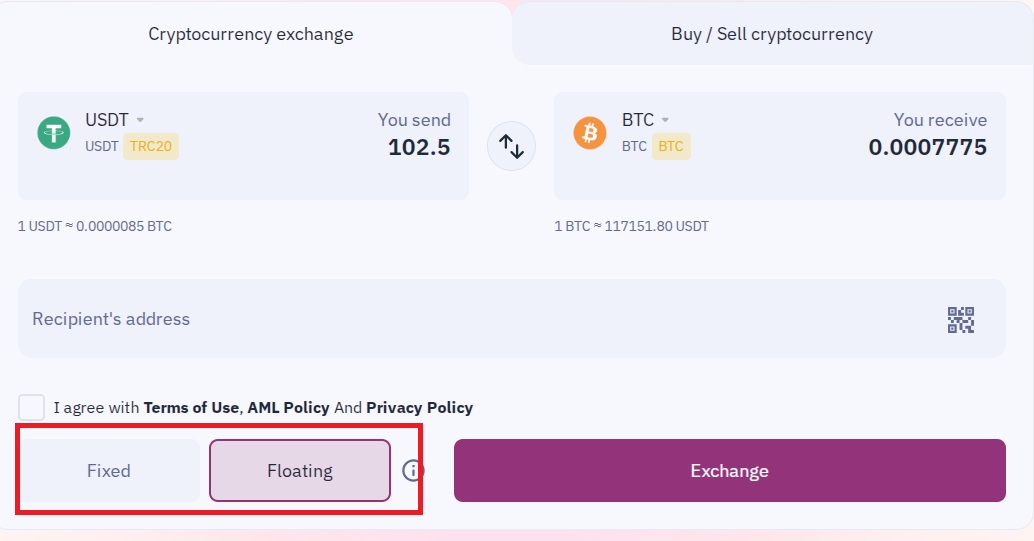
Example of the Quickex exchange interface
4. Calculate the final amount, not just the fee
Claims of “0% commission” are often misleading. In practice, the final amount depends on the spread and network fees. Focus on the final amount that will actually reach your wallet, not the fee advertised by the exchanger.
5. Check reputation and reviews
A reliable crypto exchanger typically has a good reputation. Review platform feedback on forums. Ask other market participants what they think in thematic chats.
Pay attention not only to the overall rating but also to the content of comments. If most complaints are about delays — that’s not so bad. Many exchangers do experience hiccups. But complaints about funds not being returned or support ignoring users should raise a red flag.
6. Look for transparency in the terms
A respectable service publishes its operating rules, exchange instructions, and legal documents. If the site only has an amount input form and no process description, that’s a sign of unreliability. Transparency always points to a long-term company strategy.
7. Clarify limits and processing times
Different exchangers may set minimums starting at $20 or $100. Maximum limits are also common, especially when working with fiat.
Speed depends on the network: on average an exchange takes 5 to 30 minutes, but under heavy load it may take longer. Reliable services allow you to track the status of a transaction in real time.
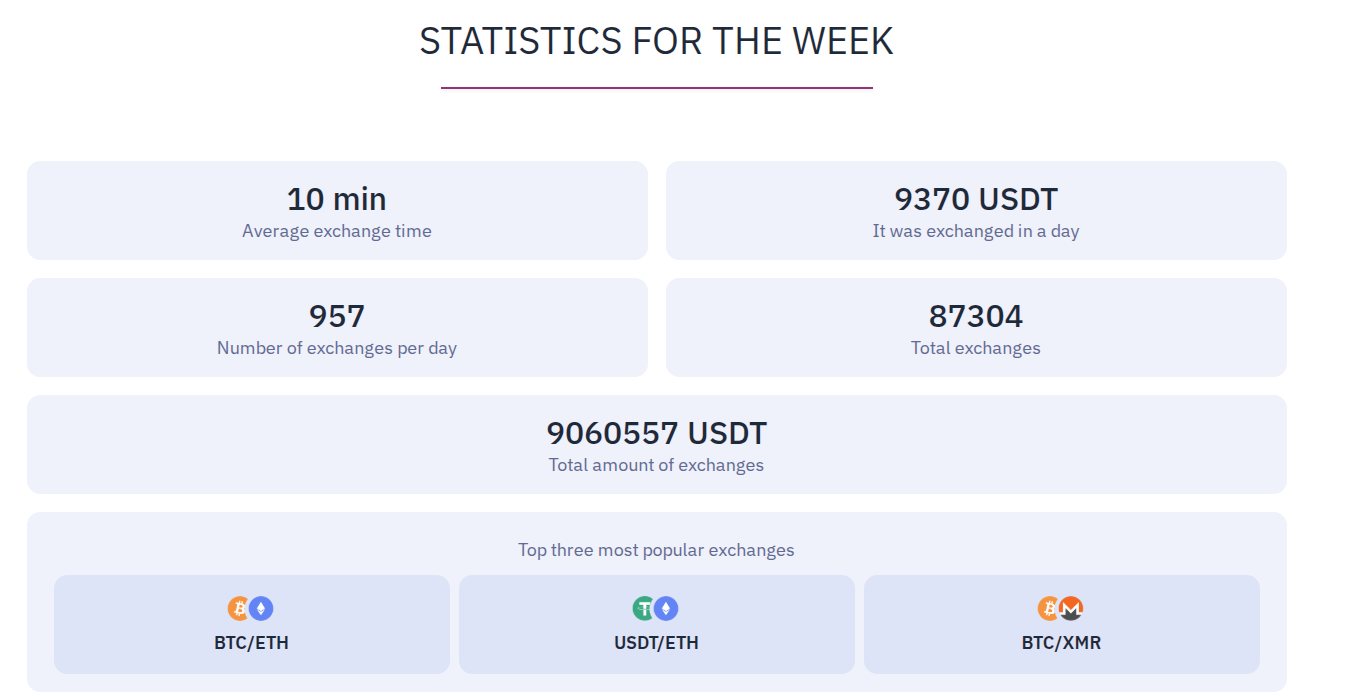
Example of Quickex exchange statistics
8. Test support in advance
Before a large exchange, it’s worth testing support. It’s enough to ask a simple question, for example, about the rate-lock period. A quick and informative reply indicates the service takes customers seriously. If support can’t give a clear answer even to a simple question, consider choosing another exchanger.
9. Check supported networks
Verify not only the list of coins, but also the networks in which they’re available. Mistakes like sending USDT to ERC-20 instead of TRC-20 can lead to loss of funds. A good service clearly indicates the network and warns about all nuances.
10. Evaluate business features
Some services offer APIs, widgets, and affiliate programs. For entrepreneurs, this is a chance to embed exchange into their own product, automate the process, and earn extra income from commissions. For regular users, an exchanger that works with businesses is a sign that large clients trust the platform.
11. Consider regulation
Crypto rules vary by country. In some jurisdictions services operate freely; in others they may be blocked. Understanding local law is a key part of exchanging cryptocurrency safely. It’s important that the exchanger clearly regulates its terms of service for users.
12. Start with a small amount
Before a large transaction, test the service with the minimum amount. This helps verify correct details, speed, the truthfulness of the rate, and how convenient it is to track the exchange status.
Let’s sum up
Following these simple tips will make it easier to find a crypto exchanger online. This approach helps you understand in advance where you can exchange cryptocurrency profitably, what pitfalls might arise, and how to protect your funds.
An example of a reliable exchanger that meets these recommendations is Quickex. The platform allows you to make deals without registration, offers both fixed and floating rates, supports dozens of currency routes, and ensures a transparent exchange process.
For those looking for how to safely exchange cryptocurrency online, Quickex is one of the worthy options.
Disclaimer: The material in this article is not financial or investment advice. Everything stated here reflects the author's personal view and should not be treated as a recommendation to trade or invest. We make no warranties regarding the accuracy, reliability or completeness of the information presented. Cryptocurrency markets are highly volatile and can move unpredictably. Before committing any funds, every investor, trader or crypto user should study several independent sources and check the regulations that apply in their own jurisdiction.