
Introduction: Understanding Your TON
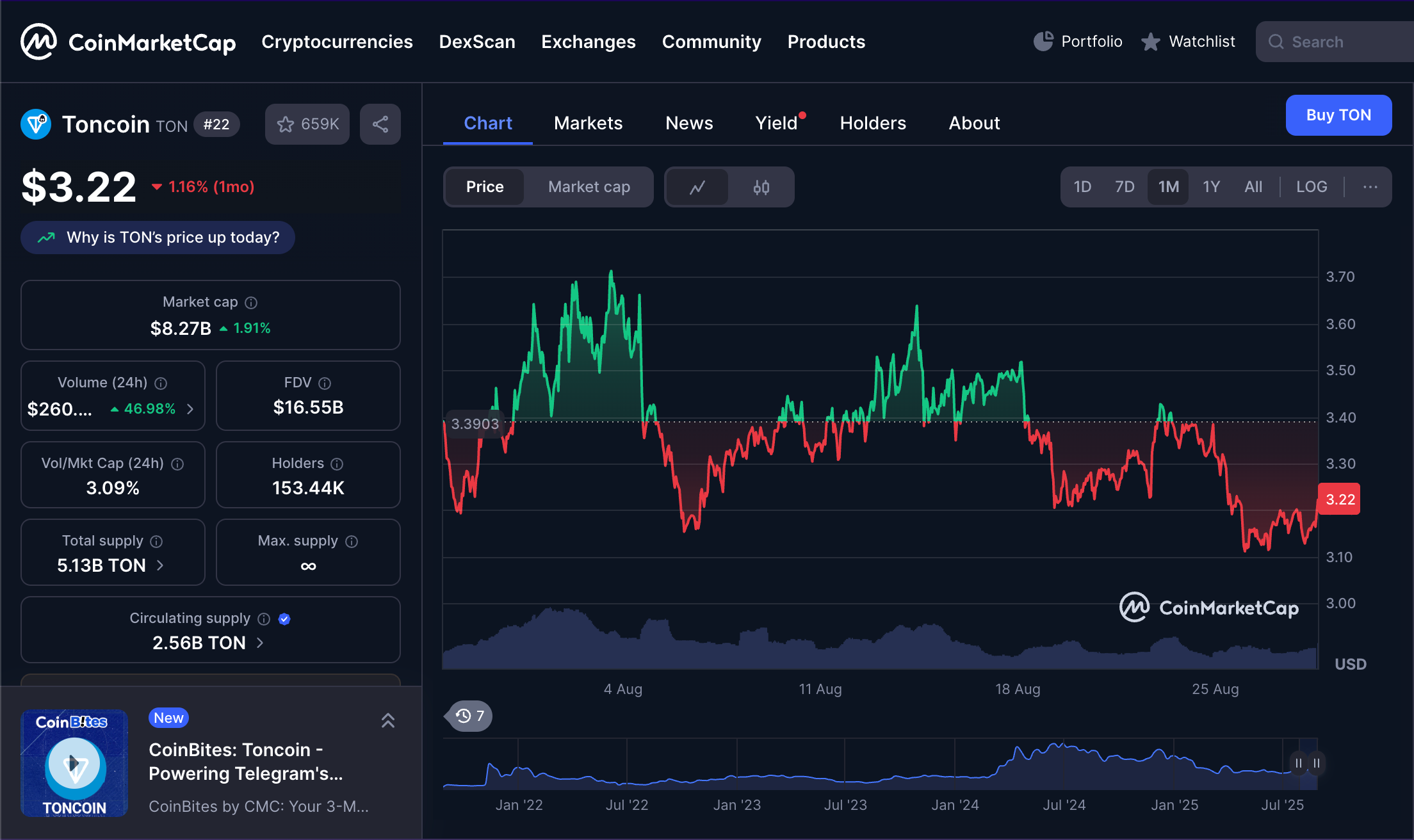
Source: Coinmarketcap
Toncoin (TON) is the native cryptocurrency of The Open Network, a high‑throughput blockchain originally inspired by Telegram’s vision and now maintained by an independent community. TON is built for speed, low fees, and consumer‑friendly apps (from payments to mini‑apps), which is why you’ll find TON wallets embedded in familiar mobile experiences.
The Goal of this guide is to give you a clear, step‑by‑step playbook for how to exchange TON, including platforms where to sell it, and practical paths for TON to fiat—so you can confidently sell TON online in 2025.
The Two Main Ways to Sell Your TON
Option 1: Centralized Cryptocurrency Exchanges (CEXs)
A centralized exchange (CEX) is a custodial platform that matches buyers and sellers and settles trades on your behalf—think of it as a regulated middleman with order books, charts, and fiat on/off‑ramps.
Major CEXs that support TON trading (availability varies by country): Quickex, Binance, Kraken, OKX, Bybit, Bitstamp. These venues let you convert TON → USDT/USDC/USD/EUR, then withdraw to bank rails or cards where available.
Pros
- High liquidity on popular pairs (e.g., TON/USDT), tighter spreads, and low‑fee exchanges when you use the order book.
- User‑friendly interfaces, mobile apps, and 24/7 support on established brands.
- More TON trading options (limit/stop orders; margin/futures in some regions).
- Integrated fiat rails can enable faster payouts on supported methods (fast exchange platforms).
Cons
- KYC (identity verification) is standard before you can withdraw.
- Possible deposit/withdrawal fees, spreads on one‑click “Convert,” and level‑based trading fees.
- You don’t control private keys while funds are on the exchange.
Option 2: Peer‑to‑Peer (P2P) Marketplaces
A P2P marketplace connects you directly with another user. The platform typically provides escrow (it locks your TON until you confirm you’ve been paid), plus a dispute process if something goes wrong.
Examples: Dedicated boards on major exchanges (Binance P2P, OKX P2P, Bybit P2P) and independent venues like Bitpapa.
Pros
- Often more private and flexible payment methods (local bank transfers, e‑wallets).
- You retain direct control until you release escrow, which can feel safer for some users.
- Sometimes better local pricing during high demand.
Cons
- Can be slower than a CEX sell—timing depends on your buyer.
- Requires more vigilance to avoid scams; liquidity varies by region/time.
- You’ll need to follow platform rules carefully to stay protected.
Step‑by‑Step Guide: Selling TON on a Centralized Exchange
Step 1: Choose an Exchange. Pick a reputable CEX that lists TON, such as Quickex. Make sure it serves your country, and supports your preferred withdrawal method (bank transfer, card, etc.). Check fees, limits, and the availability of TON to fiat instantly features in your region.
Step 2: Create and Verify Your Account. Sign up with your email/phone, enable 2FA, and complete KYC. Verification is required on most platforms before you can withdraw funds.
Step 3: Transfer TON to the Exchange. Open the exchange app or web interface → Deposit → choose TON (Toncoin) → copy your TON deposit address. From your personal wallet (e.g., Tonkeeper, Wallet in Telegram, Tonhub), send the desired amount of TON to that address. Double‑check the network (TON mainnet) and any memo/tag fields the exchange requires.
Step 4: Place a Sell Order. Go to Trade and choose a pair like TON/USDT, TON/USD, or TON/EUR.
- Market order: sells immediately at the best available price—fast and simple.
- Limit order: you set the TON price; the order fills when the market reaches it—better control over execution and fees.
For bigger amounts, limit orders on liquid pairs usually deliver better pricing.
Step 5: Withdraw Your Funds. After selling, convert to your local currency if needed (e.g., USDT → USD), then open Withdraw. Select your bank transfer or card method, review fees and limits, and submit. Some rails can be near‑instant in supported regions; others may take business days.
Step‑by‑Step Guide: Selling TON via a P2P Marketplace
- Step 1: Choose a P2P Platform. Pick a trusted P2P venue with active TON or USDT markets and strong user protection (escrow, verified traders, dispute support).
- Step 2: Find a Buyer. Browse existing buy offers or create your own sell offer. Specify how much TON you’re selling, the payment method(local bank, e‑wallet), price, and any requirements (e.g., verified buyers only). Many P2P boards use USDT as the settlement asset—you can first swap TON → USDT on a CEX for broader demand.
- Step 3: Secure the Transaction (Escrow). When you start a trade, the platform holds your TON in escrow. The buyer sends payment using the agreed method. Keep all communication in‑app so moderators can help if needed.
- Step 4: Receive Payment and Release Funds. Confirm that cleared funds arrived in your bank/e‑wallet (not just a screenshot). Once confirmed, release the TON from escrow to the buyer. Save receipts and leave feedback for reputation.
Key Considerations Before Selling
Fees
- Network fees: moving TON from your wallet to an exchange incurs a small on‑chain fee.
- Platform fees: CEX trading, withdrawal, or “Convert” spreads; P2P platforms may charge ad/posting or escrow fees.
- Payment rails: banks or card processors may add their own charges.
Security
- Use reliable crypto exchanges with 2FA, withdrawal allow‑listing, and device checks.
- On P2P, rely on escrow and never go off‑platform or release funds before payment clears.
- Beware look‑alike domains and phishing; bookmark official sites.
Price
- Check the live market before you sell; prices can move quickly.
- For larger amounts, use limit orders on the order book to control slippage.
- If timing matters, consider staging your sale rather than sending one large market order.
Taxes (important disclaimer)
- Selling crypto can trigger taxable events. Rules vary by country—capital gains, income classification, reporting thresholds, and more.
- Keep records (dates, amounts, costs, fees) and consult a local tax professional.
Conclusion: Making the Best Choice for You
- Choose a CEX if you want speed, deep liquidity, and integrated off‑ramps. It’s typically the easiest route for where to sell TON and getting TON to fiat instantly where your rails support it.
- Choose P2P if you value privacy and local payment flexibility. It can be the best way to swap TON into cash using methods your bank supports, provided you follow escrow rules.
Whatever you pick, secure your accounts, verify fees and withdrawal limits, and start with a small test trade. With a bit of prep, you can sell TON online smoothly in 2025—on your terms for cost, speed, and safety.
Disclaimer: The material in this article is not financial or investment advice. Everything stated here reflects the author's personal view and should not be treated as a recommendation to trade or invest. We make no warranties regarding the accuracy, reliability or completeness of the information presented. Cryptocurrency markets are highly volatile and can move unpredictably. Before committing any funds, every investor, trader or crypto user should study several independent sources and check the regulations that apply in their own jurisdiction.