

Just five years ago, MicroStrategy was merely a developer of data analytics software. Today this company, which has changed its name to Strategy, owns over 3% of the entire BTC supply. Its founder Michael Saylor has become a symbol of cryptocurrencies. His biography resembles an American drama: a rise, a crash, a change of heart, and a new ascent—this time in the world of digital assets.
We explain why MicroStrategy invests in Bitcoin, what successes the company has achieved, and why its interest in cryptocurrency poses a risk to the crypto community.
Track the Bitcoin rate with Quickex.
How MicroStrategy Appeared
The company was founded in 1989. Two MIT graduates, Michael Saylor and Sanju Bansal, conceived a project that would help businesses make decisions based on data analysis. Within a few years, MicroStrategy was signing contracts with corporations like McDonald’s, and in 1998 it went public. That’s when Saylor first appeared on billionaire lists.

Michael Saylor.
But the joy didn’t last long. In the early 2000s, when the dot-com bubble burst, the company faced a stock price collapse and regulatory scrutiny.
A New Life After Failure
In the spring of 2000, Saylor lost $6 billion in a single day. It was a record personal loss at the time. The SEC accused MicroStrategy of accounting errors, and the firm paid a multimillion-dollar fine to stay afloat.
For some, such a blow would have ended a career, but it didn’t stop Saylor. Amid the regulatory problems, as he himself says, he first began to think that real wealth isn’t in money, but in controlling something scarce. He realized that:
- digital value rests solely on scarcity
- fiat currencies can be devalued by officials’ decisions
- true stability lies in what cannot be printed
These ideas later crystallized into his interest in Bitcoin.
First Experiments With Digital Assets
Back in the 1990s, Saylor became fascinated by the idea of digital property. He started with domain names. MicroStrategy bought short words—“Voice.com,” “Hope.com,” “Angel.com,” “Alarm.com”—for about a hundred thousand dollars each.
Later these purchases turned into millions: “Alarm.com” sold for $27.7 million, “Angel.com” for $110 million. And in 2019 “Voice.com” was sold to blockchain company Block.one for a record $30 million. It was the largest deal in the history of the domain market.
That’s when Saylor realized: rare digital assets can preserve value like gold. And when he first looked seriously at Bitcoin, the idea of “digital scarcity” had long been on his mind.
The First Step Into Crypto
In August 2020, MicroStrategy announced it was buying Bitcoin for $250 million. The price was around $12,000, and the decision seemed crazy. But within a few months, the price doubled, and the company unexpectedly found itself ahead.
From that moment Saylor decided that Bitcoin would become the company’s core asset. His logic is simple: “Money loses value; Bitcoin does not.”
Investors quickly caught on, and MicroStrategy’s stock began to rise almost in sync with BTC. Thus, the firm transformed from a software developer into a “corporate Bitcoin fund.”
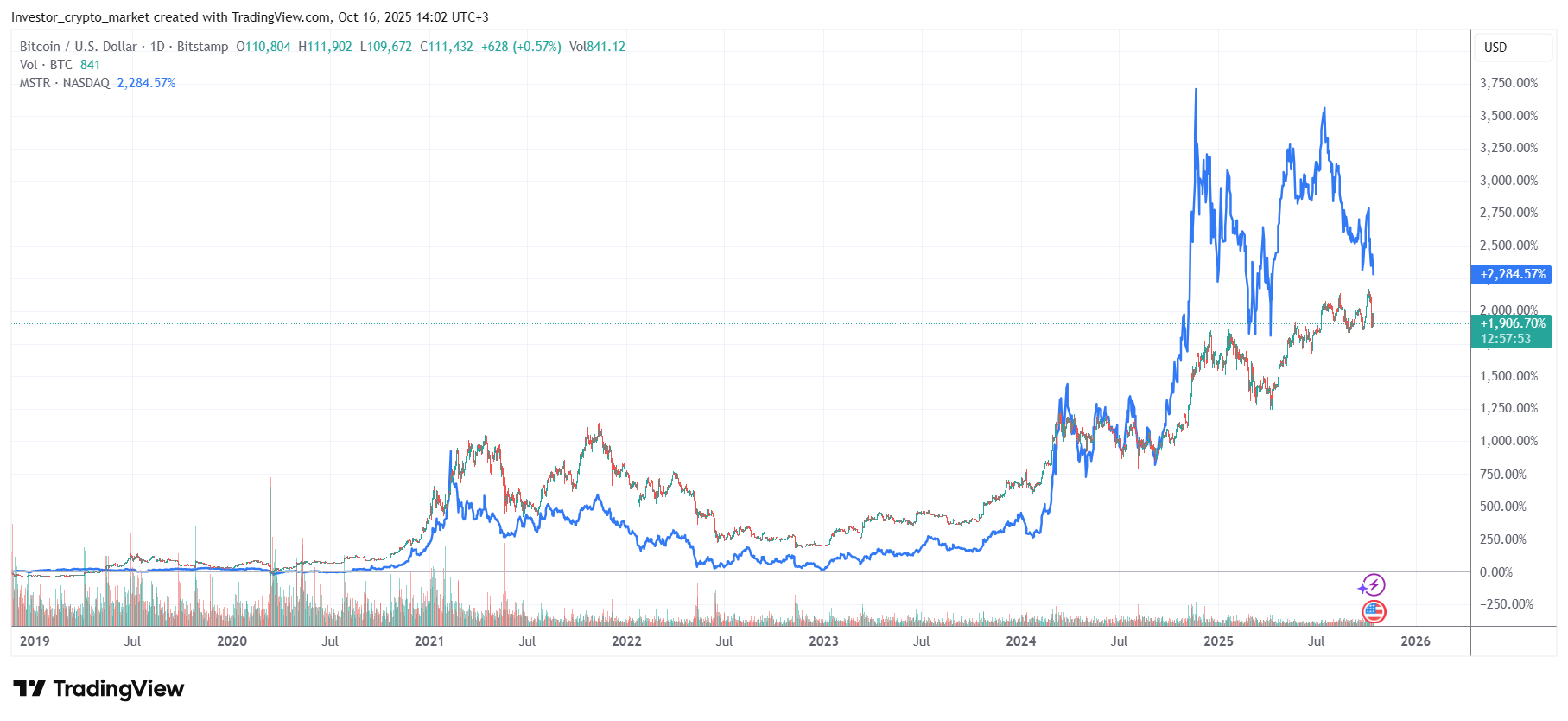
Comparison of Bitcoin price behavior and Strategy shares. Source: TradingView
Major Deals
Over the following years, Strategy turned buying Bitcoin into a strategy.
The loudest milestones:
- 2020 — the start: $250 million for 21,454 BTC, then new allocations up to $1.125 billion
- Late 2024 — a decisive surge: over a month and a half, more than 134,000 BTC acquired for nearly $12 billion
- Spring 2025 — a series of purchases totaling $3.9 billion, including one of the record deals for 22,000 BTC
- July 2025 — the largest single purchase: 21,021 BTC for $2.465 billion
- September 2025 — eight consecutive buys, totaling about $850 million
As of October 16, 2025, Strategy owns 640,031 BTC—about 3% of total supply. Their value is estimated at $71.31 billion.
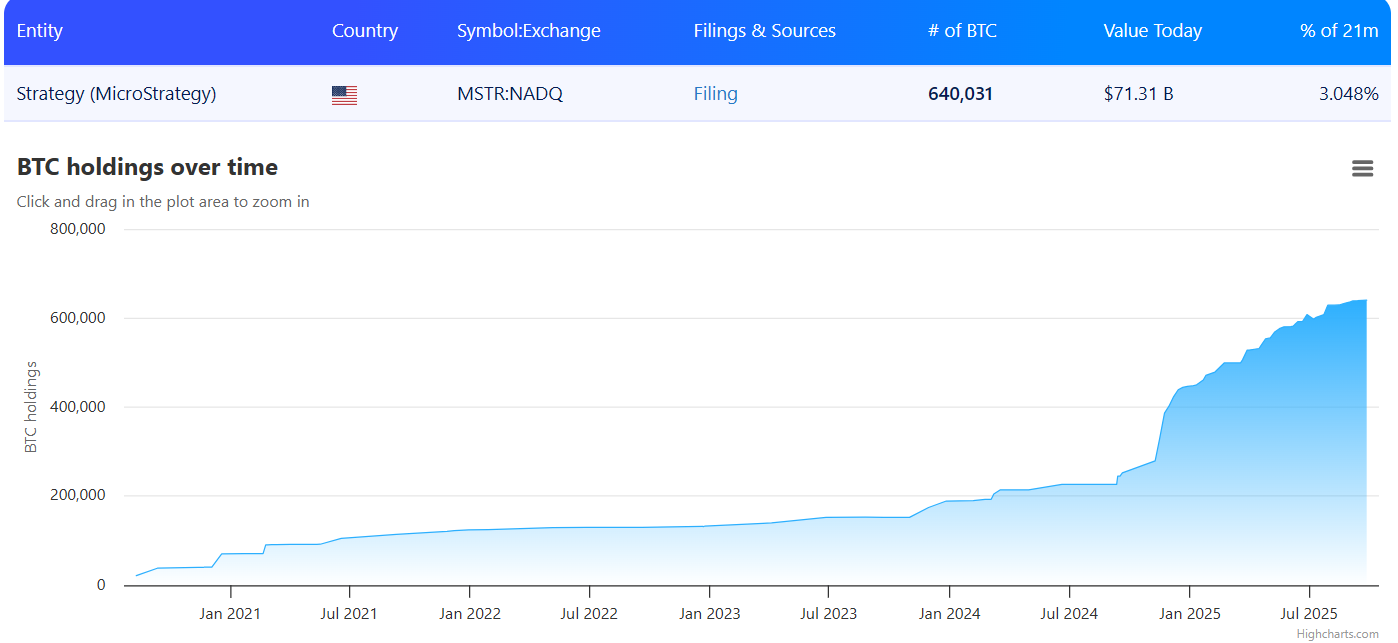
Information about Strategy’s Bitcoin balance and its change over time. Source: bitbo
Where the Money Comes From
The company finances purchases not from software profits but through issuing shares and bonds. Among the instruments:
- zero-coupon convertible bonds
- regular stock issuances
- new Strike (STRK) securities, convertible into shares at a 10-to-1 ratio
In 2025, Strategy raised over $11 billion, and the total amount invested in Bitcoin has already exceeded $33 billion.
Bitcoin as Part of Corporate Strategy
Saylor has long argued that Bitcoin isn’t just an asset but a way to protect capital from inflation. He sees it as the digital analogue of gold.
To help other companies replicate the experience, MicroStrategy publishes documents describing its strategy. They detail how to add cryptocurrency to a corporate balance sheet without breaking the law.
Thus MicroStrategy became not only an investor but also a kind of mentor for other companies interested in digital assets.
How the Company Evangelizes Other Market Participants
By the end of 2024, Saylor decided to go further—bringing tech giants into the industry. He presented Microsoft with a 44-page plan for investing in Bitcoin. By his calculations, if the corporation invests $100 billion a year, its market cap could grow by $5 trillion.
This proposal came after the National Center for Public Policy Research suggested that Microsoft consider buying BTC. A vote on the issue took place on December 10, 2024.
Management opposed the idea, but major shareholders—BlackRock and State Street—supported it. Although the decision was ultimately not adopted, the very fact that Microsoft seriously discussed Bitcoin at the board level was already a win for Saylor.
Debates and Risks
In the summer of 2025, Strategy changed its stock-issuance rules, removing the restriction that new shares could be issued only when the market price was at a certain ratio to the company’s Bitcoin holdings. Now the company can issue shares at any moment it deems necessary.
Some analysts saw this as a red flag. WhaleWire CEO Jacob King stated that “this is not about Bitcoin at all, but about Saylor’s personal gain.” Others recalled his past conflicts with the SEC in 2000.
But Saylor’s supporters are confident that his strategy is transparent: all of the company’s wallet addresses are known, and transactions are easy to verify on-chain.
What Remains Behind the Scenes
Strategy continues to develop its core business—the Strategy One platform for analytics and artificial intelligence. The company holds an annual Strategy World conference where it talks not only about crypto but also about the future of corporate data.
Financially, this line hasn’t brought big profits yet: at the end of 2024 the company reported a $670 million loss on $120 million in revenue. But Saylor believes the software business is the foundation, and Bitcoin is the protection of that foundation for decades to come.
Conclusion
Michael Saylor’s story isn’t merely a success story. It’s an example of how defeat can be the beginning of a new path. After losing billions, he built a company that owns more than 3% of Bitcoin’s supply and sets the tone for the crypto market.
He managed to turn the idea of digital scarcity into a tool for business. To some he’s a risky player; to others, a visionary. But the fact remains: he kicked off the era when belief in Bitcoin became a corporate strategy.
You can exchange bitcoin quickly and anonymously on Quickex.