

When people first encounter cryptocurrency, everything can feel a bit confusing. Wallets, addresses, seed phrases, some kind of keys — public, private… And everyone repeats the same thing: “The main thing is: don’t lose your private key.” It sounds alarming, but if you explain it without complicated words, it all becomes much simpler.
You can track the price of your favorite cryptocurrency on Quickex.
How the system works
In the world of cryptocurrencies, there is no bank that stores your money or confirms your identity. Instead, math does the work. So that the network knows who owns the coins, it creates two keys for each user — a private key and a public key.
A public key is like your card number. You can show it to anyone to receive a transfer.
A private key is like your PIN code. Only you should know it; otherwise, you risk losing everything that’s in the wallet.
The two keys are linked: the public key is derived from the private key, but the reverse process is impossible. No one can derive the private key from the public one.
A real-life example
Imagine a regular mailbox. Anyone can drop a letter into it if they know the address — that’s your public key. But opening the box and taking out the contents is only possible with your own key — the private key. If you lose it, the letters will remain inside forever.
Cryptocurrency works the same way. Coins are stored not on your phone and not in an app wallet, but on the blockchain. Your private key is simply the proof that it’s you who can control those funds.
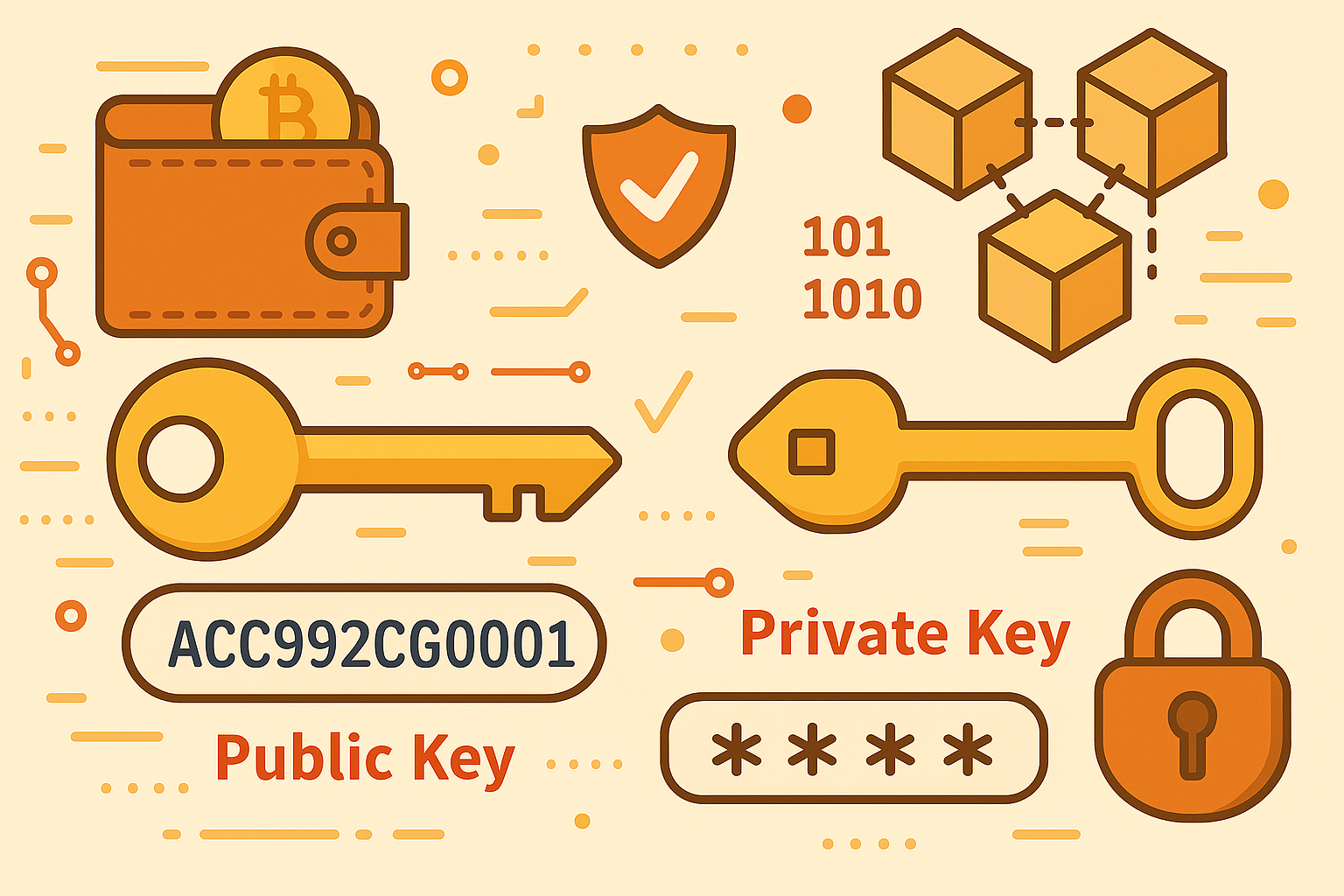
Comparison of public and private keys
Why the private key is an important thing
If someone learns your private key, consider that the wallet is no longer yours. With it, they can withdraw the coins — and there’s no way to get them back. There’s no support team here, no “recover access” button, no second chance. That’s why protecting the key is the foundation of security. To avoid losing funds, seed phrases were invented — a set of 12–24 words with which you can restore access to the wallet.
A seed phrase should not be stored on your phone, in the cloud, or in notes. Only on paper, in a safe place where no one but you can get to it. There are also hardware wallets — small devices where keys are stored without connecting to the internet. And for long-term storage, people use “cold storage” — when the keys never touch the network at all.
How a public key differs from an address
Many people confuse a public key with an address, thinking they are the same thing. In reality, they are different, though closely related. Understanding the difference helps you see how the crypto system works and why your funds remain protected.
When a cryptocurrency wallet is created, it first generates a private key — a large random number. Using mathematical algorithms, a public key is then generated from it, which can be safely shared with others. But that’s not the end of the process: the public key itself is long and inconvenient for everyday use, so it’s turned into a shorter and simpler version called an address. This address is what you actually use to send and receive funds.
The process of converting a public key into an address is called hashing. It’s a mathematical operation that takes a long string of data and turns it into a short sequence of characters. Hashing is a one-way process: you can’t reverse it to get the public key, and certainly not the private one. This is what makes an address safe to share.
Example:
• Public key: 04ab34f9c5… (about 130 characters)
• Address: 1BvBMSEYstWetqTFn5Au4m4GFg7xJaNVN2 (around 34 characters)
The public key is used within the network to verify that a digital signature really belongs to the owner. The address, on the other hand, is used for practical purposes — you can write it on a card, display it on a website, or share it with someone so they can send you cryptocurrency.
It’s important to understand that an address doesn’t reveal your balance or give anyone access to your funds. It simply shows where a transaction can be sent. Even if someone knows your address, they can’t find out your private key or sign a transaction on your behalf.
Think of it like a mailbox. The address is the box number that anyone can use to send you mail. The public key is the mechanism that ensures the mail goes into the right box. The private key is the physical key that lets you open the box. If you lose it, you won’t be able to retrieve your letters, but no one else can either without that key.
In short, an address is a convenient representation of your public key. It’s designed to make interaction with the blockchain safe and simple. As long as your private key is securely stored, you can share your address freely — it’s completely safe.
A few simple security rules
- Write down your seed phrase and store it in several places, away from prying eyes.
- Never enter your private key on websites, even if they look familiar.
- Use hardware wallets or vetted applications.
- Make backups so you don’t lose access if a device fails.
- Don’t keep large sums on an exchange — there the keys are controlled not by you, but by the platform itself.
Keys and real independence
One of the ideas of cryptocurrency is to give people complete financial freedom. Your private key is the proof that the money belongs to you, not to a bank or a company. No one can freeze, block, or seize it. But freedom always comes with responsibility. Lose the key — lose access. And no support desk can help. That’s why in the crypto world, security is not a formality, but a habit you cannot do without.
Differences
| Concept | What it is | Is it okay to share |
|---|---|---|
| Public key | An address for receiving transfers | Yes |
| Address | A shortened version of the public key | Yes |
| Private key | Access to funds — your personal “key to the safe” | No |
| Seed phrase | A backup way to restore access | Only for yourself |
What is a digital signature?
When a person sends cryptocurrency, the network must make sure it’s really the owner of the funds doing it — not someone else. That’s what a digital signature is for: a simple-looking but very reliable layer of protection.
Every time you make a transfer, your wallet uses your private key to “sign” the data — the amount, the recipient’s address, and other details. Then the network checks this signature using your public key, without ever seeing the private one. The private key never leaves your possession.
If someone tries to change even a single number or letter in the transaction, the signature will no longer match, and the network will reject it. Because of this, crypto transactions don’t need banks or intermediaries — the system itself understands who owns the funds and protects them with math instead of passwords or documents.
In simple terms, a digital signature proves three things: that it was really you who sent the transaction, that the data wasn’t changed, and that everything follows the rules. Without this technology, blockchain wouldn’t exist — no one could be sure who sent what to whom.
When you sign a transfer, you’re not asking anyone to process it — you’re showing the network that you have the right to manage those coins. And as long as the private key is in your hands, no one else can do it for you. That’s why protecting your keys isn’t just a precaution — it’s the only way to keep your money safe.
Custodial and non-custodial wallets
When people first start using cryptocurrency, they often keep it on an exchange or in an app without thinking about who controls the keys. But that’s the key difference: whoever holds the keys, holds the money.
Custodial wallets are those where your keys are stored by a third-party service. For example, on an exchange you can see your balance and trade easily, but the keys belong to the platform, not you. It’s convenient while everything works fine, but if the platform freezes your account or faces restrictions, you’re left with no access. It’s like having a safe in a bank while the key stays with the clerk.
Non-custodial wallets mean full independence. The keys are stored only by you, and no one else can access your coins. It’s safer, but all responsibility lies with you. Lose the key — and there’s no way to restore it. That’s why such wallets are usually used for long-term storage when security matters most.
Experienced users often do it this way: they keep small amounts on exchanges for trading and the main funds in non-custodial wallets. This approach offers both convenience and peace of mind.
The main idea is simple: if you don’t control your keys, you don’t control your money. Cryptocurrency was created to give people independence — but with it comes responsibility. Knowing how to store your keys properly is part of managing your finances like an adult, just in a digital world.
What to remember
A public key is needed to receive money. A private key is needed to control it. That’s it. This is the whole point of cryptocurrency: as long as you have the key, you own the funds. Lose the key — lose the money. That’s not a reason to be afraid, just a reminder that in crypto everything depends on you. Store your keys wisely, and they will serve you faithfully.
You can exchange cryptocurrency quickly and keep your privacy on Quickex.