

Not long ago, only programmers and well-funded teams could create their own cryptocurrency. Today it’s different: you can launch a coin in a couple of minutes for just a few dollars. Pump.fun makes that possible — a platform that has literally blown up the memecoin market.
Pump.fun has turned token issuance into something simple and fun. Thousands of coins appear here every day — from goofy jokes to unexpected hits that earn their creators real money. Here’s how Pump.fun works and what makes it special.
Track the price of your favorite memecoins on Quickex.
What Is Pump.fun
Pump.fun is a platform on the Solana blockchain where anyone can come up with and launch their own token. No code, no complicated settings, no middlemen — the system handles everything for you.
The core idea is simple: remove all technical barriers and give everyone a chance to try crypto. That’s why thousands of coins are born on Pump.fun: some parody trends, some launch a token in honor of a beloved cat, and some hope to repeat Dogecoin’s success.
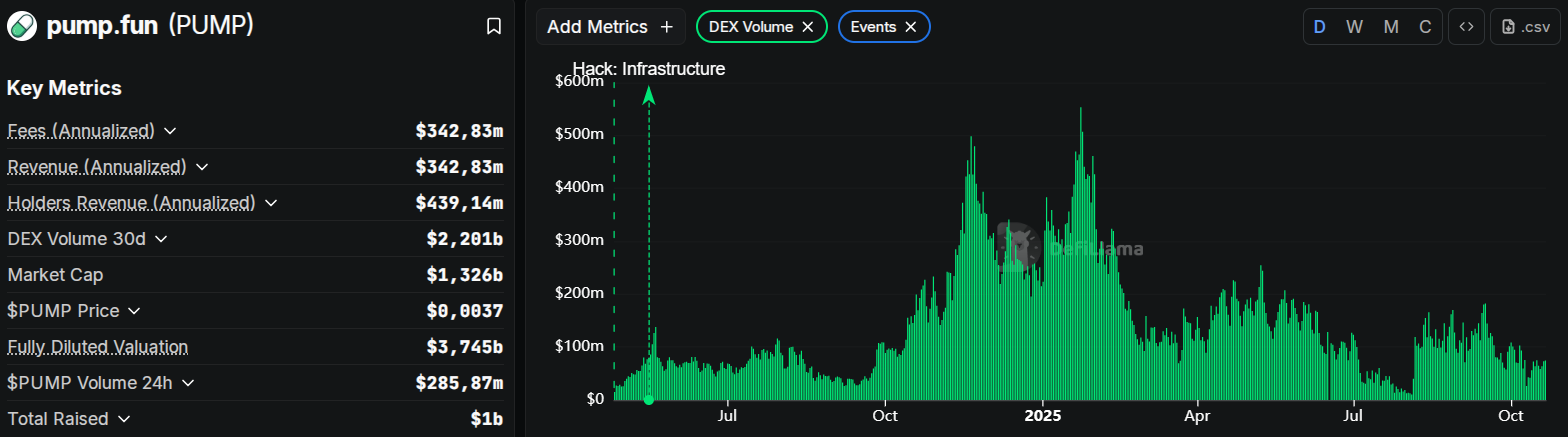
Platform metrics. Source: defillama.
How Pump.fun Works
At the heart of the platform is a mechanism called a bonding curve. It’s a formula where a token’s price rises when people buy it and falls when they sell it. The more interest, the higher the price.
This approach keeps the market fair: nobody receives coins in advance or can “dump” them on newcomers at inflated prices. Demand decides everything, which means a token’s fate is determined by users.
The bonding curve is especially important for beginners because it protects them from the usual schemes where a developer runs off with the money and the coin goes to zero.
Why Pump.fun Became Popular
Before this platform, launching a token was expensive and required expertise. Now about $4–5 (roughly 0.02 SOL) is enough to create a coin and list it on the market immediately.
Pump.fun lets people experiment without fearing big losses. You can simply try: draft an idea, set up a page, and see how the community reacts. That’s why the platform has become a magnet for creative users — from artists to marketers.
Technology Under the Hood
Pump.fun runs on Solana — a blockchain known for speed and low fees. That allows the platform to handle thousands of launches per day without lag or overpayment.
How it works:
• The user creates a token through the interface.
• The price forms automatically via the bonding curve.
• When the token’s market cap reaches $69,000, the system adds $12,000 of liquidity to the Raydium exchange.
• After that, the LP tokens are burned and the liquidity becomes permanent.
This step matters — it protects the market from bad actors who used to be able to pull liquidity and leave investors holding “empty” coins.
What the Site Looks Like
The Pump.fun interface feels more like a social network than an exchange. The home page is a feed of new tokens with charts and comments. On the left is the menu: home, chat, profile, and the button to create a coin.

Pump.fun interface. Source: the official project website.
Navigation is intuitive, so even first-timers quickly figure things out. Simplicity is one of the reasons the platform has attracted millions of users.
How to Create a Token
The process takes less than a minute:
• Connect a Phantom or Solflare wallet.
• Click “Create Coin.”
• Enter a name, ticker, and image.
• Pay a 0.02 SOL fee — that’s about $4.
Done: the coin is immediately available on the market.
When the market cap reaches $69,000, Pump.fun will automatically add liquidity to Raydium. You don’t need to do anything manually — the system does it for you.
Why Users Choose Pump.fun
The main reason is accessibility. You don’t need to be a techie or spend thousands of dollars to get started. The platform also makes the process transparent: no private sales and no early access for a select few. Everyone buys under the same rules.
Another factor is the community. An active audience has grown around Pump.fun that discusses new releases, shares ideas, and even supports projects when they catch interest.
Memecoins That Became Legends
Plenty of viral tokens have appeared on Pump.fun. Peanut the Squirrel (PNUT) became a favorite among gamers and NFT collectors. Goatseus Maximus (GOAT) mixed humor and AI. Just a Chill Guy (CHILLGUY) became a TikTok hit.
These examples show that memecoins aren’t just a joke. They’re a way to build communities and unite people around ideas they genuinely care about.
Risks and Weak Points
The ease of launching tokens is a double-edged sword. Some create original projects, others — copies and scams. And memecoins are extremely volatile: today a token may be worth $0.0001 and tomorrow ten times more.
In spring 2024, Pump.fun ran into a serious problem — a former employee stole around $2 million. The team quickly closed the vulnerability and strengthened security, but the incident was a reminder that even the simplest solutions need oversight.
Project Economics
By the end of 2024, users had launched more than 3.8 million tokens on Pump.fun. The platform’s cumulative revenue exceeded $355 million. At one point, Pump.fun ranked second among all DeFi protocols by revenue — behind only Uniswap.
These numbers show that memecoins have moved beyond mere fun. A real economy is forming around them, powered by user activity.
What’s Happening With Pump.fun in 2025
As of October 22, 2025, Pump.fun remains the leading player in the memecoin market. The platform handles about 95% of all new launches and earns roughly $1 million per day.
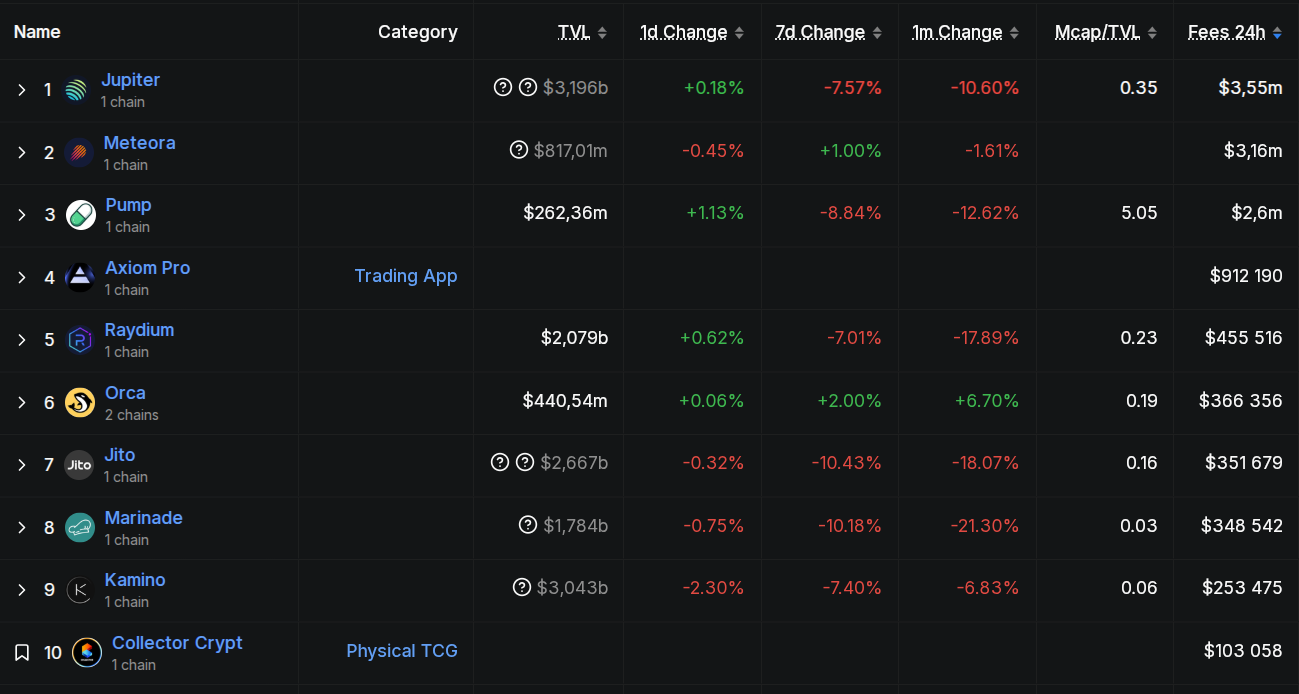
The project is among the top-10 platforms on Solana by total fees generated over a 24-hour period. Source: defillama.
Competitors like LetsBonk and Moonshot have tried to reclaim market share, without success. Almost all tokens that make it to the liquidity stage and land on Raydium are created here. That’s an important signal: it reflects which projects actually find demand instead of disappearing right after launch.
Even though overall market activity has cooled — daily trading volume has fallen to $100 million — Pump.fun holds on thanks to a loyal audience and network effects. People come back because the flow is convenient and easy to understand.
The Pump.fun idea has been so successful that it’s being copied in other networks. Similar services have appeared on BNB Chain and Base, indicating a growing cross-chain trend.
What’s Next
If the altcoin and memecoin market revives, Pump.fun could evolve from a “meme factory” into a full-fledged platform for launching any kind of token — not only joke coins but also utility assets.
The project has already shown it can survive a downturn, which gives it the key advantage — resilience. That’s what separates a living product from a short-term hype cycle.
Bottom Line
Pump.fun is an example of how technology stops being reserved for the few. The project has proven that anyone can become part of the crypto economy when the tool is simple and fair.
Even when interest in memecoins fades, Pump.fun keeps running because its strength lies in the community and clear rules. It’s not just a token-launch site; it’s a platform that brings blockchain closer to people.
Pump.fun FAQ
What Is Pump.fun?
It’s a platform on the Solana blockchain where anyone can create their own token — most often a memecoin — without any programming skills. Everything happens on the site: enter a name, add an image, pay a small fee, and you get a finished coin that can be traded right away.
How Does Pump.fun Work?
The system uses what’s called a bonding curve — a formula by which the token’s price rises when it’s bought and declines when it’s sold. This protects the market from manipulation and makes the process fair: no one can buy coins in advance or crash the price.
How Much Does It Cost to Create a Token on Pump.fun?
Launching a coin costs about 0.02 SOL (around $4–5). After that, the token appears in the site’s feed and is immediately available for trading. The fee per trade is 1%, which is how the platform earns revenue.
How Do I Create a Token on Pump.fun?
Connect a Phantom or Solflare wallet, click “Create Coin,” come up with a name and ticker, and add an image. Pay 0.02 SOL — and your coin is already on the market. If market cap reaches $69,000, Pump.fun will add $12,000 of liquidity on Raydium and burn the LP tokens to strengthen trust in the project.
What Is a Bonding Curve and Why Is It Needed?
A bonding curve is a mathematical model that automatically regulates a token’s price. The more people buy it, the higher the price. Thanks to this, there’s no need for market makers or liquidity manipulation — the market develops on its own.
How Can You Make Money on Pump.fun?
There are two paths:
• Create your own token, attract attention, and sell part of the coins when the price rises.
• Buy promising memecoins at an early stage and take profits as their price grows.
The main thing is to understand the risks and never invest more than you can afford to lose.
Who Created Pump.fun?
The platform appeared in January 2024 with support from the venture fund Alliance DAO. Since then it has grown into the world’s largest memecoin launchpad, controlling almost the entire market for such launches.
Is It Safe to Use Pump.fun?
In general, yes — with caveats. The platform doesn’t do private sales and automatically adds liquidity, which reduces the risk of fraud. However, memecoins are very volatile, and some projects can be empty. Always check what you’re investing in.
How Do I Connect a Phantom Wallet to Pump.fun?
On pump.fun click Connect Wallet, choose Phantom, and approve the connection. After that you can create or buy tokens right from the interface.
How Does Pump.fun Make Money?
Most revenue comes from the 1% fee on each trade and the token-creation fee. In total, this brings the platform around $1 million per day, making it one of the most profitable projects in the Solana ecosystem.
Quickly and at a good rate, you can exchange cryptocurrency while keeping anonymity on Quickex.
Disclaimer: The material in this article is not financial or investment advice. Everything stated here reflects the author's personal view and should not be treated as a recommendation to trade or invest. We make no warranties regarding the accuracy, reliability or completeness of the information presented. Cryptocurrency markets are highly volatile and can move unpredictably. Before committing any funds, every investor, trader or crypto user should study several independent sources and check the regulations that apply in their own jurisdiction.