
In 2–8 years, next-gen machines could “crack” up to 30% of all BTC. But Bitcoin has a chance not just to survive, but to come out stronger.
The Quickex editorial team looked into whether quantum computers are really that dangerous for the crypto industry. Here’s whether you should be afraid of next-generation machines.
Track how the Bitcoin price changes amid the debate over quantum threats.
A new fear for old code
When Satoshi Nakamoto launched Bitcoin in 2009, everything rested on a single principle—mathematical impregnability. No intermediaries, no banking secrets—just cryptography and unreachable private keys.
Sixteen years later, mathematics has encountered an opponent Satoshi couldn’t have foreseen: quantum computers. These are machines that operate not with bits but with qubits—units that can be zero and one at the same time. This state is called superposition. It allows them to perform millions of calculations in parallel and to solve problems beyond even the most powerful supercomputers.
This very capability is both strength and threat. The same quantum power that promises a revolution in medicine and science can also break the ciphers that protect money, data, and the very essence of digital trust.
Q-Day: the date everyone fears
The crypto community has already adopted the term Q-Day—the day when a quantum computer will first be able to break classical encryption algorithms. And although there are no precise forecasts, the estimates are growing more alarming.
According to Charles Edwards, founder of Capriole Invest, this could happen in two to eight years. And the consequences would be colossal:
“Quantum machines could take 20–30% of all bitcoins, and we wouldn’t be able to stop it,” Edwards warns.
This is not speculation. He says old P2PK wallets created in Bitcoin’s early days are completely vulnerable. Among them, analysts believe, are wallets holding about one million BTC belonging to Satoshi Nakamoto. Their combined value exceeds $120 billion.
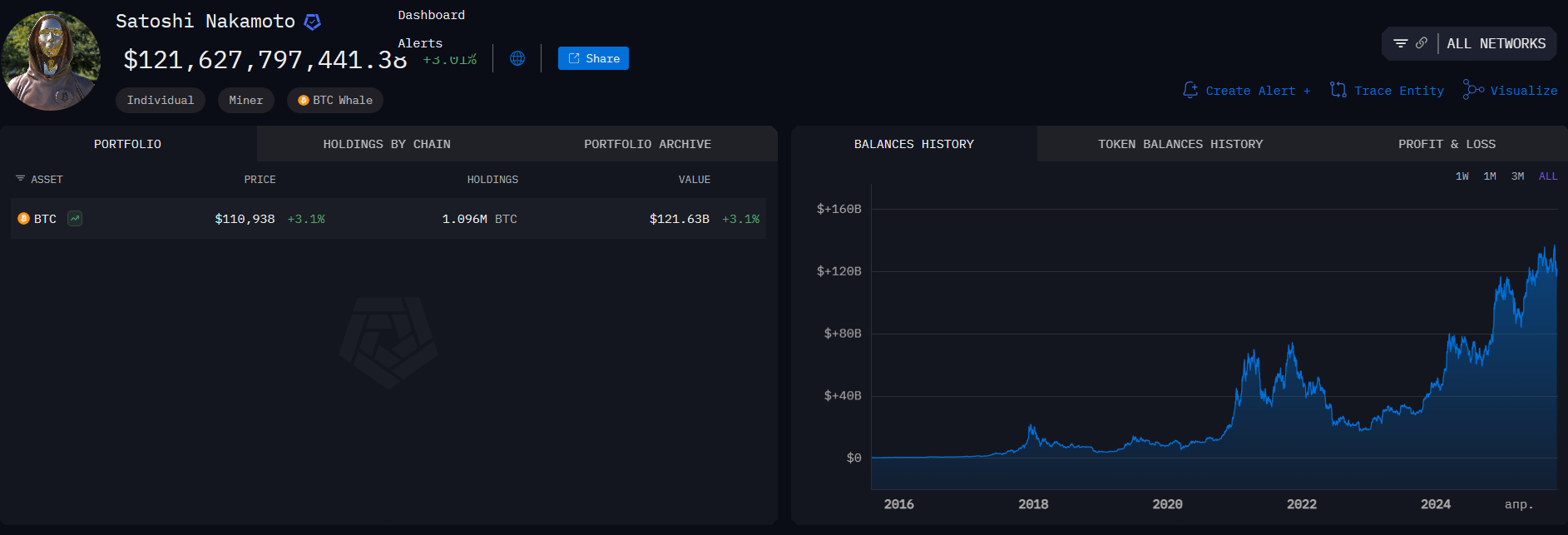
Balance of Satoshi Nakamoto’s wallets. Source: Arkham
Why coins are at risk
Bitcoin’s security hinges on two algorithms:
- ECDSA (elliptic curves) protects transaction signatures;
- SHA-256 provides data hashing and Proof-of-Work robustness.
On classical computers, deriving a private key from a public one takes billions of years. But Shor’s quantum algorithm can do it in minutes. If such a machine appears, the private keys of old wallets could be computed directly from the blockchain.
Particularly vulnerable are addresses where the public key has already been revealed. Modern formats (P2PKH, P2WPKH, Taproot) keep it hidden until the first spend, but older ones created before 2010 leave keys exposed forever.
How many coins are at risk
A Chaincode Labs study shows that roughly 6.5 million BTC—about 33% of total supply—are potentially vulnerable to quantum attacks. This includes not only old addresses but also wallets with public-key reuse, as well as assets on forks like Bitcoin Cash.
In essence, $700 billion worth of digital gold could be at risk—at today’s price.
MARA confirms: to break ECDSA within a reasonable time, a quantum computer would need 317 million physical qubits. By comparison, Google’s newest Willow chip (2025) has only 105 qubits. We’re decades away from a real threat, but the direction of travel is set.
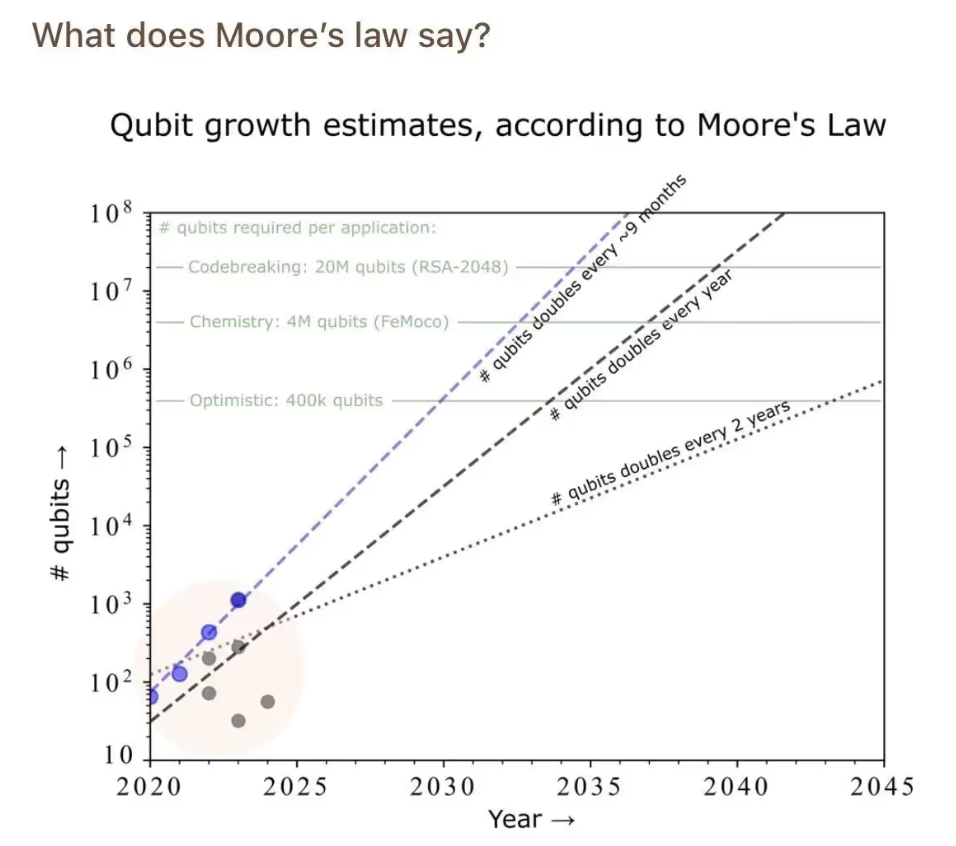
The image shows a chart projecting qubit growth in quantum computers according to Moore’s law. Source: Introduction to Quantum Computing for Business
Not just Bitcoin
If a quantum computer can break ECDSA, it won’t be only crypto that suffers. The entire internet would be at risk—bank transactions, government archives, messengers, and SSL encryption.
“Quantum risk isn’t a problem for tomorrow; it’s a blind spot of today,” notes researcher Jai Singh Arun, co-author of Becoming Quantum Safe.
Even so, Bitcoin may become the first system to face this threat fully armed—thanks to its openness and ability to upgrade.
Is Bitcoin ready to adapt
The network’s history proves it: Bitcoin can change. The SegWit and Taproot upgrades already showed the community can implement sweeping changes without breaking consensus.
Developers now discuss two migration scenarios:
- Long-term—gradual transition to quantum-resistant signatures (e.g., SPHINCS+, Dilithium, Kyber) over 7 years.
- Emergency—rapid protection in the event of a sudden quantum breakthrough within 2 years.
Both scenarios require protocol updates and moving millions of coins to new addresses. By some estimates, migration could take four to eighteen months even with the blockchain fully saturated.
Solutions on the table: burn, steal, or freeze
The quantum threat has spawned a debate that goes beyond tech—it’s about philosophy and fairness.
What to do with vulnerable coins:
- Leave everything as is. Then quantum hackers will get millions of “ownerless” bitcoins.
- Burn old addresses. That protects the market but violates the “code is law” principle.
- Freeze or restrict spending. For example, allow withdrawals of one coin per block to avoid shock.
Edwards rejects compromises: “Such measures aren’t viable. It’s a diluted mix of options where no one ends up satisfied.”
What the industry is doing
While users argue, corporations act. NIST has already approved three quantum-resistant standards: Kyber, Dilithium, and SPHINCS+. They are being rolled out across the ecosystems of Google, Apple, Cloudflare, and Signal and should become the norm by 2035.
Within the Bitcoin community, work is underway on:
- P2QRH (Pay-to-Quantum-Resistant-Hash)—a new address type;
- QRAMP—an asset-protection and compatibility protocol;
- QuBit Proposal—public keys resistant to quantum attacks.
Hardware wallets like Ledger and Trezor are already testing hybrid schemes—combinations of classical and post-quantum signatures.
Why Bitcoin is safe for now
Even if a quantum revolution happened tomorrow, Bitcoin wouldn’t vanish. Here’s why:
- Public keys are hidden until the first transaction—there’s nothing to crack.
- Mining difficulty is dynamic—the network adapts if someone gains an edge.
- Soft forks enable upgrades without breaking the blockchain.
- Decentralization accelerates consensus—decisions are made by users, not corporations.
“Quantum computers are advancing, but Bitcoin was built to evolve,” Marathon Digital reminds.
What users should do
- Don’t reuse addresses. Ideally, every payment uses a new address.
- Use Taproot and SegWit. These formats keep public keys concealed.
- Watch for wallet updates. PQC support will arrive sooner than you think.
- Store coins offline. Hardware wallets remain the most reliable option.
- Beware of phishing. Old threats are still more dangerous than quantum ones.
Bottom line
Yes, one day quantum computers may crack old addresses. Yes, 30% of bitcoins might “wake up” or disappear. But this isn’t the end. It’s a moment of rethinking.
The shift to post-quantum cryptography isn’t a catastrophe—it’s a natural step in the evolution of digital trust. Just as we once moved from passwords to ciphers and then to blockchains, we’ll now move to a new mathematics of protection.
“Security isn’t a static state but a process of renewing trust,” the Deloitte report says.
And if Bitcoin has survived exchange collapses, forks, and battles with regulators, it will survive the quantum era—provided it starts preparing now.
You can quickly exchange cryptocurrency at an attractive rate while preserving anonymity on Quickex.
Disclaimer: The material in this article is not financial or investment advice. Everything stated here reflects the author's personal view and should not be treated as a recommendation to trade or invest. We make no warranties regarding the accuracy, reliability or completeness of the information presented. Cryptocurrency markets are highly volatile and can move unpredictably. Before committing any funds, every investor, trader or crypto user should study several independent sources and check the regulations that apply in their own jurisdiction.