

Try sending someone a tiny amount of Bitcoin — not a big transfer, just enough for a tip or a quick split of a bill. The moment you’re about to confirm it, the wallet flashes a number that looks suspiciously like it belongs in a physics lab. A shy decimal. A tail of zeros that refuses to end. A figure so wispy it almost feels embarrassed to exist.
That’s not the app misbehaving. That’s Bitcoin revealing its smallest grain of value: the satoshi.
So, What Is a Satoshi Anyway?
People who type what is a satoshi into a search bar often brace for a dense explanation. But the idea is small, almost quaint. A satoshi is the tiniest unit of Bitcoin the network recognizes. One speck. Barely a financial crumb. Yet stack enough of these little pinheads together and they quietly fuel nearly every practical payment flowing through the system.
You’ll see the formal form — satoshi. The plural — satoshis. And the everyday version — sats. The last one is what people say when they’re not in the mood for long words.
This thing is technically the smallest unit of Bitcoin, but even that phrase doesn’t fully capture its microscopic nature.
Where the Name Comes From (A Small Tale from Old Forums)
The name grew up during Bitcoin’s unruly childhood — the era of message boards, heated debates, and long nights staring at addresses. Users were constantly dealing with amounts like 0.00000042 BTC. After enough sighing and joking about needing magnifying glasses, someone casually suggested naming the smallest piece after Satoshi Nakamoto.
No vote. No whitepaper amendment. People simply nodded (digitally) and carried on. The term stuck harder than anyone expected.
What Are SATS in Crypto?
Curious users often ask what are sats in crypto after seeing the word pop up in Lightning wallets or in fee displays. “Sats” is just the shortened name for satoshis — nothing mystical. More practical than anything. Whole numbers make the mind relax a little, and sats let even tiny payments look like something you can hold in your hand.
One Satoshi: Barely There, Yet Everywhere
In a literal sense, one satoshi won’t take you far — 1 satoshi is frequently worth less than the dust you find in your pocket. And yet these tiny units wander through the Bitcoin world constantly. Miner fees often nibble a few. Lightning payments rely on them entirely. Apps toss them out as small rewards, almost like a barkeep sliding a single copper coin across an oak counter.
Funny how the smallest parts of a system often end up holding it together.
Sats Bitcoin Meaning: Why Bitcoin Goes So Small
People who look up sats Bitcoin meaning usually want to know why Bitcoin bothers slicing itself into such microscopic pieces. The reason is rooted in its original architecture. One Bitcoin contains exactly 100,000,000 satoshis.
Not a rough estimate — an exact, unwavering count. It gives Bitcoin room to breathe. Prices can soar, dip, or zigzag, and the currency still works cleanly for both everyday transfers and grand gestures.
Bitcoin stretches with the market but doesn’t tear.
How Many Satoshis in a Bitcoin?
Newcomers often ask how many satoshis in a Bitcoin, and the answer is direct: one Bitcoin equals 100,000,000 satoshis.
Someone else might phrase it differently — for instance, how many satoshis are in a Bitcoin — usually because they’ve seen a micro-transaction and want to understand its scale. Another newcomer may type how many satoshis in a Bitcoin? with a question mark, half hoping a calculator will spare them the math.
Lightning users often prefer the phrasing how many sats in a Bitcoin, since “sats” is what they see daily. Meanwhile, people diving deeper into protocol details might wonder how many satoshis in one Bitcoin, trying to match units to code. A curious onlooker might search satoshis in a Bitcoin simply to confirm that the tiny numbers they’re seeing make sense. Developers sometimes reference satoshis per Bitcoin in internal notes or documentation.
And yes — there are tools like a how many satoshis in a Bitcoin calculator. They exist. They’re neat. But multiplying Bitcoin by one hundred million gets you the same result without the spectacle.
BTC → SAT Table (A Handy Little Thing)

It’s almost talismanic — the kind of reference you keep near your keyboard without admitting why.
Converting SATS to BTC and SATS to USD
Conversions work in a rhythm you’ll pick up quicker than you expect. People often search sats to BTC when they encounter unfamiliar numbers. The recipe is straightforward: divide satoshis by 100,000,000.
The reverse comes up in searches like 1 Bitcoin to satoshi. That one is even easier — multiply by 100,000,000.
Curious about satoshis to USD? The formula is simple enough to do in your head on a good day:
take your satoshi amount, multiply it by the current Bitcoin price, and divide by that same 100 million. After a few tries, your brain starts doing half the work automatically.
The Subtle Power of Satoshis in Payments
Satoshis shine in the fine-grained edges of Bitcoin. Many fee estimators use sats per vByte, which gives users a surprising amount of control over cost versus speed. The Lightning Network leans even more heavily on satoshis — tipping creators, unlocking small snippets of content, settling tiny social debts that once required spare change or an awkward “I’ll get you next time.”
These little units give Bitcoin the nimble small-change quality older currencies took centuries to perfect.
Why More Wallets Are Switching to SATS
If you’ve noticed more wallets showing balances in sats, you’re not imagining things. It’s easier to read. Easier to think about. And, frankly, it makes Bitcoin feel more familiar. Whole numbers sit in the mind comfortably, while long decimals feel like a riddle someone left unsolved.
How to Buy Satoshis
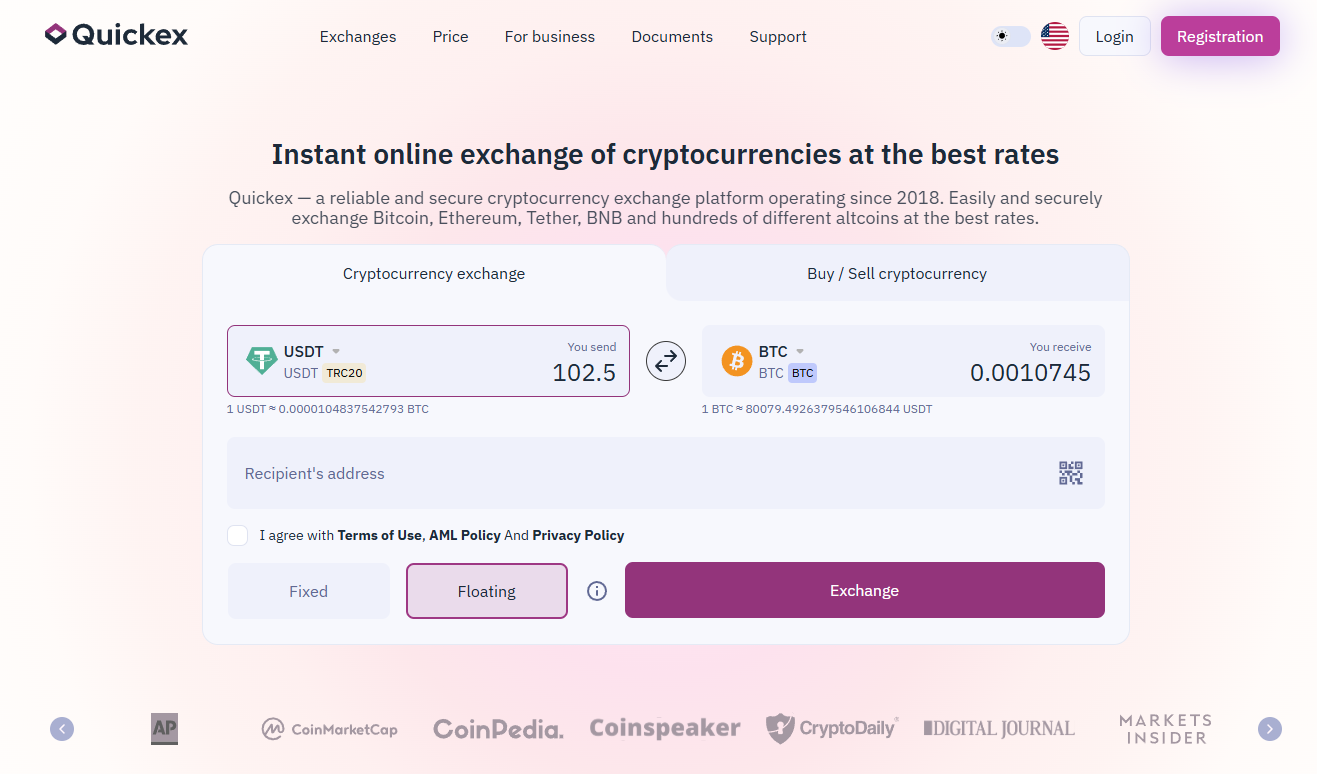
You don’t need to buy a full Bitcoin to pick up satoshis — few people do. One simple path goes through Quickex. Open the Exchange section, choose the cryptocurrency you want to trade, and the swap delivers Bitcoin straight into your wallet, already broken into sats.
FAQ: Satoshis and Bitcoin
What are satoshis?
The smallest units of Bitcoin — tiny pieces that make the entire system usable.
How many satoshis in a Bitcoin?
Exactly one hundred million.
How many satoshis in a dollar?
It depends on the BTC/USD market price. Divide 100,000,000 by that value and you’ll have your answer.
How to buy satoshis?
Swap another cryptocurrency for sats on Quickex, buy fractional Bitcoin on exchanges, or fund a Lightning wallet that lists balances in satoshis.