

The launch of spot Bitcoin ETFs in January 2024 became one of the most notable events in the history of the cryptocurrency market. Approval from the U.S. regulator, the SEC, made Bitcoin accessible to investors who prefer to operate through traditional exchange mechanisms.
Here’s how crypto ETFs work and how their launch affected the market.
Track changes in the Bitcoin price with Quickex.
What crypto ETFs are
A crypto ETF is an exchange-traded fund whose shares trade on traditional stock exchanges. The securities reflect the value of digital assets.
Such funds can be backed either by actual cryptocurrency or by derivative financial instruments. By derivatives we mean contracts—such as futures—whose price depends on the value of the underlying asset.
Here’s a simple analogy: suppose you plan to buy a gold coin but don’t want to keep it at home for fear of losing it. Instead, you buy a certificate that confirms you own a share in a vault full of gold coins. This certificate is easily bought and sold on an exchange, and its price is always roughly equal to the price of real gold. Crypto ETFs work the same way—only instead of gold in the vault there are bitcoins or other coins.
Types of crypto ETFs
Crypto ETFs can differ by structure and by how they track an asset’s value. The market highlights several basic formats:
- spot ETFs — the fund buys and holds real coins, and the shares mirror the asset’s market price;
- physically backed ETFs — a subtype of spot funds that emphasizes the fact of owning and storing the cryptocurrency;
- futures ETFs — the fund doesn’t own coins; it uses futures contracts that provide an indirect reflection of the asset’s price;
- thematic ETFs — focused on entire segments of the crypto market, for example DeFi or blockchain infrastructure.
There are also multi-asset ETFs—funds that include more than one asset. No doubt, more variants will appear over time.
How a spot ETF works
The key feature of a spot ETF is that the fund buys real bitcoins and stores them with a custodian—a specialized company with secure digital vaults. Investors don’t get access to the coins themselves: they own fund shares that represent a stake in those assets.
Shares trade on regular exchanges via brokers, making the process familiar to stock-market participants. If an ETF’s share price starts to deviate from Bitcoin’s actual price, market makers quickly align it by creating or redeeming shares. This maintains balance and transparency.
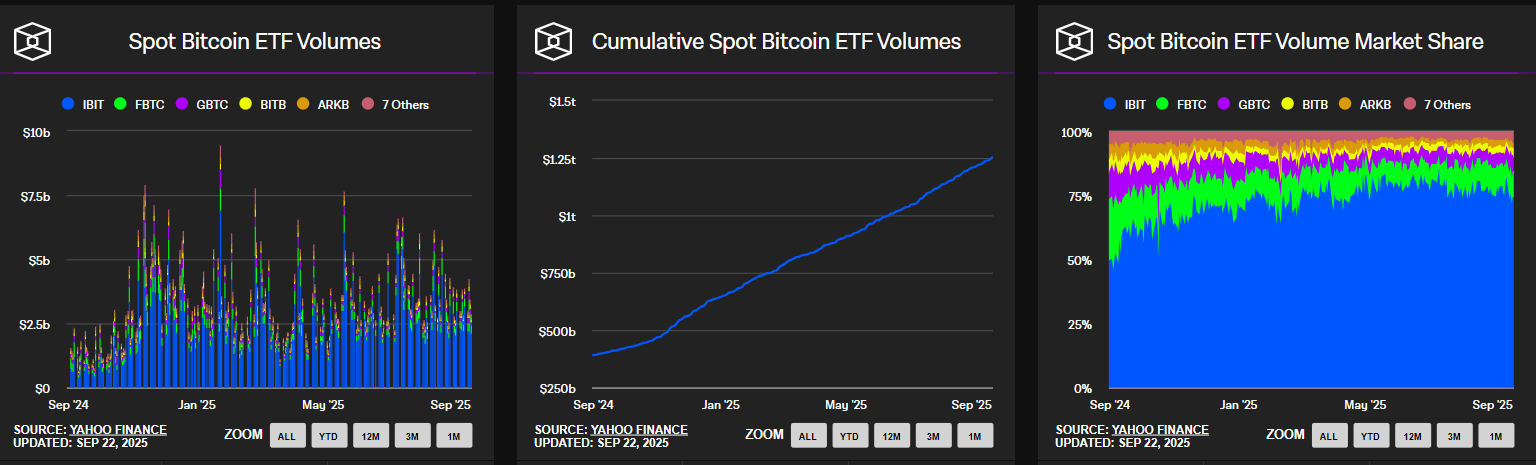
Statistics on spot Bitcoin ETFs. Source: The Block
Advantages of spot ETFs
The launch of such funds gave investors a number of advantages:
- the ability to buy and sell ETF shares through familiar brokerage accounts;
- access to cryptocurrency without the need to set up wallets and store keys;
- regulation and oversight by the SEC and other authorities;
- lower fees compared with direct trades on crypto exchanges;
- the ability to include cryptocurrencies in retirement and institutional portfolios.
Disadvantages and risks
Despite their advantages, spot ETFs come with drawbacks:
- high volatility of cryptocurrencies, which directly affects fund share prices;
- regulatory uncertainty and the possibility of new restrictions;
- management fees and expenses that reduce net returns;
- no direct ownership of the asset and no ability to use it for transfers or in DeFi.
Why institutions waited specifically for a spot ETF
Futures-based Bitcoin ETFs appeared in the U.S. back in 2021, but they failed to generate much interest. The reason is that such funds reflect not the current price of the asset but the cost of futures contracts. These contracts must be rolled regularly, which leads to additional costs and distorts the market’s real dynamics. As a result, futures ETFs often lagged the actual price of Bitcoin and didn’t provide a clear reflection of value.
Institutional investors were waiting specifically for a spot ETF because it provides a direct link to Bitcoin’s real price. For large funds, banks, and pension systems, this is crucial: a spot ETF reduces risk, makes the asset legible and liquid, and fits it into familiar infrastructure.
The approval of spot Bitcoin ETFs on January 10, 2024 was a turning point. The very next day, trading in 11 funds reached $4.6 billion, and in the first week exceeded $20 billion. At the time of writing, inflows specifically into spot ETFs are one of the main drivers of BTC’s growth.

Comparison of market share: futures vs. spot Bitcoin ETFs. Source: The Block
The approval timeline in the U.S.
Attempts to launch a spot ETF began back in 2013, when the Winklevoss brothers filed for the Winklevoss Bitcoin Trust. At the time, the SEC rejected it, citing manipulation risks and insufficient investor protection.
Under SEC Chair Jay Clayton (2017–2020), the regulator took a hard line and rejected all applications, explaining that there was no reliable mechanism for monitoring the cryptocurrency market.
Under his successor, Gary Gensler (since 2021), the situation gradually changed. First, the SEC approved only futures-based Bitcoin ETFs, and then—under market pressure and after a court ruling in favor of Grayscale in August 2023—returned to considering spot products.
On October 16, 2023, Cointelegraph posted on X (formerly Twitter) that the SEC had allegedly approved BlackRock’s spot Bitcoin ETF application. The news triggered an instant jump in Bitcoin’s price to $30,000, but it soon turned out to be fake. Cointelegraph apologized and acknowledged a fact-checking error; nonetheless, within hours traders lost about $190 million. The incident showed just how sensitive the market is to the ETF theme.
On January 9, 2024—one day before the official decision—the SEC’s account on X posted a message announcing approval of spot Bitcoin ETFs. Bitcoin immediately rose to $48,000, but 20 minutes later a correction followed. It turned out the account had been hacked. After that, the price fell by more than 6%, triggering the liquidation of large positions. The incident undermined trust in the SEC’s official channels and drew criticism from the crypto community and U.S. senators.
On January 10, 2024, the SEC under Gary Gensler nonetheless approved 11 applications to launch spot Bitcoin ETFs at once. Trading in the shares began on January 11.
The future of crypto ETFs
Spot funds for Bitcoin and Ethereum were only the first step. ETFs for other cryptocurrencies may appear in the future. The main vector of development is integrating digital assets into traditional finance with an emphasis on regulation and institutional trust.
Conclusion
The launch of spot Bitcoin ETFs was an important stage in the development of the crypto economy. The funds opened access to Bitcoin and Ethereum for millions of investors, made the market more mature and transparent, but preserved the main challenges: volatility, competition, and dependence on regulators.
You can exchange cryptocurrency quickly and at an attractive rate—while preserving anonymity—on Quickex.
Disclaimer: The material in this article is not financial or investment advice. Everything stated here reflects the author's personal view and should not be treated as a recommendation to trade or invest. We make no warranties regarding the accuracy, reliability or completeness of the information presented. Cryptocurrency markets are highly volatile and can move unpredictably. Before committing any funds, every investor, trader or crypto user should study several independent sources and check the regulations that apply in their own jurisdiction.