
Web3 almost never arrives loudly. No countdowns, no official switch. It usually slips into daily routines through small, almost unremarkable actions. Someone gets paid in USDT and stops waiting for banks. Someone signs a transaction instead of filling out a form. Someone sells a digital item months later and realizes it never belonged to the platform at all.
Most people are not chasing decentralization as a philosophy. They want things to work. Faster. Cleaner. With fewer points of failure. Web3 survives precisely where older systems keep getting in the way.
Quickex fits naturally into this flow, allowing users to quickly exchange coins without registrations or complicated steps when speed actually matters.
Web3 Usually Enters Through a Side Door
Web3 does not replace everything at once. It sneaks in where friction feels unbearable.
Payments move without delays. Ownership becomes explicit instead of implied. Middlemen quietly step aside. When things go smoothly, nobody notices. When they break, the contrast becomes obvious.
This pattern repeats across industries. Finance feels it first, but gaming, identity, and even supply chains follow closely behind.
DeFi as a Practical Detour Around Banks
Decentralized finance works best when it stays modest.
Uniswap feels almost mechanical. Connect a wallet. Swap tokens. Disconnect. No accounts. No approvals. No support tickets. During periods of extreme volatility, when centralized exchanges paused withdrawals or limited access, Uniswap continued to operate as usual. There was nothing to pause.
Aave and Compound sit one layer deeper. Users deposit ETH or USDC and earn yield automatically. Borrowers lock collateral and receive liquidity within minutes. Crypto-native companies use these protocols for treasury flexibility. Individuals in unstable financial systems use them because local banks are slow, unreliable, or simply unavailable.
Stablecoins deserve special mention. USDT and USDC are not exciting, and that is their strength. Freelancers rely on them for cross-border payments. Small businesses settle invoices without waiting days. In some economies, holding stablecoins feels more predictable than holding local currency. No marketing needed.
NFTs When They Stop Trying to Be Art
NFTs become useful when speculation steps aside.
Ticketing is one of the clearest examples. An NFT ticket cannot be duplicated. Resale conditions live inside the smart contract. Event organizers test this format to reduce fraud and regain control over secondary markets. Some pilots fail quietly. Others continue without much attention, which usually means they work.
Gaming highlights the difference even more sharply. Axie Infinity and Gods Unchained treat characters and items as external assets. Cards and creatures live in wallets, not accounts. Players leave games, but ownership remains. That single shift breaks decades of traditional game design assumptions.
Luxury brands explore NFTs as certificates of authenticity. No hype. Just a verifiable ownership trail, especially useful in resale markets where trust has always been fragile.
Games Where Assets Do Not Forget You
Web3 games carry memory.
The Sandbox and Illuvium tokenize land, characters, and equipment directly on-chain. Assets move through open marketplaces rather than locked stores. Developers no longer act as the sole source of value.
The play-to-earn narrative overheated quickly. That phase passed. What remains is more grounded. Time spent in a digital world can result in transferable assets. Sometimes valuable, sometimes not. Ownership does not guarantee profit, but it does guarantee persistence.
Studios notice another effect. When players own parts of the economy, departure slows down. Attachment deepens. Design choices start carrying economic weight, whether planned or not.
DAOs That Get Things Done Anyway
DAOs rarely look tidy. Many still function.
MakerDAO governs the DAI stablecoin and manages billions of dollars in collateral. Risk parameters change through public on-chain votes. Treasury actions are visible to anyone. Mistakes happen in full view. Transparency feels uncomfortable, but it works.
Smaller DAOs coordinate contributors across continents. Tasks get completed. Payments execute automatically. People leave without paperwork or delays. No HR systems. No invoice loops. That simplicity explains much of the appeal.
Some DAOs drift. Others stabilize. Structure adapts to human behavior instead of forcing hierarchy.
Identity With Built-In Restraint
Decentralized identity focuses on sharing less.
Users prove age without sending passports. Confirm credentials without uploading files. Verify facts without exposing everything. Selective disclosure sounds abstract, then feels obvious once used.
Universities experiment with on-chain diplomas. Professional organizations issue licenses that verify instantly. No emails. No waiting. No manual checks.
Privacy improves for users. Institutions store less sensitive data. Fewer databases usually mean fewer long-term problems.
Supply Chains That Leave Fewer Shadows
Supply chains rarely get credit when they work.
Food producers record product batches on-chain. When contamination appears, specific lots get isolated instead of triggering massive recalls.
Pharmaceutical companies track medicine authenticity through blockchain records. Pharmacies verify packages. Consumers check origin. Counterfeit channels shrink.
Luxury brands apply similar systems to protect resale markets and confirm provenance.
Social Platforms Without Platform Gravity
Decentralized social networks shift control quietly.
On platforms like Lens, profiles and follower graphs live on-chain. Applications become interchangeable shells. Identity survives interface changes and shutdowns.
Monetization changes tone. Subscriptions. Token-gated access. NFTs. Less dependence on advertising logic. More direct relationships. Not every creator prefers this model, but niche communities often thrive inside it.
Algorithms still exist. They simply stop owning everything.
Enterprise Web3 Without Applause
Large organizations adopt Web3 without announcements.
Tokenized financial instruments settle faster. Internal ledgers gain auditability. Cross-border payments lose layers of reconciliation.
For many users, services like Quickex act as a practical bridge here, combining fast exchanges with convenient rate tracking in one place.
Most end users never notice. Infrastructure improves, then disappears from attention. That silence usually signals maturity.
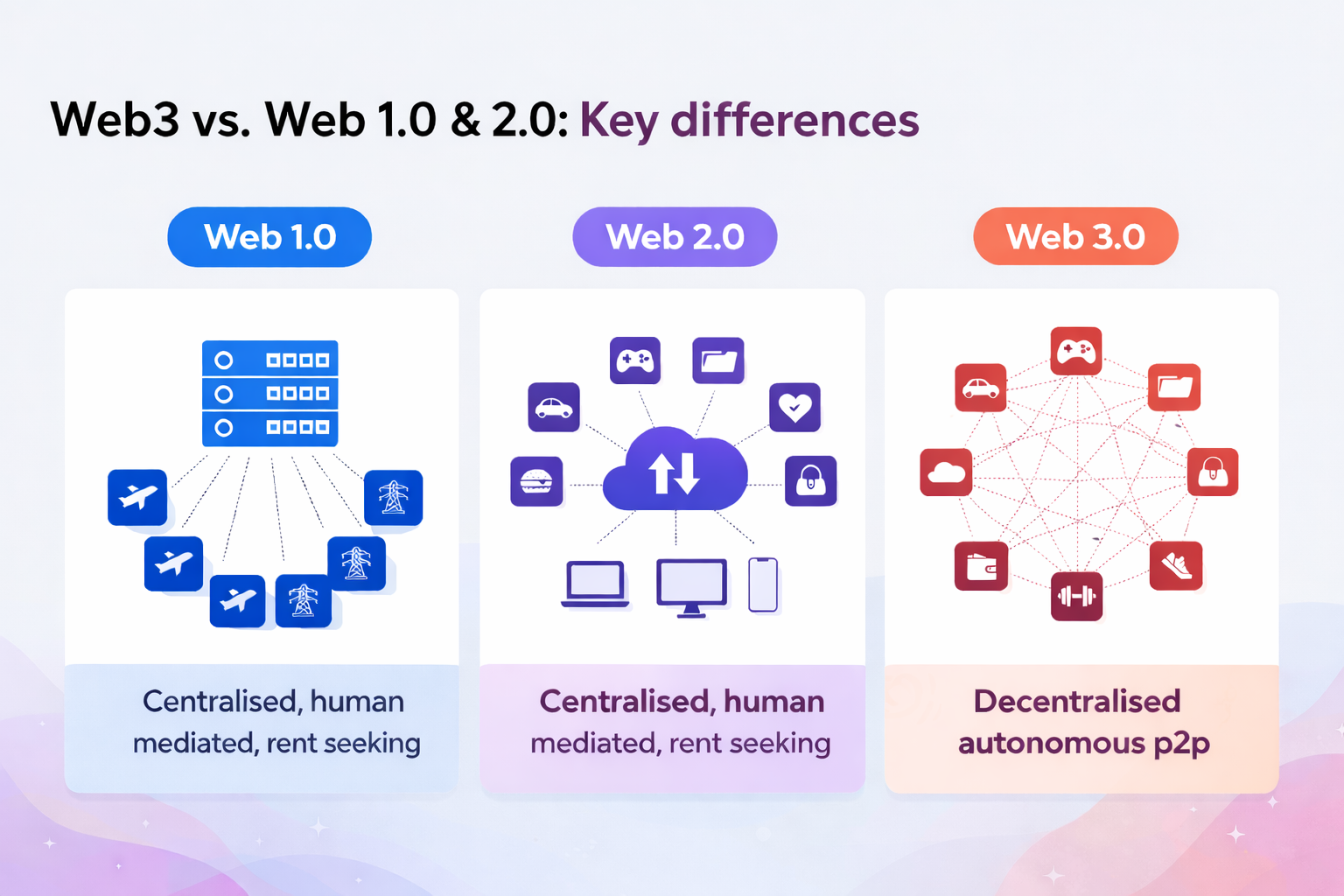
Web2 and Web3 Side by Side
| Aspect | Web2 | Web3 |
|---|---|---|
| Asset custody | Platform-controlled | User-controlled |
| Ownership | Conditional | On-chain enforced |
| Payments | Slow and layered | Direct and global |
| User data | Company-controlled | User-controlled |
| Access model | Accounts and permissions | Cryptographic keys |
| Transparency | Limited | Verifiable |
FAQ
What separates Web3 from the traditional internet?
Web3 replaces platform-controlled accounts with user-controlled wallets and records ownership directly on-chain. Control shifts toward individuals rather than services.
Is Web3 only for technical users?
Modern Web3 tools increasingly target non-technical users. Wallets and interfaces improve each year. Basic security habits still matter.
Is Web3 safe for everyday use?
Web3 introduces different risks instead of removing them. Users manage private keys themselves, reducing intermediary failure risk while increasing personal responsibility. Safety depends largely on behavior.
Where does Web3 offer the clearest advantages today?
Payments, asset ownership, global transfers, gaming economies, and verification systems show the strongest practical impact.
How can users quickly exchange crypto or move between crypto and fiat?
Quickex provides fast crypto-to-crypto and crypto-to-fiat exchanges, making it easier to move funds without friction when timing matters.
Disclaimer: The material in this article is not financial or investment advice. Everything stated here reflects the author's personal view and should not be treated as a recommendation to trade or invest. We make no warranties regarding the accuracy, reliability or completeness of the information presented. Cryptocurrency markets are highly volatile and can move unpredictably. Before committing any funds, every investor, trader or crypto user should study several independent sources and check the regulations that apply in their own jurisdiction.