
If the crypto market had its own holidays, the main one would undoubtedly be altseason—the time when everything “goes to the Moon,” and portfolios grow so fast that investors start believing in miracles. Ethereum, Solana, XRP, Avalanche, Dogecoin—everything that isn’t Bitcoin suddenly takes center stage.
But behind the euphoria and billions in profits lies a very clear logic. Altseason is a phase of the market cycle, not magic. And those who understand its patterns know not only how to make money, but also how to survive after the music stops.
Track altcoin prices on Quickex.
Altseason in Simple Terms
Altseason is a period when altcoins massively outperform Bitcoin in returns. It’s commonly considered to “officially” begin when 75% of the top 100 altcoins show better performance than BTC over 90 days.
To grasp altseason’s potential: in 2021, major altcoins rose by 174%, while Bitcoin—by only 2%.
Every altseason begins the same way: after BTC stops being the main character. In other words, when the primary surge of the first cryptocurrency slows down, investor attention and capital start to flow to the rest of the market.
Why Altseason Always Follows Bitcoin
Bitcoin is the crypto market’s barometer. Its bull cycle sets the tone for the entire sector. Historically, altseason occurs roughly a year and a half after the halving—the miner reward reduction that happens every four years.
After the halving, BTC supply decreases, the price rises, and investors’ wealth grows with it. When Bitcoin’s rise slows, investors begin to look for more volatile assets with upside potential. That’s when capital rotation into altcoins starts.
How to Tell Altseason Is Near
Experienced traders watch a set of indicators that help pinpoint the start of altseason.
Bitcoin Dominance (BTC.D) reflects Bitcoin’s share of total market capitalization. When it drops below 60%, it means capital is starting to migrate into altcoins.
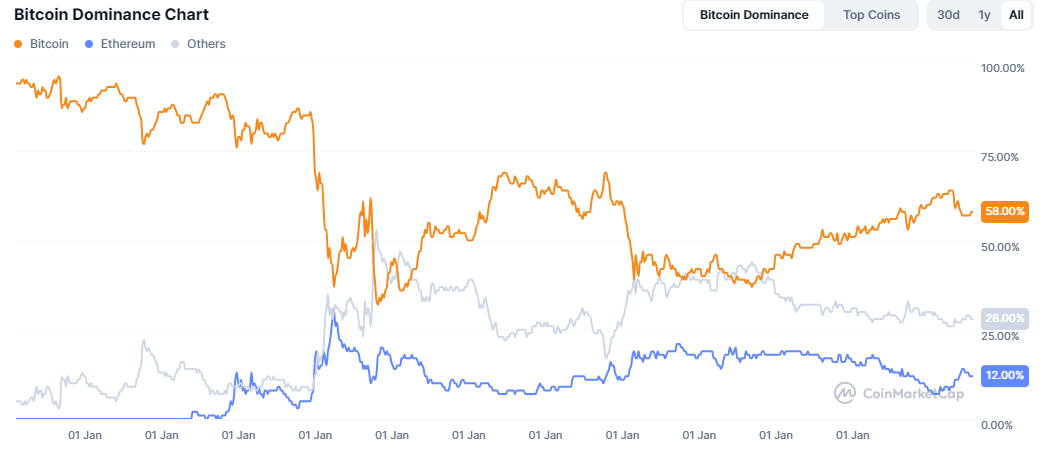
A chart showing how Bitcoin dominance has changed. Source: CoinMarkerCap.
Altcoin Season Index is another key tool. If the index of the altcoin season exceeds 75, that’s an official confirmation it has begun.
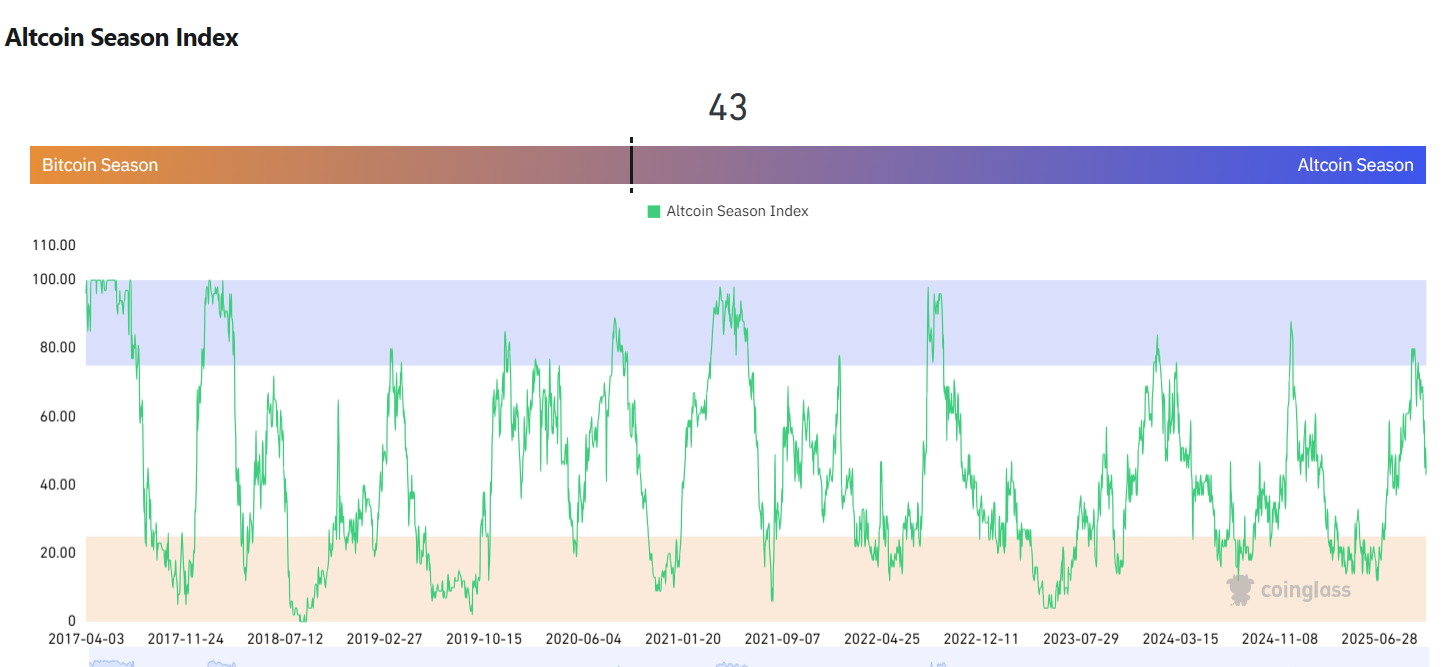
Altcoin Season Index. Source: coinglass.
In addition, pay attention to rising trading volumes in altcoins and the behavior of TOTAL2 and TOTAL3 charts (market cap excluding BTC and ETH). A decline in the stablecoin share (USDT.D) shows that capital is leaving “safe havens” and returning to the market.
And a rise in OTHERS.D (the share of all coins except the top 10) signals that participants are ready to take risk again and are switching to lesser-known projects.
How Long Does Altseason Last
Altseasons are short but intense. According to analysts’ observations, the active phase usually lasts from two to six months. It’s a time when even random tokens make 2–10x, Ethereum gains tens of percent, and projects like Solana in past cycles delivered +400% in a quarter.
However, every rise is followed by a decline. After a cycle ends, altcoins on average lose 70–90% of their value within just a few months of the peak.
Therefore, altseason is less a moment to buy and more the best period to take profits and reassess your strategy.
Altcoin Dominance and False Signals
Growth in altcoin dominance (altcoins’ total market share) is often taken as a signal of cycle onset. But in recent years this metric has become less reliable.
The reason is that stablecoins like USDT and USDC are included in the calculation. When investors get scared and move into stable assets, Bitcoin’s share does indeed drop—not because altcoins are rising, but because the market is going defensive.
A true altseason starts only when Bitcoin and USDT dominance fall simultaneously, while trading activity in altcoins grows. That’s the moment showing that money is truly returning to speculative assets.
Why Altseason Is Also About Psychology
Altseason is not just economics—it’s emotions. When Bitcoin stops surprising, retail investors start hunting for “the next ETH.”
FOMO—the fear of missing out—becomes the market’s fuel. Social media is boiling, Google Trends hits records, and memecoins turn into a sentiment gauge.
When even random tokens begin rising for no reason, it’s a sure sign the market has entered the euphoria stage.
What Makes the 2025 Altseason Special
This cycle differs from the previous ones. First, institutions play a much bigger role: billions of dollars arrive via ETFs on Ethereum, Solana, and other altcoins.
Second, new narratives are taking shape—tokenization of real-world assets, integration of artificial intelligence, and the development of Layer-2 solutions.
Third, memecoins are back on stage. Dogecoin grew from $20 to $56 billion in market cap, which became the first sign of revived retail interest.
And finally, the regulatory landscape is changing. The anticipated resignation of SEC Chair Gary Gensler in January 2025 led to a softening of pressure on the crypto market.
All this creates a unique combination of factors—institutional liquidity plus mass FOMO—which often acts as the trigger for a full-fledged altseason.
What to Do: Strategy, Not Gambling
Altseason isn’t just a celebration—it’s a discipline test. To avoid the euphoria trap, it’s important to define your strategy in advance and follow the plan.
Plan ahead: decide which assets you want to sell if prices multiply. Take profits in stages—the best time to sell is within 60 days after altseason is confirmed.
Don’t give in to FOMO and don’t increase exposure when the market is already overheated. Study fundamentals: after the euphoria, only projects with real utility, users, and revenue will survive.
Diversify your portfolio across sectors—Layer-1, DeFi, NFT, infrastructure, memecoins. Watch RSI and MACD: if the market is overbought, it’s worth easing off the gas.
The main mistake of beginners is buying at the top and failing to sell when needed. Altseason isn’t the time to enter the market; it’s when rational investors exit with profits.
After Altseason
History shows: after every bout of euphoria comes a downturn. Out of thousands of coins, only a handful with real products and ecosystems survive.
According to analysts, more than half of cryptocurrencies issued after 2021 have already faded into oblivion. So the best way to weather the storm isn’t to try to guess the top, but to act according to a pre-planned strategy.
A cool head and an understanding of market patterns turn volatility into a tool—not a source of stress.
Conclusions
Altseason is a financial celebration with an unpredictable ending. It’s always accompanied by an emotional storm, social-media records, and a temporary feeling that “from now on it’s only up.”
But those who prepare in advance use this period not for reckless bets, but to harvest profits on time.
In crypto, as in life, the celebration is brief, and success comes to those who know when to leave the table.
You can quickly and at a favorable rate exchange altcoins for Bitcoin or stablecoins in the time-tested Quickex exchanger.