
There was a time when Bitcoin was hailed as the great redeemer of money — noble, but rather sluggish in practice. Dash appeared in 2014, quietly declaring: what good is digital gold if one cannot buy a loaf of bread with it?
So, what is Dash crypto? In the simplest sense, it is digital cash, or, if you will, money that remembers how to move. Swift as a thought, discreet as a whisper, and steady enough for daily trade.
How Does Dash Work?
Dash Blockchain and Two-Tier Architecture
The Dash blockchain resembles Bitcoin’s skeleton yet wears a different heart. It runs upon two layers — miners below, masternodes above — like a clock with two sets of gears.
Miners confirm transactions and mint new coins, whilst masternodes, those steadfast keepers who pledge 1 000 DASH as surety, handle the finer arts: instant payments, optional privacy, and the governance of the realm itself.
It is a curious republic of code — one that pays its own bills through a treasury drawn from block rewards. No king, no corporation, merely a system that tends itself.
How Dash Ensures Privacy and Speed
Dash’s charms lie chiefly in two spells: InstantSend and PrivateSend.
The first makes a payment arrive almost before you finish saying “sent.” The second veils its origin by mingling your coins with others, much as ink mixes in water. It is not secrecy absolute, yet it keeps prying eyes at bay.
Together they render Dash digital cash in earnest — brisk, polite, and mindful of discretion.
History of Dash: From XCoin to Digital Cash
In its infancy Dash bore other names — XCoin, then Darkcoin — before finding its proper skin as digital cash.
Its tale took an unexpected turn in Venezuela, where paper money turned to dust under inflation’s cruel breath. People began using Dash not as theory but as bread-and-butter currency.
By 2018, two hundred merchants each month joined the fold. You could pay for a sandwich at Subway, a shirt at Calvin Klein, or a coffee at a corner café. Billboards sprang up, and the community, with near one million dollars from its treasury, taught people how to trade in freedom.
For many, Dash became the coin that still worked when the world did not.
Its star blazed brightest on December 20, 2017, when one DASH reached $1 642. In 2025 it rests around 51st place by market cap, no longer young but far from forgotten.

Dash chart. Source: TradingView
The Total Value Locked in DeFi, some $185 820, is modest — yet Dash was never built for the games of yield. It was born for motion.
Dash vs Bitcoin: What’s the Difference?
If Bitcoin is digital gold, Dash is the silver in one’s pocket. The Dash vs Bitcoin comparison is rather like comparing a vault to a wallet.
Bitcoin hoards wealth; Dash circulates it. Bitcoin’s confirmations drag their feet; Dash races ahead in seconds. Bitcoin governs by endless debate; Dash votes by code.
In short, Bitcoin dreams. Dash pays.
What Makes Dash Unique?
Dash endures because it minds its craft.
- Masternodes keep it swift and civil.
- A self-funded treasury shields it from fickle investors.
- Micro-fees — less than a penny — make it fit for a baker or a bookseller alike.
- And it has weathered storms that broke newer ships.

Dash’s roadmap. Source: website
No fanfare, just quiet persistence — the mark of seasoned metal.
How to Become a Dash Masternode
Those who ask how to become a Dash masternode seek not mere profit but participation.
You must lock away 1 000 DASH, tend a server faithful as a lighthouse, and register it through the Dash Core Wallet. Your node shall earn its due reward and a voice in the council of proposals.
It is less an investment, more a stewardship — the keeping of watch over one’s digital village.
How to Buy and Store Dash in 2025
Where to Buy DASH
You may acquire Dash upon Binance, OKX, or Quickex, where the great caravans of crypto gather.
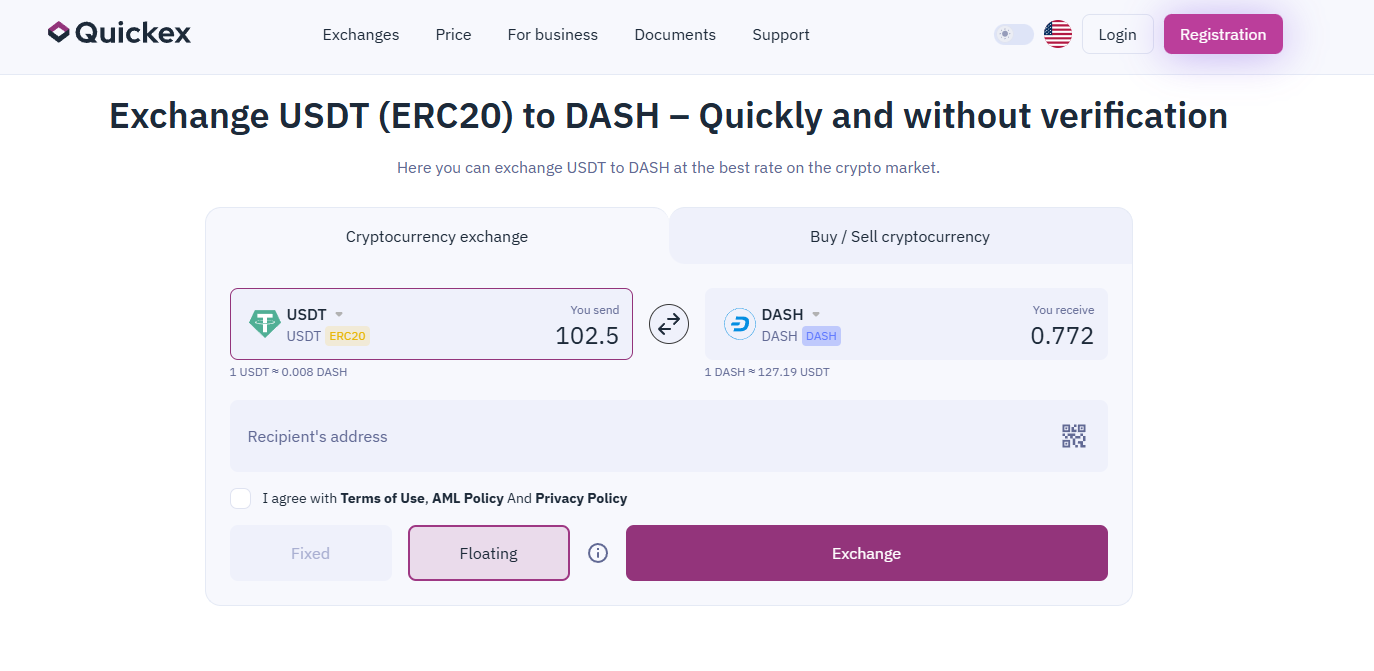
Yet if you value privacy or haste, Quickex offers another road. Since 2018, this marketplace has let travellers swap coins without ceremony or sign-up. One chooses a pair, enters an address, and the trade is done almost before the tea cools.
To buy DASH on Quickex, just follow a few simple steps:
- Go to the Quickex website and log in — or create an account if it’s your first time.
- Pick the coin you want to exchange and choose DASH as the one to receive.
- Enter your DASH wallet address.
- Send the amount shown and wait a minute or two — the coins will arrive shortly.
That’s it. Anonymity, no extra forms, just a quick and easy swap.
Best Dash Wallets
As for safekeeping:
- Dash Core Wallet — the full companion with InstantSend and PrivateSend.
- Ledger and Trezor — small fortresses of hardware.
- Edge or Dash Wallet — light as a purse for daily errands.
And for heaven’s sake, write down your recovery phrase. Paper remembers; hard drives do not.
FAQ: What is Dash (DASH) — Digital Cash Explained
What is Dash Digital Cash?
Dash (DASH) is a peer-to-peer cryptocurrency originally forked from Bitcoin in January 2014 by Evan Duffield under the name “XCoin,” then “Darkcoin,” before rebranding to Dash (Digital Cash) in March 2015. It was designed to solve Bitcoin’s limitations in speed, privacy, and governance — delivering fast, inexpensive, and optionally private digital payments.
- Core mission: Function as everyday digital cash — fast enough for point-of-sale purchases, cheap enough for micro-transactions, and private enough for personal financial freedom.
- Consensus: Proof-of-Work (X11 hashing algorithm) combined with a masternode network — a two-tier architecture unique to Dash.
- Block time: ~2.5 minutes (same as Litecoin, 4× faster than Bitcoin).
- Max supply: ~18.9 million DASH — similar scarcity profile to Bitcoin’s 21M cap.
- Block reward split: 45% to miners, 45% to masternodes, 10% to the Dash DAO Treasury — making Dash one of the first self-funding decentralised autonomous organisations in crypto.
Three signature features that define Dash
- InstantSend: Masternodes lock and confirm transactions in ~1–2 seconds — enabling point-of-sale payments comparable in speed to Visa/Mastercard. No need to wait for block confirmations.
- CoinJoin (formerly PrivateSend): Optional coin-mixing protocol that breaks the on-chain link between sender and recipient by mixing transactions with other users across multiple rounds. This provides enhanced (though not absolute) transaction privacy — stronger than Bitcoin, but less comprehensive than Monero or Zcash.
- Decentralised Governance by Blockchain (DGBB): Masternode operators vote on protocol upgrades, treasury funding proposals, and ecosystem development — making Dash self-governing without relying on a foundation or company to make decisions.
What is a Dash masternode?
- A masternode is a full node that provides enhanced network services (InstantSend, CoinJoin, governance voting) in exchange for a share of block rewards.
- Collateral required: 1,000 DASH must be held and locked to operate a masternode — this ensures operators have a significant financial stake in the network.
- Reward: Masternodes receive 45% of each block reward — providing passive income to operators.
- Active masternodes: ~3,500–4,000 globally as of 2026 — one of the largest masternode networks in crypto.
How does Dash work — and how is it different from Bitcoin?
Dash was forked from Bitcoin’s codebase but adds a second-tier masternode network on top of the standard miner layer. This dual-layer architecture is what enables InstantSend, CoinJoin, and on-chain governance — features Bitcoin doesn’t natively support.
| Feature | Dash | Bitcoin |
|---|---|---|
| Consensus | PoW (X11) + Masternodes | PoW (SHA-256) |
| Block time | ~2.5 minutes | ~10 minutes |
| Transaction speed | ~1–2 seconds (InstantSend) | ~10–60 minutes (1–6 confirmations) |
| Average fee | ~$0.01–$0.05 | $0.50–$5+ (varies with congestion) |
| Privacy | Optional CoinJoin mixing | Pseudonymous only (transparent ledger) |
| Governance | On-chain DAO (masternode voting) | Off-chain (BIPs, developer consensus) |
| Self-funding | 10% of block rewards → Treasury | No built-in funding mechanism |
| Max supply | ~18.9 million DASH | 21 million BTC |
| Smart contracts | Dash Platform (in development) | Limited (Script-based) |
- Dash Platform: A Layer-2 application layer (formerly “Dash Evolution”) currently in development — it aims to bring decentralised identity (usernames instead of addresses), data contracts, and dApp capability to Dash. The Evo testnet has been running since 2023.
- ChainLocks: Dash uses masternode-powered ChainLocks to prevent 51% attacks — making Dash’s PoW significantly more resistant to mining attacks than standard single-tier PoW chains.
What is the Dash price and market overview in 2026?
Here’s a snapshot of the Dash market data as of mid-2026:
- Current DASH price: ~$22 – $28 USD
- All-time high: $1,493 (December 2017)
- Distance from ATH: ~98% below peak
- Market cap: ~$280 – $360 million USD
- Circulating supply: ~12.2 million DASH out of ~18.9 million max
- Rank: ~#90–120 by market cap — DASH has declined significantly in rankings from its former top-10 position
- Masternode count: ~3,500–4,000 active
- Real-world adoption: Dash remains one of the most widely accepted cryptos for payments in Latin America (Colombia, Venezuela, Brazil) and parts of Africa. Dash Direct enables spending at 155,000+ US retail locations via gift card conversion.
What is the best Dash wallet?
Choosing the right wallet is essential for securely storing and using Dash. Here are the best Dash wallets in 2026, ranked by type:
- Best for privacy: Dash Core or Dash Electrum — the only wallets that support CoinJoin mixing natively. Dash Core also lets you run a full node, verify transactions independently, and manage masternodes.
- Best for everyday mobile payments: Dash Wallet (official) — lightweight, InstantSend-enabled, QR code support for in-person payments.
- Best for cold storage: Ledger or Trezor — hardware wallets provide maximum security for long-term DASH holdings.
- Best all-rounder: Exodus — manages DASH alongside 250+ other assets with a built-in swap feature and desktop+mobile sync.
- All listed wallets are non-custodial — you hold your own keys and seed phrase. Never store significant DASH holdings on an exchange.
What can you use Dash for?
Dash’s core value proposition is practical digital cash — fast, cheap, and accessible. Here are the main use cases in 2026:
- Everyday payments: Dash is accepted at 155,000+ US retail locations via Dash Direct (gift card conversion) and at thousands of merchants globally via direct integration, BitPay, and CoinGate. InstantSend’s ~1–2 second confirmation makes it practical for point-of-sale.
- Remittances: Dash is popular in Latin America (Colombia, Venezuela, Brazil) for cross-border remittances — ~$0.01–$0.05 fees compared to $5–$25 for Western Union or bank transfers.
- Privacy-enhanced transactions: CoinJoin mixing provides optional privacy for users who want to delink their transaction history — stronger than Bitcoin’s transparent ledger, useful for personal financial privacy.
- Savings & passive income: Masternode operators earn 45% of block rewards as passive income. Even without a masternode, users can participate in shared masternode services to earn proportional rewards.
- Store of value: With a ~18.9M max supply and PoW security, Dash shares Bitcoin’s scarcity narrative — though its ~98% decline from ATH makes this case speculative at current levels.
- Dash Platform (upcoming): When fully launched, Dash Platform will enable usernames as wallet identifiers (e.g. “john.dash” instead of a 34-character address), decentralised data storage, and dApps — expanding Dash beyond payments.
How to buy or exchange Dash via QuickEx?
The fastest way to buy or exchange Dash without KYC is via QuickEx — a non-custodial swap service that requires no account and no identity verification:
- Set up a Dash wallet — download Dash Wallet (official mobile), Dash Electrum (desktop with CoinJoin), Exodus, or Trust Wallet. For cold storage: Ledger or Trezor. Save your seed phrase offline.
- Go to QuickEx.io — no account, no email, no KYC required.
- Select your exchange pair — e.g. BTC → DASH, ETH → DASH, USDT → DASH, LTC → DASH, or any of 500+ supported coins.
- Enter the amount and choose your rate type:
- Fixed rate — output DASH amount guaranteed, no slippage.
- Floating rate — follows live market rate, slightly lower fee.
- Paste your Dash wallet address — a 34-character string starting with
X(standard) or7(multisig). - Send your crypto to the QuickEx deposit address shown on screen.
- Receive DASH directly in your wallet — typically within 5–15 minutes. No funds are ever held by QuickEx.
How to sell DASH?
To sell DASH for BTC, ETH, USDT, or any other coin — simply reverse the process: select DASH as the source coin on QuickEx, enter your destination wallet address, and send your DASH. No KYC in either direction.
Disclaimer: The material in this article is not financial or investment advice. Everything stated here reflects the author's personal view and should not be treated as a recommendation to trade or invest. We make no warranties regarding the accuracy, reliability or completeness of the information presented. Cryptocurrency markets are highly volatile and can move unpredictably. Before committing any funds, every investor, trader or crypto user should study several independent sources and check the regulations that apply in their own jurisdiction.