
The financial world is undergoing a massive, irreversible shift. For decades, if you wanted to trade an asset, you had to ask a middleman for permission. You had to prove who you were, deposit your funds into their vaults, and trust that they wouldn’t go bankrupt or freeze your account. Today, the blockchain has completely rewritten those rules.
If you are stepping into the modern landscape of Web3 and digital finance, you are inevitably going to hear one specific acronym repeated endlessly. You are probably wondering what is DEX, and why are billions of dollars migrating away from traditional trading platforms every single month?
This comprehensive guide will break down the mechanics, the risks, and the massive opportunities of decentralized finance. We will explore everything from automated market makers to the legal landscape, ensuring that by the end of this article, you will never have to ask what is a DEX ever again.
Defining the DEX: Trading Without the Middleman
To grasp the future of trading, we first have to understand the foundational definitions and the underlying philosophy that sparked this revolution.
Decentralized Exchange Basics
Let’s clear up the terminology right away. The DEX meaning is simply “Decentralized Exchange.” At its core, what is a decentralized exchange? It is a peer-to-peer marketplace where users can trade digital assets directly with one another, completely bypassing traditional financial intermediaries like banks, brokers, or corporate payment processors.
When you ask what is DEX in crypto, you are essentially asking how software can replace a stockbroker. Instead of a centralized company acting as the clearinghouse and holding your funds, a DEX relies entirely on self-executing lines of code. There is no CEO, no headquarters, and no customer service hotline. There is only mathematics and cryptography.
The “Not Your Keys, Not Your Crypto” Philosophy
The entire decentralized finance (DeFi) movement was born out of a profound distrust of centralized entities. The phrase “Not your keys, not your crypto” is the golden rule of the industry. It means that if you do not personally control the private cryptographic keys to your digital wallet, you do not actually own your assets; you simply have an IOU from a company.
So, what does DEX mean in crypto philosophically? It means absolute sovereignty. When you trade on a decentralized platform, your funds remain in your personal, non-custodial wallet until the exact moment the trade executes. You are never forced to hand over custody of your wealth to a third party.
How DEXs Differ from Centralized Exchanges (CEXs)
To truly solidify what is a decentralized crypto exchange, we have to compare it to what you probably already know. Centralized Exchanges (CEXs) like Coinbase, Binance, or Kraken operate much like traditional banks. You create an account, upload your passport, and deposit your money into their corporate wallets.
Here is a clear breakdown of how the two models stack up against each other in 2026:
| Feature | Centralized Exchange (CEX) | Decentralized Exchange (DEX) |
| Custody of Funds | The exchange holds your money. | You hold your money in your own wallet. |
| KYC / Identity Verification | Mandatory (Passport, ID, Address). | None. Completely anonymous. |
| Trading Mechanism | Internal, off-chain order books. | On-chain Smart Contracts / AMMs. |
| Asset Availability | Only coins approved by corporate. | Infinite. Anyone can list any token. |
| Security Risk | Hacks on the exchange’s hot wallets. | Smart contract bugs or phishing links. |
| Censorship | Can freeze accounts or block regions. | Unstoppable and globally accessible. |
How Decentralized Exchanges Work in 2026
Now that we know the basic DEX crypto meaning, let’s look under the hood. How can you trade without an actual company facilitating the trade?
The Role of Smart Contracts
The secret sauce of any DEX is the “smart contract.” A smart contract is a self-executing contract where the terms of the agreement between the buyer and seller are written directly into lines of code.
Imagine a traditional vending machine. You put a dollar in, and a soda falls out. The machine doesn’t need a cashier; the mechanics ensure the trade is fair. A smart contract does this digitally. When you swap Ethereum for USDT, the smart contract acts as an unbreakable escrow. It mathematically guarantees that you will only send your Ethereum if you receive the exact corresponding amount of USDT in return. If the trade fails for any reason, the contract instantly refunds both parties.
The Evolution of the AMM (Automated Market Maker)
Source: Techopedia
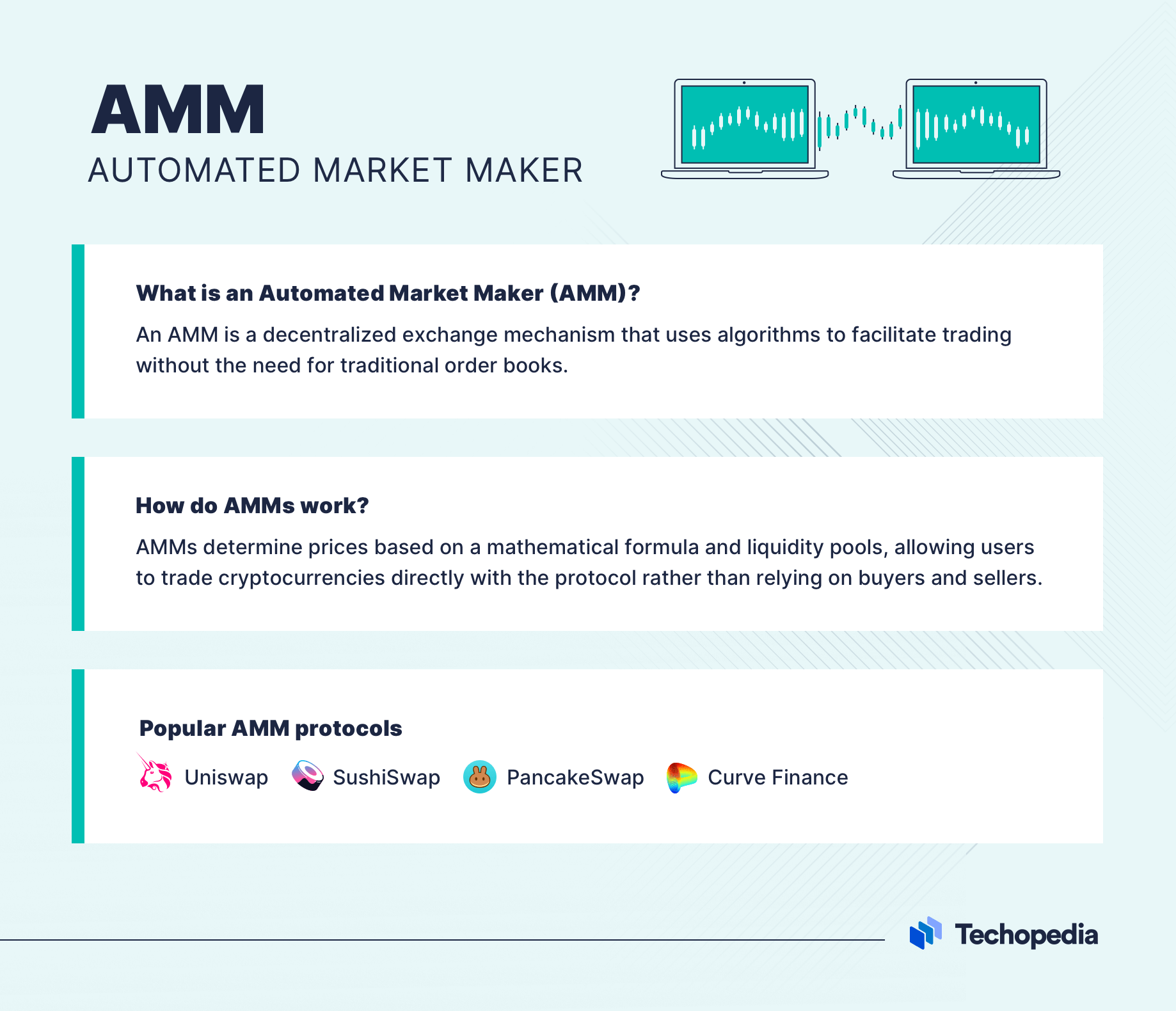
If you are trying to understand what is DEX crypto technology, you have to understand the AMM. Before AMMs, exchanges relied on matching a buyer with a seller. If I wanted to sell 10 coins at $5, I had to wait for someone to come along who wanted to buy exactly 10 coins at $5. If no one showed up, my trade sat there forever.
The Automated Market Maker fixed this. Instead of trading against another human, you trade against a pool of funds locked inside a smart contract. These algorithms use mathematical formulas to automatically determine the price of an asset based on supply and demand, guaranteeing that you can always make a trade instantly, even if there isn’t another human on the other side of the screen.
Order Book DEXs vs. AMMs
While AMMs are the most popular, they aren’t the only way to trade.
- AMMs are incredibly user-friendly for retail investors who want to execute a quick swap at the current market price without overthinking it.
- On-chain Order Books, on the other hand, allow professional traders to set “limit orders” (e.g., “Only buy this coin if the price drops to $100”). These are preferred by institutions and algorithmic traders who require massive precision.
The Three Main Types of Decentralized Exchanges
As the ecosystem has matured into 2026, the answer to whats a DEX has fractured into three distinct categories.
1. Automated Market Makers (AMM)
This is the bedrock of DeFi. The most famous example is Uniswap. In 2026, the launch of Uniswap v4 revolutionized the space by introducing “hooks,” which allow developers to add custom logic (like dynamic fees or custom limit orders) directly into traditional AMM pools.
Another massive player here is Curve Finance. Curve specifically designed an AMM formula that caters exclusively to “like-kind” assets, such as swapping one stablecoin for another stablecoin (USDC for USDT). Their unique math ensures you can trade millions of dollars with virtually zero price disruption.
2. On-Chain Order Books
Historically, putting a full order book on a blockchain was impossible because blockchains were too slow and gas fees were too high. You couldn’t pay a $10 fee just to place or cancel an order.
However, with the rise of ultra-fast blockchains like Solana, on-chain order books are thriving. Platforms running Central Limit Order Books (CLOBs) allow users to experience the lightning-fast, high-frequency trading environment of a Wall Street firm, all while retaining total self-custody of their funds.
3. DEX Aggregators
With thousands of different liquidity pools spread across the internet, how do you know you are getting the best price? You use an aggregator.
If someone asks you whats DEX aggregation, point them to platforms like Jupiter on the Solana network, or 1inch on Ethereum. These platforms act like the Google Flights of crypto. When you hit “swap,” the aggregator’s algorithm instantly scans hundreds of different DEXs in milliseconds. It splits your order up, routing a portion of it through Uniswap, a portion through Curve, and a portion through another AMM, piecing it all together to guarantee you get the absolute maximum amount of tokens possible.
Advanced DEX Concepts
To truly grasp what is a DEX crypto platform, you have to look past the surface-level swapping and understand where the money actually comes from.
Understanding Liquidity Pools and Yield Farming
Source: MyEtherWallet
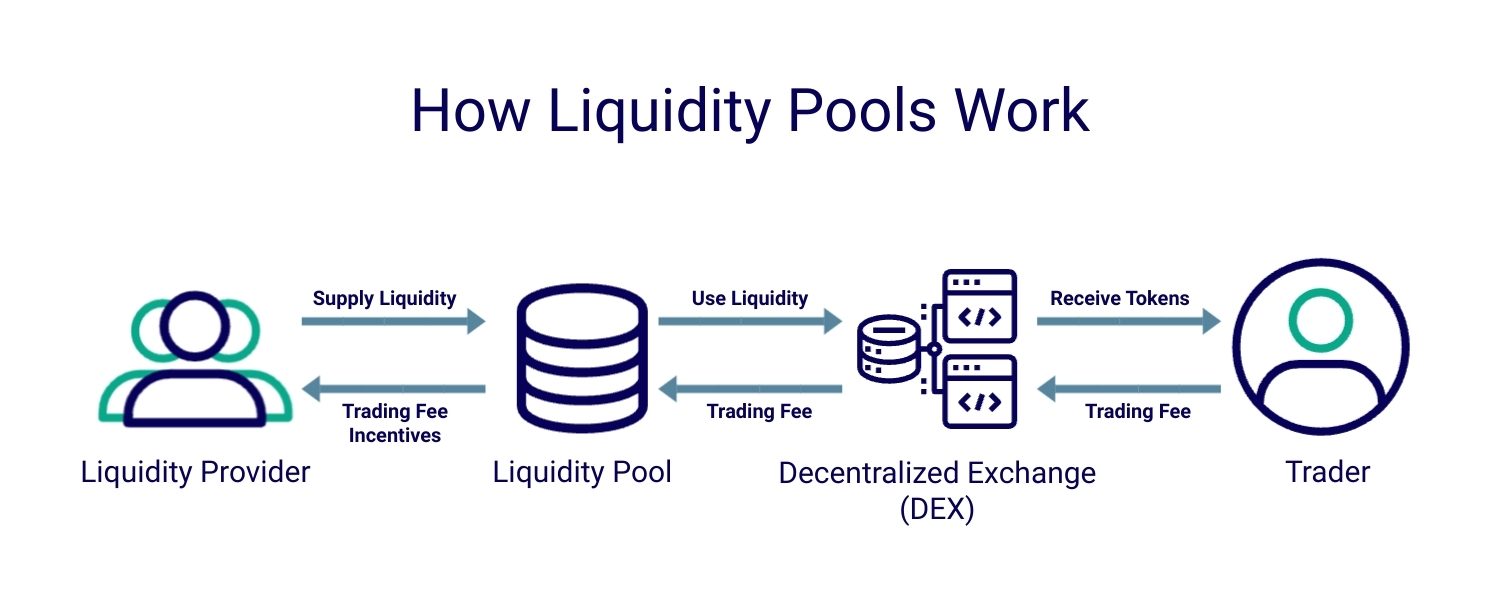
Since there is no corporate market maker providing the money, who funds these AMMs? Regular users do.
Anyone can become a “Liquidity Provider” (LP). If you have $1,000 in ETH and $1,000 in USDC, you can deposit both into a smart contract liquidity pool. Now, when other traders want to swap ETH for USDC, they use your money to do it. In exchange for providing this vital service, the protocol pays you a percentage of every single trading fee generated by that pool. This process of locking up your assets to earn passive income is known as yield farming.
Understanding Impermanent Loss
While yield farming sounds like free money, it comes with a massive, highly misunderstood risk called Impermanent Loss. This is a crucial concept for anyone diving into what is DEX in cryptocurrency.
Impermanent Loss is essentially the “opportunity cost” of providing liquidity to an AMM compared to simply holding the assets in your wallet. AMMs rely on a constant mathematical ratio (usually 50/50) between the two tokens in the pool.
Let’s say you provide liquidity to an ETH/USDC pool. Suddenly, the price of ETH explodes on the open market. Arbitrage traders will rush to your pool to buy the “cheap” ETH, draining the ETH from your pool and replacing it with USDC.
Because the AMM must maintain its formula, it is essentially selling your winning asset (ETH) as the price goes up, and buying more of the losing asset.
If you withdraw your liquidity after a massive price swing, you will find that you have less ETH and more USDC than you started with. Even with the trading fees you earned, the total value of your holdings might be less than if you had just held the ETH in your cold wallet. The loss is “impermanent” because if the price of ETH returns to the exact price it was when you deposited it, the loss disappears. But if you withdraw early, you lock in that loss permanently.
Understanding MEV (Maximal Extractable Value)
Source: WallStreetMojo
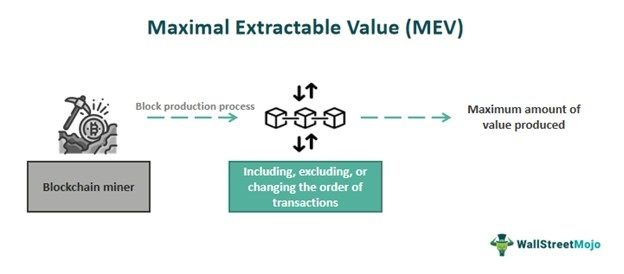
Because the blockchain is a public ledger, a transaction sits in a public “waiting room” (the mempool) before it is finalized. Specialized trading bots monitor this waiting room.
If a bot sees you are about to make a massive purchase that will drive the price of a token up, the bot will bribe the blockchain miners to process the bot’s purchase before yours. The bot buys the token cheap, your massive order pushes the price up, and the bot instantly sells the token back to you at the newly inflated price. This is called a “sandwich attack,” and it is an invisible tax that sophisticated actors extract from retail users on decentralized networks.
Gas Fees and Layer 2 Solutions
For years, the biggest argument against what is DEX? adoption was Ethereum gas fees. Paying $50 to execute a $10 trade simply didn’t make sense.
In 2026, the ecosystem solved this via Layer 2 (L2) rollups. Networks like Arbitrum, Optimism, and Coinbase’s Base network sit on top of Ethereum. They bundle thousands of transactions together off-chain, compress the data, and send it to the main Ethereum chain as a single receipt. This drops the cost of a DEX swap from $50 down to a fraction of a cent, unlocking true micro-transactions for a global audience.
Why Use a DEX?
So, with all these complexities, why go through the trouble? The answer lies in freedom.
Absolute Privacy
The most appealing aspect of what is a DEX in crypto is the preservation of anonymity. To trade on Uniswap, you do not need to provide an email, a phone number, or a driver’s license. Your only identity is a string of random numbers representing your wallet address. In an era of constant corporate data breaches and aggressive financial surveillance, this level of privacy is unprecedented.
Unstoppable Access
Centralized exchanges frequently restrict users based on their geographic location. If you live in a specific state or a sanctioned country, a centralized platform will block your IP address and seize your funds. A DEX is globally permissionless. Because the smart contracts live on a distributed network of thousands of computers worldwide, no government or corporation can turn the DEX off, and no one can stop you from accessing your own money.
Enhanced Security
The history of crypto is littered with the corpses of hacked centralized exchanges—Mt. Gox, FTX, Celsius. When a centralized exchange gets hacked, millions of users lose everything because the funds were stored in a single corporate honey-pot. On a DEX, the only way someone can steal your funds is if you personally give them your private keys or sign a malicious contract. The security is entirely in your own hands.
The DEX Learning Curve
We cannot discuss what is DEX crypto technology without acknowledging its severe friction points.
Wallet Management
With absolute freedom comes absolute responsibility. If you forget the password to your traditional bank account, you click “forgot password” and receive an email. If you lose the 12-word recovery phrase to your non-custodial wallet, your money is gone forever. There is no customer support to call. This terrifying reality is a massive psychological barrier for traditional retail investors.
Slippage and Price Impact
If you try to execute a massive trade in a liquidity pool that doesn’t have enough funds to support it, you will suffer from “price impact.” Your own trade will move the needle so severely that you end up getting a terrible price for your tokens. Furthermore, network congestion can cause “slippage”—meaning the price of the token changes in the few seconds between when you click “swap” and when the blockchain finalizes the transaction.
Rug Pulls and Token Scams
Because anyone can list any token on a DEX without permission, the market is flooded with scams. Malicious developers will create a token with a smart contract that allows you to buy it, but maliciously removes your ability to sell it. They wait for liquidity to build up, then drain the entire pool, executing a “rug pull.” Understanding how to use block explorers and contract auditing tools is mandatory for survival.
Bridges and Alternatives to DEX
For many, the pure decentralized experience is just too tedious.
Quickex.io: Combining DEX Privacy with CEX Simplicity
This complexity is exactly why hybrid solutions are dominating the 2026 market. For users asking what is a DEX simply because they want privacy, there is a better way. Platforms like Quickex serve as the ultimate user-friendly bridge.
Quickex.io offers the absolute best of both worlds. It gives you the privacy of a DEX (no KYC, no accounts) with the seamless simplicity of a centralized exchange. You don’t have to worry about routing algorithms, slippage tolerances, or managing different Layer-2 gas tokens.
Quickex also supports DEX exchanges through a widget. You simply send your starting asset, and we instantly bounce the desired asset directly to your self-custody wallet. It completely removes the technical headache while perfectly preserving your financial sovereignty.
Cross-Chain Swaps
For the purists who insist on staying entirely on-chain, cross-chain DEX protocols are evolving. Technologies like LayerZero and Chainlink CCIP are allowing users to execute native swaps across entirely different blockchains (e.g., swapping native Bitcoin for native Ethereum) without relying on fragile, hack-prone “wrapped” token bridges.
Is DEX Trading Legal in 2026?
As decentralized trading volume surpasses centralized volume, regulators have panicked.
Regulatory Pressure on DEX Protocols
Governments classify self-custody wallets as “unhosted wallets.” Over the last few years, the SEC and global regulatory bodies have aggressively attempted to classify DEX front-end developers as unlicensed securities brokers. The legal argument is complex: can a software developer be held liable for the actions users take on an open-source, unstoppable smart contract that the developer no longer controls?
Permissioned DEXs
To appease regulators, 2026 has seen the rise of the “Permissioned DEX.” These are decentralized protocols that utilize on-chain KYC mechanisms. Institutions love them because they offer the self-custody and algorithmic transparency of a DEX, but they utilize zero-knowledge proofs to guarantee that every wallet trading in the pool belongs to a legally verified, non-sanctioned entity.
How MiCA and US Regulations Impact DEX Users
In Europe, the MiCA (Markets in Crypto-Assets) framework has heavily burdened centralized entities, inadvertently driving massive volume into the unregulated, decentralized shadows. In the US, aggressive enforcement actions have forced many protocol developers to geo-block US IP addresses from accessing their front-end websites, forcing American users to access smart contracts directly through decentralized interfaces or VPNs.
How to Get Started
Ready to take the plunge? Here is the basic roadmap.
Step 1: Setting Up a Non-Custodial Wallet
You cannot trade on a DEX with your Coinbase app. You must download a non-custodial Web3 wallet. In 2026, Rabby Wallet and MetaMask are the industry standards for desktop browsers, while Trust Wallet dominates the mobile space. Write your 12-word seed phrase on a physical piece of paper and lock it in a fireproof safe.
Step 2: Funding Your Wallet
You cannot make a trade if you cannot pay the network fee. Every blockchain requires its native token to process data. If you are trading on Arbitrum, you need a few dollars worth of ETH in your wallet to pay the miners. If you are on Solana, you need SOL.
Step 3: Connecting, Signing, and Executing the Swap
Navigate to the DEX (e.g., Uniswap or Jupiter). Click “Connect Wallet.” You will be prompted to “sign” a message proving you own the wallet. Select the tokens you want to swap, adjust your slippage tolerance (usually 0.5% is safe for highly liquid pairs), and hit execute. Wait a few seconds for the blockchain to confirm, and the new tokens will appear in your wallet.
Conclusion
Understanding what is DEX technology is no longer optional; it is a prerequisite for participating in the future economy. We have moved from a system of corporate permission to a system of cryptographic truth.
Whether you are seeking the absolute privacy of a direct smart contract interaction, the high-frequency speeds of an on-chain order book, or the simplified, non-custodial ease of instant platforms like Quickex.io, the power to manage your wealth is finally back where it belongs: in your own hands.
FAQ: What is a DEX — Decentralized Exchange Explained
What is a DEX?
A DEX (decentralized exchange) is a crypto trading platform that runs entirely on blockchain smart contracts, allowing users to swap tokens directly from their own wallets — without depositing funds into a company’s custody, without creating an account, and without submitting identity documents. Unlike Coinbase or Binance, a DEX has no central operator, no corporate server matching orders, and no ability to freeze your account.
- One-sentence definition: A DEX is a peer-to-peer crypto marketplace powered by smart contracts where you trade from your own wallet and never give up control of your private keys.
- Core principle: “Not your keys, not your coins” — a DEX embodies this philosophy by design. You connect your wallet (MetaMask, Phantom, Trust Wallet), approve a trade, and receive tokens directly back to the same wallet. No intermediary touches your funds.
- Examples: Uniswap (Ethereum), Jupiter (Solana), PancakeSwap (BNB Chain), Curve (Ethereum), Raydium (Solana), Aerodrome (Base), STON.fi (TON).
- What a DEX is NOT: A DEX is not the same as a non-custodial instant exchange like QuickEx. A DEX operates on a single blockchain using on-chain smart contracts. QuickEx aggregates liquidity across multiple chains to execute cross-chain swaps (e.g. BTC → SOL) — something no single DEX can do.
Need cross-chain swaps a DEX can’t do? Exchange any crypto on QuickEx →
What is a DEX in crypto — and how does it work?
In the broader crypto ecosystem, a DEX serves as the decentralized alternative to centralized exchanges (CEXs) like Binance or Coinbase. It replaces the company with code — smart contracts automatically execute trades based on predefined rules.
How a DEX works — two main models
- AMM (Automated Market Maker): The most common DEX model. Instead of matching buyers with sellers, users trade against liquidity pools — shared reserves of two tokens funded by other users (called liquidity providers or LPs). Price is determined by a mathematical formula (typically x × y = k).
- Example: On Uniswap, if you swap ETH for USDC, you’re trading against a pool containing both ETH and USDC. The pool’s ratio adjusts after your trade, which changes the price.
- AMM DEXs: Uniswap, PancakeSwap, Raydium, Orca, Curve, SushiSwap, Aerodrome.
- CLOB (Central Limit Order Book): An on-chain order book that matches buy and sell orders directly — similar to how a traditional stock exchange works, but fully transparent on the blockchain.
- Example: On Phoenix (Solana), you can place a limit order to buy SOL at $140. If someone places a sell order at $140, the orders match and execute on-chain.
- CLOB DEXs: Phoenix, dYdX, Hyperliquid, OpenBook.
DEX trade lifecycle (step by step)
- You connect your wallet to the DEX website (e.g. MetaMask → Uniswap).
- You select the token pair (e.g. ETH → USDC) and enter the amount.
- The DEX smart contract calculates the output based on pool liquidity (AMM) or order book (CLOB).
- You approve the transaction in your wallet (gas fee applies).
- The smart contract executes the swap atomically — your ETH leaves your wallet and USDC enters it in the same transaction.
- The trade is recorded on the public blockchain — fully transparent and verifiable.
DEX meaning in crypto: key properties and why it matters
The DEX meaning in crypto extends beyond just “a place to trade” — it represents a fundamental philosophy of financial sovereignty. Here are the defining properties:
| Property | What It Means | Why It Matters |
|---|---|---|
| Non-custodial | You never deposit funds into the exchange; tokens stay in your wallet until the moment of swap | No risk of exchange insolvency (FTX 2022), hacks, or account freezes |
| Permissionless | Anyone can list a token, create a liquidity pool, or trade — no approval needed | Access to new tokens immediately at launch; no gatekeeping by corporations |
| Transparent | All trades, pools, and fees are visible on the public blockchain | You can verify everything — no hidden order flow, no spoofing, no manipulation behind closed doors |
| Censorship-resistant | No central authority can freeze accounts, block trades, or restrict access | Financial access for anyone with an internet connection, regardless of geography or identity |
| KYC-free | No identity verification — connect wallet and trade | Privacy preserved; no personal data stored by the exchange |
| Composable | DEX smart contracts can be combined with other DeFi protocols (lending, yield, derivatives) | Enables complex financial strategies in a single transaction (“money legos”) |
- Why DEXs matter for crypto: They embody the original vision of blockchain — trustless, permissionless, censorship-resistant financial infrastructure that operates without intermediaries. If centralized exchanges are
“crypto banks,” DEXs are “crypto protocols.” - Market share: DEXs now account for approximately 15–20% of total crypto spot trading volume globally (2026) — up from under 5% in 2020. On Solana, DEX volume frequently exceeds CEX volume for SPL tokens.
What are the risks of using a DEX?
DEXs remove custodial risk but introduce a different set of risks. Understanding these is essential before trading:
- Smart contract risk: DEXs are only as secure as their code. Bugs or vulnerabilities can be exploited to drain liquidity pools. Major incidents: Euler Finance ($197M, 2023), Curve Finance ($70M, 2023). Always check if the DEX has been audited by reputable firms (Trail of Bits, OpenZeppelin, Halborn).
- Rug pulls & scam tokens: Because listing is permissionless, anyone can create a token and add liquidity — then drain it. Always verify the token contract address on the project’s official channels before swapping.
- Slippage & price impact: Large trades on low-liquidity pools move the price against you. Set slippage tolerance carefully — too low and your trade fails; too high and you may receive significantly fewer tokens.
- MEV (Maximal Extractable Value): On Ethereum, MEV bots can front-run or sandwich your transaction — buying before you and selling after to extract profit. Use MEV protection tools (Flashbots Protect, Jupiter’s MEV guard on Solana).
- Impermanent loss (for LPs): If you provide liquidity to an AMM pool, price divergence between the paired tokens can reduce your total value compared to simply holding. Concentrated liquidity positions (Uniswap v3, Orca Whirlpools) amplify this risk further.
- Wallet approval exploits: Connecting your wallet to a DEX grants token spending approvals. A malicious or compromised contract can use unlimited approvals to drain your tokens. Audit approvals at revoke.cash after trading.
- Single-chain limitation: A DEX only swaps tokens on its native blockchain. You can’t swap BTC for SOL, or ETH for XMR, on any single DEX. For cross-chain needs, use a non-custodial swap service like QuickEx.
- No customer support: If you send to the wrong address, swap the wrong token, or lose funds to a scam contract — there is no support team to reverse the transaction. DEX trades are final.
DEX vs. CEX vs. QuickEx: which should I use?
Each type of exchange solves a different problem. Here’s when to use each:
| Scenario | Best Tool | Why |
|---|---|---|
| Swap ETH → USDC (same chain) | DEX (Uniswap) | On-chain, lowest fee, instant |
| Swap SOL → BONK (same chain) | DEX (Jupiter) | Aggregated best price, ~1 second |
| Buy a newly launched memecoin | DEX | Permissionless listing — available instantly |
| Swap BTC → SOL (cross-chain) | QuickEx | No DEX can natively swap between Bitcoin and Solana |
| Swap ETH → XMR (cross-chain + privacy) | QuickEx | Monero isn’t on any DEX; cross-chain required |
| Buy crypto with USD/EUR (fiat) | CEX (Coinbase, Kraken) | Fiat on-ramp — DEXs and QuickEx are crypto-only |
| Trade with margin / futures | CEX (Binance, Bybit) or Hyperliquid (DEX) | Deepest leverage liquidity |
| Swap without connecting wallet to dApp | QuickEx | No wallet connection = zero approval exploit risk |
How to get started: using a DEX + QuickEx together
The most powerful crypto workflow combines a DEX for on-chain trading and QuickEx for cross-chain funding — all without KYC at any step:
Step 1: Fund your wallet via QuickEx (cross-chain)
- Go to QuickEx.io — no account, no email, no KYC.
- Select your pair — e.g. BTC → ETH, USDT (TRC-20) → SOL, LTC → BNB, or any of 500+ coins. Choose the gas token of the blockchain where you want to trade on a DEX.
- Paste your wallet address — MetaMask (for Ethereum/L2), Phantom (for Solana), Trust Wallet (multi-chain).
- Send your crypto → receive the gas token in your wallet within 5–15 minutes.
Step 2: Trade on a DEX (on-chain)
- Go to your chosen DEX — Uniswap (Ethereum), Jupiter (Solana), PancakeSwap (BNB Chain).
- Connect your wallet.
- Select token pair, set slippage, review output.
- Confirm — trade executes in seconds (Solana) or ~15–60 seconds (Ethereum).
Step 3: Cash out via QuickEx (optional)
- Swap your DEX profits back to BTC, USDT, or any coin via QuickEx.
- Send to your personal wallet or exchange deposit address for fiat off-ramp.
- ✅ No KYC at any step (QuickEx or DEX)
- ✅ Full self-custody throughout
- ✅ Cross-chain in via QuickEx → on-chain trading via DEX → cross-chain out via QuickEx
- ✅ 500+ coins accessible
- ✅ 24/7 live support chat on QuickEx
Disclaimer: The material in this article is not financial or investment advice. Everything stated here reflects the author's personal view and should not be treated as a recommendation to trade or invest. We make no warranties regarding the accuracy, reliability or completeness of the information presented. Cryptocurrency markets are highly volatile and can move unpredictably. Before committing any funds, every investor, trader or crypto user should study several independent sources and check the regulations that apply in their own jurisdiction.