

So if someone’s ever wondered what is market cap in crypto, the answer they are looking for is, in fact: it is the total market value of a cryptocurrency that is currently in circulation. In most cases, it is found by multiplying one unit of each coin’s current price. Key data entities like CoinGecko, CoinMarketCap, and Messari view market capitalization in virtually the same way.
Another question often asked by beginners is what does the market cap mean in crypto. Essentially, it’s a fast way of guessing at the size of a crypto asset using the metrics of other assets on the market. The market cap does not tell you anything about quality or utility or future performance, but it is a particularly useful idea to start with, comparing one project versus the other.
In the traditional world of finance, market capitalisation serves as a barometer to gauge the size of any public company. In Cryptoland, the scenario goes with words similar, but the mechanical and technical aspects differ because of the ability to change, lock up in time, and burn. For this reason, crypto market capitalisation enlightens a good frame of reference rather than a complete valuation model.
Market Cap and Coin Price Are Not the Same Thing
One of the most common mistakes in crypto is assuming that a cheap coin must have more upside than an expensive one. Price on its own can be misleading because it tells you nothing about supply. A token trading at £0.01 may still be worth billions overall if there are enough units in circulation. By contrast, a token priced in the hundreds can still have a relatively modest market cap if its circulating supply is small.
That is why market cap is usually more useful than price when comparing assets. Price shows you the cost of one unit. Market cap shows you the size of the whole network as the market currently values it. When investors compare Bitcoin, Ethereum, and smaller altcoins, they usually look at market capitalisation first because it provides a more meaningful basis for comparison.
Why Market Cap Matters in Crypto
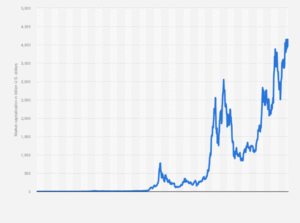
Market cap matters because it helps investors quickly judge scale, relative maturity, and potential risk. Larger crypto assets tend to have deeper markets, broader recognition, and stronger liquidity than very small projects. Smaller assets can still deliver dramatic gains, but they are often more volatile and easier to move with relatively little capital.
It also helps when looking at the market as a whole. Analysts and traders often refer to the total crypto market cap as a rough indicator of the sector’s overall size and sentiment. When total market capitalisation rises, it often reflects stronger participation and confidence across the space. When it falls sharply, it can suggest weaker demand or a broader risk off mood.
That said, market cap should not be treated as a guarantee of safety. A larger number can suggest greater stability compared with tiny speculative tokens, but it does not remove risk. Crypto remains highly volatile across all segments of the market.
How to Calculate Market Cap
The basic formula is very simple:
Market Cap = Current Price × Circulating Supply
If a coin trades at $50 and there are 10 million coins in circulation, its market cap is $500 million. This is the standard method used by leading crypto data platforms.
In reality, most people do not calculate this by hand. They simply check trusted aggregators such as CoinGecko or CoinMarketCap, which update prices, supply figures, and rankings continuously. Still, understanding the formula matters because it helps you interpret the numbers properly instead of relying on rankings alone.
What Is Circulating Supply?
Circulating supply refers to the number of coins or tokens that are currently available in the market and in the hands of the public. It is different from total supply and max supply. Total supply refers to the amount already created, minus tokens that have been verifiably burned. Max supply is the estimated maximum number of units that will ever exist.
This distinction matters because market capitalisation is usually based on circulating supply, not total supply or max supply. According to CoinGecko and Messari, circulating supply is intended to reflect tradable availability, excluding certain locked, vested, or burned tokens. That makes it more useful for measuring the value of assets that are actually in the market today.
However, supply figures are not always perfect. In some projects, the true availability of tokens can be difficult to assess, especially when large allocations are subject to vesting schedules, treasury control, or future unlocks. This is one reason why experienced investors look beyond the headline market cap figure.
How Market Cap Influences Price Expectations
Market cap does not directly control price, but it shapes what is realistic. For a coin to rise in price in a meaningful and lasting way, the market usually needs to assign more total value to it. If a token has a very large supply, reaching even a modest price target may require an enormous market capitalisation.
This is why low priced coins are often misunderstood. A token that trades for a fraction of a penny may look cheap, but if its supply runs into the tens or hundreds of billions, even a small move higher can imply a very large overall valuation. In other words, price targets only make sense when you also consider supply.
Market cap can also affect visibility. Assets that move up the rankings often receive more attention from traders, exchanges, analysts, and the media. That extra attention can support higher trading volume and stronger market participation, although it is never guaranteed.
Large Cap, Mid Cap, and Small Cap Crypto
In crypto, assets are often grouped by size. While exact thresholds can vary by platform, a common rule of thumb is that large cap cryptocurrencies are above $10 billion, mid cap assets fall between $1 billion and $10 billion, and small cap projects are below $1 billion. CoinGecko, Crypto.com, and other industry sources use similar ranges.
Large cap assets are usually the best known names in the market. Bitcoin and Ethereum are the obvious examples. These projects tend to have the strongest liquidity, the widest recognition, and a longer track record than smaller competitors. That does not mean they cannot fall sharply, but they are often seen as more established than early stage tokens.
Mid cap cryptocurrencies sit in an interesting middle ground. They may already have active communities, working products, and exchange support, but they still have more room to grow than the very largest assets. For many investors, this category represents a balance between opportunity and risk.
Small cap projects are usually the most speculative. They can produce outsized returns if adoption accelerates, but they also tend to suffer from weaker liquidity, thinner order books, and a greater risk of sharp losses. In this part of the market, due diligence becomes especially important.
The Limits of Market Cap as a Metric
Market capitalisation is useful, but it has clear limitations.
First, it can overstate reality if supply data is incomplete or misleading. A token may appear valuable on paper while a large share of its supply is still locked, controlled by insiders, or scheduled for future release. In such cases, the headline number can look stronger than the actual market structure underneath it.
Second, market cap does not tell you much about liquidity. An asset can show a respectable valuation while still being hard to trade in size. CoinMarketCap’s liquidity methodology makes clear that order book depth and slippage matter because they affect how easily traders can enter or exit without moving the price against themselves.
Third, market cap ignores many fundamentals. It does not measure code quality, developer activity, governance standards, revenue, product market fit, or the strength of the community. Two projects can have similar capitalisations while being completely different in terms of execution and long term viability.
Finally, market cap can be distorted in thin markets. If a token has low liquidity, a relatively small amount of buying can push the price up and inflate the apparent market value. That is why market cap should be read alongside volume, liquidity, supply schedules, and project fundamentals.
Market Cap vs Fully Diluted Valuation
Another important concept is fully diluted valuation, often shortened to FDV. Market cap uses circulating supply, while FDV estimates what the project would be worth if all tokens were already in circulation at the current price. Messari defines FDV as the theoretical market cap if all tokens were in circulation, and CoinMarketCap explains it in a very similar way.
This matters because a project can have a moderate current market cap but a very large FDV if many tokens are still due to be unlocked. In that situation, future supply growth could place pressure on the market unless demand rises strongly enough to absorb it. For that reason, serious investors often compare market cap and FDV together rather than relying on one number alone.
How to Use Market Cap More Effectively

The best way to use market cap is as part of a wider framework. It is excellent for comparing relative size, identifying whether a project is established or speculative, and setting more realistic expectations about future growth. It is far less useful when treated as a standalone verdict on quality.
A sensible process is to start with market cap, then move on to circulating supply, FDV, trading volume, liquidity, and the project’s actual fundamentals. If the tokenomics look aggressive, liquidity is weak, or the product still lacks adoption, a large headline figure may not mean very much. On the other hand, a smaller project with healthy trading activity, credible development, and a clear use case may deserve closer attention.
Final Thoughts
So, what is market cap in crypto? It is a simple but powerful measure of how much value the market currently assigns to a cryptocurrency based on its price and circulating supply. And what does market cap mean in crypto for investors? In most cases, it means a fast way to understand size, compare projects, and judge where an asset sits on the risk spectrum.
Used properly, market capitalisation can help you filter noise and make better comparisons. Used carelessly, it can create false confidence. The smartest approach is to treat it as one important metric among several, not as the final word on whether a coin is worth buying.
FAQ — What is Market Cap in Crypto
What is a market cap in crypto?
Market capitalization represents the total monetary value of all coins or tokens in circulation for a particular cryptocurrency, calculated by multiplying the current price per coin by the total number of coins in existence. This metric provides investors with a comprehensive snapshot of a project’s size and market position within the broader cryptocurrency ecosystem. Market Cap = Current Price × Circulating Supply
A coin’s price alone often doesn’t tell you much about its true value. Many new investors make the mistake of chasing low-priced coins, thinking they’re “cheap.” But price without context is misleading. Market cap gives you a more thorough picture.
Example: Let’s say Bitcoin is priced at $90,000 with 19.6 million coins in circulation. Bitcoin Market Cap: $90,000 × 19.6 million = $1.76 trillion. Now take a smaller coin priced at $0.50 with 2 billion coins. Altcoin Market Cap: $0.50 × 2 billion = $1 billion. This shows how market cap helps you compare value and scale—not just price.
Unlike traditional stock markets where market cap reflects company ownership stakes, crypto market cap indicates the aggregate value that the market has assigned to a specific digital asset at any given moment.
What is the market cap meaning in crypto — and why does it matter for investors?
Price is just one way to measure a cryptocurrency’s value. Investors use market cap to tell a more complete story and compare value across cryptocurrencies. As a key statistic, it can indicate the growth potential of a cryptocurrency and whether it is safe to buy, compared to others. The significance of this metric extends beyond mere numerical representation; it fundamentally influences how investors perceive risk, volatility, and growth potential. Cryptocurrencies with higher market capitalizations typically exhibit greater stability and liquidity, making them more suitable for conservative investors, while smaller-cap projects often present higher volatility but potentially greater returns.
What are large-cap, mid-cap, and small-cap crypto coins?
Analysts categorise cryptocurrencies by market cap into large-cap, mid-cap and low-cap, with each category offering different risk levels and growth potential.
Large-cap (> $10 bil)
Large-cap cryptocurrencies are crypto assets with a market cap of over US$10 billion. These are generally considered the safest and most reliable options in the crypto market, with lower risks and higher liquidity. Examples: Bitcoin (BTC), Ethereum (ETH), Tether (USDT), USD Coin (USDC). Large-cap cryptocurrencies typically have high liquidity and less susceptibility to price manipulation. Most large-cap cryptocurrencies are available to trade on most major exchanges and have high trade volume. That means they typically see less volatility than small-cap cryptocurrencies. Because large-cap cryptocurrencies are more valuable, it’s harder for any one individual to manipulate their prices.
Mid-cap ($1–10 bil)
Mid caps are cryptocurrencies with a market capitalization between one and ten billion dollars. They are less risky than small caps, but still offer interesting growth potential. Of course, even these coins are volatile. Mid caps are usually actively developing: new features, partnerships, or integrations with other blockchains. This can attract more users and thus increase their value.
Small-cap (< $1 bil)
Small caps are cryptocurrencies with a market capitalization of less than one billion dollars. They are generally new or emerging projects that are still gaining a user or follower base. These coins are often sensitive to hype generated by influencers and positive market sentiment. Small market cap means high risk, high reward: lower market cap suggests a more volatile and potentially high-growth investment opportunity. While lower market cap coins are typically riskier, they have a better chance of increasing in value.
What is circulating supply vs. fully diluted market cap — and what’s the difference?
There are two common ways to express cryptocurrency market cap: circulating supply or fully diluted supply. Market cap can be calculated by using the number of coins currently in circulation (circulating supply).
- Circulating Supply Market Cap — стандартная формула: цена × монеты в обращении прямо сейчас. Given that this serves mainly as a tool for making investment decisions in the present, circulating supply is almost exclusively used when calculating market cap.
- Fully Diluted Market Cap (FDV) — Fully diluted market cap considers the total value of a cryptocurrency if all possible coins were in circulation — including coins that have not yet been mined or distributed. Fully diluted market cap can provide a more comprehensive view of a cryptocurrency’s potential market value.
Typically, a significant difference between the current market cap and fully diluted supply means that more tokens may be released to the market. This can place downward pressure on a cryptocurrency’s price. Some projects include locked or unreleased tokens in their valuation. A fully diluted market cap assumes all potential tokens are in circulation. For example, if a coin has a low circulating supply but a high total supply, its price may inflate temporarily before more tokens enter circulation.
Don’t lose sight of tokenomics: pay close attention to how many coins are yet to come to market (FDV), because if many are going to be released soon, the price of your coins could fall due to pure inflation.
What are the limitations of market cap — and is it enough to evaluate a crypto?
Market cap is simply price × circulating supply — it says nothing about how much revenue a project makes, how many people use it, or whether it has a working product at all. In crypto, hype and speculation can drive market caps to astronomical heights without any underlying revenue or adoption to back them up. A meme coin might rally to a $500 million market cap in a few days thanks to viral attention on social media, even if it has no roadmap, no partnerships, and no use case. Meanwhile, established projects with real-world utility might have smaller market caps simply because they aren’t in the speculative spotlight at that moment. Market cap is useful because it allows you to compare a large number of assets with a single number. However, it is not the whole truth. It does not tell you how liquid the actual trading is. It also does not show you things like who actually owns the supply, whether massive unlocks are coming, or how big one issuer or brand is.
Successful investment decisions demand an assessment of market cap, trading volume, on-chain activity, and project fundamentals data. To analyze a cryptocurrency like a pro, market cap is just the starting point — the first thing you should do is cross-reference it with volume and liquidity. It is useless for a coin to be worth millions on paper if there aren’t enough people buying and selling (volume) for you to exit your position when you want.