

Many people ask what is Monero and what is Monero cryptocurrency in practice. Bitcoin and many other digital assets have transparent transactions, which reduces financial privacy. In this environment, Monero became a unique alternative. The Monero meaning is simple: a digital cash system built to protect user identity and financial activity.
Monero (XMR) is often compared to digital cash, where transactions remain hidden from outside observers. Below is a full explanation of what is XMR, how it works, and why users around the world rely on it.
Monero Basics. A Private, Secure, and Untraceable Digital Currency
When was Monero created? XMR appeared in 2014 as a community-driven initiative. Monero launched without a premine, without venture investors, and without hidden advantages for early participants. This foundation helped build trust and allowed the project to become one of the leading privacy-focused assets.
On the official Monero website, the team emphasizes that the project aims to give people a tool for private payments without external oversight.
The network hides all essential transaction elements. The blockchain does not reveal:
- who sent the funds
- who received them
- what amount was transferred
The Monero token is highly fungible because the blockchain does not contain transaction histories tied to specific coins. This gives users confidence that no operation can be analyzed or interpreted in a harmful way.
Monero is suitable for international transfers, everyday payments, and any situation where confidentiality matters.
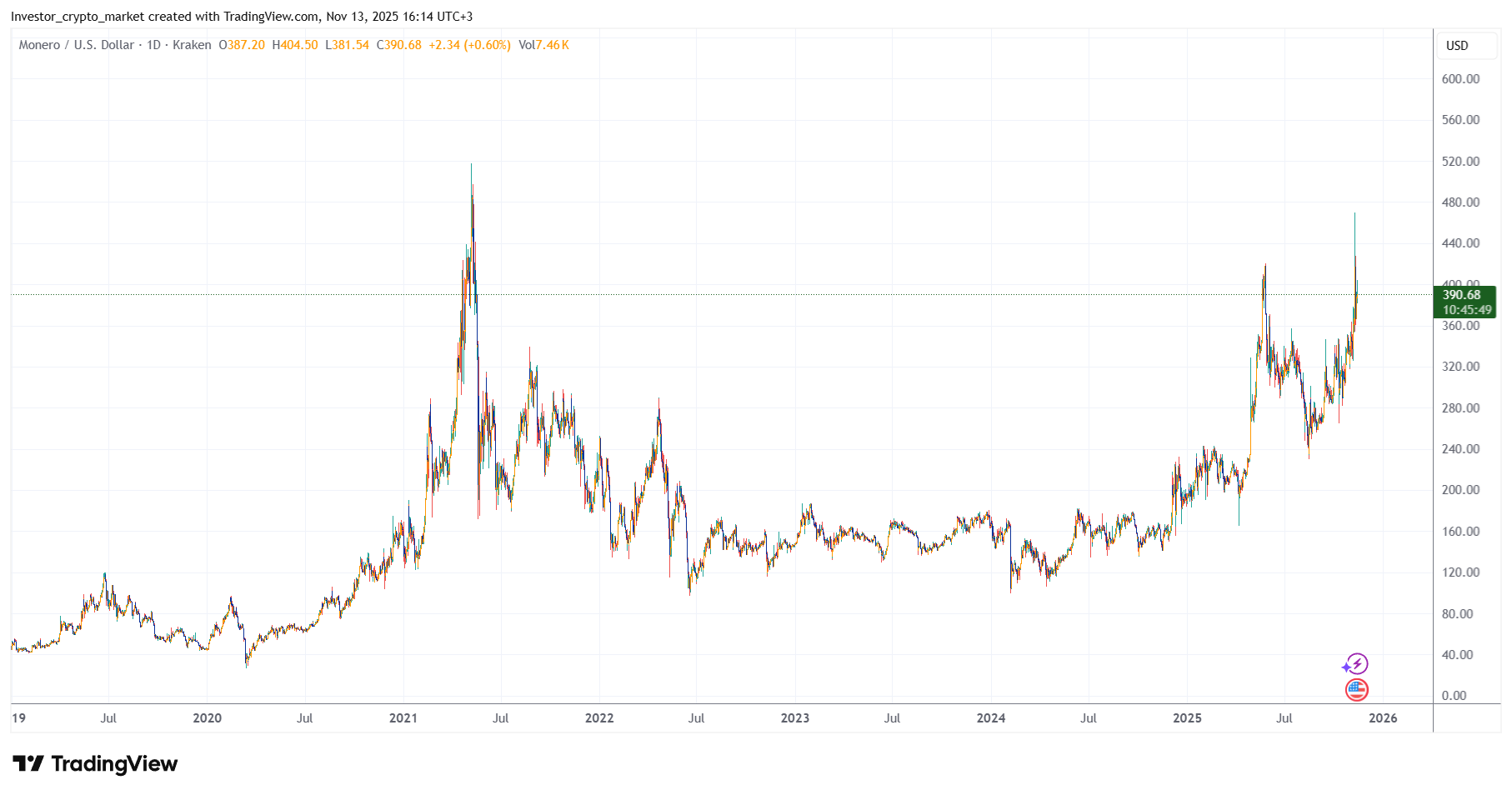
Monero Chart. Source: TradingView
XMR Tokenomics and Use Cases
Monero works like digital cash. It has no physical form and is not backed by external collateral. The cryptocurrency can be used:
- to pay for goods and services
- for international settlements
- for private transfers
- as a long-term store of value
The block reward has already decreased to its minimum and will shift to a constant small tail emission. This model keeps miners motivated and ensures long-term network stability. XMR remains fully fungible, which makes it convenient for everyday use.
How Monero Works. Privacy Technologies
Stealth Addresses. Protecting the Receiver
Each incoming payment generates a one-time address. It is impossible to determine who received the funds or link their transactions. A user scans the blockchain using a private view key, and this happens locally without exposing data to third parties.
RingCT. Hiding the Transaction Amount
RingCT hides the transferred amount, and the network only verifies the mathematical correctness of the transaction. This eliminates the possibility of analyzing financial activity through transaction volumes.
Bulletproofs and Default Privacy
Bulletproofs significantly reduced transaction size and lowered fees. Privacy is always enabled by default, so users cannot accidentally create transparent transactions.
Monero vs. Bitcoin. Privacy, Fungibility, and Censorship Resistance
Some users search for what is Bitcoin Monero, usually trying to compare the two assets. Bitcoin is transparent, and anyone can view the transaction history of any address. Monero hides this information at the protocol level, making it one of the most private cryptocurrencies. XMR’s fungibility protects users from discrimination and makes it difficult to block or blacklist specific coins.
In 2025, an important incident occurred involving Qubic. A mining pool using Proof of Work gained more than half of Monero’s hashrate and performed the largest reorganization in the network’s history — an 18-block reorg. A total of 118 confirmed transactions were invalidated. This sparked debates about security, DNS checkpoints, and the importance of decentralized mining. User privacy was not affected. Monero continued operating without data leaks, and the network remained stable.
Where and How to Buy Monero in 2025
Users have several ways to buy XMR:
- exchanges offering XMR trading pairs
- p2p platforms
- registration-free swap services
Exchanges allow trading XMR against other assets or stablecoins, but in some regions support is limited due to regulatory rules. Many users therefore prefer swap services. On Quickex, you simply select the direction, enter the receiving address, and send the funds. This method is popular because:
- no account is required
- transactions are fast
- the interface is beginner-friendly
- the service works around the clock
To buy XMR on Quickex, open the website, choose a pair with Monero, and enter your wallet address.
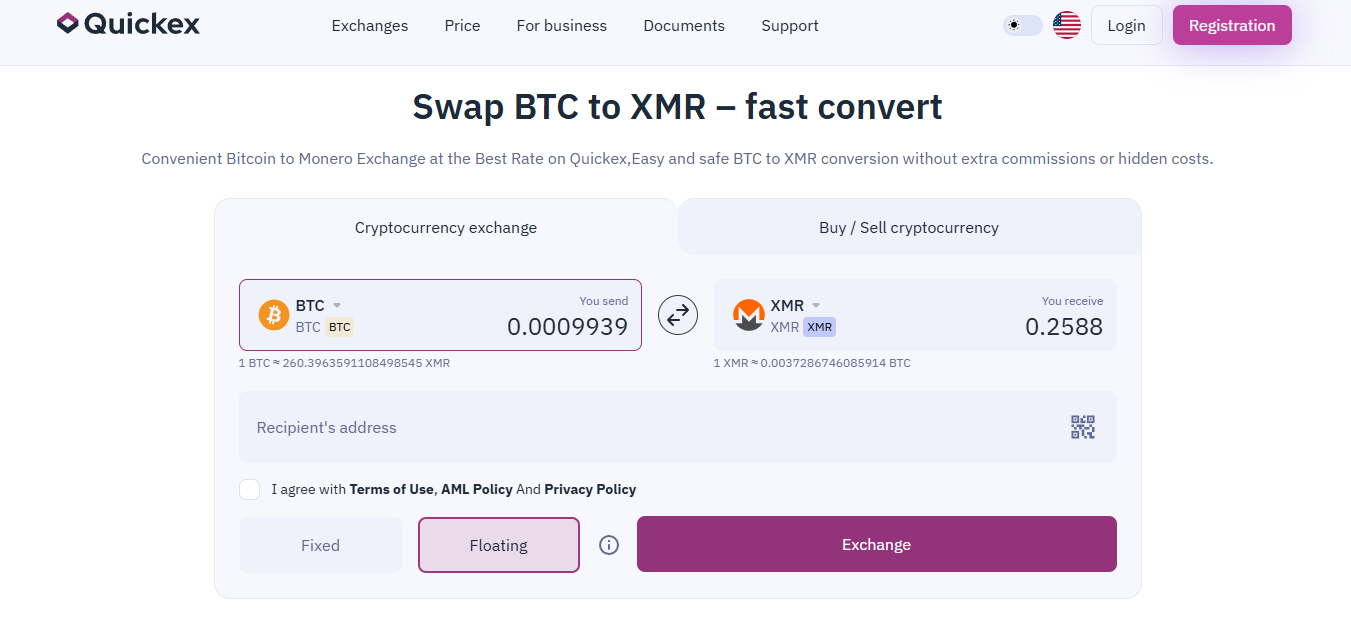
Quickex allows anonymous use, which is not possible on centralized exchanges.
How to Store Monero Safely
You can store XMR using supported wallets, including:
- Monero GUI Wallet
- Monero CLI Wallet
- Monero.com Wallet
- Feather
- Monerujo
- Stack Wallet
Hardware wallets such as Ledger Nano and Trezor provide strong cold-storage protection. Many users prefer local storage with their own node for maximum privacy.
FAQ — What is Monero XMR
What is Monero (XMR)?
Monero (XMR) is a decentralized, open-source privacy cryptocurrency where anonymity is mandatory by default, not an optional feature. Monero (XMR) is a blockchain cryptocurrency that is private, untraceable, fungible, and decentralized. The protocol is open-source and based on CryptoNote v2 — a concept described in a 2013 whitepaper. The mainnet was launched in 2014. Monero (XMR) is the world’s leading privacy-by-default cryptocurrency, launched in April 2014 as a fork of Bytecoin. Unlike Bitcoin or Ethereum, where every transaction is permanently recorded on a public ledger, Monero hides the sender, receiver, and amount of every transaction — by default, without any user participation required. The name “Monero” comes from the Esperanto language and simply means “coin”. By the number of developers, Monero ranks third among all cryptocurrencies — behind Bitcoin and Ethereum.
How does Monero work? What technologies make it private?
Monero’s privacy is ensured by three complementary cryptographic mechanisms working simultaneously at the protocol level.The sender, receiver, and amount of every transaction are hidden using three key technologies: Stealth Addresses, Ring Signatures, and RingCT. Since every transaction is private, Monero cannot be traced. This makes it a truly fungible currency.
Here is how each mechanism works:
Ring Signatures — hides the sender: When you send Monero, your transaction is grouped with 15 decoys from the blockchain into a ring of 16 participants. An observer sees 16 possible senders but cannot determine which one is the real one.
Stealth Addresses — hides the receiver: To hide the receiver, Monero uses stealth addresses. The address published by the receiver is never recorded directly on the blockchain. Instead, each transaction generates a one-time destination address.
RingCT — hides the amount: In January 2017, Monero added a critical upgrade: Ring Confidential Transactions. RingCT hides the transaction amount using Pedersen commitments — a mathematical way to prove the correctness of a number without revealing it. Since September 2017, all Monero transactions use RingCT by default.
FCMP++ — the latest 2026 upgrade: FCMP++ (Full-Chain Membership Proofs++) is the most ambitious cryptographic upgrade in Monero’s history. It is a Non-Interactive Zero-Knowledge (NIZK) proof system that proves a transaction output belongs to the global set of all unspent outputs without revealing which one. The anonymity set grows from 16 decoys to every UTXO ever created on the blockchain.
Is Monero really untraceable? How does XMR compare to Bitcoin?
Yes — by default, Monero fundamentally differs from Bitcoin in its level of privacy. Although Monero is a public and decentralized ledger, all transaction details are hidden. This contrasts with Bitcoin, where all transaction details, user addresses, and wallet balances are fully public and transparent.
Bitcoin offers pseudonymity, but not true anonymity. Every Bitcoin address and every transaction is visible on the public ledger. In contrast, XMR Monero automatically hides the sender, receiver, and amount. That is why people often ask: “Can Monero be traced?” — and the answer remains: no.
Fungibility — a key difference: Because all XMR coins are indistinguishable from one another, no coin can be tainted, censored, or discriminated against. Fungibility is not a feature in Monero. It is the default.
Merchants and individuals accepting Monero do not have to worry about blacklisted or “tainted” coins.
What are the risks and legal status of Monero in 2026?
Monero is legal in many jurisdictions; however, regulatory pressure has intensified, and several major exchanges have delisted XMR. In 2025, the privacy coin space saw 73 XMR exchange delistings — the highest number in a single year since the asset’s launch.
The main driver behind almost all delistings is European legislation. The MiCA Regulation reached full force in late 2024 for licensed crypto-asset service providers, and the Anti-Money Laundering Regulation (AMLR) added rules that effectively prohibit licensed CASPs from offering coins with anonymity-enhancing features. Following the wave of exchange delistings in 2024–2025, Monero trading migrated to decentralized and P2P platforms, demonstrating resilient demand and continued use. P2P markets, decentralized exchanges (DEXs), and atomic swaps now allow users to trade XMR coins securely without intermediaries.
Important: Monero does not exempt you from tax obligations. Always check the laws of your jurisdiction before using XMR.
How can I buy or swap Monero (XMR) without KYC?
Quickex is one of the most direct ways to buy or swap XMR without registration and verification. Recent Monero upgrades, including Bulletproofs+, View Tags, and the Jamtis wallet system, have improved network performance, making it faster and more efficient while maintaining strong privacy features. That is why swapping through a reliable no-KYC service remains the preferred route for privacy-conscious users.
How to swap or buy XMR via Quickex — step by step:
- Go to quickex.io and choose a pair — for example, BTC → XMR, ETH → XMR, or USDT → XMR in the calculator.
- Enter the amount — the service will show the current real-time rate. Choose the rate type: fixed (guaranteed receiving amount) or floating (follows the market at the time of execution).
- Enter your Monero wallet address — paste your XMR address (Cake Wallet, Monerujo, official GUI). Always double-check the address after pasting: blockchain transactions are irreversible.
- Send the coins to the generated deposit address for your order.
- Receive XMR — once the network confirms the deposit, Quickex will automatically convert and send the XMR to your wallet.
For convenient storage and swaps: MyMonero (web/mobile, remote nodes) and Cake Wallet (multi-coin, with built-in swaps). For mobile users: Monerujo (Android) and Edge (iOS) — with 2FA support and Tor integration. No registration or KYC is required — only your Monero wallet address.