
In a world where Bitcoin mining means warehouse-sized rigs and massive power bills, the Pi Network team proposed an alternative. The project’s developers insist you don’t need industrial-scale energy to mine crypto — you just need to press a button on your phone.
Pi Network split the world into two camps: some defend the project and believe in its prospects, others claim the platform is run by real scammers. Let’s examine both sides’ arguments to see who’s right.
Track your favorite cryptocurrencies’ prices on Quickex.
From a Stanford Idea to a Global Phenomenon
Pi Network was born at Stanford in 2018. The project’s founders are Dr. Nicolas Kokkalis and Dr. Chengdiao Fan — specialists in computer science and computational anthropology.
On March 14, 2019 — Pi Day (3.14) — the project launched its app and released a whitepaper. The documents state that Pi Network’s mission is to make cryptocurrency accessible to everyone. To do this, the developers proposed abandoning classic mining.
The idea of mining coins on a phone went viral quickly. More than 60 million active users registered in the app, and according to unofficial data, total downloads exceeded 100 million. These numbers make Pi Network one of the largest crypto communities in the world.

Screenshot of the Pi Network website
The project’s mainnet didn’t launch until February 2025. Over the years, many labeled Pi Network a scam where users “mine” worthless play-money. Despite the criticism, the cryptocurrency did eventually appear on an exchange.
Mining Without Mining
To “mine” Pi, a user only needed to press a button in the app once a day. The process required no GPUs, no farms, and no large energy costs — that’s why Pi is often called the most environmentally friendly way to mine.
Technically, though, this wasn’t real coin mining. Before the open network launched, users received digital vouchers that were later converted into real tokens.
When Did Pi Mining End
Pi mining was shut down on March 14, 2025. That day marked the end of the final Grace Period for network participants. It was introduced to give users extra time to complete mandatory KYC verification and move their accumulated tokens from the mobile app to the mainnet.
The Grace Period was extended several times because many participants faced technical glitches and didn’t manage to verify their identity in time.
Ending the Grace Period was the logical next step after the open mainnet launched in February 2025. The team announced that continuing mobile mining no longer made sense: the test-accumulation phase had ended, and the system was moving to a real economy with transfers and use of the coin within the ecosystem.
The reason for ending Pi mining was the developers’ intention to purge the network of inactive and unverified accounts, stabilize the token’s circulating supply, and prepare the project for future exchange listings.
Until March 2025, users could verify their identity and preserve their balances, but after the deadline the daily “mining” button in the app was disabled.
Now, participation in the ecosystem is only available to those who managed to pass KYC and move their tokens to the mainnet, where development of Pi-based apps and services continues.
Technology and Trust Principles
The network is based on the Stellar Consensus Protocol, an algorithm built on the federated Byzantine agreement model. Instead of energy-hungry Proof-of-Work like Bitcoin, Pi relies on social trust. Users form “security circles” — groups that vouch for transaction integrity.
This builds a web of trust where security is provided through human interaction rather than computing power. That reflects Pi’s philosophy: the human factor is treated as a resource.
The Pi Cryptocurrency
Pi’s long-awaited trading began in February 2025. Notably, even before the official release of coins, fake tokens appeared on the market and caused a stir.
Unfortunately for fans, after a sharp surge in the first days of trading, the coin went into a prolonged decline. As of the time of writing, Pi trades 92% below its peak. The crash is largely tied to the project’s inflationary issues, which we’ll cover shortly.
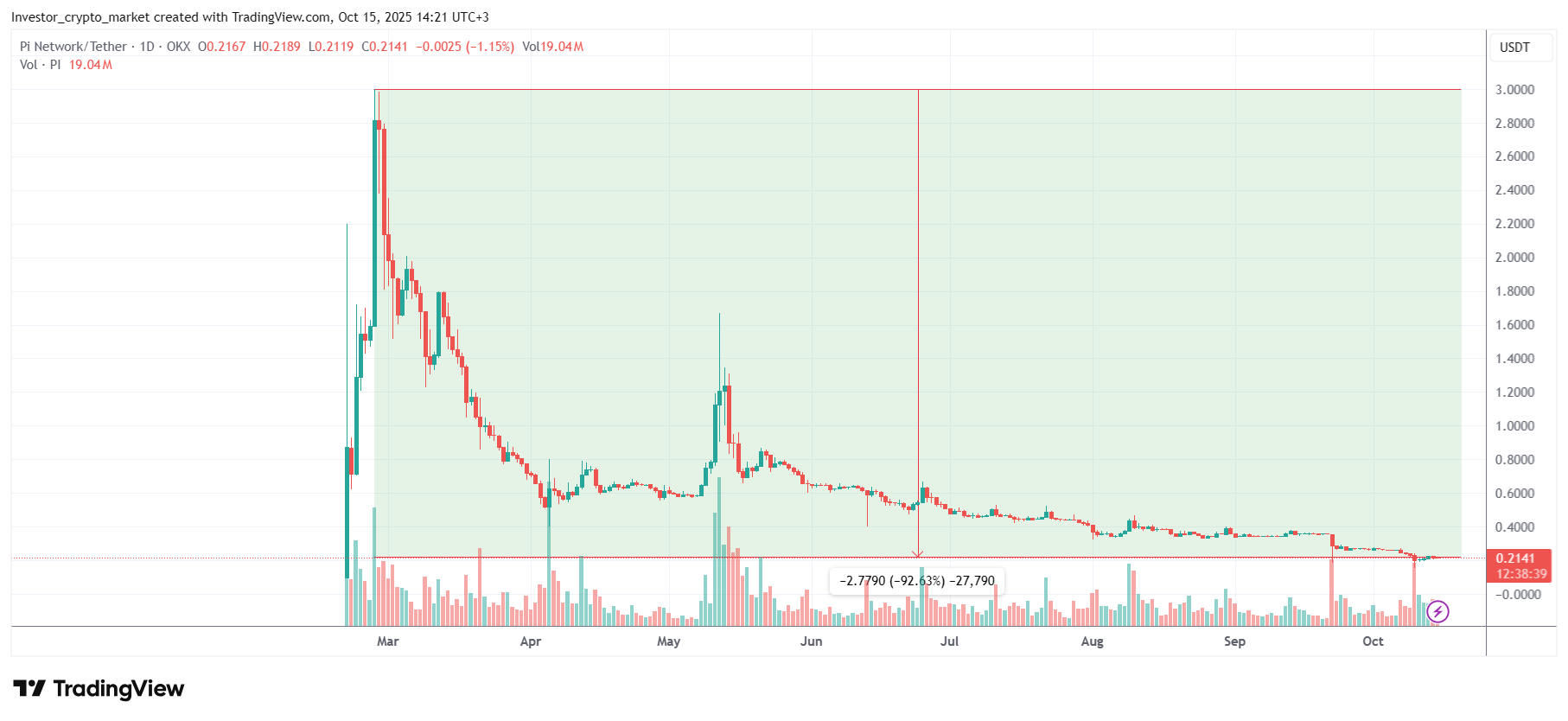
Chart Source: TradingView
What’s Wrong With Pi
There are many complaints about the project. Let’s take a look.
Endless Launch Delays
For years, the developers kept “promising for tomorrow” when it came to the launch. Yes, the release happened, but during those years of “building a crypto community,” many grew tired of waiting.
Inflation
Pi’s inflation is one of the project’s weakest spots and is being flagged more and more by analysts. By the end of mining in March 2025, tens of billions of Pi were in circulation, yet there were few real use cases for the token. Transactions remained inside a closed ecosystem, and Pi’s price wasn’t set on an open market.
With no external demand, the large token supply effectively undermines its potential value. The project’s economy ended up in a situation where user activity created tokens faster than the network could give them real utility. This was one reason the Pi team decided to end mining — to limit issuance and try to stabilize the future economic model.
Operating Like a Pyramid
Pi Network uses an internal hierarchy of roles. Many see signs of a pyramid scheme or at least an MLM structure. Here’s how the mining hierarchy worked in the app:
- Pioneer — taps the button once a day.
- Contributor — forms a circle of trusted participants and increases earnings.
- Ambassador — invites new users and receives bonuses.
- Node — runs software to validate transactions.
The system combines elements of gaming, social interaction, and network marketing. The more people are involved, the higher the mining rate. Because of this, the structure is often compared to a pyramid, although users are not required to invest money directly.
Closed Economy
Since 2021 the network operated in an Enclosed Mainnet mode — the blockchain functioned but was isolated from the outside world. Coins couldn’t be withdrawn, sold, or exchanged. The developers explained this as a desire to first build infrastructure and real services and to prevent exchange speculation.
Inside the network, its own apps emerged: Pi Browser, small marketplaces, an NFT platform, and campaigns like PiFest where shops accepted Pi as payment. In some countries, users could top up mobile balances or buy gift cards. The scale is still small, but steps like these keep the community’s faith alive.
Pi Isn’t Listed on Many Major Exchanges
In six years, Pi still hasn’t appeared on major platforms like Binance or Coinbase. The main reasons are compliance issues, user verification, and centralization risks.
The most notable episode came in 2025, when Binance held a poll: more than 80 percent of users voted to list Pi. However, after an internal review the exchange declined, citing a lack of transparency, incomplete verification, and excessive control by the project team. This sparked community protests — project supporters began massively down-rating Binance in the app stores.
KYC and Privacy Concerns
To convert vouchers into real tokens, users had to pass KYC — identity verification. At first, the process was handled by Yoti; later Pi switched to its own system. As of early 2025, about 13 million people had been verified.
Mass verification raised concerns. Users submit documents and photos to an app that also earns money from ads. It’s unclear how the data is stored and who is responsible for its security. There’s no external audit, and protection is based on trust in the developers.
The coins of those who didn’t manage to pass KYC simply get burned.
Why the Community Keeps Believing in the Project
Despite criticism, Pi Network remains unusually popular. For millions of users in developing countries, Pi was their first chance to join digital finance.
The project gives people a sense of belonging to the crypto industry and hope that their accumulated tokens will one day gain value. For many participants, this isn’t an investment but a form of waiting for the future.
Pi Network’s Plans
The team announced that 2025 would be decisive. The plans include scaling KYC using AI and community checks, upgrading the protocol to v23 with smart-contract support, expanding the app ecosystem, and running new PiFest events.
The open network should allow users to transfer and sell tokens on external exchanges. However, delivering on these promises depends on how quickly the project resolves compliance, security, and transparency issues.
Bottom Line
Pi Network is a rare example of a crypto project where technology intertwines with social dynamics. It shows how belief, attention, and habit can sustain an ecosystem without a real market. Some see a pyramid, others see a step toward a new model of digital economy.
Pi remains an experiment on the border between innovation and anticipation. Its future depends on whether the team can turn millions of button taps into a working cryptocurrency and prove there is real value behind the idea.
Sadly, the token’s 90%+ crash suggests the idea didn’t “take off.”
You can profitably exchange cryptocurrency and keep your anonymity with the Quickex exchanger.
FAQ
What is Pi Network?
Pi Network is a cryptocurrency project launched in 2019 by Stanford PhDs Dr. Nicolas Kokkalis and Dr. Chengdiao Fan. Its core idea: let anyone “mine” crypto from their phone using a lightweight consensus mechanism based on the Stellar Consensus Protocol (SCP), with no battery drain or expensive hardware required. The project has grown to over 47 million engaged pioneers, making it one of the largest crypto communities in the world by user count.
The Pi Network Open Mainnet launched on February 20, 2025, at 8:00 AM UTC, enabling external connectivity, exchange listings, and real-world Pi transfers for the first time.
The native token is PI, with a maximum supply of 100 billion tokens. As of mid-2026, approximately 14 million pioneers have fully migrated their tokens to mainnet, while millions more remain in an unverified state awaiting KYC completion.
What is the current Pi Network value? (PI price today)
As of June 18, 2026, the Pi Network price is trading at $0.126, with a market cap of $1.35 billion. Key metrics:
- 24h volume: ~$8.17 million
- Circulating supply: 10.74 billion with a maximum supply of 100 billion
- Ranking: #56 by market cap
- All-time high: $2.98 (February 26, 2025)
- Discount from ATH: ~96%
Pi Network still sits in a strange middle ground between massive community adoption, ongoing migrations, uneven liquidity, and limited proven demand outside its own ecosystem. Pi Network price has slumped by 27% year-to-date in 2026, and the network will unlock over 174 million tokens worth over $26 million in June, leading to more supply in its ecosystem.
💶 Valore PI / Valor PI (EUR & other currencies)
At ~$0.126 USD:
- PI/EUR: ~€0.115 (EUR/USD ~1.09)
- PI/INR: approximately ₹13.90–₹14.10
- PI/BRL: ~R$0.70 (USD/BRL ~5.55)
What is the latest Pi Network news? (June 2026)
Several significant developments have occurred in 2026:
- Protocol v24 & v25 upgrades (June 2026): Protocol v24 is a major technical upgrade improving node stability and database performance, with a strict deadline. The network is upgrading to Protocol v25 by June 18, which forces node operators to upgrade to Stellar Core V20 and Soroban smart contracts.
- Consensus 2026 appearance: Pi Network founders Dr. Nicolas Kokkalis and Dr. Chengdiao Fan appeared at Consensus 2026 in Miami, marking one of the project’s most visible public appearances in the broader crypto industry.
- Pi Launchpad testing: Almost 480,000 Pioneers took part in the Launchpad testing, and a second test token called “SLICE” is live until Pi2Day (June 28).
- Smart contracts: Pi Network has introduced subscription-based smart contracts on Testnet (PiRC2), marking a major step toward on-chain utility.
- Token lockups: By early 2026, roughly 65 billion Pi had been locked, which the Core Team argues will reduce sell pressure — though whether that lockup commitment holds once real money is on the table remains an open question.
Does Pi Network have real value?
This is the most debated question in the Pi community. The honest answer has two sides:
The case for value:
- PI is traded on real exchanges (OKX, Bybit, MEXC, Bitget, Gate.io) with a ~$1.35B market cap — it has a market-determined price.
- 47+ million user community — larger than most Layer-1 blockchains.
- Smart contracts (Soroban) and a DEX are being activated in mid-2026.
- Pioneers in several countries have organized local marketplaces where goods and services are exchanged for Pi.
- 65 billion PI locked voluntarily, reducing near-term sell pressure.
The case against:
- Pi Network is currently facing multiple structural bottlenecks such as insufficient liquidity, pricing disagreements, and compliance obstacles.
- Only ~10.7B of 100B total supply is circulating — massive future dilution risk as remaining 89B tokens unlock over time.
- 24h volume (~$8M) is extremely thin for a $1.3B market cap — the turnover ratio of 1.14% indicates that daily trading activity is relatively low compared to its total market value.
- Not listed on Coinbase, Binance, or Kraken — the largest exchanges have not listed PI, limiting institutional access.
- PI has dropped ~96% from its $2.98 ATH in just 16 months.
Bottom line: Pi has a price — but that price reflects thin liquidity, massive uncertainty about future supply, and an ecosystem still in early beta. Treat PI as a highly speculative, experimental asset.
What is the Pi Network price prediction for 2026?
The general expected trading zone for 2026 is roughly $0.12 to $0.57. Analyst breakdowns:
- Pessimistic: if selling pressure keeps dominating, Pi could fall to around $0.053 to $0.055 by the end of 2026 — a worst-case scenario if confidence collapses.
- Base case: CoinDCX views that Pi can slowly climb within $0.16 to $0.50 if ecosystem usage keeps improving and more apps actually start using the network.
- Optimistic: price predictions range from optimistic $0.85–$3.50, with extreme bull case at $5 — though this requires major exchange listings and breakthrough adoption that has not materialised.
PI can move up a bit, but it’s still stuck in a wide, weak range unless something big changes in adoption or demand. The key events to watch: Protocol v25 activation, Pi2Day (June 28), potential Binance/Coinbase listing announcements, and whether the 65B locked PI stays locked as prices remain low.
Where can I trade Pi Network (PI)?
PI is listed on OKX, Bybit, MEXC, Bitget, Gate.io, and several other mid-tier exchanges. It is not listed on Coinbase, Binance, or Kraken as of June 2026 — listing on a top-3 exchange would be a major catalyst.
If you hold PI and want to convert it to BTC, ETH, USDT, or any other asset — or if you want to swap another coin for PI — you can do it instantly on Quickex. No registration, no KYC, live rate at the moment of exchange, and coins go directly to your wallet.