

Polymarket is a blockchain-based prediction platform where users trade on the outcomes of real-world events. Instead of placing classic bets, people buy and sell shares that reflect how likely a specific outcome is. Prices move between $0 and $1 and change as news, rumors, and new data appear.
The platform became widely known through political markets. Election odds and presidential odds on Polymarket often react faster than polls, sometimes noticeably so. For many observers, that speed turned the platform into a kind of real-time sentiment tracker rather than just another betting product.
People who follow crypto markets alongside prediction markets usually care about timing. Quickex fits naturally into that routine, offering a convenient way to track the price of favorite coins and complete profitable crypto-to-crypto exchanges without unnecessary steps.
How Polymarket Works
At its core, Polymarket works through simple probability contracts tied to clearly defined outcomes.
- a Yes share settles at $1 if the event happens
- a No share settles at $1 if the event does not happen
- prices between $0 and $1 represent the market’s current probability estimate
A Yes share trading at $0,68 implies a 68% probability. That number is not set by the platform. It is the result of users buying, selling, hedging, and reacting to information in real time.
Positions can be opened or closed before the market resolves. That flexibility makes Polymarket feel closer to trading than to traditional fixed-odds wagering. Prices move continuously, sometimes calmly, sometimes sharply.
Polymarket itself does not act as a bookmaker and does not take the opposite side of trades.
Prediction Markets and Betting Markets Compared
Traditional betting markets depend on fixed odds and a central bookmaker. Polymarket removes that structure entirely. Users trade directly with each other, and prices adjust purely through supply and demand.
Key differences include:
- no bookmaker and no built-in house margin
- direct peer-to-peer trading
- prices that react instantly to news and sentiment
Some participants treat Polymarket as crypto betting or rypto betting, especially during high-profile political or economic events. Others use it more as a forecasting tool, watching how probabilities shift rather than focusing on profit alone.
Many traders combine prediction markets with active asset management. Quickex helps with that workflow by making it easier to convert assets, monitor exchange rates, and move between crypto and fiat when conditions change quickly.
Popular Polymarket Markets
Polymarket covers a wide range of real-world topics. The categories below represent only part of what is available on the platform, as new markets appear regularly.
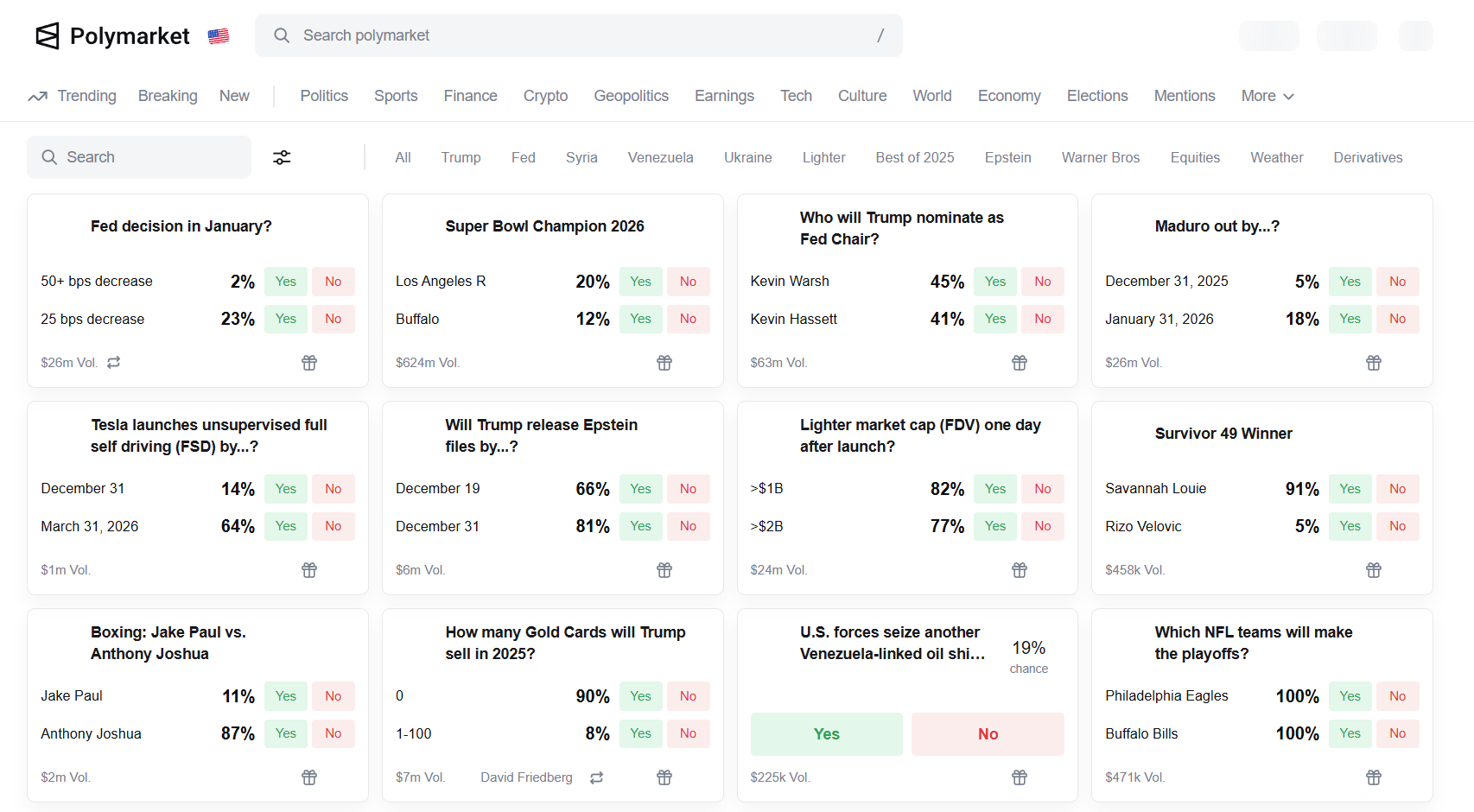
Polymarket interface
Politics and Elections
Politics remains the most active category on Polymarket. Election odds tend to attract the highest liquidity and the most attention.
Common markets include:
- national and local elections
- polymarket government shutdown scenarios
- leadership resignations and confirmations
- city-level races such as polymarket nyc mayor markets
Cryptocurrency and Blockchain
Crypto-related markets usually focus on events rather than short-term price moves.
Typical topics include:
- ETF approvals
- exchange listings and delistings
- network upgrades
- regulatory and enforcement actions
Sports
Sports markets exist alongside political and crypto markets. Pricing remains dynamic, without fixed odds or bookmaker intervention.
Geopolitics, Economy, and Culture
Broader markets cover:
- international conflicts and sanctions
- inflation data and interest rate decisions
- cultural and media events
- religious leadership outcomes, including polymarket pope markets
The list above is not exhaustive. Polymarket regularly adds new themes and regions.
Polymarket and Regulation
Regulation has played a major role in shaping how Polymarket operates.
United States
In 2022, Polymarket settled with the U.S. Commodity Futures Trading Commission and blocked U.S. users from accessing the platform.
A significant change followed in September 2025. Polymarket acquired QCX, a CFTC-regulated derivatives exchange, for $112 000 000. After that acquisition, the CFTC issued a no-action letter related to QCX. This created a compliant pathway for Polymarket to return to the U.S. market under regulatory oversight, with limits on market scope.
France and Other Countries
French regulators temporarily restricted access to Polymarket in 2024 due to concerns tied to gambling laws. After compliance adjustments, access remains limited.
In other regions, Polymarket often operates in a legal gray area. Users remain responsible for understanding local rules, which is why questions like is polymarket legal continue to come up.
Polymarket Competitors
Several platforms operate in the prediction market space, but one competitor is mentioned more often than the rest.
Kalshi
Kalshi is widely considered the main competitor to Polymarket. Together, the two platforms dominate global prediction market volume.
Kalshi operates under direct CFTC regulation in the United States. That regulatory clarity allows partnerships with major brokers and wallets and makes institutional participation easier.
By late 2025, Kalshi had expanded through:
- integration into the Phantom wallet
- use as underlying infrastructure by exchanges and brokers
- close cooperation with Robinhood
Kalshi’s regulatory clarity positions it as the most direct and consistent alternative to Polymarket.

Comparison of Kalshi and Polymarket statistics. Source: DefiRate
Opinion
Opinion approaches prediction markets from a more social angle. Markets come with built-in discussions, explanations, and visible shifts in sentiment alongside price changes.
Key traits include:
- community discussions attached to each market
- user-generated reasoning and commentary
- coverage of politics, technology, culture, and global affairs
While Opinion’s liquidity and trading volume are smaller compared to Polymarket and Kalshi, the community-centric design gives it a distinct place in the landscape.
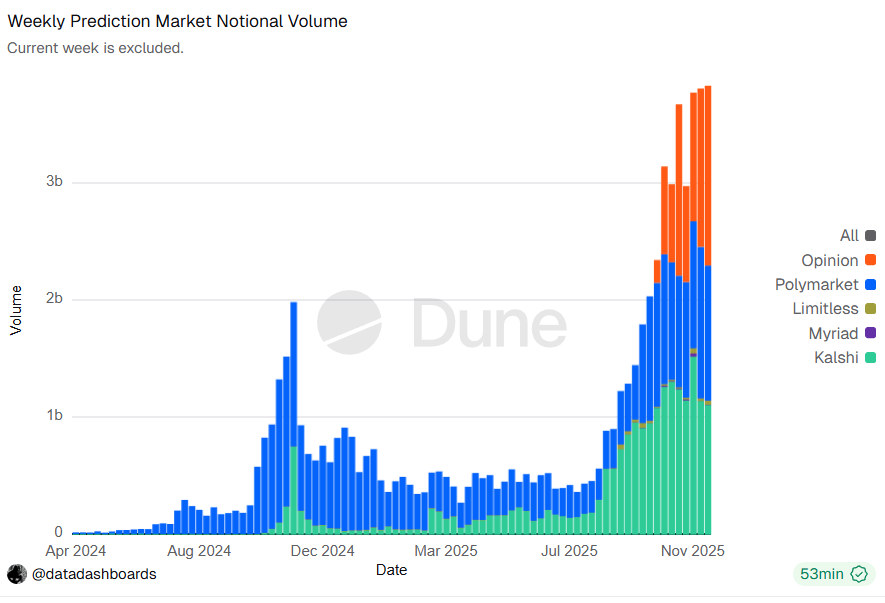
Comparison of statistics across major prediction markets. Source: Dune
Other Competitors and Alternatives
Other platforms include:
- Gemini Predictions, launched via Gemini Titan with U.S. regulatory approval
- Probable on BNB Chain, incubated by PancakeSwap
- predict.fun, focused on improving capital efficiency
Wallet integrations from MetaMask, Trust Wallet, and Coinbase suggest prediction markets are moving closer to core crypto infrastructure.
FAQ: Polymarket Explained
What is Polymarket
Polymarket is a prediction market platform where users trade on real-world outcomes using market-based probabilities.
How does Polymarket work
Users buy and sell outcome-based shares priced between $0 and $1. Prices reflect collective expectations and update continuously.
Is Polymarket legal
Legal status depends on jurisdiction. Polymarket returned to the U.S. in 2025 through a regulated exchange structure, while access in other regions may be limited.
Why people track Polymarket election odds
Markets backed by real capital tend to respond faster to new information than opinion polls, especially during major political events.
People who actively trade or follow market signals usually value speed and simplicity. Quickex offers a practical platform for profitable crypto-to-crypto and crypto-to-fiat exchanges, making it easier to act when timing matters.
Disclaimer: The material in this article is not financial or investment advice. Everything stated here reflects the author's personal view and should not be treated as a recommendation to trade or invest. We make no warranties regarding the accuracy, reliability or completeness of the information presented. Cryptocurrency markets are highly volatile and can move unpredictably. Before committing any funds, every investor, trader or crypto user should study several independent sources and check the regulations that apply in their own jurisdiction.