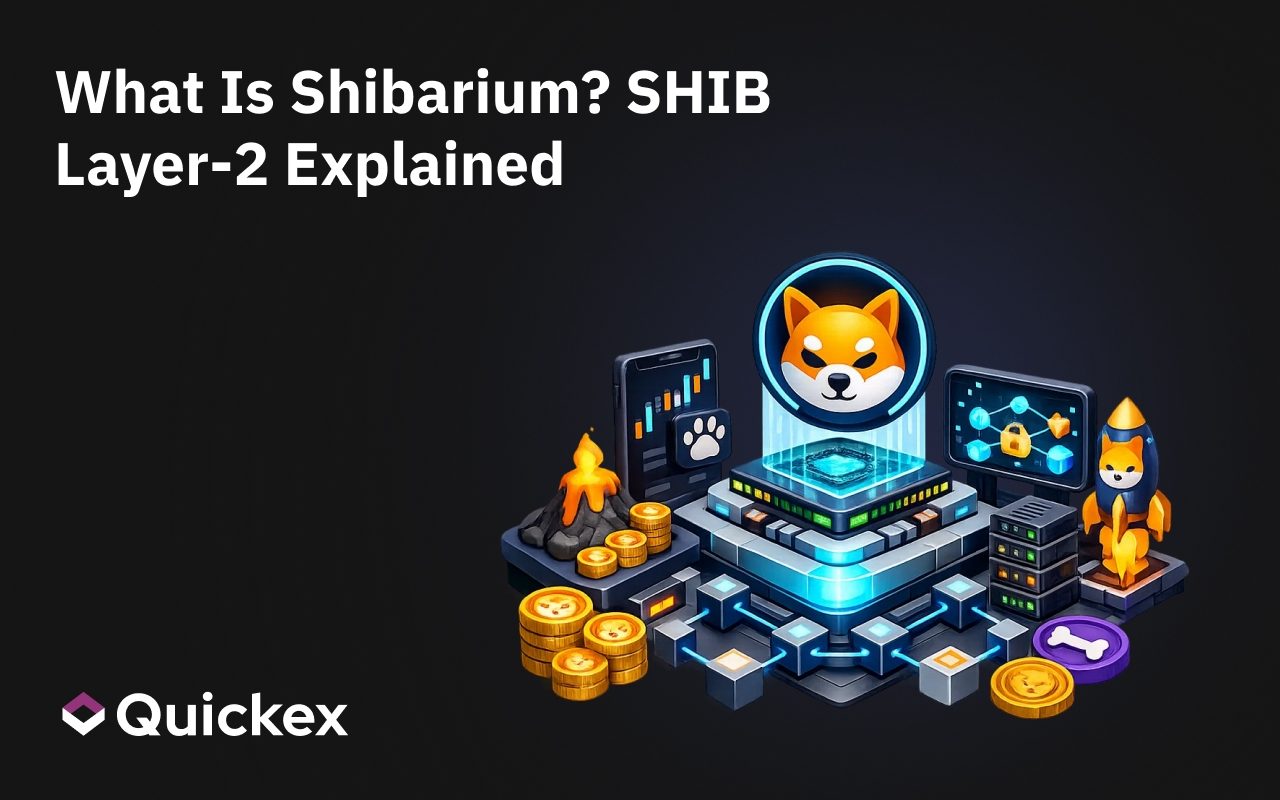

If you’ve spent any time around the Shiba Inu ecosystem, you’ve probably heard the same question repeated in different forms: what is Shibarium, what does it actually do, and why does it matter beyond meme-coin hype?
At the base level, Shibarium is a Layer-2 (L2) blockchain network that aims to leverage the Ethereum blockchain by keeping down transaction costs and timing. Instead of forcing every action to compete in the expensive blockspace of the Ethereum mainnet, Shibarium routes those activities through its own network and later settles back to Ethereum.
This guide explains how Shibarium works, which tokens are involved, what “gas” means on Shibarium, how bridging typically works, and what kinds of shibarium news are worth tracking if you’re trying to understand where the ecosystem is heading.
Shibarium in one sentence
Shibarium is a 2nd layer network that involves the Shiba Inu ecosystem, running on Proof of Stake, which is designed to offer faster, lower-cost transactions through taking care of security and settlement through Ethereum.
What problem is Shibarium trying to solve?
Ethereum is an overly used smart-contract chain, but this very feature adds much extra cost and instability during peak times. If you want to create consumer-friendly applications (game, marketplace, micropayment, frequent DeFi transactions), ever changing high Ether fees are just a deal-breaker.
Shibarium’s goal is to:
- Reduce payment fees for users;
- Increase on-chain throughput (more transactions per period);
- Make it easy for developers to build and deploy applications in the Shiba Inu ecosystem;
- Support real use-cases in which doing small things on chain matter (e.g., crypto payments, gaming interactions, etc.).
In essence, it is an infrastructure move: Shiba Inu is translated into ‘token + community + chain.’
When did Shibarium launch?
The Shibarium mainnet was launched on August 16th 2023 – the date refers to the progress from theoretical/testnet practice to live production environment where real value systems are in operation and errors and/or security practices are non-theoretical.
How does Shibarium work?
Layer-2 explained
When people ask what is Shibarium, they often get stuck on “Layer-2”. The easiest way to think about it is:
- Ethereum is the “base layer” (Layer-1);
- Shibarium runs alongside Ethereum (Layer-2);
- Transactions happen on Shibarium most of the time (cheap/fast);
- The network periodically anchors or settles results to Ethereum (security/immutability).
Shibarium is a multi-layer Proof-of-Stake network on top of Ethereum’s ether. The architecture is said to be a variant of Polygon PoS, much recognized for its Ethereum scaling technology, unbiased for the selection of tokens and ecosystem goals specific to Shiba Inu.
Validators and Proof-of-Stake
Unlike energy-intensive Proof-of-Work in Bitcoin, Shibarium engages in Proof-of-Stake. A validator participates in block production and network security by staking tokens. The “security budget” is created by means of staked collateral and incentives organized by protocol rather than by hardware and electricity necessary in the case of mining.
Which token powers Shibarium?
One of the major dilemmas for new initiates is that Shibarium is not a typical coin but rather a network. The token underpinning the work and use of the network is BONE, staking as well as for funds transaction purposes, referred to as “gas” on the network.
This is why you will often see people saying “Shibarium represents BONE for gas”, where the transaction fees are paid for in BONE and not in SHIB. (Depending on how applications are designed, users might still interact with SHIB heavily, but the base fee mechanism centres on Bone.)
How do SHIB, BONE, LEASH fit together?
The Shiba Inu ecosystem includes multiple tokens with different functions. The exact focus shifts over time as the ecosystem evolves, but what you have to remember is that Shibarium has remained as the infrastructure, while tokens are required to perform specific functions (fees, staking, governance, community use, and so on). Changelly highlights that Shibarium is the L2 network and that the project’s tokens are SHIB, BONE, TREAT, and LEASH.
Bridging: moving assets between Ethereum and Shibarium
Since Shibarium is a Layer-2, users frequently want a way to move tokens between Ethereum and Shibarium. This is where bridges come into play.
Shibarium documentation discusses mechanisms used for bridging between Ethereum and Shibarium. It uses Plasma and PoS. Proof-of-Stake security mechanisms facilitate transfers over these two networks.
In plain language:
- You lock (or escrow) assets on one side;
- A corresponding representation is released (or minted) on the other side;
- When you bridge back, the process reverses.
Bridges are mighty but also the greatest more often attacked part of the crypto infrastructure. This is not a reason to say don’t bridge; it will be saying While fixing bridges with regard to heavy-risk plumbing, double-check the URLs, and don’t rush.
What can you actually do on Shibarium?
Shibarium has been designed to support the most common activities in the crypto space but without the exuberant fees encountered when interacting with Ethereum. The typical use cases include:
1) Simple transfers
The sending of tokens is an important use case. Lower fees make it more realistic for everyday transfers especially concerning small amounts.
2) DeFi
Low-cost transactions make it easy to do things like:
- Swapping tokens;
- Providing liquidity;
- Borrowing and lending;
- Yield strategies.
3) NFTs and digital collectibles
It is much more feasible to mint and trade NFTs when transaction costs are fixed.
4) Gaming and “on-chain” interactions
Games generally entail lots of small transactions (inventory changes, crafting, scoring, marketplace trades). L2 networks generally offer the only viable approach to do that without fees spoiling the user experience.
Shibarium’s own documentation describes it as allowing for fast, low-cost operation for microtransactions and wider endeavors.
Why do people care about “burns” and Shibarium?

The Shiba Inu community often talks about a decrease in supply-burning tokens. Moreover, while the specifics of burning mechanics may seem different and then transform, the general, cleaner logic remains:
- More on-chain activity → more fees and ecosystem flows;
- Some designs set a share of that value into burns or other tokenomics mechanics.
The most important thing is to stay calm: burns are only important when they are used regularly and for the long term. To put it otherwise, Shibarium’s fall-back value with long-lasting value is more dependent on adoption (apps, users, transactions) and less on one-off headline burns.
Shibarium news: what updates should you actually watch?
Anything announced under “Shibarium news” may be serious or just an echo in the wind. If you are looking for valuable information, give priority to the following:
1) Developer tooling and documentation
Refinement in tooling (docs, SDKs, wallet integrations, explorer features) goes hand in hand with developer adoption. For instance, articles have indicated upward momentum as a result of where the official documentation portal has been upgraded.
2) Scaling, privacy, and cryptography upgrades
Several crypto news portals reported a potential privacy upgrade with Full Homomorphic Encryption (FHE) and Zama, the cryptographic firm in Q1 2026. SidQt saw this move as a push towards doing anything and everything about privacy or scalability capabilities around the Shibarium framework. Until officially released and thoroughly mapped to the code – watch for them; the direction they signify is substantial.
3) Real partnerships and real applications
The most vital of all the various sideways news is so blandly good that I let out a yawn: success of actively working apps, partnerships, and user-activity numbers that one can measure. Once Shibarium becomes the playground and runway for the Shiba Inu community to shape its Shiba Inu experience, all other aspects become distant memories.
Benefits and trade-offs
Potential benefits
- Lower fees than Ethereum mainnet for routine activity.
- Faster confirmations (depending on network conditions).
- Easier on-boarding for consumer apps (games, marketplaces).
- Ecosystem coherence: a shared network layer for Shiba Inu products and community experiments.
Trade-offs and risks
- Bridge risk: cross-chain transfers are an attractive target for attackers in the wider industry.
- Centralisation concerns: many L2 networks start more centralised than ideal and decentralise gradually.
- Ecosystem risk: if apps don’t gain traction, the network can become underused.
- Hype cycles: Shiba Inu has a strong community, but attention can swing quickly in crypto markets.
The mature approach would be to think of Shibarium as infrastructure – judge it on its reliability, adoption, developer action, and actual user results, not on sentiment.
The bottom line
So, what is Shibarium in practical terms? Well, Shibarium is Shiba Inu’s endeavor to transform a highly visible money brand into a truly functioning network; it creates a Layer-2 network for carrying out very low-cost transactions where developers can build apps unburdened by the high transaction fees of Ethereum.
If one follows Shibarium news, they should focus on updates indicating real progress, such as upgrades that have been released, improvements in tools associated therewith, the launch of some credits within apps, and some measurable growth in practice. All else is a means of chit-chatting.
FAQ
Is Shibarium its own coin?
No, Shibarium is a blockchain network; not made of just one coin. Think of this project with various tokens that will actually work together on this ecosystem as the vehicle with the network infrastructure riding on it to see that the tides of apps and transactions move further.
Which token do I use to pay fees (gas) on Shibarium?
If the bridge operates efficiently, will layoffs be a part of the transfer of the operational cost to the network? By employment, we mean not only the actualisation of the bridge but also its maintenance and task commitments.
Is Shibarium “safe” to use?
No blockchain is risk-free. Shibarium security depends on its validator set, bridge design, smart contract quality, and user behaviour (phishing is a major risk). A practical approach is to start small, test with a tiny transfer, avoid rushed clicks on social links, and use well-known wallets and explorers.
Disclaimer: The material in this article is not financial or investment advice. Everything stated here reflects the author's personal view and should not be treated as a recommendation to trade or invest. We make no warranties regarding the accuracy, reliability or completeness of the information presented. Cryptocurrency markets are highly volatile and can move unpredictably. Before committing any funds, every investor, trader or crypto user should study several independent sources and check the regulations that apply in their own jurisdiction.