
People often search for what is USDC when they realize a digital dollar might not merely replicate cash but surpass it in precision and reach. This realization usually comes gradually, as traditional payment systems reveal their structural limitations. Interest deepens once newcomers explore what is USDC crypto and discover a mechanism that moves value with an almost machine-like directness. That contrast raises an obvious question about how far such a system can extend beyond conventional finance.
This article explains exactly what USDC is and why it represents more than just another step in digital payments.
How USDC Works: Stability and Peg to $1
The mechanism behind the digital dollar is built on a straightforward convertibility model: every unit can be redeemed for an equivalent U.S. dollar, and that promise is supported by reserves composed of cash and short-term Treasuries. This structure ensures that the asset behaves as a claim on highly liquid instruments rather than as a speculative token. Monthly attestations from a major accounting firm verify that the reserve pool remains larger than the quantity in circulation.
Weekly disclosures outline minting activity, redemptions, and the precise composition of the reserve portfolio. With these controls in place, the one-dollar price is maintained not through algorithmic incentives or collateral auctions, but through conventional asset backing and continuous transparency that removes ambiguity about value.
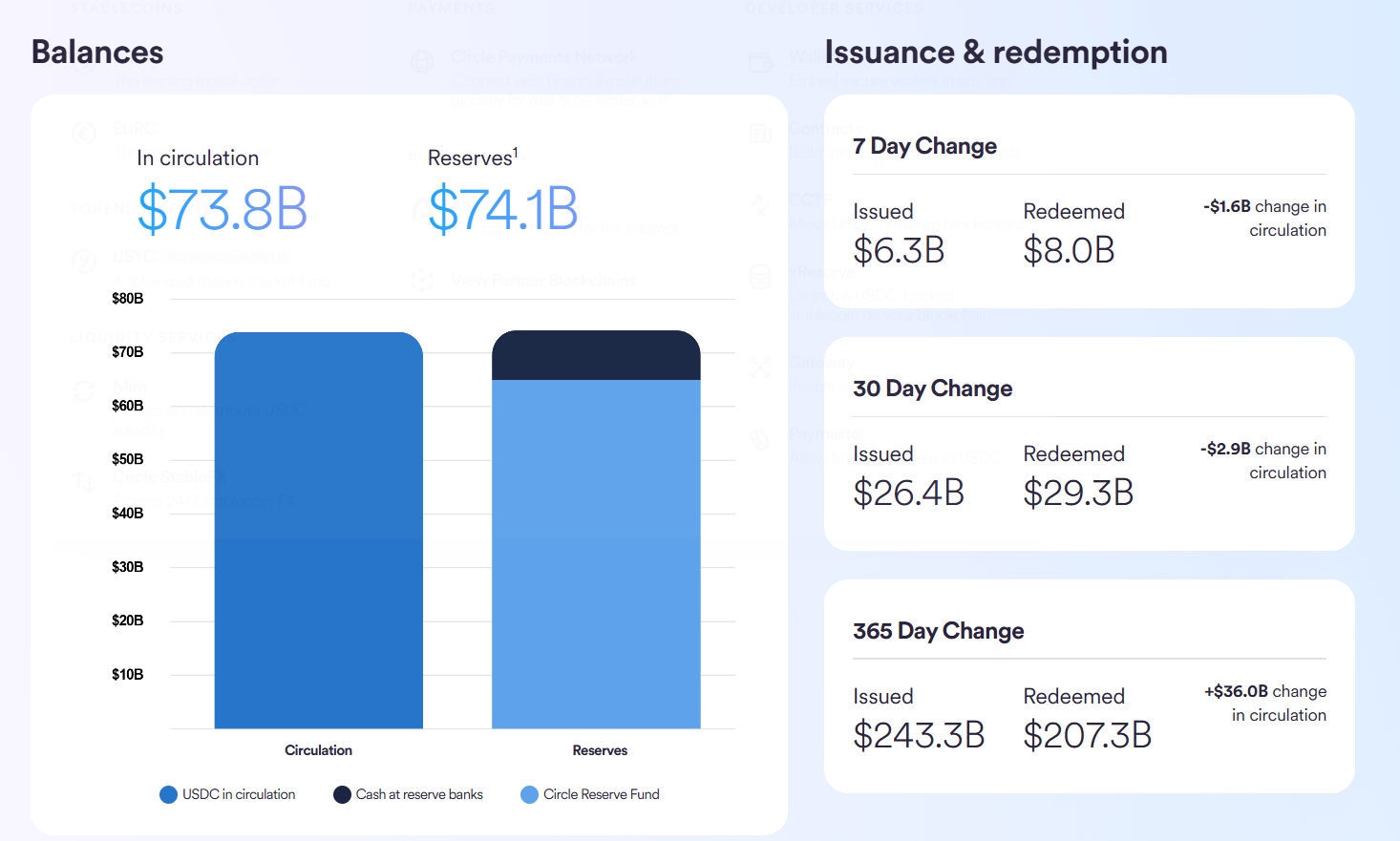
USDC reserves. Source: circle.com
Who Created USDC and Why
The digital dollar was originally introduced by Circle in cooperation with Coinbase through the CENTRE consortium. This partnership brought together regulatory expertise and large-scale distribution, giving the asset a foundation that was both compliant and operationally broad from day one. Their intention was to construct a monetary instrument capable of moving without the delays embedded in conventional settlement systems.
That objective reflected a broader ambition: redesign the movement of value so it could function continuously rather than on the intermittent schedule imposed by traditional financial infrastructure.
Companies adopted this model to shorten treasury cycles and avoid the procedural drag associated with cross-border transfers. Individuals embraced it for its ability to preserve purchasing capacity and facilitate transactions without the inertia of legacy payment channels.
Circle and Coinbase partnership
The project emerged from collaboration between Circle and Coinbase, combining regulatory structuring with extensive distribution capabilities. Their joint approach enabled rapid integration across exchanges, wallets, and fintech applications. Circle later became the sole issuer while Coinbase continued supporting user access and ecosystem growth.
USDC as ERC-20 and Multichain Expansion
New users often ask is USDC erc20, a question tied to the asset’s initial release on Ethereum. The ERC-20 standard allowed immediate compatibility with existing smart-contract tooling. Guides explaining what is USDC erc20 clarify that this label applies strictly to the Ethereum deployment. Developers sometimes reference USDC erc20 when designing systems that rely on EVM-based environments.
The digital dollar has since expanded across numerous networks including Solana, Polygon, Base, Avalanche, Stellar, Hedera, NEAR, and Sui. Movement between these ecosystems is coordinated through the Cross-Chain Transfer Protocol, which burns tokens in the originating chain and recreates them in the destination chain to maintain unified liquidity.
Use Cases: What is USDC Used For?
This dollar-linked instrument underpins payment systems, decentralized finance, digital marketplaces, and trading infrastructure. Developers integrate it into automated settlement engines, financial applications, and Web3 platforms that depend on stable valuation.
Payments and everyday transactions
Users often rely on USDC crypto when they need global transfers that finalize within seconds. This immediate finality transforms cross-border payments into a routine action rather than a multi-day process. In regions with unstable currencies, individuals frequently adopt USDC stablecoin to preserve purchasing power. Companies implement the digital dollar for supplier settlements, payroll distribution, and programmable invoicing. Developers employ stable valuation in games, marketplaces, and digital payment frameworks that cannot tolerate volatility.
Pros and Cons of USDC
Pros:
The asset is supported by cash reserves and liquid U.S. Treasuries held by regulated custodians. Transparency is reinforced through monthly attestations and weekly reporting. Transactions settle quickly across supported blockchains. Ecosystem adoption spans exchanges, wallets, fintech platforms, and DeFi protocols. Programmability enables automated and capital-efficient financial workflows.
Cons:
Reserve management depends on traditional banking institutions. Regulatory shifts in the United States may influence usage in certain jurisdictions. The asset is not designed for capital appreciation due to its dollar target. Short-lived deviations from the peg can occur during extreme market fluctuations. Long-term reliability requires strict operational discipline and continuous oversight.
How to Buy, Convert and Store USDC
Users can obtain the digital dollar through exchanges, fintech applications, or wallet-to-wallet transfers. Many platforms allow quick conversion between this asset, fiat currencies, and other digital tokens. Storage options range from custodial platforms to self-custodied wallets for those who prefer full autonomy.
Exchange USDC on Quickex (fast & no KYC)
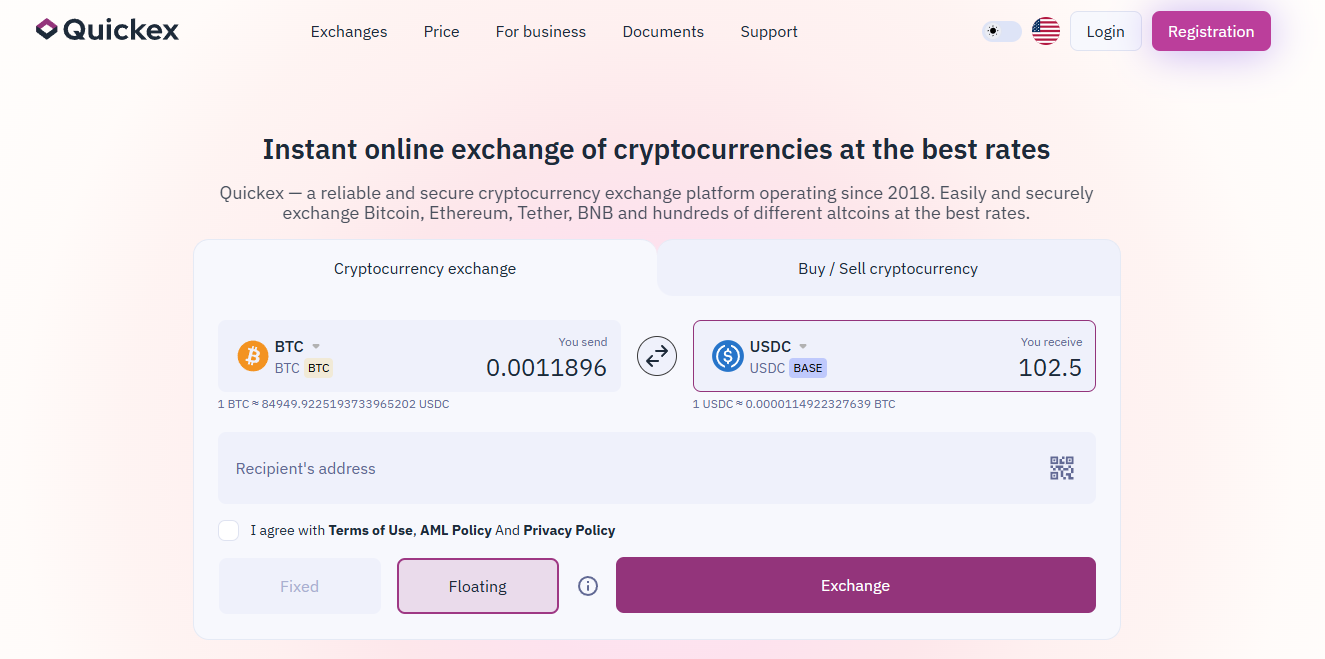
You can swap USDC instantly on Quickex.io. The platform is non-custodial and does not require verification.
How to exchange:
- Visit Quickex.io and select the coin you want to exchange on USDC.
- Enter wallet address
- Get your coins.
Best wallets for USDC
Ledger offers hardware-level isolation well suited for long-term storage. MetaMask enables flexible interaction with EVM-compatible networks and DeFi applications. Coinbase Wallet provides a streamlined multichain interface ideal for navigating Web3 environments.
FAQ
What does USDC stand for?
It expands to “United States Dollar Coin,” reflecting its purpose as a dollar-linked digital currency.
What is usd coin?
It is a fully backed digital representation of the U.S. dollar designed for fast and predictable global transactions.
What is USDC?
It is a dollar-denominated digital instrument supported by cash and short-term government securities.
Is USDC an ERC-20 token?
The original version was launched on Ethereum under the ERC-20 standard before expanding across additional networks.
Does USDC always stay $1?
The currency aims to maintain dollar parity through complete backing, routine attestations, and weekly disclosures.
Is USDC safe in 2025?
Reserve quality, regulatory alignment, and transparent reporting contribute to its reliability.
How to exchange USDC without KYC?
Users can convert the digital dollar through non-custodial platforms such as Quickex, which do not require identity verification.