
YiFi is a non-custodial platform that combines a full-spectrum crypto swap aggregator with a modular DeFi yield product.
It sources liquidity across DEX, CEX-style and private routes, and offers one-click access to curated on-chain strategies.
YiFi itself does not custody user funds; execution may rely on third-party protocols or providers with their own settlement and compliance rules.
As a relatively new platform, it has a shorter public track record than longer-established aggregators.
Disclaimer
This is an independent editorial overview for informational purposes only. It is not financial, investment or legal advice. Cryptocurrency and DeFi involve significant risk, including possible loss of funds. Always verify current terms, smart-contract risks and live interface details before using any service.
What Is YiFi?
YiFi is a non-custodial crypto platform focused on two core functions: exchanging digital assets and accessing on-chain yield.
Public materials describe it as a unified interface that aggregates liquidity and yield sources so users can interact with multiple protocols without building the routes themselves.
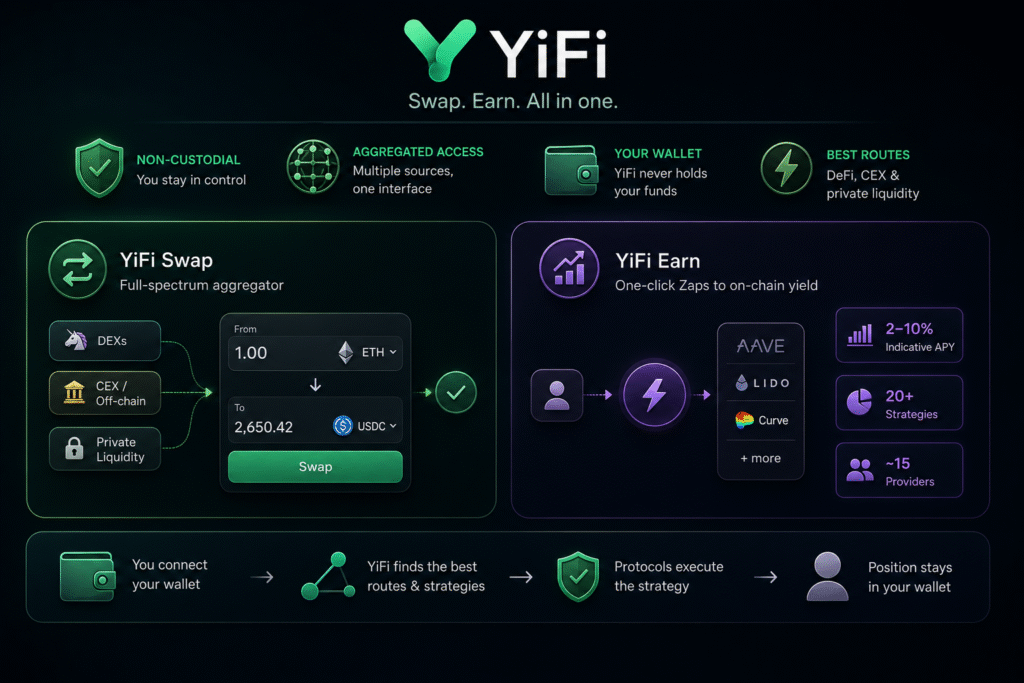
The service is designed so that users operate from their own wallets.
YiFi itself does not hold long-term user balances.
Execution of swaps and strategy entries can involve third-party protocols or liquidity providers, each of which may apply its own rules.
The two main products are:
- YiFi Swap — a full-spectrum aggregator that sources quotes from decentralized exchanges, selected centralized/off-chain routes and private liquidity.
- YiFi Earn — a modular yield product that packages DeFi strategies into one-click Zaps.
Both are accessible from the main site: yifi.io.
How Does YiFi Swap Work?
YiFi Swap operates as an aggregator rather than a single liquidity venue.
When a user selects a pair and amount, the system queries multiple sources.
These include:
- On-chain DEX liquidity, via routing integrations such as Li.Fi, 1inch and others.
- Off-chain / CEX-style liquidity from partner providers.
- Private routing options.
The system compares available quotes and presents routes to the user.
Depending on the selected route, the user either signs an on-chain transaction from their wallet or follows the deposit flow of the selected third-party provider.
After processing, the output asset is delivered to the address specified by the user.
YiFi also offers a Private Swap mode.
According to platform materials, this uses a multi-step, two-rail, routing design intended to reduce the direct, publicly visible on-chain link between the original sending address and the final receiving address.
This does not eliminate all analytical or compliance risks and remains subject to the policies of the underlying providers.
Users can access the swap interface here: YiFi Swap.
How Does YiFi Earn Work?
YiFi Earn aims to simplify entry into on-chain yield strategies.
Instead of requiring users to perform multiple manual steps, swaps, bridging, approvals and protocol interactions, the product packages strategies into single-transaction Zaps.
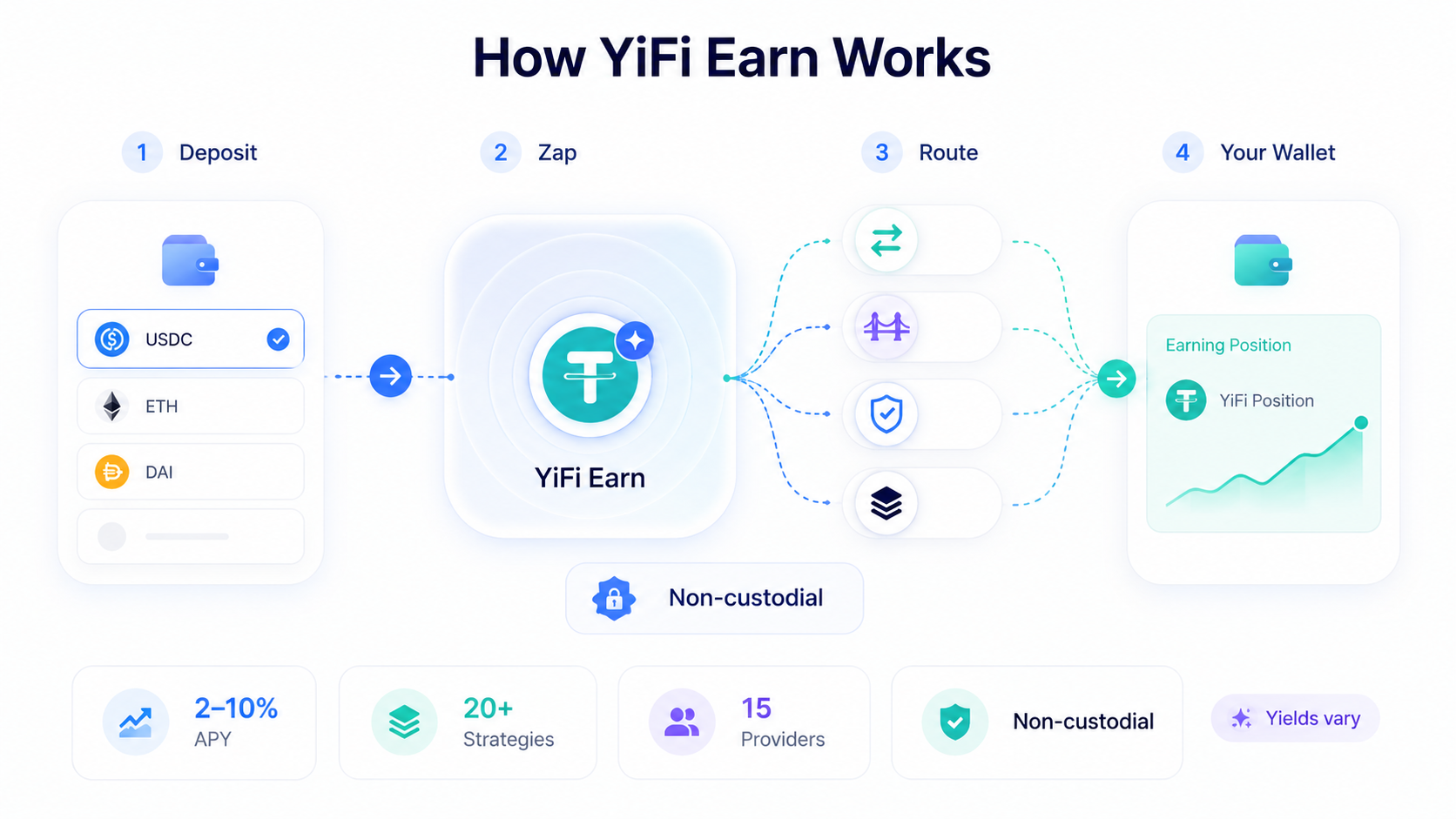
Users deposit a supported asset.
YiFi coordinates the necessary routing and protocol interactions.
The resulting position remains under the user’s control in their own wallet.
YiFi itself does not take custody of the funds.
At the time of review, the platform’s public materials displayed an indicative APY range of 2–10%, more than 20 strategies and approximately 15 underlying providers.
Actual yields fluctuate with market conditions, protocol performance and strategy design.
Strategy pages aim to surface underlying protocols, expected ranges and risk notes.
The Earn product is available at: YiFi Earn.
What Are YiFi’s Main Features?
- Non-custodial Architecture
Users retain control of their private keys.
YiFi does not maintain long-term balances.
Positions in Earn strategies can be managed directly on-chain.
- Multi-source Swap Routing
By combining DEX, CEX-style and private liquidity, the swap product seeks competitive execution across a wide set of assets and networks.
- One-click Strategy Entry
Earn reduces operational complexity for users who want exposure to curated DeFi strategies without managing every intermediate step themselves.
- No Mandatory Platform Account
Standard interactions do not require registration or platform-level KYC.
Individual providers in a given route may still apply their own compliance checks.
- API and Partner Tools
YiFi exposes Swap and Earn capabilities for wallets and applications, including revenue-share and white-label options.
This makes the platform relevant both to end users and to B2B integrators.
- Transparent Strategy Information
Earn pages aim to show the protocols involved, indicative returns and associated risks so users can evaluate strategies before entering.
What Fees Does YiFi Charge?
Swap
According to current public materials, YiFi itself does not charge an additional platform fee on swaps.
Users still pay network, gas, fees and the fees charged by the underlying liquidity providers or exchanges used in the selected route. Spreads may also be embedded in the quoted rate.
Earn
Zap execution carries a fee.
Public information indicates a range of approximately 0.3–0.5%, depending on the specific strategy. Additional protocol-level fees may apply inside the underlying yield sources.
Minimum amounts, supported assets and exact fee components are dynamic and should be checked in the live interface at the time of use.
What Are the Pros of YiFi?
- Unified access to both swapping and on-chain yield in one interface.
- Multi-source routing that includes DEX, CEX-style and private options.
- Non-custodial design with no long-term platform balances.
- Simplified entry into multi-step DeFi strategies via Zaps.
- No mandatory registration for standard use.
- Strategy pages that attempt to surface risk and protocol information.
- API and partner tools for wallets and applications.
What Are the Main Limitations of YiFi?
- Relatively new platform with a shorter public track record than established aggregators.
- Execution quality and availability depend in part on third-party liquidity providers and protocols.
- Yield is not guaranteed; displayed APY ranges are indicative and can change.
- Private routing reduces direct on-chain linkage but does not provide absolute privacy or eliminate provider-level screening.
- Liquidity and route availability vary by pair and market conditions.
- Users remain fully responsible for address accuracy, network selection, approvals and understanding of strategy risks.
- Independent long-term performance and incident data are still limited.
Who Is YiFi Suitable For?
YiFi may suit users who already operate with self-custody wallets and want a single place to compare swap routes and curated yield opportunities.
It can also be relevant for wallet or application teams looking for aggregator and yield infrastructure via API.
It is less suitable for users who need the deep order-book liquidity and fiat services of major centralized exchanges, or for those who prefer only the most battle-tested, multi-year protocols with extensive independent audit histories.
Is YiFi Safe to Use?
YiFi emphasizes a non-custodial model: the platform itself does not hold user funds long-term, and users interact from their own wallets.
However, residual risks remain:
- Smart-contract risk in the underlying protocols used by Earn strategies.
- Temporary control of funds by certain off-chain liquidity providers during execution, on-chain routes remain wallet-signed.
- Possible risk-based screening by individual providers.
- Strategy underperformance, impermanent loss or liquidation risk in yield products.
- User operational errors, wrong address, wrong network, excessive approvals.
- General market and token-price risk.
Users should review strategy details, understand the protocols involved, start with small amounts, verify addresses carefully, and maintain strong wallet security practices.
FAQ
Is YiFi Non-custodial?
YiFi itself does not custody user funds; users interact from their own wallets.
Execution of swaps and strategy entries may involve third-party protocols or providers that handle settlement according to their own rules.
Does YiFi Require KYC?
YiFi does not require platform-level registration or mandatory KYC for standard use.
Individual liquidity providers in a selected route may still apply their own compliance checks.
What Fees Does YiFi Swap Charge?
According to current public materials, YiFi itself does not charge an additional platform fee on swaps.
Users pay network gas fees and the fees of the underlying providers used in the route.
How Does YiFi Earn Work?
YiFi Earn packages DeFi strategies into one-click Zaps so users can enter positions without manually performing every intermediate step.
The resulting position remains in the user’s wallet.
At the time of review the platform displayed an indicative 2–10% APY range across 20+ strategies.
What Is YiFi Private Swap?
Private Swap is a multi-step routing mode intended to reduce the direct on-chain link between the sending and receiving addresses.
It does not eliminate all analytical or compliance risks and remains subject to the policies of the underlying providers.
Is Yield on YiFi Guaranteed?
No. Displayed APY ranges are indicative and can change with market conditions and protocol performance.
Smart-contract, strategy and market risks still apply.
Conclusion
YiFi combines multi-source swapping and simplified access to on-chain yield inside a non-custodial interface.
The swap product follows the aggregator pattern of collecting quotes across DEX, CEX-style and private routes, while Earn attempts to lower the friction of entering DeFi strategies.
Its main strengths are the unified product surface, the non-custodial approach, and the availability of both retail and API/partner tools.
Its main limitations are the platform’s relative youth, dependence on external providers, and the inherent risks of DeFi itself.
For users comfortable with self-custody who want to compare routes and curated strategies in one place, YiFi is a functional option worth evaluating carefully.
As with any newer infrastructure, small test amounts, thorough review of live terms and ongoing monitoring remain advisable.
Explore the Platform
Information based on publicly available platform materials reviewed in September 2026.
Features, fees, supported assets and strategy availability can change.
Disclaimer: The material in this article is not financial or investment advice. Everything stated here reflects the author's personal view and should not be treated as a recommendation to trade or invest. We make no warranties regarding the accuracy, reliability or completeness of the information presented. Cryptocurrency markets are highly volatile and can move unpredictably. Before committing any funds, every investor, trader or crypto user should study several independent sources and check the regulations that apply in their own jurisdiction.