

On September 9, 2025, Apple held another product launch. But the main debates in the crypto community flared not around the iPhone 17, but around rumors. Posts claimed that Apple would partner with Ripple, start accepting XRP for payments, and even invest billions of dollars in the cryptocurrency.
It’s not the first time such chatter has surfaced—years ago, “code leaks” and “insider tips” kept popping up on social media. The Quickex editorial team decided to check what’s real and what’s outright fake.
Track cryptocurrency prices with Quickex.
Where the 2025 rumors came from
Even before the launch, posts began appearing claiming that Apple was preparing to accept XRP payments for the iPhone 17.
At the same time, even louder claims spread that the tech giant was getting ready to announce a $1.5 billion purchase of XRP. According to the authors of those posts, it would be one of the biggest moves by a traditional corporation toward crypto.
Another pretext for speculation was a supposed new Apple subdomain. Social media posts said the company had allegedly registered it specifically for a future XRP-related service.
Supporters of the theory also saw “proof” in the new iPhone’s design. They drew a parallel between the outlines of the device’s cameras and the Ripple symbol. Their similarity, the posts argued, hints at collaboration.
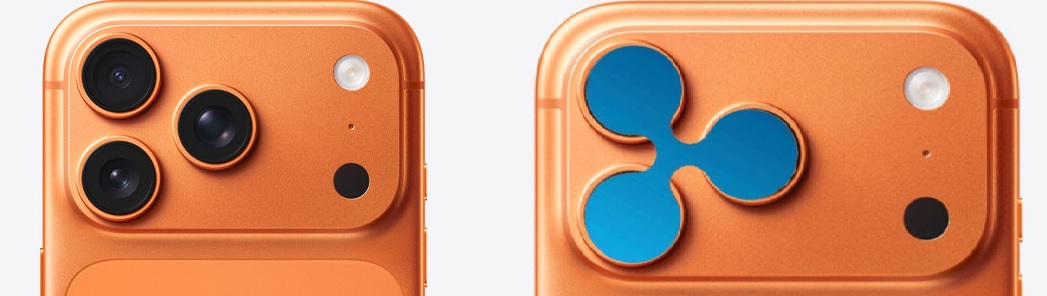
Comparison of the new Apple phone’s design and the Ripple logo
The wave was also stoked by a screenshot of alleged “internal Apple code” mentioning XRP — a screenshot of alleged “internal Apple code”.
Analyzing the “code leak”
It’s worth discussing the screenshot with the purported Apple code separately. Here’s what it looks like:

The image does indeed show the line:
$payment_option = “$XRP”;
But a closer look at the code immediately shows a broken structure: HTML and CSS are mixed up, typos appear (unndernline, vontainer, bord-pleck). Such code can’t work in real development.
The JSON format contains errors: the object with the $XRP string is inserted into the middle of HTML without logic—something you wouldn’t see in Apple’s production code or any major company’s.
The syntax also looks fake: individual fragments read like the output of a neural network that confuses tags or swaps letters.
And most importantly, there’s no connection to any real payment logic. Even if Apple experimented with cryptocurrencies, it would happen via payment SDKs and APIs, not by randomly dropping a $XRP variable into website markup.
The verdict is obvious: the so-called “leak” is a fabrication—either hand-made or generated with AI.
Rumors trace back to 2019
Talk of a potential Apple–Ripple partnership appeared six years ago. Unfortunately for theory supporters, none of those claims were ever confirmed. But they set the tone for later waves of rumors that return after nearly every splashy Apple presentation.
Apple and other crypto projects
Ripple isn’t the only project that fans have linked to Apple. In 2024, a similar rumor cycle emerged around Render. After the Apple Vision Pro presentation, users claimed that on one of the slides the RNDR logo was allegedly visible. The “find” was presented as proof that Apple supports Render and plans joint projects in graphics and visualization.
In reality, it was simply demo material that included third-party elements. But—as with XRP—that was enough to spark a storm of discussion and a spike of interest in the token.
Conclusions
Apple is indeed expanding payment services, including Apple Pay and Apple Wallet, and it collaborates with fintech companies. But claims about buying XRP, accepting the cryptocurrency for iPhone 17 payments, making billion-dollar investments, or using Ripple’s symbol in device design have no supporting evidence.
The code-leak and subdomain stories likewise look more like speculation than facts. Similar rumors have already appeared—around XRP in 2019 and around Render in 2024.
All of this shows that Apple remains a magnet for crypto gossip, but none of it has moved beyond fantasy and hype so far.
Fast crypto exchange at a fair rate—on Quickex.