
Thousands of Nepalese residents downloaded the Bitchat messenger, created by Twitter co-founder and Block CEO Jack Dorsey, after the authorities banned social networks amid mass anti-corruption protests.
This is not the first time the app has surged in popularity around the world alongside rising protest sentiment.
Track how the price of Bitcoin and other cryptocurrencies reacts to the news with Quickex.
What is Bitchat
Bitchat is a decentralized messaging application. The platform’s key feature is that it works without the internet. The project launched in July 2025.
The messenger runs on Bluetooth Low Energy mesh-network technology. Devices connect directly to each other via Bluetooth and relay messages hop by hop. If one phone is out of another’s range, a message is forwarded through intermediate nodes. This setup lets you keep talking even when mobile service and Wi-Fi are down.
The more users Bitchat has, the stronger the signal and the more stable the network becomes. The same principle powers blockchain systems: the more network nodes there are, the safer and more stable the system is.
The app supports encryption and user identification via the Noise protocol. Unfortunately, as of the time of writing, the software has not undergone an independent audit, so we cannot yet assert that it is fully secure.
Early versions of Bitchat had vulnerabilities—for example, the ability to spoof contacts or bypass protections against compromise. At the same time, the fully decentralized design—eschewing central servers, registrations, and infrastructure dependencies—makes the messenger handy in conditions of crisis and censorship.
How you can use the messenger
Because the app works over Bluetooth, you can chat with Bitchat in places with no internet. Here are a couple of examples:
- Flights. There’s no internet on airplanes. Suppose you’re flying with someone but were seated in different rows. With Bitchat you can talk to your travel companion. The messenger can also be indispensable on trains: when traveling by rail, coverage often isn’t enough for a stable internet connection.
- Large events and holidays. During major events, because so many people are packed into one place, connectivity often gets worse. On holidays, the extra load on carriers also makes it hard to reach someone. Bitchat solves the problem.
There’s one more use for the messenger that stands out. Bitchat has become a popular tool among protesters.
How Bitchat Became a Tool of Protest
According to callebtc, in just a few days the number of Bitchat installs in Nepal grew from 3,344 to 48,781. That’s four times more than in Indonesia, where anti-corruption protests had previously flared up as well.

Bitchat download statistics. Source: callebtc
The sharp jump in interest in the messenger in Nepal followed the blocking of Facebook, Instagram, WhatsApp, and YouTube. The ban angered young people, and protests quickly escalated into street clashes. The country’s parliament and Supreme Court were set on fire, and the prime minister’s residence was attacked.
Security forces used live ammunition and tear gas. At least 19 people were killed and hundreds were injured. In the end, the prime minister, who was at the center of a corruption scandal, resigned.
Bitchat’s popularity is tied to protests not only in Nepal and Indonesia. According to Dorsey himself, in July 2025 the largest share of the app’s users was in Russia.
The project’s rise in Russia is explained by a combination of factors. First, the authorities are actively pushing the MAX messenger, which users distrust due to the likely access that security services have to chats. Second, people in the country have faced partial blocking of WhatsApp and Telegram—apps used by most of the population. Amid restrictions and sanctions, Bitchat’s unimpeded availability became a key advantage.
Russians have taken to the app because it gives users greater confidence that their privacy will be preserved.
At the time of writing, Nepal and Indonesia have pushed Russia into second place in the ranking of countries with the most Bitchat users.
Dorsey has repeatedly stressed that his messenger is meant to fight censorship. The developer welcomed protesters’ shift to Bitchat. He noted that his app happened to be in the right place at the right time.
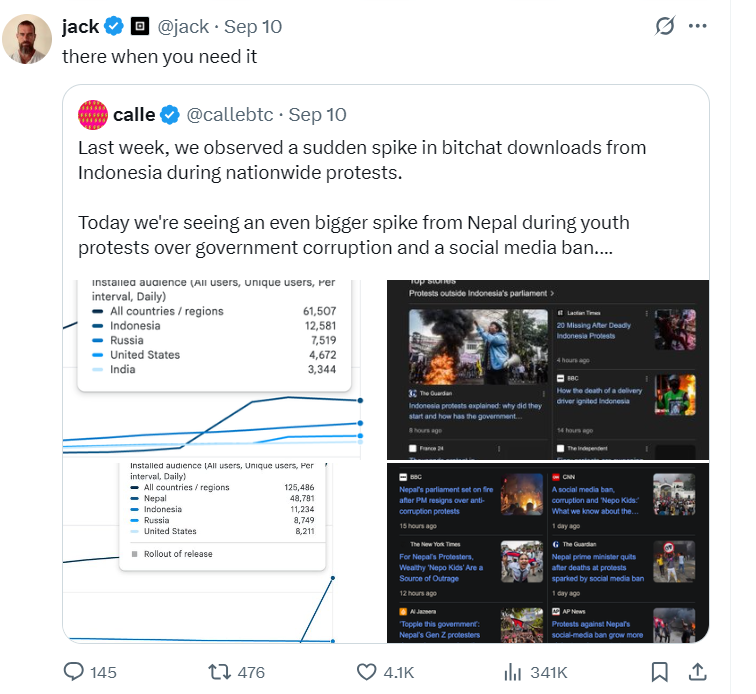
Jack Dorsey’s reaction to protesters using bitchat. Source: the developer’s X
To sum up
Bitchat hit the market at the right moment. Around the world, sparring between citizens and the authorities keeps flaring up, and governments try every possible way to cut people off from the usual channels of communication and information sharing. With Bitchat, that won’t work.
The decentralized messenger has already proved its effectiveness. The project’s network keeps growing. In time, people in different parts of the world may be able to communicate without the internet and without the risk of being blocked, thanks to Jack Dorsey’s invention.
Favorable cryptocurrency exchange without loss of anonymity—on Quickex.