

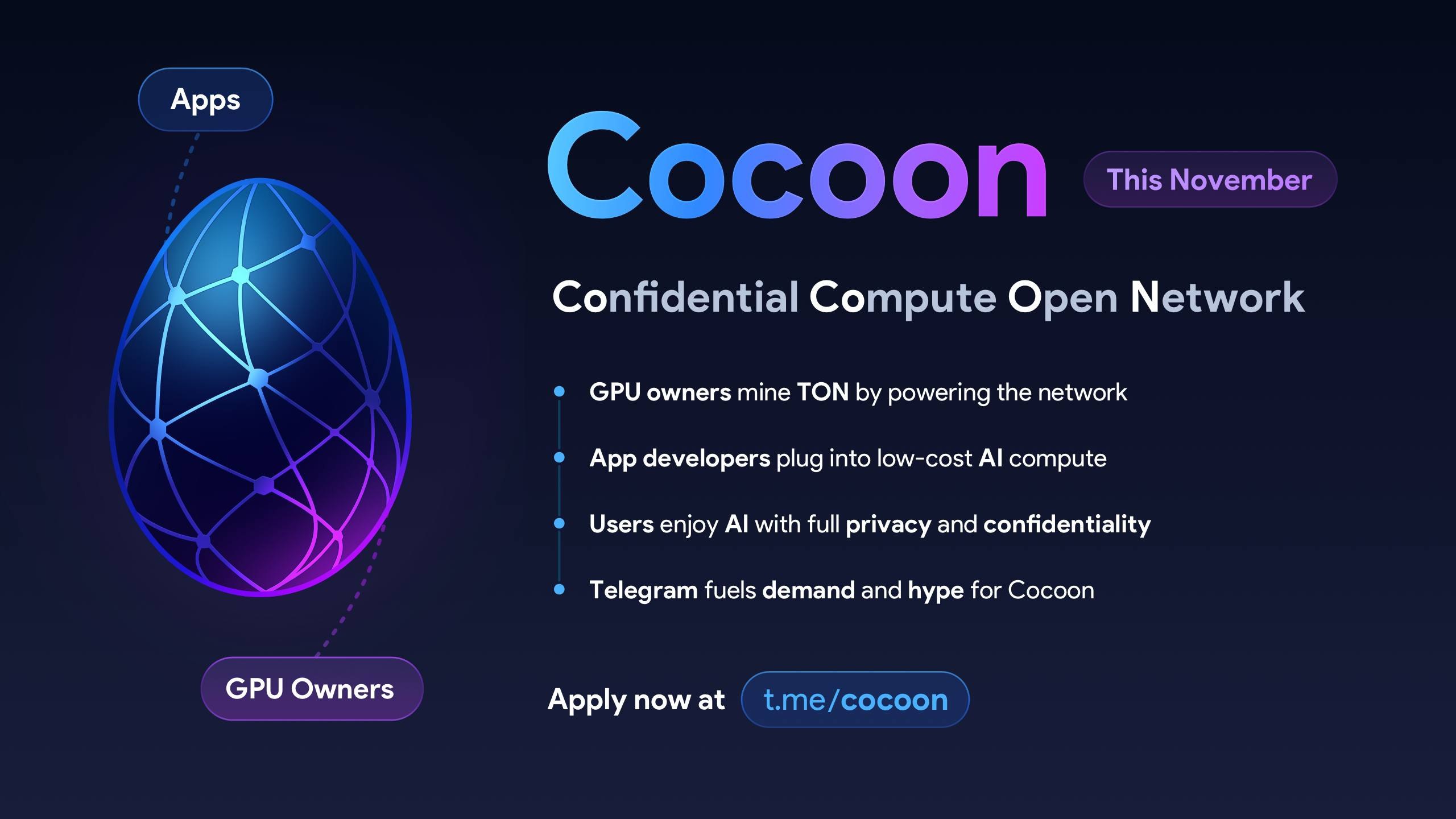
On October 29, 2025, Pavel Durov presented the Cocoon project — the Confidential Compute Open Network — in Dubai at the Blockchain Life 2025 conference. This network, built on the TON blockchain, is designed for secure, confidential artificial intelligence computations. The announcement is not just about a new technology product, but an attempt to rethink what AI should be in a world where privacy has become a rarity.
The Quickex editorial team dug into the project’s specifics. We explain what Cocoon is and exactly how Durov plans to change the AI market with it.
Follow the prices of your favorite cryptocurrencies with Quickex.
Why the World Needs Cocoon
Modern AI systems rely on centralized cloud computing. When a user interacts with ChatGPT, Google Gemini, or Anthropic Claude, their prompts and content pass through the company’s servers, where they are stored, analyzed, and may be used to train models.
Over the past two years, this has already led to a whole string of scandals:
- In 2023, there was a data leak in Google Cloud affecting corporate clients, including elements of confidential AI prompts.
- In 2024, it emerged that some users’ ChatGPT prompts were used in test datasets without their consent.
- And in 2025, investigations by several media outlets showed that large AI platforms filter responses along political and geographic lines, turning models into instruments of control.
Cocoon offers a different approach. Here, prompt processing is performed not on a single company’s servers but on a distributed network of devices, where data remains encrypted at every stage. The GPU owner receives a reward for participating in the computations but has no access to the content of the prompts.
This is not just data protection — it is giving users back control over how artificial intelligence operates.
How Cocoon Works
Cocoon is based on confidential computing technology. This is a method by which data remains encrypted even while it is being processed. Such computations can be performed using trusted execution environments (TEEs) or multi-party cryptographic protocols, which eliminates the possibility of leaks.
The network brings together GPU owners who provide compute power and developers who run AI inference. All interactions and settlements run through the TON blockchain. Smart contracts record who provided how many resources, and rewards are paid in Toncoin (TON).
In effect, Cocoon turns GPUs into elements of a single distributed supercomputer, governed by token economics and protected by cryptography.
Where the Project Comes From
The ideas embedded in Cocoon are directly connected to the history of TON itself. Back in 2018, Pavel Durov launched The Open Network as a blockchain for Telegram. But by 2020, the project faced intense pressure from the U.S. Securities and Exchange Commission (SEC). The regulator accused Telegram Group Inc. of illegally offering Gram tokens worth $1.7 billion, treating them as unregistered securities.
As a result, Durov had to shut the project down and return funds to investors. However, the developer community continued the work, creating the independent TON Foundation, which brought the technology to a mature state.
Now, five years later, Durov returns to TON with a different mission — not to issue a token, but to build infrastructure for private artificial intelligence.
Could Cocoon End Up in Regulators’ Crosshairs?
That scenario cannot be ruled out. Cocoon is a network in which users receive Toncoin rewards for computations. In some jurisdictions, such models may be interpreted as investment programs or distributed computing pools, drawing the attention of financial watchdogs.
However, Cocoon has an important distinction from the Gram situation: the project is not a fundraising vehicle, does not issue new tokens, and operates within the ecosystem of the already existing TON blockchain. Moreover, its business model is built around a real infrastructural service — computing — rather than asset speculation.
That said, the question of regulating decentralized AI networks remains open. As soon as Cocoon starts serving large commercial workloads, it will likely have to engage with regulators under the same rules that apply to cloud platforms.
DePIN and Cocoon’s Place Among Distributed Networks
Cocoon belongs to the DePIN category — decentralized physical infrastructure networks. These are ecosystems where users contribute real resources — compute, energy, storage, connectivity — and receive token rewards.
Today’s largest DePIN projects include:
- Render Network
- Akash
- io.net
- Bittensor
Render specializes in GPU rendering and visual tasks. Akash provides distributed cloud servers. io.net coordinates GPU clusters for machine learning. Bittensor builds a marketplace for knowledge exchange between AI models.
Cocoon differs from all of them in three ways:
- A full focus on private inference, not just distributed computing.
- Integration with Telegram — the ready-made user base and the Mini Apps ecosystem will ensure demand from day one.
- Using TON as the settlement blockchain, which simplifies the architecture and increases transaction speed.
In essence, Cocoon combines the best elements of existing DePIN models while adding the missing piece — confidentiality.
Where Durov Drew Inspiration
Cocoon shows the influence of several technological directions:
- Enterprise confidential computing systems (Intel SGX, Google Confidential VM), where data is processed in an encrypted environment.
- Tokenized GPU networks like Render, where users are paid for compute resources.
- The Web3 philosophy that centers on data protection and decentralized governance.
In effect, Durov adapted to AI the same principles he originally applied in Telegram: the absence of intermediaries, user independence, and resilience to external pressure.
Scale and Community
Interest in Cocoon is growing rapidly. The project’s official Telegram channel already has nearly 150,000 subscribers — an impressive result for an initiative that has not yet been officially launched. This points to ready demand for decentralized AI solutions and trust in the Durov and TON brands.
Why Cocoon Can Change the World
Cocoon addresses three systemic problems of the digital age:
- Concentration of power. Centralized AI companies control not only computing but also the perception of information. Cocoon offers a model where control is returned to users.
- Opacity of algorithms. In a distributed network, model behavior and the computation chain can be recorded on-chain, increasing trust and verifiability.
- Infrastructure inaccessibility. Decentralization opens the door to mass participation — anyone can contribute by providing a GPU and earn rewards.
If TON was a step toward financial independence, Cocoon becomes a step toward intellectual independence. It turns artificial intelligence from a closed technology into an open ecosystem in which every network participant is not a consumer but a co-author.
To Sum Up
Cocoon is not just a Telegram project. It is an attempt to redefine the balance between technology, users, and corporations.
It unites decentralization, cryptography, and artificial intelligence into a single computation model where trust is ensured not by laws and contracts but by mathematics and code.
TON Foundation put it succinctly: “AI meets TON.” But behind that phrase lies an idea of digital freedom that could change the very structure of the future internet.
Find the best crypto exchange rates on Quickex.