
The phrase “Trump’s tariffs” has been stirring the crypto community for more than a month now. The point is that the war unleashed by the U.S. President on financial markets is strongly affecting cryptocurrency quotes.
Here’s how it happened, why Trump’s tariffs determine how much bitcoin will cost today, and what tests you should be prepared for.
Track the Bitcoin rate on Quickex.
What Is Trump’s Tariff War
The term “tariff war” refers to Donald Trump’s confrontation with regulators in other countries on issues related to tariffs on the import and export of goods. Back in his first presidential term, the politician began introducing trade barriers, especially against China. The initiative was then dubbed the “trade war with the PRC.” In the realities of 2025, however, the geography of Trump’s initiative has expanded significantly.
With the tariff war, the U.S. President wants to establish, in his view, fair rules of international trade. The initiative is also intended to reconfigure global supply chains in favor of the United States. In practice, the tariff war is a set of political-economic goals expressed in the form of tariff pressure. Here are a few of Trump’s theses that help explain why he needs this project:
Reducing the U.S. trade deficit. Trump believed that America “loses” to other countries, especially China, because it imports more than it exports. Tariffs should make imports more expensive and stimulate domestic production.
Bringing manufacturing back to the U.S. The White House sought to force companies to move factories and assembly lines from China, Mexico, and Vietnam back to the United States. The slogan: “Bring jobs back home.”
Punishing “unfair” trading partners. China has repeatedly been accused of currency manipulation, technology theft, and unequal conditions for American companies, while the EU, Canada, and Mexico have been accused of “dumping” steel and aluminum and subsidizing the auto industry.
Trump’s speech on “Liberation Day”, during which he announced a 10% tariff on all imports and higher rates for certain countries.
In Trump’s view, the tariff war will give national producers an edge over foreign ones. That is why the White House considers the initiative an instrument of economic sovereignty.
How The War Unfolded
If during the first presidential term only China was, by and large, under fire, then in 2025 the initiative’s geography expanded greatly. Here are the main steps in Trump’s tariff war:
| Date | Event |
|---|---|
| January 20, 2025 | Donald Trump returns to the White House and declares that “America will once again be the master of its economy.” Preparations begin for a new wave of tariffs. |
| February 1, 2025 | The U.S. announces 25% tariffs on imports from Mexico and Canada, as well as 10% on certain Chinese goods. The goal is to “protect the market from neighbors’ manipulations.” |
| February 3, 2025 | After a sharp reaction from Canada and Mexico, the tariffs are temporarily suspended for 30 days. |
| March 4, 2025 | The tariffs take effect. Canada announces counter-duties, Mexico threatens sanctions on agricultural products. |
| March 12, 2025 | The U.S. again imposes 25% tariffs on all imported steel and aluminum, canceling previous exemptions. Domestic prices begin to rise. |
| March 26, 2025 | An order is signed imposing a 25% tariff on cars and auto parts, taking effect in early April. |
| April 2, 2025 | “Liberation Day” is announced. The U.S. introduces a universal 10% tariff on all imports and higher rates for certain countries. |
| April 5, 2025 | Actual application of the 10% base tariff begins. Importers and retail chains record rising prices for electronics and auto goods. |
| April 9, 2025 | The White House suspends tariff increases for allies (the EU, Japan, South Korea), but China, India, and Mexico remain under fire. |
| May 13, 2025 | The U.S. and China hold talks in Geneva. A temporary compromise is reached: the U.S. reduces part of the tariffs, and China promises to increase purchases of American goods. |
| May 30, 2025 | Trump announces tariff increases on steel and aluminum to 50%. Industry associations warn of rising costs. |
| June 4, 2025 | The 50% tariffs take effect. The EU prepares retaliatory measures. |
| July 2025 | Canada and Mexico secure partial exemptions from certain tariffs. Talks with the EU and China reach an impasse. |
| August 1, 2025 | The U.S. imposes a 50% tariff on copper semi-finished products and additional duties on industrial goods. For Canada, the tariff is hiked to 35%. |
| August 7, 2025 | Additional tariffs come into force against countries that lack trade agreements with the U.S. — effectively against most of the world. |
| September 2025 | Inflation accelerates, exports fall. Trump declares that “America is winning,” pointing to rising employment in industrial states. |
| October 2025 | Trump announces additional 100% tariffs on Chinese imports, including critical software and tech components. The International Trade Court rules that some tariffs imposed under the “national security” order exceed the President’s authority. Legal battles begin, but the tariffs remain in force. |
The Impact Of Trump’s Tariffs On Cryptocurrency
Cryptocurrency is a relatively new financial instrument with a high level of volatility. Observations show that the crypto market is highly sensitive to economic news. In the context of Trump’s tariffs, crypto has repeatedly declined because the market saw them as a signal of global economic tension and a flight from risk assets.
Here’s why Trump’s tariffs terrify investors and provoke them to dump crypto:
- risks of slowing global trade and rising inflation;
- falling stock indexes;
- reduced liquidity — capital flows into the dollar and bonds rather than crypto.
Simply put, new turns in Trump’s tariff war increase the risk of recession. In such conditions, investors look for “safe havens,” not high-risk assets. That’s why capital flees from crypto into less risky instruments such as gold.
In the chart below, vertical lines mark bitcoin’s reaction to:
- the U.S. introduction of 25% tariffs on February 1;
- “Liberation Day” on April 2;
- the 100% tariffs on Chinese imports on October 10.
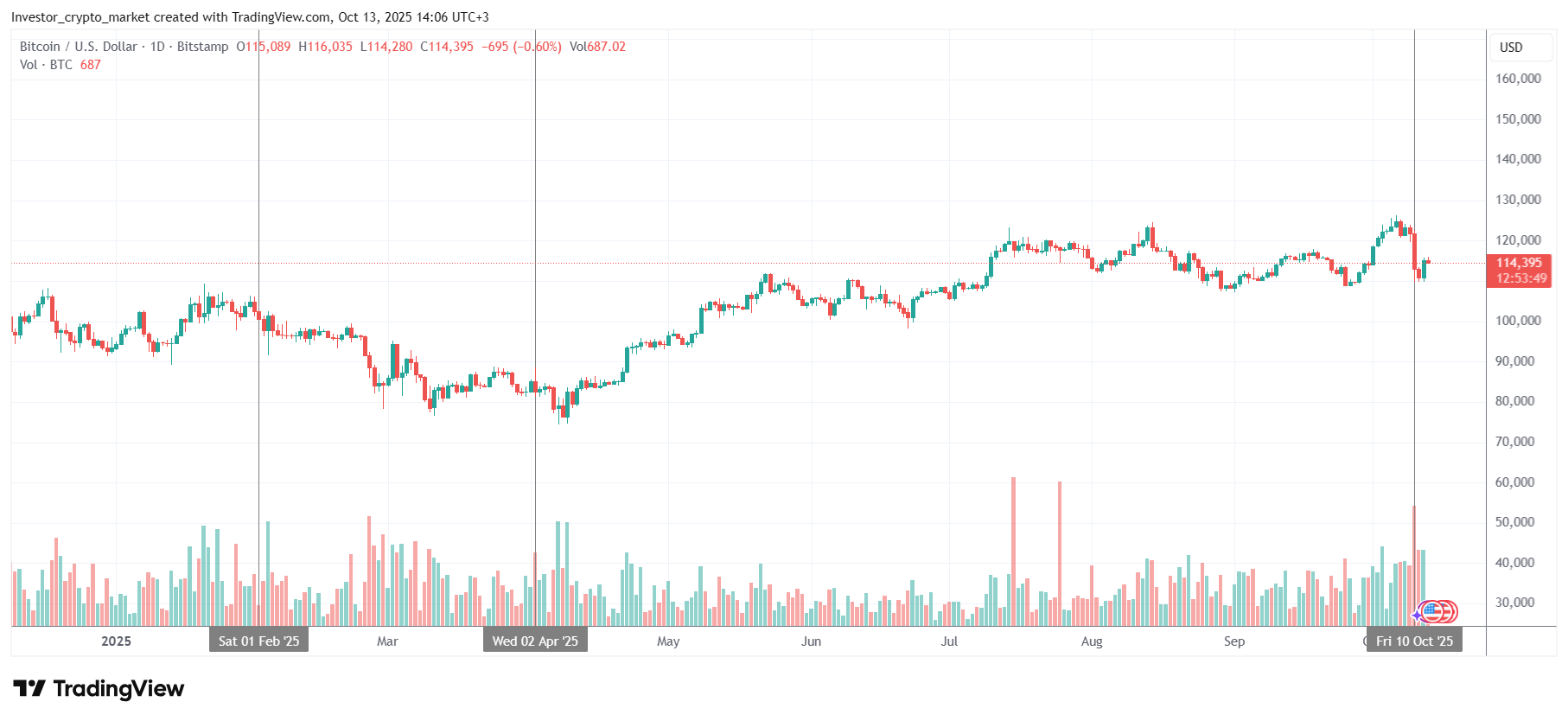
Bitcoin’s reaction to Trump’s tariffs. Source: TradingView
What Else Crypto Investors Should Expect From The Tariff War
Unfortunately, Trump is famous for his unpredictability. Observations have shown that crypto investors react nervously to news of new turns in his tariff war. Therefore, there is a risk of facing a new batch of adverse news in the near future, as the U.S. President has not announced the end of the initiative.
But there is a “silver lining.” Trump is painfully sensitive to criticism related to stock market crashes. He has the power to spark a rally that could offset the crushing effect of tariff-war headlines.
Discouraging Conclusions
Unfortunately, there is every reason to believe that Trump’s tariff war is far from over. Therefore, crypto investors should always keep the risks in mind. The market crash after the latest “batch” of tariff-war news on October 10 confirmed this theory.
It is important to remember that autumn 2025 is a time when bitcoin’s bull cycle may be running out of steam. The timing indicated by the cyclicality theory points to this. Therefore, the blows from the tariff war are especially painful in October. Because of them, bitcoin may lose its last strength to continue the bull run.
You can profitably exchange Bitcoin for USDT or another cryptocurrency at the time-tested Quickex exchanger.