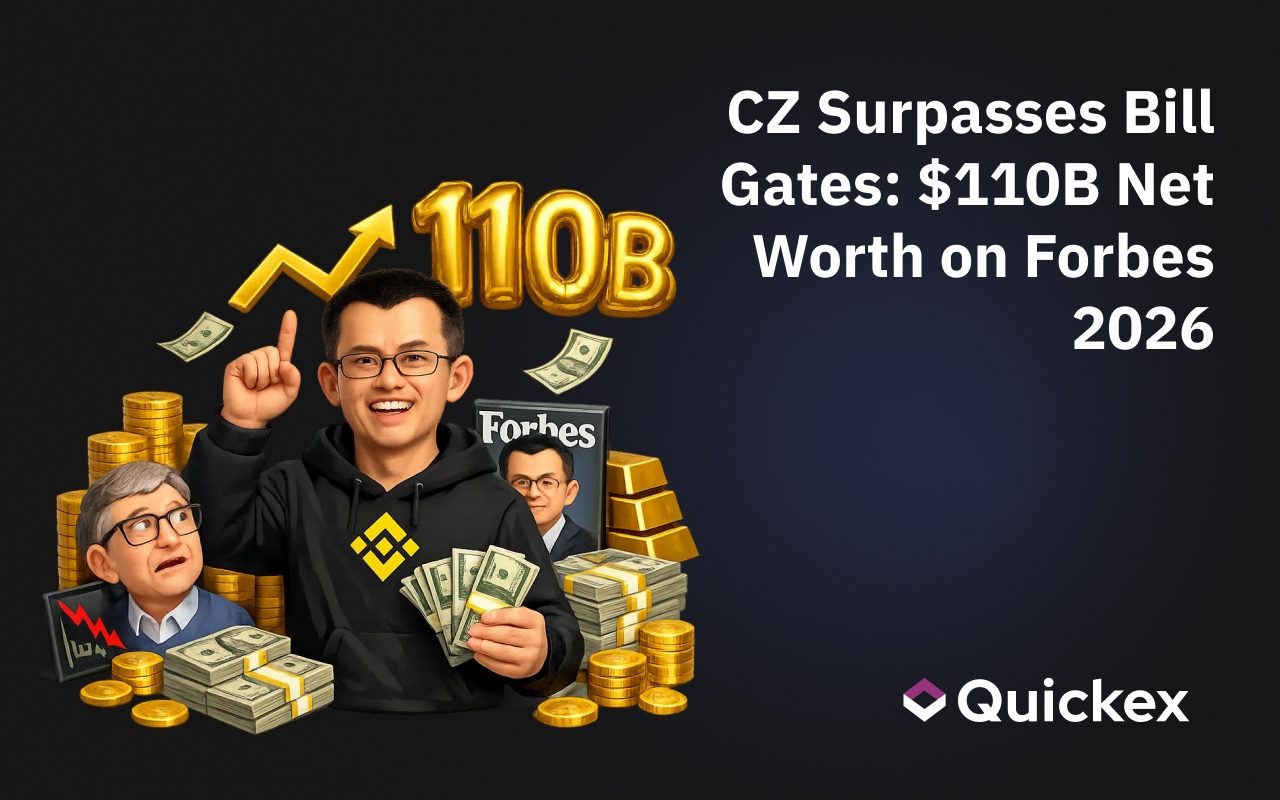

Changpeng Zhao, widely known as CZ and the founder of Binance, has officially entered the ultra-exclusive “centibillionaire” club. According to Forbes’ 2026 World’s Billionaires list (snapshot as of March 1, 2026, with real-time updates showing fluctuations), CZ’s net worth stands at an estimated $110 billion — a staggering $47 billion increase from the previous year. This surge propels him to #17 globally, overtaking tech icon Bill Gates (now at $108 billion and ranked #19).
The milestone marks a dramatic turnaround for CZ, who — just 17 months ago — completed a four-month federal prison sentence in 2024 following a guilty plea related to regulatory violations. Today, he stands as a symbol of crypto’s explosive resurgence and Binance’s enduring dominance in the global digital asset landscape.
The Driving Force: Binance’s Rebound to $100 Billion Valuation
Forbes attributes the bulk of CZ’s fortune to his approximately 90% ownership in Binance, the world’s largest cryptocurrency exchange by trading volume and market share. Industry comparisons and insider estimates value the platform at around $100 billion — a remarkable rebound fueled by:
-
Annual revenues estimated at $16–17 billion in 2024–2025 (roughly 2.5× Coinbase’s figures).
-
Over $30 trillion in combined spot and derivatives trading volume annually.
-
A commanding ~38% share of the centralized exchange market.
-
The thriving BNB Chain ecosystem (with BNB token market cap around $88 billion) and user incentive programs.
Despite operating largely outside full U.S. regulatory oversight (unlike Nasdaq-listed Coinbase), Binance’s scale and profitability justify the twelve-figure valuation in Forbes’ methodology. CZ’s stake, combined with his holdings in BNB and other digital assets, accounts for the vast majority of his wealth.
A Historic Leap: Ahead of Traditional Titans
CZ’s rise places him ahead of several Wall Street heavyweights and legacy billionaires:
-
#16: Carlos Slim Helú & family – $125 billion (Mexico, Telecom)
-
#17: Changpeng Zhao – $110 billion (Canada, Cryptocurrency exchange)
-
#18: Michael Bloomberg – $109 billion (United States, Bloomberg LP)
-
#19: Bill Gates – $108 billion (United States, Microsoft/diversified investments)
-
#20: Françoise Bettencourt Meyers & family – $100 billion (France, L’Oréal)
Gates’ slight decline stems from massive charitable donations through the Gates Foundation and the impact of his 2021 divorce settlement. CZ’s ascent highlights crypto’s growing role in reshaping global wealth rankings — joining just 20 individuals worldwide with 12-figure fortunes (up from 15 last year).
This also underscores broader trends: the 2026 Forbes list features a record 3,428 billionaires with collective wealth of $20.1 trillion (up $4 trillion year-over-year), driven heavily by tech and crypto sectors.
Context and Controversy
Not everyone agrees with the exact figure. CZ himself has publicly questioned Forbes’ methodology in recent statements, noting that digital asset prices fell over 50% in parts of 2026, making a sharp net-worth increase seem inconsistent. Some analysts (e.g., Bloomberg Billionaires Index) peg his wealth lower, around $49 billion, applying heavier discounts for regulatory and institutional risks.
Nevertheless, Forbes stands by its estimate, based on comparisons with peers, revenue multiples, and legal filings confirming CZ’s controlling stake. The real-time tracker shows minor daily fluctuations (e.g., $111.1 billion as of March 11 updates).
At Quickex, we view this as a powerful testament to the maturation and resilience of the crypto industry. Binance’s sustained leadership — even amid past regulatory headwinds — demonstrates the demand for accessible, high-volume trading infrastructure. CZ’s story from founder to one of the planet’s richest individuals reinforces that decentralized finance continues to create unprecedented wealth opportunities.
As the crypto market evolves, figures like CZ remind us: innovation in digital assets can outpace even the most established sectors. The centibillionaire club just got a little more decentralized.