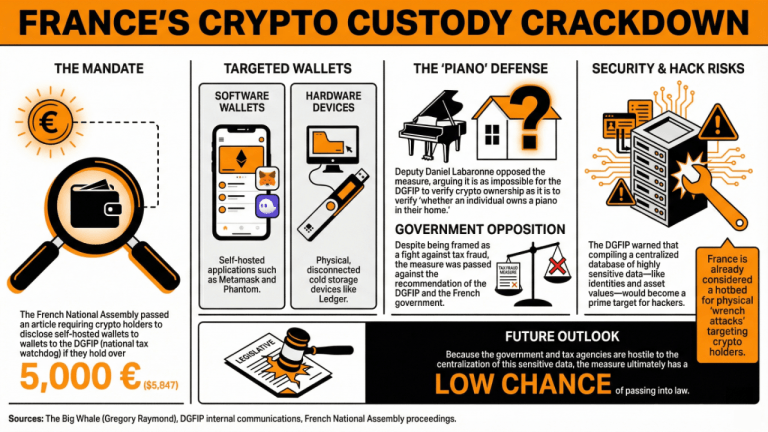
In a controversial push to tighten oversight of the crypto sector, France’s National Assembly has passed an amendment requiring holders of self-custodial (non-custodial) wallets to declare any holdings exceeding €5,000(~$5,850) to the tax authorities (DGFiP). The measure targets popular wallets such as MetaMask, Phantom, Rabby, and hardware devices like Ledger, even though authorities admit they currently lack effective tools to independently verify the reported data.
The proposal is part of a broader bill aimed at combating social and tax fraud. While it has cleared its first reading in the National Assembly, it still needs approval from the Senate and a joint committee before becoming law. Enforcement is expected toward the end of 2026 or early 2027.
What the New Requirement Would Mean
If the bill passes in its current form, French crypto users would be obligated to annually declare:
- The existence of each self-hosted wallet (non-custodial wallets where the user controls the private keys).
- The fair market value of assets held in those wallets once the total exceeds €5,000.
This would apply to software wallets (MetaMask, Phantom), browser extensions, mobile apps, and hardware wallets (Ledger, Trezor, etc.). The declaration would be integrated into the annual tax return process, similar to how foreign bank accounts are already reported.The French tax authority (DGFiP) has explicitly acknowledged that tracking and verifying self-custodial wallet holdings remains technically challenging due to the decentralized nature of blockchain. Nevertheless, lawmakers argue the measure will create a formal registry and deter underreporting.
Why France Is Targeting Self-Custody
The initiative stems from recommendations by the Conseil des prélèvements obligatoires (CPO) and aims to close what authorities see as a major transparency gap. While centralized exchanges (PSANs in France) already face strict KYC/AML and reporting obligations under MiCA and the Travel Rule, non-custodial wallets have largely remained outside direct surveillance.
Supporters claim the rule will:
- Improve tax collection on crypto gains.
- Align crypto reporting with traditional financial assets.
- Reduce risks of money laundering and tax evasion.
Critics, including privacy advocates and parts of the crypto community, warn that it creates a “honeypot” of sensitive data linking real identities to wallet addresses and holdings, without providing authorities with reliable verification methods.
Practical Implications for French Crypto Users
- Small holders (under €5,000 total in self-custody) would likely be exempt from this specific declaration.
- Larger holders would need to calculate and report the euro value of their portfolios annually.
- Non-compliance could result in fines, though exact penalties are still being defined by decree.
- The measure does not ban self-custody — it simply adds a reporting burden.
Many in the French crypto space view this as another step in Europe’s broader push for greater oversight following the implementation of MiCA and the Crypto-Asset Reporting Framework (CARF).
Reaction from the Crypto Community
The news has sparked heated debate on social media and forums. Some users are already discussing privacy strategies, such as using mixers (where still legal), splitting holdings across multiple wallets, or exploring decentralized tools. Others point out the irony: authorities are demanding self-reported data they cannot easily audit.
Gregory Raymond, co-founder of The Big Whale, noted that while the National Assembly passed the article, the government itself appears hostile to the measure in its current form, suggesting it may still be significantly amended or softened.
At Quickex, we believe self-custody remains one of the core principles of cryptocurrency — true ownership without intermediaries. However, regulatory trends in Europe show a clear direction toward greater transparency and reporting. Users in France (and across the EU) should stay informed about evolving obligations and consider professional tax advice.
This proposal highlights the ongoing tension between individual financial privacy and governments’ desire for full visibility into digital assets. We will continue monitoring the bill’s progress through the Senate and any final adjustments.The story is still developing — stay tuned for updates as the legislative process continues.