
The Hyperliquid exchange has completed its first major validator vote. The project’s community selected the company that will issue its first native stablecoin, USDH. The winner was the Native Markets team, which, to the crypto community’s surprise, managed to beat heavyweights like Paxos, Frax, and BitGo.
Here’s how Native Markets won, why parts of the crypto community criticize the choice of issuer, and what the launch of USDH means for the market.
Track how cryptocurrency prices react to Hyperliquid news with Quickex.
What is Hyperliquid and why does it need USDH
Hyperliquid is a decentralized exchange (DEX) focused on perpetual futures. In November 2024 the project launched its own L1 blockchain, and by summer 2025 it was doing over $330 billion in monthly volume with a team of just 11 people.
Until now, the exchange has relied on external stablecoins—primarily USDC. According to DeFiLlama, about 95% of deposits on Hyperliquid (roughly $5.6 billion) were in USDC. That dependence introduces risks:
- losing part of revenues to third-party issuers;
- the threat of censorship from centralized entities;
- potential vulnerabilities in cross-chain bridges.
Launching its own stablecoin, USDH, will help Hyperliquid keep revenues within the ecosystem and reduce reliance on external providers.
Why a contest instead of issuing it in-house
Hyperliquid was built from the outset as a decentralized ecosystem where key decisions are made by the community rather than the admins. The USDH launch put that approach to the test. Instead of centrally appointing an issuer, the team proposed a competition and a validator vote.
This format made it possible to:
- bring in outside expertise from players with diverse backgrounds;
- compare reserve-management models and choose the optimal one;
- enshrine the principle that the ecosystem’s strategic assets are created through open voting.
How the race for the ticker unfolded
The competition for the right to issue USDH was announced on September 5, 2025 and immediately drew strong interest. Paxos, Frax, Sky, Agora, Ethena, Curve, OpenEden, and BitGo submitted bids. Each company presented its own issuance and revenue-sharing model.
Ethena ultimately withdrew its bid and backed the newcomer, Native Markets. On the Polymarket prediction platform, the team’s probability of winning at one point exceeded 95%.
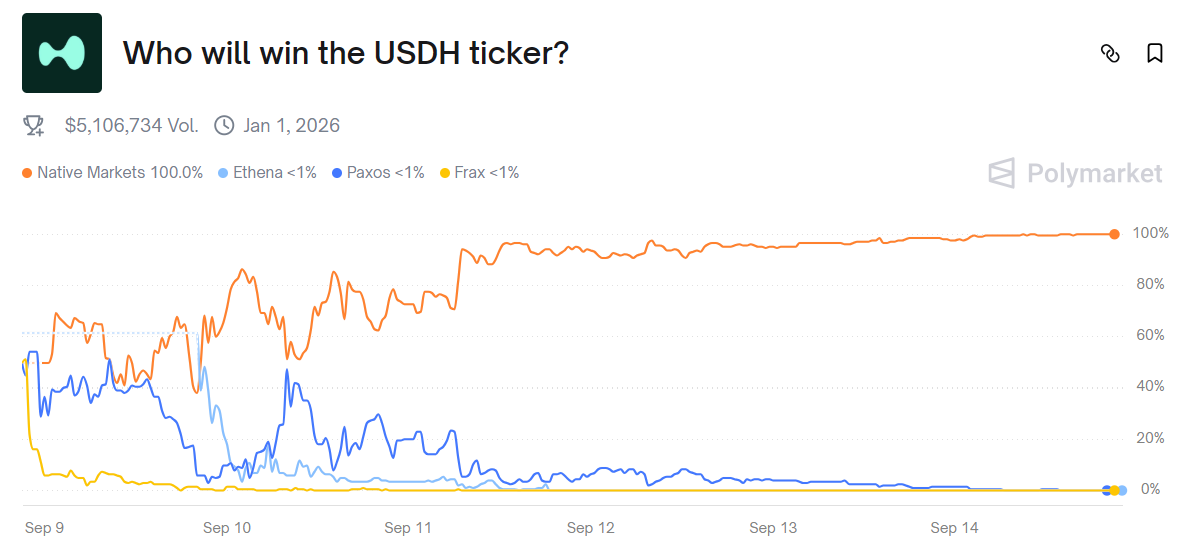
Voting for the winner in the USDH race. Source: Polymarket
The vote was held among Hyperliquid validators, with voting power proportional to staked HYPE. A two-thirds supermajority was required to win. The Hyperliquid Foundation and staking provider Kinetiq, which controlled around 63% of tokens, abstained, leaving the outcome in the community’s hands.
What the competitors proposed
Paxos, the issuer of BUSD and PYUSD, promised full compliance with the U.S. GENIUS Act and the EU’s MiCA, and pledged to direct 95% of reserve income to buybacks of the HYPE token.
Sky (formerly MakerDAO), the issuer of USDS, proposed making USDH multichain from day one via LayerZero and offering a 4.85% yield to holders.
Frax Finance planned to issue USDH through a U.S. bank partnership, fully back it with Treasuries, and direct all income to the Hyperliquid ecosystem.
Agora planned to bring in VanEck as reserve manager and send 100% of profits to the Hyperliquid Foundation while criticizing Native Markets for using Stripe’s Bridge asset-tokenization platform.
Curve, OpenEden, and BitGo submitted proposals on the last day but failed to gain community support.
Despite the generous terms from competitors, Native Markets’ proposal won. Validators bet on the native team, signaling trust in its integration with the Hyperliquid ecosystem.
How USDH will work
The USDH stablecoin will be issued on the HyperEVM network—Hyperliquid’s own virtual machine.
Reserves will be backed by two types of assets:
- off-chain reserves (cash and U.S. Treasuries) managed by BlackRock;
- on-chain reserves under Superstate’s management via Bridge.
USDH will be fully backed by assets, and reserve yield will be split evenly: half will go to HYPE buybacks; half to programs for USDH development and adoption.
First steps after launch
Max Fiege, co-founder of Native Markets, reported that in the coming days the first Hyperliquid Improvement Proposal (HIP-1) will be submitted and an ERC-20 token for USDH will be launched.
The project will start with a test phase for minting and redemption capped at $800 per transaction. After that, the USDH/USDC spot order book will open and the caps will be lifted. Fiege also invited large traders to test the project’s API during the trial.
Competing with USDC
The USDH launch could pose a challenge to Circle and its USDC stablecoin, which currently holds a dominant position in Hyperliquid’s ecosystem. According to DeFiLlama, about $6 billion of USDC reserves are held on the platform.

USDC reserves data on Hyperliquid. Source: DeFiLlama
Even so, USDC and other external stablecoins will remain on the platform as quoted assets. To do so, they must meet a set of conditions:
- a minimum stake of 200,000 HYPE (about $10 million);
- a reliable dollar-peg mechanism;
- sufficient liquidity in pairs with HYPE and USDC.
Community reaction
The decision in favor of Native Markets sparked lively debate.
Hasib Qureshi, a partner at venture firm Dragonfly, called the process a “farce”, hinting at backroom dealings. Helius CEO Mert Mumtaz emphasized that the situation shows stablecoins turning into a commodity, and that in the future users might not even see different tickers.
Some market participants backed the winner but pointed to high expectations.
Other commentators voiced doubts about the new asset’s practical value:
“In a world dominated by USDC and USDT, how can USDH stand out? Other than making Hyperliquid’s tokenomics more complex, this stablecoin doesn’t solve any real problems.”
Who is behind Native Markets
The Native Markets team was formed specifically to launch Hyperliquid’s stablecoin. It includes Max Fiege (early Hyperliquid investor and advisor); Anish Agnihotri (blockchain researcher and developer); and MC Lader (former president and COO of Uniswap Labs).
Their proposal was the only one that combined hands-on experience with Hyperliquid, trading know-how, institutional expertise, and an understanding of DeFi regulatory processes.
Risks and expectations
Despite the win, questions remain around the project:
- dependence on Stripe’s Bridge could create conflicts of interest;
- shifting liquidity from USDC to USDH may prove difficult;
- the decision to split yield 50/50 instead of directing all of it to the ecosystem is controversial;
- there remains a risk of changes to stablecoin regulation in the U.S. and Europe.
Conclusions
The race for the USDH ticker became one of 2025’s most notable events. Native Markets’ victory showed that in decentralized systems, community trust—not just scale or yield promises—can be decisive.
For Hyperliquid, launching USDH is a strategic move that will strengthen its independence and keep revenues within the ecosystem. But the project’s success will depend on how effectively Native Markets can migrate liquidity, deliver on validator trust, and prove USDH’s value against the dominance of USDC and USDT.
Find the best crypto exchange rate on Quickex.