
On August 12, 2025, the Qubic mining pool team reported achieving 51% of the hashrate in the network of the most capitalized privacy cryptocurrency, Monero (XMR). This is an alarming sign that could destroy the crypto project.
The Quickex editorial team investigated how the attack started, why it benefits Qubic, and how the project can regain decentralization.
Track Monero’s exchange rate changes in real time on Quickex.
Timeline of Events
May 2025. The Qubic project, led by Sergey Ivancheglo, one of the co-founders of IOTA, began connecting miners to its mining pool focused on Monero mining.
At the start, Qubic’s share of Monero’s hashrate was less than 2%. This was not enough to influence the network.
June–July 2025. Qubic’s pool power grew exponentially. Its share of the hashrate reached 25%, and later — 40%.
Discussions emerged in the Monero community about the risk of project centralization. However, many still believed this was only a temporary spike.
Early August 2025. The Qubic team announced it controlled more than 51% of the network’s hashrate. This meant the pool had taken over the process of block creation.
August 11–12, 2025. Halborn recorded a reorganization of the Monero blockchain to a depth of 6 blocks, equivalent to a rollback of about an hour of network activity. These actions led to the cancellation of around 60 blocks. This confirmed that the Qubic team could rewrite blockchain history — the key threat of a 51% attack.
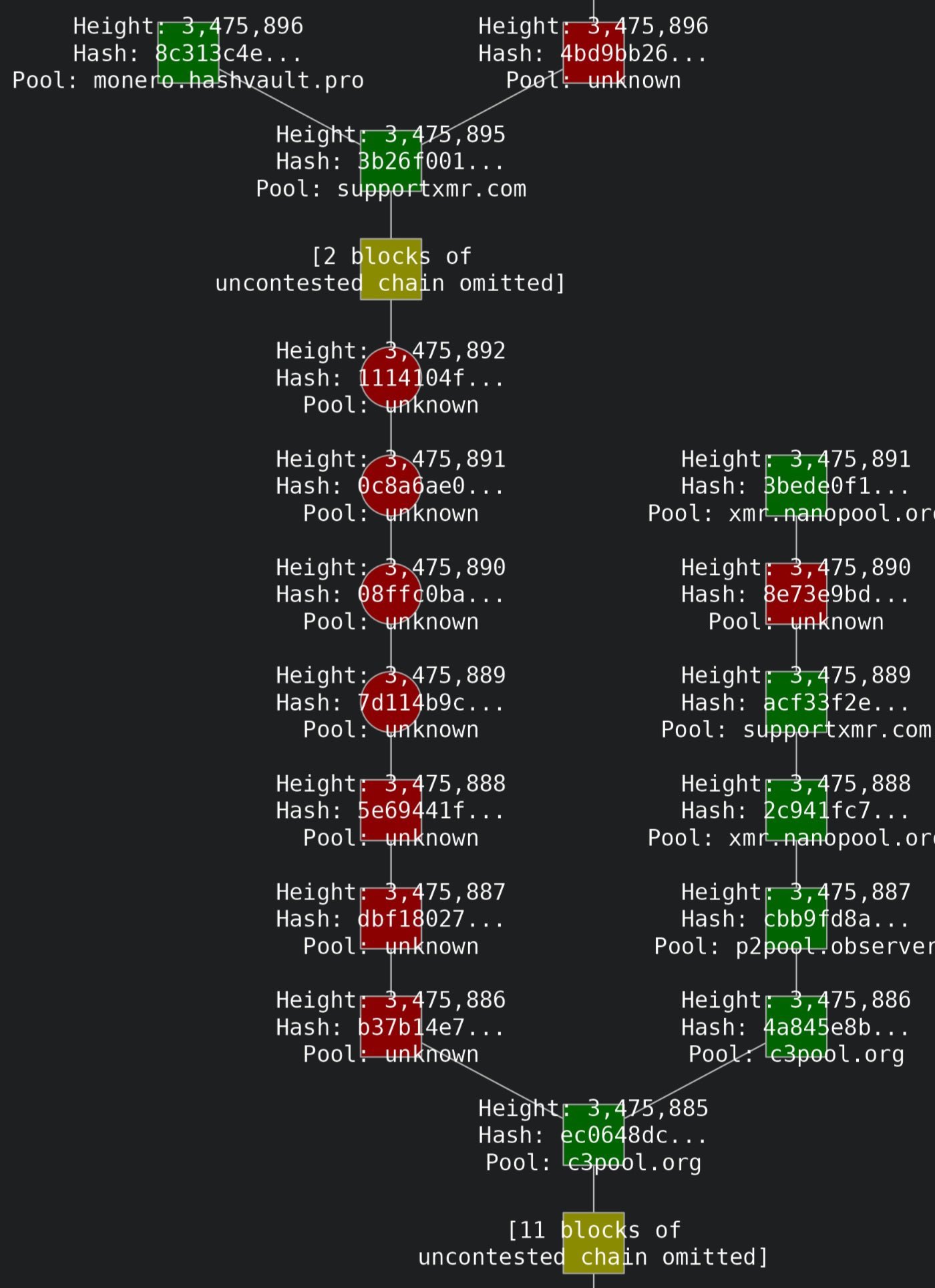
Example of a Monero block reorganization allegedly carried out by the pool team. Source: x.com/evilcos
What Is a 51% Attack?
Any blockchain network using the Proof-of-Work algorithm, including Monero, remains secure as long as no single person or organization controls the majority of computing power — that is, 51%.
If someone gains more than 50% of the mining hashrate, they can:
- Create a chain of blocks faster than others;
- Censor transactions;
- Take a share of profits from other miners;
- Rewrite recent transaction history in blocks;
- Temporarily remove or ignore other participants’ transactions;
- Perform double spending.
In other words, whoever controls 51% of the network essentially becomes its owner. The Monero case is a prime example of such an incident.
However, it is important to clarify that a 51% attack does not allow the attacker to:
• Steal coins from other wallets;
• Create coins “out of thin air.”
It only grants power over the order of record entries in the blockchain.
How Qubic Attracted Miners
The Qubic team took a strategic approach. To attract as many miners as possible, the pool representatives implemented several steps.
- Financial incentives. Qubic offered increased payouts to miners. By joining the pool, participants could earn more XMR, making it profitable. This drew miners to Qubic.
- Aggressive recruitment and technical integration. Qubic worked with large data centers and organizations that already had mining capacities. The pool’s team offered them to connect large volumes of computing power in exchange for favorable conditions and higher profits. Businesses saw the value in the offer.
- Recruiting hidden miners. Some of Qubic’s hashrate might have come from cryptojacking or compromised servers — secretly connecting to computing devices to use their power for crypto mining. However, this theory lacks solid evidence.
Psychology also played a role. Many perceived Qubic’s rapid hashrate growth in the Monero network as a game with the ultimate prize — the chance to gain control over the most capitalized privacy cryptocurrency network.
Why Qubic Attacked Monero
The organizers of the attack have not revealed their goals, so we can only speculate. Many believe the motivation could simply be the desire to control a major project’s network. Some suggest it might be an act of revenge against Monero’s developers.
Economic incentives are also possible. The Qubic team may have attacked the privacy cryptocurrency’s network simply to accumulate as much XMR as possible. Another possible motive is to support the value of the pool’s native token, QUBIC.
“The only way to mine Monero will be through them [Qubic], and it’s 3 times more profitable than mining Monero directly. They give half the profit to miners and sell the other half to buy QUBIC tokens and send them to a burn address. If they mine 100% of Monero’s blocks, that gives them 432 XMR per day. At Monero’s current price, that’s $118,342.08. Half of this amount they keep, and the other half they give to miners — meaning $59,171.04 worth of QUBIC is burned every day. That’s $414,197.28 burned weekly and $1.656 million monthly,” one network user commented on the pool’s possible motives.
Interestingly, some members of the crypto community are convinced that the pool’s team falsified data. They argue that Qubic’s actual share of Monero’s hashrate may be smaller than claimed. Unfortunately, the recorded block reorganizations suggest the pool’s claims might be true. Developer Luke Parker disagrees. He believes that reorganizing a few blocks does not confirm the pool’s control over the network.
Consequences for Monero
For the crypto project, the 51% attack was a severe blow. The mere fact that someone obtained control over the network poses a direct threat to private miners, cryptocurrency users, and its investors. Many rushed to sell their XMR.
Since the start of the attack, Monero has dropped in price by more than 40%. The cryptocurrency has been unable to recover, despite the alleged start of altseason and optimism among crypto investors.
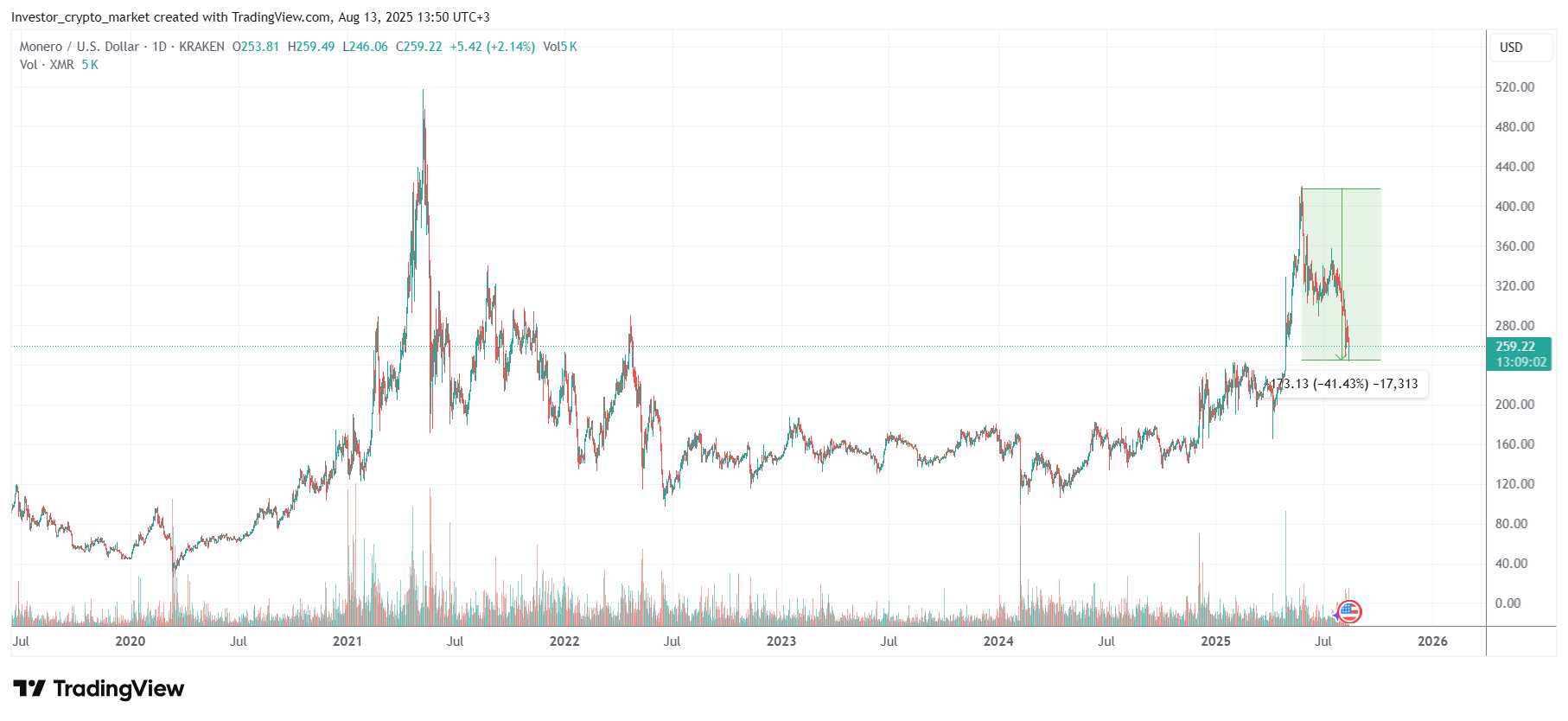
Monero chart. Source: TradingView
Will XMR Survive?
Unfortunately, there is no clear answer. The project’s fate currently depends on the mining pool. As long as XMR mining remains profitable for the Qubic team, Monero will survive.
However, the project’s developers could intervene and fix the situation. To do this, they would need to quickly release a fork supported by the crypto community. At the time of writing, the Monero team had not announced such plans.
Exchange Monero for USDT or other cryptocurrencies quickly and at the best rate on Quickex.