
In Serbia and neighboring Bosnia, a project called HiveBits is turning living beehives into on-chain assets.
Sensors track temperature, weight and bee activity in real time, data is recorded on Solana, and each hive can be represented as an NFT or linked to a token that gives holders a share of the honey, and other products, the colony produces.
Roughly 60,000 bees per hive are now working for the blockchain.
It sounds like science fiction, but it is already happening — and it is only one of the more colorful examples of real-world asset, RWA, tokenization that have emerged in 2025–2026.
HiveBits: Turning Beehives into DePIN Nodes
HiveBits started with actual beekeeping experience.
The team, including a long-time beekeeper and an IoT engineer, has already generated more than $200,000 in revenue from physical hives and operates an apitherapy center.

They are now scaling the model on-chain.
Key elements of the project:
- IoT sensors inside each hive continuously monitor temperature, humidity, weight and colony activity. The data streams to a dashboard, HivePulse, and onto the blockchain, giving transparent proof that the asset is alive and productive.
- Hives function as DePIN-style nodes. Investors can own exposure through NFTs or the $NECTAR token.
- Revenue comes from honey, bee bread, pollen, propolis, wax and potentially bee venom. Projections for a planned 300-hive farm point to meaningful annual revenue with strong margins in an average season.
- Holders of certain NFTs have received real-world perks such as free apitherapy sessions.
- The current community round for $NECTAR aims to fund a larger commercial farm, with R&D apiary in Serbia’s Fruška Gora national park. The farm is expected to be operational for the 2027 honey season, with revenue flowing into a treasury governed on-chain, using futarchy-style decision markets via MetaDAO.
The project already reports 120+ active hives, thousands of kilograms of honey produced, and a growing community.
Later plans include selling hardware to other beekeepers so they can join the network as nodes, plus urban hives.
In short: thousands of bees are producing measurable economic value, and that value is being fractionalized and made transparent on Solana.
The Broader Trend: Tokenizing the Unexpected
HiveBits is far from the only unusual real-world asset moving on-chain.
Here are some of the more memorable cases that have appeared in recent years:
Brazilian Dairy Cows as Loan Collateral
In mid-2026, farmers in Paraná, Brazil, used ten sensor-equipped dairy cows to back a formal credit operation registered on the B3 stock exchange.
Smart collars from agtech firm Cowmed track health, location and behavior in real time.
Each animal receives a unique digital identity.
This allowed the cows to serve as movable collateral without the traditional heavy physical inspections and steep discounts banks usually apply to livestock.
The deal opened a new financing channel for agricultural producers and highlighted how sensor data + blockchain can turn living animals into verifiable financial assets.
Whisky and Spirits Casks
Platforms such as Cask Capital and others have tokenized aging whisky, rum and other spirit casks.
Investors can buy fractional ownership of barrels stored in bonded warehouses.
The physical liquid stays in place while ownership and provenance move on-chain.
Some offerings start at accessible ticket sizes, turning a traditionally high-barrier collectible into a tradable digital asset.
Racehorses
Dubai-based platform Tokinvest has tokenized thoroughbred racehorses, partnering with stables and the Dubai Racing Club.
Token holders receive a share of prize money without taking on the full cost and risk of ownership that traditional syndicates impose.
Earlier offerings sold out quickly, showing demand for fractional access to high-value bloodstock.
Fine Wine
Projects using NFC chips or similar technology link individual bottles or cases to on-chain records.
This improves provenance tracking in a market long plagued by counterfeits and enables fractional ownership or easier secondary trading of rare vintages without moving the physical bottles.
These examples sit alongside more mainstream RWAs, tokenized U.S. Treasuries, real estate fractions, private credit, that now total tens of billions of dollars on-chain.
The difference is that bees, cows, racehorses and aging whisky feel more tangible — and more surprising.
Why These Projects Matter
Tokenization of living or highly physical assets does three useful things:
- Transparency — Sensors + blockchain make it harder to hide problems, such as a dying colony, a sick cow, or a missing barrel.
- Accessibility — Assets that once required large capital, local connections or specialized knowledge become available in smaller pieces to a global audience.
- New capital flows — Beekeepers, farmers and stable owners gain alternative financing or investment channels beyond traditional banks and local investors.
Of course, risks remain: weather affects honey yields, animals can get sick or die, regulation of novel RWAs is still evolving, and smart-contract or oracle failures are always possible.
Projects that combine real operational expertise, actual beekeepers, actual farmers, with solid technology tend to look more credible than pure marketing plays.
The Strange New Frontier of RWAs
In 2026 the tokenization conversation is no longer limited to Treasuries and office buildings.
It now includes beehives in the Balkans, dairy cows in Brazil, whisky maturing in Scottish warehouses, and racehorses training in Dubai.
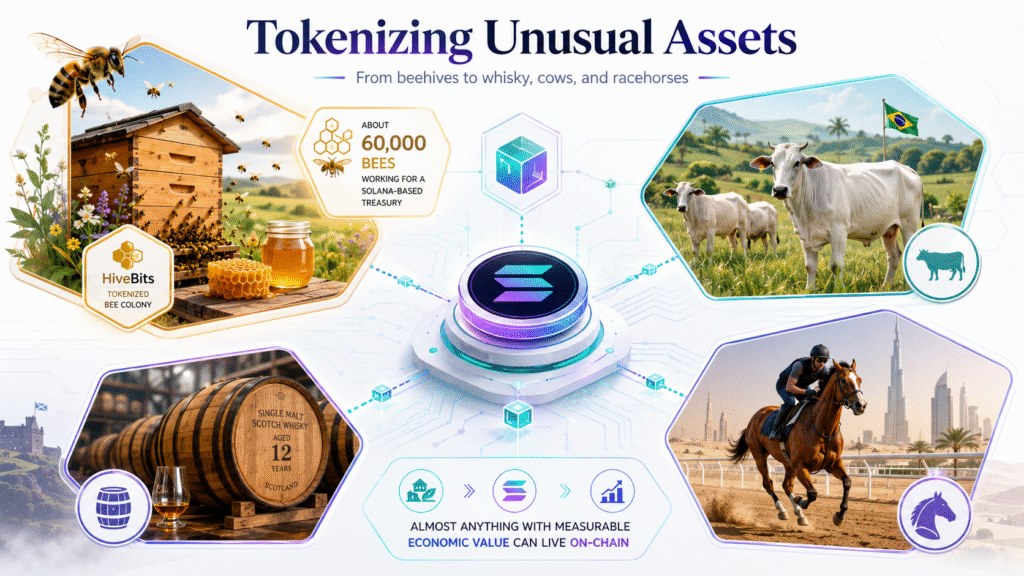
HiveBits’ experiment — putting roughly 60,000 bees to work for a Solana-based treasury — is one of the most charming illustrations yet of how far the idea has traveled.
Whether these unusual assets scale into major markets or remain niche curiosities, they demonstrate that almost anything with measurable economic value and reliable data can, in principle, be represented on-chain.
The next time you open a jar of honey, you might be tasting the product of a tokenized colony.
And that is a very 2026 thought.
Disclaimer: The material in this article is not financial or investment advice. Everything stated here reflects the author's personal view and should not be treated as a recommendation to trade or invest. We make no warranties regarding the accuracy, reliability or completeness of the information presented. Cryptocurrency markets are highly volatile and can move unpredictably. Before committing any funds, every investor, trader or crypto user should study several independent sources and check the regulations that apply in their own jurisdiction.