
At the beginning of September, the crypto project Tempo came into the spotlight. It’s a new layer-1 (L1) blockchain network built specifically for payments and stablecoins. The initiative emerged from a collaboration between Stripe, a major international payments company, and Paradigm, one of the most prominent venture funds in the crypto space.
Here’s what’s interesting about Tempo and what prospects the project has.
Track cryptocurrency rates on Quickex.
Why Tempo
Most popular blockchains were originally designed for trading and decentralized finance. They don’t account for the specifics of mass settlements where stable fees, high speed, and a business-friendly user experience are crucial.
For example, the Bitcoin network can realistically process only about five transactions per second, and Ethereum—about twenty. That’s not enough for continuous settlement flows. Therefore such networks can’t fully compete with fiat payment systems.
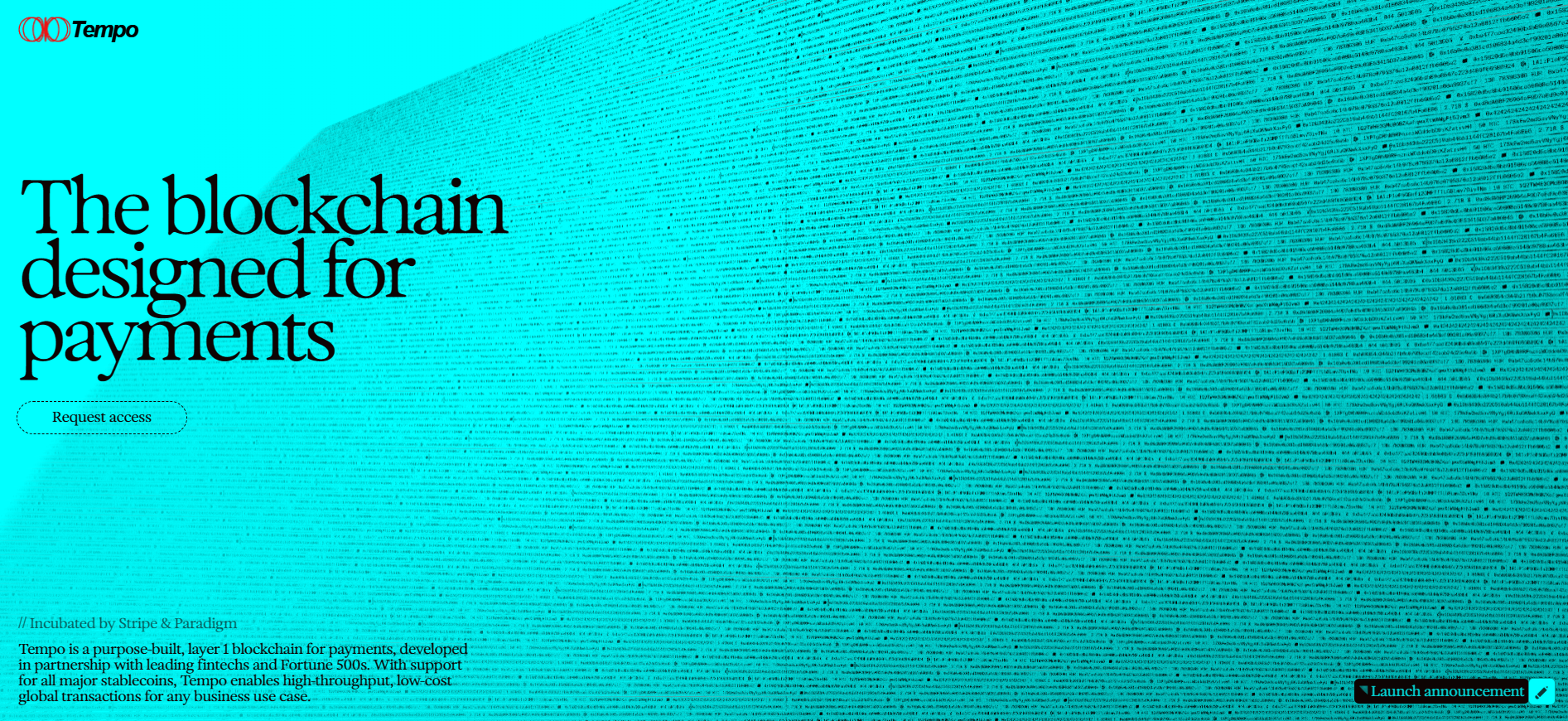
Screenshot of the Tempo official website home page.
The developers proposed to solve the problem by combining the strengths of two worlds: fiat and digital. For instance, payment systems like Stripe handle over ten thousand operations per second. Yet they lack the advantages of digital assets. Tempo combines the two worlds.
There is another problem the developers tried to address. In the crypto community, fees are typically paid in the network’s token. That requirement is inconvenient for users who prefer to think in familiar fiat categories. Tempo has a built-in automated market maker. The network converts assets into stablecoins and lets users pay fees directly with them, without having to buy a separate native token.
The developers state that Tempo will not depend on any single stablecoin. Any company will be able to issue its own digital currency in the network. All assets will be equal. Users will be able to pay fees with whichever stablecoin is convenient for them.
As of September 5, Tempo is in closed testing.
Network characteristics
Tempo is positioned as a layer-1 blockchain optimized for payments. The developers highlight the following features:
- predictably low fees;
- the ability to pay transaction fees with any stablecoin;
- a built-in automated market maker for swapping stablecoins;
- dedicated payments functionality, including channels, memos, and access lists;
- scalability with over one hundred thousand transactions per second and sub-second processing;
- compatibility with the Ethereum Virtual Machine.
Thanks to these features, the developers suggest viewing Tempo as a cross-border settlement platform. It’s suitable for building embedded financial accounts, enabling cheap transfers, and settlements based on tokenized deposits, micropayments, and automated transactions.
Network security will be provided by an independent set of validators. In the future, the validation process is planned to become fully open to all interested participants.
Who is behind the project
At the helm of the project is Stripe—one of the largest providers of payment solutions for businesses worldwide. Paradigm—a venture fund that supports cryptocurrency and blockchain projects—helped the company implement the initiative.
Deutsche Bank, Revolut, Nubank, Visa, Shopify, DoorDash, OpenAI, and a number of other companies in finance, e-commerce, and technology have joined the project.
Criticism and skepticism
Despite an impressive list of partners, the project received a mixed reaction. Crypto analyst MartyParty said under a post by Stripe co-founder Patrick Collison that Tempo contradicts the very idea of decentralization.
In his view, attempting to create a new intermediary only deepens users’ dependence on centralized structures. He noted that true blockchain progress is only possible in open and fully public networks. Given its technical characteristics, he is certain Tempo is doomed to fail.
There are other problems, too. Users pointed out that the developers deprived the project of Ethereum’s liquidity by voluntarily isolating the network. There are no guarantees that the big names of the project’s partners will help attract even a fraction of the crypto community.
Conclusions
The Tempo network could play an important role in the development of blockchain-based payment solutions. Unfortunately, the crypto community is left wondering whether the platform will truly be a decentralized tool or will turn into yet another form of corporate infrastructure controlled by large companies.
The best cryptocurrency exchange rates — at the Quickex exchanger.