

The Monero blockchain has experienced the biggest attack in its history — a chain reorganization of 18 blocks, during which dozens of minutes of history were rewritten and hundreds of transactions were annulled. Against the backdrop of this event, discussions have intensified about whether other cryptocurrencies, including Bitcoin, may also be at risk.
The Quickex team decided to investigate what exactly happened and what conclusions the market should draw.
Track Bitcoin’s reaction to major events with Quickex.
Rollback in Monero’s history
It all started with an unexpected chain reorganization, which became the deepest in the entire history of Monero. The Bitcoin News team was the first to report that as a result of the attack, 118 confirmed transactions were canceled. Confidence in the network’s stability was under threat. Let us recall, the Monero network came under the control of Qubic in the summer of 2025. The project team has not been able to eliminate the threat.
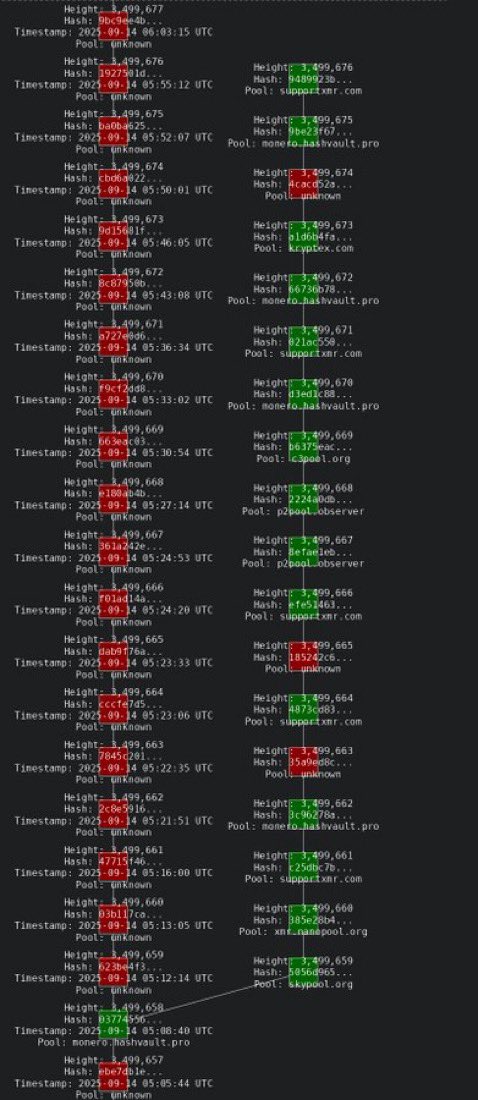
Monero block reorganization, noted in Bitcoin News
Amid the incident, some community members said that Monero might not survive what had happened.
The investigation showed that the mining pool Qubic was behind the latest attack. It was its power that made it possible to rewrite blockchain history and temporarily seize control of the network. But the project itself does not consider its actions destructive. Qubic founder Sergey Ivancheglo (CFB) emphasized that he does not plan to destroy Monero. His words sounded especially harsh: Monero will remain because Qubic wanted the project to live.
Reaction and criticism
The reaction to the attack was mixed. Part of the community insists that Qubic is not a hostile project, but only tests new solutions and verifies them in practice. Ivancheglo has been a prominent figure in the industry for more than ten years. He is known as the author of a number of innovations. Therefore, some observers perceived the incident more as a demonstration of strength than as an attempt to destroy Monero.
However, independent analysts see the situation differently. Vini Barbosa stated that Monero continues to suffer from selfish mining attacks. This method consists in a miner deliberately withholding found blocks and publishing them with a delay in order to deceive the network and increase his share of rewards at the expense of other participants. According to Barbosa, in just the past 24 hours, almost a third of the blocks turned out to be orphaned. Against this background, he refused to accept XMR as payment until the network stabilized and recommended setting at least 20 confirmations for transactions.
MetaRyuk analysts added that Qubic’s economic model is tied to Monero mining and the subsequent sale of XMR to buy QUBIC tokens. Despite threats and loud statements from the founder, over the past 30 days Monero has risen in price by 33%, while Qubic has fallen by 35%.
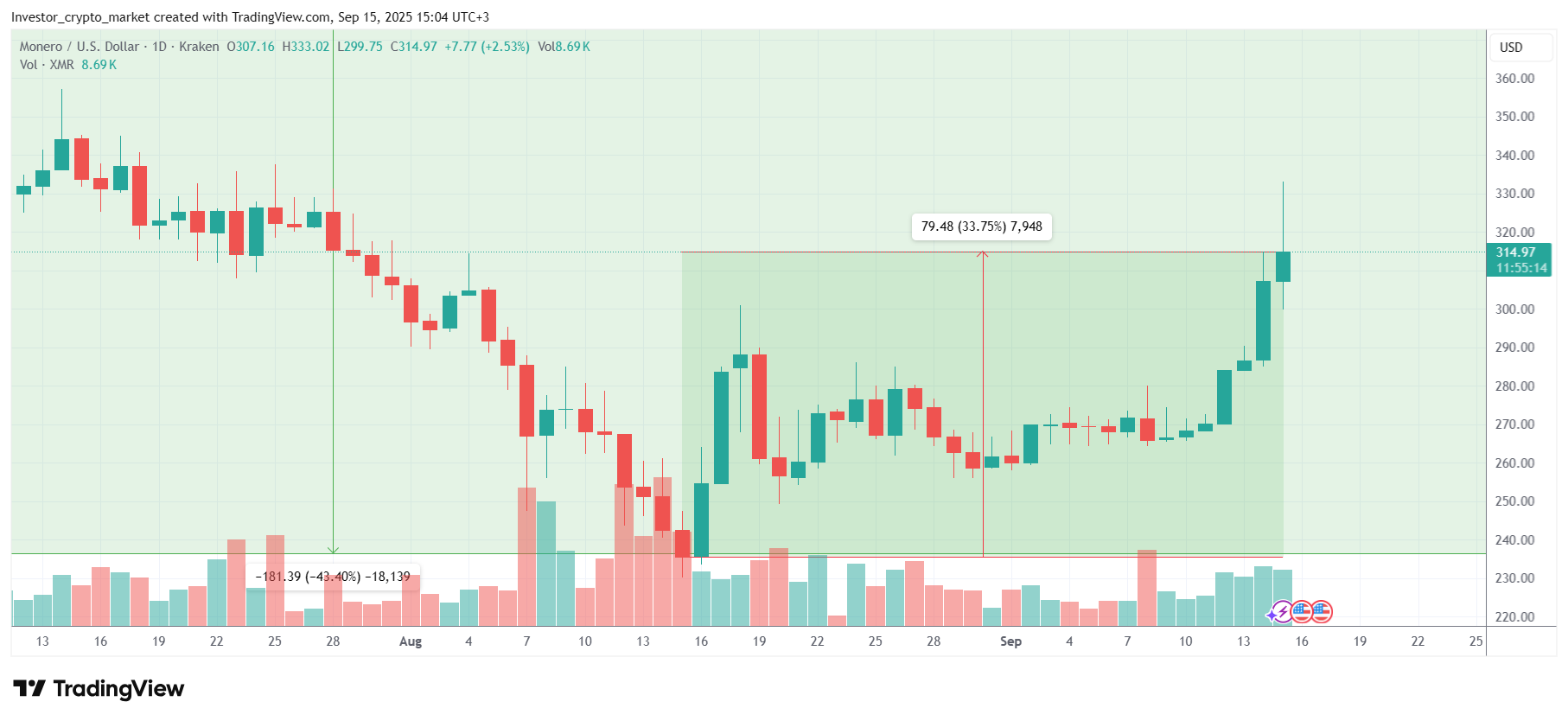
Monero chart. Source: TradingView
Interesting! The growth of XMR may be linked to rumors that Qubic will buy back Monero for the subsequent buyback of its own tokens.
At the same time, Wise Advice drew attention to the fact that the largest Monero reorganization, which rolled back 18 blocks and deleted 117 transactions, is a disturbing signal for the cryptocurrency. The authors of the post stressed that the incident became a resilience test for other cryptocurrencies as well.
What the Monero team is working on
Despite the heavy blow to its reputation, Monero developers continue to work on the project’s development. Developers have focused on developing the Cuprate client and integrating Full-Chain Membership Proofs (FCMP++) tools into the Monero codebase. This technology should strengthen the proof system in the network and increase its resistance to manipulation.
At the same time, part of the crypto community criticizes the Monero team for trying to create the impression that no block reorganization took place. According to skeptics, this position undermines trust in the project’s transparency and raises additional questions about its willingness to acknowledge vulnerabilities.
Bitcoin under threat
The Monero case has shown: even mature blockchains may turn out to be vulnerable to an attack by a powerful pool. The community is already discussing whether a similar scenario could affect Bitcoin in the future. For now, this looks unlikely due to the network’s much higher hashrate, but the very fact that the largest anonymous coin came under attack has made many think about the risks to the entire ecosystem.
Concerns were also fueled by Ivancheglo himself. In response to a post about a Satoshi-era wallet waking up, he wrote that Bitcoin whales should stop trying to make him look bad. Otherwise, the Qubic quorum may decide to start Bitcoin mining after Dogecoin. In that case, the consequences for the holdings of major investors would be unpredictable. Ivancheglo, apparently, threatened the Bitcoin community with a 51% attack following a familiar scenario.
Conclusions
The attack on Monero showed that even mature projects that have built a reputation over the years may be vulnerable. The block reorganization carried out by the Qubic mining pool has become a disturbing signal not only for the Monero community but for the entire crypto market. It revealed weak spots in the protection mechanisms and reminded us that decentralization does not always equal security.
At the same time, the market’s reaction turned out to be unexpected: Monero managed to rise in price, while the Qubic token lost a significant part of its value. This can be interpreted as evidence of user trust in the project even in times of crisis, but such trust may prove fragile if developers do not find quick and convincing solutions.
The discussion around Sergey Ivancheglo’s actions and statements has shown how strongly personalities continue to influence the perception of cryptocurrency initiatives. His hints about the possibility of switching Qubic to Bitcoin mining only heightened the tension.
The Monero team, meanwhile, demonstrates its readiness for development but faces criticism for insufficient transparency. This highlights a key problem: the future of such networks depends not only on technology but also on trust, which is built over years and can be undermined in just a few days.
Quickly exchange XMR for USDT or another cryptocurrency with Quickex.
Disclaimer: The material in this article is not financial or investment advice. Everything stated here reflects the author's personal view and should not be treated as a recommendation to trade or invest. We make no warranties regarding the accuracy, reliability or completeness of the information presented. Cryptocurrency markets are highly volatile and can move unpredictably. Before committing any funds, every investor, trader or crypto user should study several independent sources and check the regulations that apply in their own jurisdiction.