

Americans will once again be allowed on foreign crypto exchanges. The U.S. Commodity Futures Trading Commission (CFTC) issued guidance that changes the rules. Now foreign trading platforms can officially offer their services to clients from the States without fear of prosecution from regulators.
For the market, this is a long-awaited step. In recent years the rules were blurred, and companies left for abroad, where requirements are simpler. Now they have a chance to return, while the U.S. gets an opportunity to strengthen its position in the race for leadership in the global crypto market. We explain how the new decision will shift the balance of power.
Track cryptocurrency prices and the market’s reaction to regulatory initiatives with Quickex.
What exactly does the CFTC propose
The regulator proposed that foreign trading platforms serve American clients through the foreign board of trade (FBOT) procedure. This mechanism has existed since the 1990s. It was originally created to allow Americans to trade on registered foreign markets. Unfortunately, with the rise of crypto, the mechanism was altered.
Problems began in 2021. Due to the absence of clear rules and pressure on already weak crypto companies, many exchanges abandoned their U.S. clients.
Regulatory uncertainty forced members of the crypto community to massively move infrastructure outside the country. As a result, a significant share of crypto trading flowed to foreign platforms. Direct access for American traders to such platforms was blocked.
Acting Chair of the Commission Caroline D. Pham stated that the new guidance will clarify the rules:
“CFTC will support Americans who want to trade efficiently and safely under the protection of our laws. We are bringing crypto trading back to the United States and opening traders’ access to the world’s most liquid markets.”
Pham notes that the CFTC made this decision as part of implementing the crypto sprint plan, which we will discuss shortly.
The CFTC press release No. 9111-25 states directly that the FBOT guidance takes effect immediately. That is, the initiative does not require a separate vote of Congress or the adoption of new rules—this is a document interpreting the existing regulatory framework.
What is crypto sprint
The crypto sprint initiative was proposed by the administration of U.S. President Donald Trump. It is an accelerated plan for reforming crypto regulation.
Crypto sprint has an ambitious goal—to bring the “lost” crypto companies back to the U.S. To achieve this, it is necessary to create unified and transparent rules and eliminate the “pitfalls” that drive businesses to more attractive foreign jurisdictions in terms of regulation.
According to the regulator, the program is aimed at giving market participants clear rules of the game that will replace pointless investigations and fines.
Who does the U.S. want to bring back
In the early 2020s, when the U.S. had no clear rules for the crypto industry, a number of major platforms began closing their doors to Americans. BitMEX, Bybit, KuCoin, and OKX, one after another, stopped working with clients from the States. Company managers complained about increasing pressure from regulators.
The case of Binance took a special place. We are talking about the world’s largest crypto exchange. U.S. regulators accused the company and its founder Changpeng Zhao (CZ) of operating in a “gray zone.” According to authorities, platform managers knowingly allowed American clients to bypass bans and use Binance.com.
CZ pleaded guilty in 2023. He was charged with violations of anti–money laundering (AML) requirements. The Chinese businessman had no choice but to pay a multibillion-dollar fine. As the “icing on the cake,” he stepped down as Binance CEO and even managed to serve his sentence. As you can see, even money didn’t help.
Unwillingness to leave the American market led the company to form a separate structure, Binance.US. This is something like the American “subsidiary” of the trading platform. It operates under U.S. law. Unfortunately, due to regulatory pressure, the platform was able to conduct business in far from all states. And restrictions also forced the Binance team to cut the number of instruments available to American users.
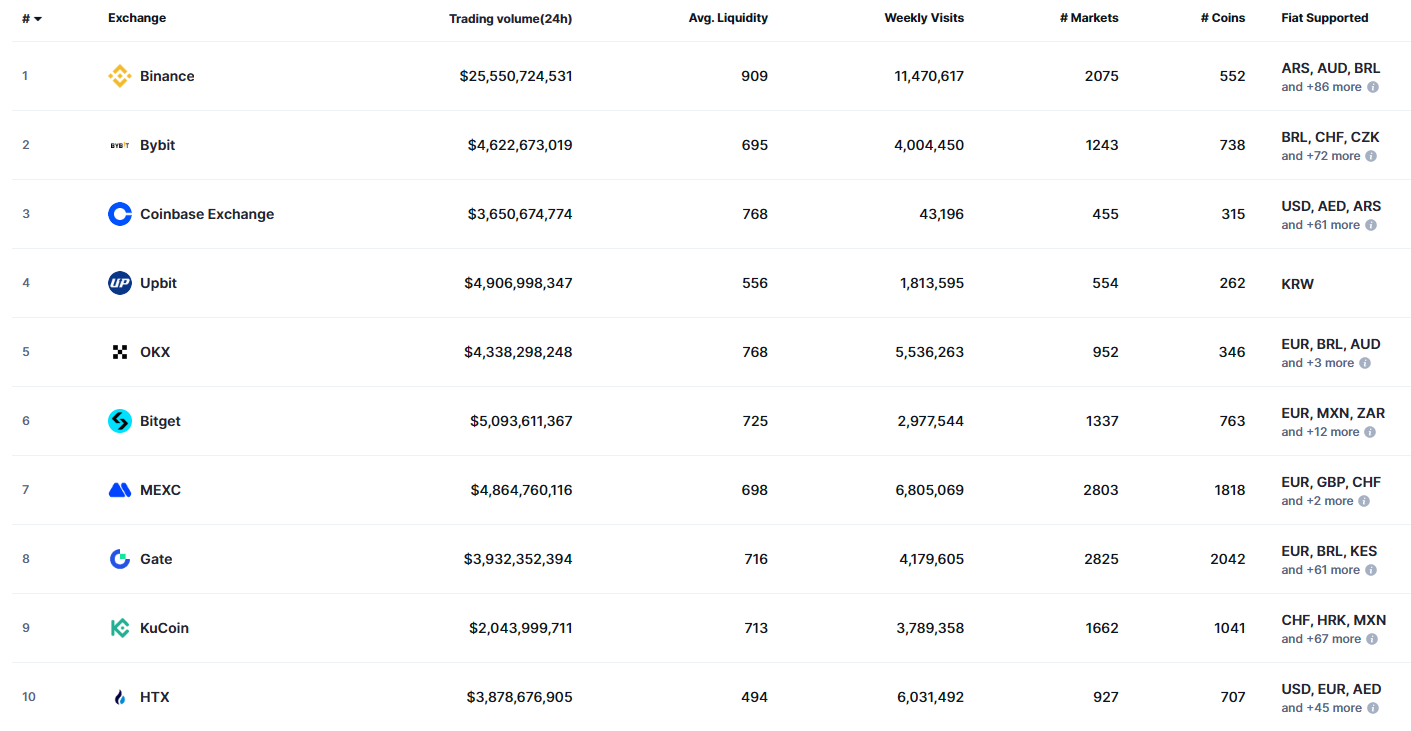
Binance amid top-10 most capitalized crypto exchanges. Source: CoinMarketCap
U.S. exchanges brace for a wave of competitors
While foreign players were leaving the market, U.S. companies—Coinbase, Gemini, and Kraken—were strengthening their positions. From the outset, they operated strictly within national regulation.
Now, however, the rules are changing: foreign exchanges registered under the FBOT scheme will be able to compete directly with Coinbase and other American platforms. For local players, this means increased competition. And the emergence of more transparent conditions is unlikely to soften the blow.
Market consequences
For traders — a wider choice of trading platforms, increased liquidity, and legal access to international markets.
For the industry — the return of crypto companies to the U.S. and reduced legal risks.
For the regulator — strengthened control over the sector and the opportunity to position the U.S. as a global hub for crypto trading.
Political aspect
The CFTC guidance reflects White House priorities. Donald Trump has repeatedly emphasized that he wants to turn the U.S. into the capital of the crypto industry. The new Commission document became a practical step in this direction.
Transparent rules will allow crypto companies to do business without fear of facing unexpected claims and fines, which previously served as reasons for moving to more crypto-friendly countries.
The CFTC has begun collecting comments on the initiative. The regulator intends to take the market’s position into account.
Anonymity and the best cryptocurrency exchange rate — on Quickex.
Disclaimer: The material in this article is not financial or investment advice. Everything stated here reflects the author's personal view and should not be treated as a recommendation to trade or invest. We make no warranties regarding the accuracy, reliability or completeness of the information presented. Cryptocurrency markets are highly volatile and can move unpredictably. Before committing any funds, every investor, trader or crypto user should study several independent sources and check the regulations that apply in their own jurisdiction.