
The US Department of Commerce announced the launch of a program under which key macroeconomic indicators will be transferred to the blockchain. To implement the project, the regulator chose two popular oracles — Chainlink and Pyth Network.
We explain how exactly the process will be organized and whether it will make US economic data more transparent.
Track the LINK cryptocurrency price via Quickex.
What are oracles
Blockchain is a system for storing information in which data cannot be changed retroactively. Technically, it is a distributed ledger with an unlimited number of copies. It is physically impossible to falsify all instances. And if adjustments are made to one block of data, comparison with the originals makes it possible to quickly detect forged entries.
The problem is that blockchain itself is isolated. It does not receive information from the outside world. For smart contracts to use real data, oracles are needed.
An oracle is a service that takes data from external sources, for example, government statistical agencies, and transmits it to the blockchain in verified and encrypted form. Such platforms can be compared to mail carriers, but instead of parcels, they deliver information.
Why Chainlink and Pyth were chosen
Chainlink has been operating since 2017. Over the years, the project has become the largest network of decentralized oracles.
Decentralization means that the data is verified not by a single participant, but by many independent network nodes. This approach eliminates the possibility of error or intentional record substitution.
The Chainlink platform is integrated with more than 2,400 applications. It is used in dozens of blockchains.
The project holds international reliability certificates ISO 27001 and SOC 2 Type 1. This is a “green flag” for working with financial institutions and government bodies.
In addition, Chainlink actively interacts with US regulators, including the Securities and Exchange Commission (SEC). To better understand the project’s status, note that its team participated in drafting the federal GENIUS Act, which regulates the use of stablecoins in the US.
Pyth Network launched later — in 2021. The project team focused on working with major data providers — exchanges and market makers.
The Pyth platform transmits information as quickly as possible, which is especially important for financial markets. The network covers more than a hundred blockchains and supplies data to hundreds of applications. Its focus on speed and reliability made it a suitable choice for the US Department of Commerce.
Together, Chainlink and Pyth create a system in which government statistics can be transmitted to the blockchain reliably and with minimal delay.
Which US data will be published on the blockchain
The US Bureau of Economic Analysis has begun publishing six key indicators on the blockchain:
- real GDP — the total size of the economy adjusted for inflation, expressed in billions of dollars at 2017 prices;
- real GDP — percentage change compared to the previous quarter, recalculated at an annual rate (this indicator shows whether the economy is growing or contracting);
- Personal Consumption Expenditures (PCE) Price Index — a measure of changes in the prices of goods and services for consumers, often used as an indicator of inflation;
- PCE Price Index — percentage change compared to the previous quarter in annual terms;
- real final sales to private domestic purchasers — the value of goods and services sold domestically adjusted for inflation, in billions of dollars;
- real final sales to private domestic purchasers — percentage change compared to the previous quarter in annual terms.
These data will be updated on the blockchain with the same frequency as in the traditional system: monthly or quarterly.
At the first stage, they are available in ten networks: Arbitrum, Avalanche, Base, Botanix, Ethereum, Linea, Mantle, Optimism, Sonic, and ZKsync.
How the data transmission process works
Chainlink receives macroeconomic statistics from the Bureau of Economic Analysis and transmits them to a network of validator nodes, represented by independent computers. The task of the latter is to verify the authenticity of the information. Here is how this works:
- each node compares the received data;
- if everything is correct, the node adds a digital signature;
- the information is then aggregated and placed in smart contracts.
Chainlink Data Feeds are data transmission channels that ensure simultaneous publication across multiple blockchains. They are built on the Onchain Data Protocol — a standard that defines the transmission format and guarantees compatibility between systems.

Scheme of Chainlink’s interaction with regulators and external blockchains. Source: Chainlink
In Pyth Network, the process is different. The Department of Commerce acts as a publisher, transmitting data to the Pythnet network. There, entries are verified using cryptographic methods and confirmed through staking — a mechanism in which network participants lock their own funds and risk them if they provide false information.
After verification, the data becomes available to consumers — applications and protocols that use statistics in their operations.
Both systems work toward the same goal: to ensure that macroeconomic statistics are available on the blockchain in immutable and verifiable form.
Why this is needed
According to the US Department of Commerce, moving data to the blockchain opens new opportunities:
- creation of trading strategies that automatically react to the release of macroeconomic indicators;
- issuance of inflation-indexed products and tokenized bonds based on real statistics;
- formation of prediction markets where users can collectively assess economic prospects;
- development of dashboards where government statistics are displayed in real time and accessible to any user.
For the government, this approach is a path to transparency and trust, and for businesses and developers — convenient access to official data without intermediaries. Society receives a new form of reporting, in which information is published openly and with a guarantee of reliability.
Market reaction
Immediately after the announcement, the LINK token of the Chainlink project rose by more than 9%, but later gave back its gains. At the time of writing, the cryptocurrency is trading at $23, which is 55% below the all-time high of $52 from May 2021.
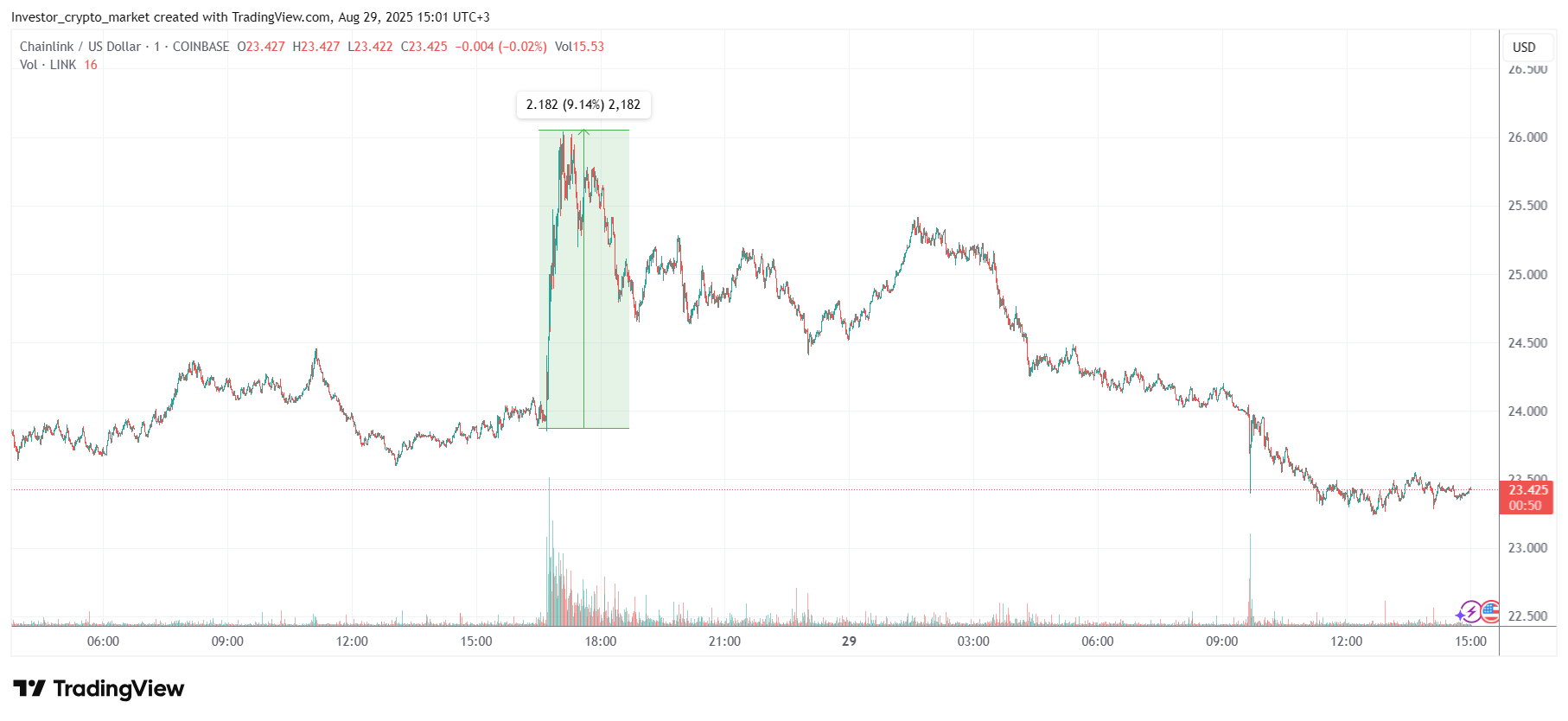
LINK chart. Source: TradingView
The lesser-known cryptocurrency Pyth surged 110% on the news. At the time of writing, the coin has only slightly corrected from its peak. However, like LINK, it remains far from its all-time high — $1.15 (March 2024).
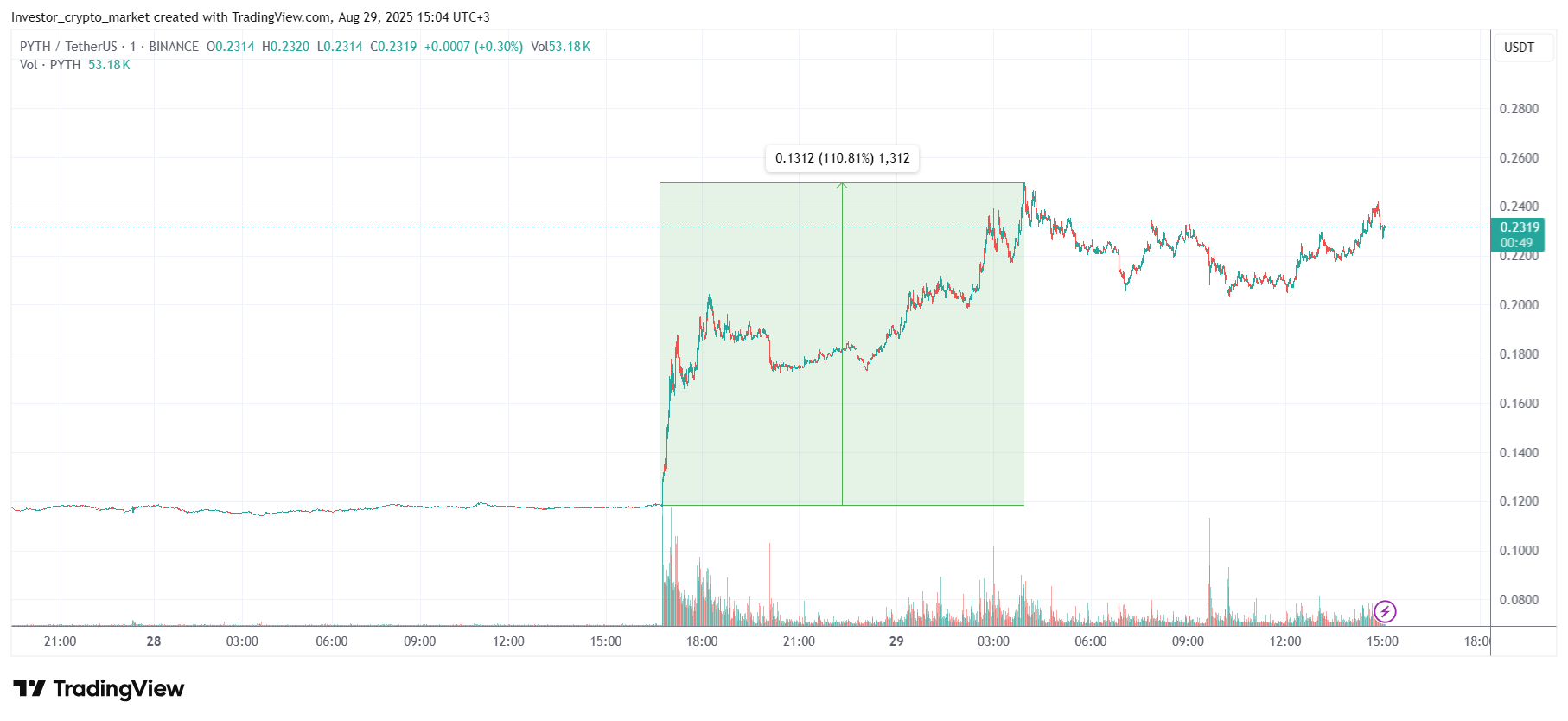
Pyth chart. Source: TradingView
The strong reaction of Pyth can be explained by the fact that, unlike Chainlink, the project found itself in the spotlight of investors for the first time on such a major occasion.
Conclusions
For the first time, the US has begun publishing official macroeconomic statistics on the blockchain. Chainlink and Pyth provide data transmission, verification, and protection from changes. This approach forms a new model of interaction between the government, business, and society. The information has become accessible and reliable.
Active work by US authorities with Chainlink and Pyth may strengthen the projects’ positions in the market and increase demand for their tokens.
Quickly buy or exchange cryptocurrency at a favorable rate on Quickex.