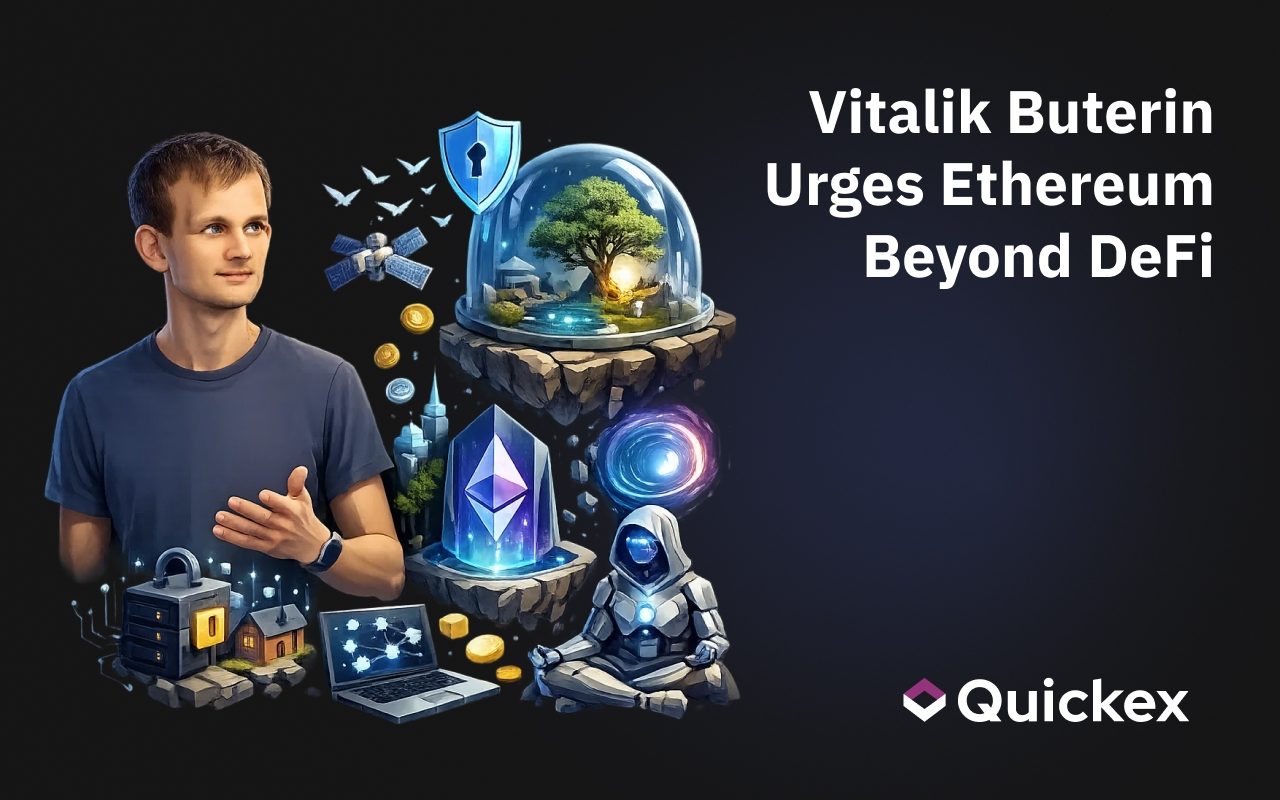

Ethereum co-founder Vitalik Buterin has issued a sobering assessment of decentralized finance (DeFi), arguing that while it has achieved remarkable technical progress, it has not yet become a genuine tool for protecting people amid rising surveillance, geopolitical conflicts, and corporate dominance. In recent statements and reflections shared across platforms, Buterin urges the crypto community to shift focus toward building “technologies of refuge” — ownerless digital spaces governed by permissionless, self-enforcing rules that extend far beyond finance.
This vision positions Ethereum and blockchain tech as foundational layers for broader human freedom, drawing explicit comparisons to real-world tools like Starlink (for connectivity) and Signal (for private communication).
DeFi’s Limits in a Chaotic World
Buterin acknowledges Ethereum’s successes in creating trustless financial primitives, smart contracts, and censorship-resistant value transfer. However, he emphasizes that DeFi alone falls short as a “shield” in an era marked by:
-
Intensifying digital surveillance by states and corporations
-
Ongoing wars and geopolitical instability driving demand for uncensorable tools
-
Corporate “walled gardens” that enclose data, communication, and economic activity
In his view, tools like Starlink provide tangible liberation through independent satellite internet access, even in conflict zones or under restrictive regimes. Signal offers end-to-end encrypted messaging that resists backdoor pressure. DeFi, despite its permissionless nature, has not reached similar “escape hatch” status for most users facing real-world threats to autonomy.
Buterin has stressed that Ethereum’s strength lies in its ability to enable financial self-sovereignty — protecting personal resources during turmoil — but the ecosystem must evolve to resist enclosure and centralization, both externally and internally.
The Vision: Technologies of Refuge
At the heart of Buterin’s proposal is the creation of “ownerless” digital ecosystems where rules exist without centralized gatekeepers.
Key elements include:
-
Fully permissionless protocols for wallets, identity, communication, and AI interfaces
-
Open-source hardware and software stacks that resist corporate or state capture
-
Expansion beyond crypto-native users to attract people seeking privacy and independence in everyday digital life
Rather than competing directly with Big Tech giants, the goal is to construct parallel systems of freedom: robust enough for high-stakes use cases (e.g., dissidents, journalists, or communities under pressure) and accessible enough to draw mainstream adoption.
This aligns with Buterin’s broader thinking on chaotic-era incentives — prioritizing Schelling points for defense against hostile intervention over idealized economic efficiency in stable times.
Why This Matters Now — And for the Future
The timing is notable amid 2026’s landscape:
-
Escalating global tensions
-
Debates over AI control and compute access
-
Renewed scrutiny of centralized platforms
Buterin’s call resonates as a reminder that blockchain’s original cypherpunk promise — technology as a bulwark for individual liberty — remains unfulfilled in many dimensions.
For Ethereum specifically, this means doubling down on:
-
censorship resistance
-
interoperability
-
privacy layers (like encrypted mempools and network anonymization)
-
reducing points of centralization (e.g., in block building or staking)
At Quickex.io, we see this as a pivotal moment for the industry. Tools that enable true self-sovereignty — secure wallets, private swaps, decentralized access — become even more essential when the conversation shifts from yield farming to survival and freedom.
Vitalik’s message is clear: one “perfect” DeFi protocol isn’t enough. The next wave must build comprehensive refuges — digital spaces no single entity can own, censor, or shut down.
The path forward? More open protocols, diverse implementations, and a commitment to expanding utility beyond speculation. In a world of increasing pressure, technologies of refuge could define blockchain’s true legacy.