
You are about to exchange cryptocurrency. On the screen, you see an attractive rate, a suitable amount to receive, and a reasonable estimated completion time. Everything looks straightforward: you check the details and click Swap.
Only then can something become apparent that was not obvious before the transaction: the provider requests an additional KYC check, processing takes longer than expected, the refund procedure is more complicated than anticipated, or you need to contact support to find out what happened to your transaction.
The problem is not necessarily that the user or the provider did something wrong. The problem is that the rate shown before a transaction does not tell the whole story.
Today, choosing where to exchange crypto can involve several variables at once: fees, liquidity, execution speed, KYC requirements, refund policies, customer support, and the provider’s track record. In this article, we will look at why the rate alone is no longer enough and what users should check before clicking Swap.
More Choice Does Not Always Mean an Easier Decision
Having more options sounds good, but it also means there is more to check before you choose.
Today, the same asset can be bought or exchanged through centralized exchanges, instant swap services, DEXs, P2P platforms, and other solutions. These providers can operate under very different models, with different liquidity sources, fee structures, execution conditions, KYC requirements, refund policies, processing times, and approaches to customer support.
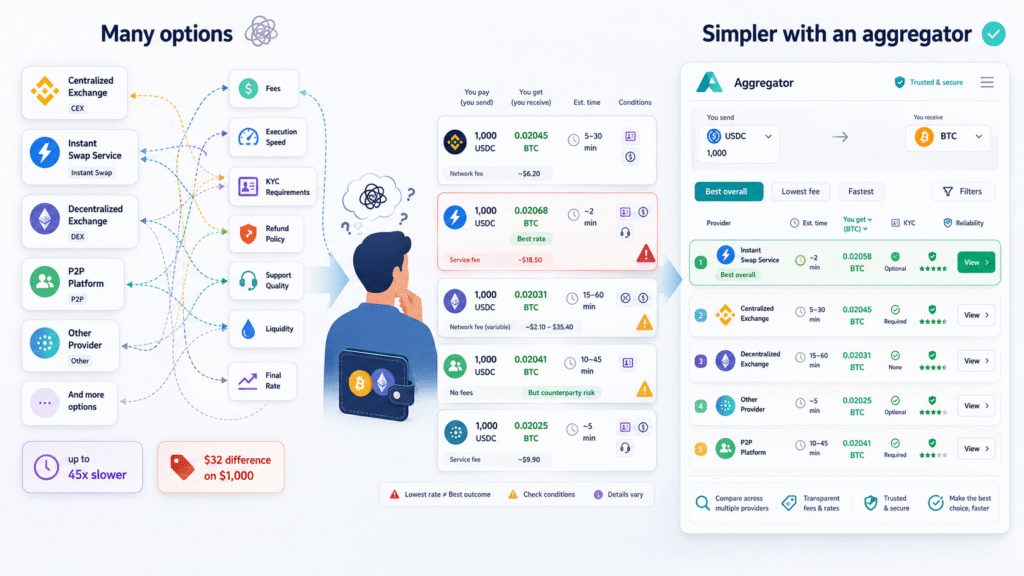
The difference is not merely theoretical. A 2026 benchmarking study based on data from 150,000 swaps across eight non-custodial providers found that execution times could vary by as much as 45x between providers. The study also identified a relationship between execution duration and the gap between the quoted and delivered rate.
For the user, that kind of difference can directly affect the outcome of a swap. A rate that looks better on paper may not be the better choice if the transaction takes significantly longer to complete. Even a relatively small difference in the final amount can add up quickly: for example, a $32 difference on a $1,000 transaction is already something most users would notice.
So even when two offers look similar, the experience of using them can be very different.
The hard part is no longer finding an offer. It is knowing what you are getting with it.
The information needed to make that decision, however, is often scattered across different sources. One website may show the rate, another may explain the provider’s terms, while reviews and information about how the service handles unusual situations may have to be found elsewhere.
A simple crypto transaction can therefore turn into a research project: find an offer, open the provider’s website, check reviews, investigate KYC requirements, understand the expected processing time, and figure out what happens if something goes wrong.
This is where an aggregator can make things easier.
How Aggregators Simplify the Search and Why That Is Not Enough
An aggregator makes it much easier to compare offers, but there is still one thing the rate cannot tell you: what the provider is like.
Instead of opening dozens of websites, users can see available options in one place and compare them before sending their funds.
Swapzone, for example, brings together offers from different crypto providers and provides access to multiple categories of crypto services. Within these categories, users can compare factors such as the exchange rate, expected amount received, estimated execution time, KYC requirements, and other transaction conditions.
This makes the initial search significantly easier.
But two similar offers can still come from very different providers.
One may be faster, another may have different KYC requirements, refund policies, product availability, or customer support.
The rate can therefore tell you what you are likely to receive, but it does not tell you everything about the service you are choosing.
That is where comparing providers becomes just as important as comparing their offers.
Partners: The Next Level of Crypto Provider Comparison
Once you have found a few offers that look good, the next question is simple: which provider do you actually want to use?
Swapzone is introducing its Partners section as a dedicated layer for researching providers before a transaction begins.
Each integrated partner has its own profile containing information about the service, its key characteristics and available products, community reviews, and an overall rating. This allows users to evaluate a provider independently of a specific offer and understand who they are actually going to transact with.
When several options are available, users can compare supported providers side by side. The comparison covers factors that directly affect the user experience, including estimated execution speed, historical likelihood of KYC, execution accuracy, refund policies, customer support quality, available products, and the provider’s overall Swapzone rating.
The idea is not to tell users which provider is “the best,” but to give them enough information to decide for themselves.
The Swapzone rating is not simply an average of user reviews. The platform independently collects and maintains information about its partners, including operational indicators, provider characteristics, and aggregated user feedback. Community reviews are displayed separately, allowing users to consider both Swapzone’s assessment and the experiences shared by other customers.
For example, someone searching for a Quickex review does not have to rely solely on individual reviews published across third-party websites. They can explore the Quickex profile in Partners, review information about the service and community feedback, and then compare the provider with another available alternative if needed.
There is no single provider that will be the right choice for everyone.
For one person, speed may be decisive. For another, it may be the likelihood of KYC, support for a particular asset, or refund conditions. Someone else may place greater importance on customer support.
A useful comparison tool should therefore not make the decision for the user. It should make the relevant differences visible so that the user can make the decision themselves.
Why Support Still Matters After You Choose a Provider
Choosing a provider is not always the end of the story. Sometimes, it is when you find out how good the support really is.
A transaction can be delayed, require additional verification, or run into a problem that the user cannot resolve on their own. At that point, the initial rate is no longer the main concern. The important question becomes: who can help resolve the situation?
This is where Swapzone can play a role beyond comparison.
Swapzone is a non-custodial platform: it does not hold users’ funds or execute exchanges itself. The transaction is completed through the provider selected by the user. But when something goes wrong, the Swapzone team can communicate with the provider, help clarify what happened, and assist the user in finding a resolution.
One user review shows what this can look like in practice.
A user accidentally sent funds to a swap in two transactions instead of one. Rather than simply directing the user back to the provider, Swapzone contacted the partner and helped work out a solution. The user was given the choice between receiving a refund or continuing the transaction at the current rate.
The user described the experience as follows:
“This service is unmatched in the crypto sphere for how they handle their business. I sent crypto to a swap in 2 transactions instead of one (my mistake) and they contacted the partner and gave me the option to get a refund or continue at the current rate. Others would just keep it or tell you it’s lost.”
— Verified Trustpilot review
This is an important distinction. Swapzone could not control the transaction itself or guarantee its outcome, but it could act as a mediator between the user and the provider when the situation needed to be resolved.
Swapzone’s Trustpilot profile currently has a 4.7/5 rating based on 530+ verified reviews.
For the user, it means there can be an additional point of support when a transaction does not go as expected.
The Decision Is Becoming More Than a Rate Comparison
A good rate is still important. It just should not be the only thing you look at.
This shift reflects how the crypto market itself has changed. Users have more services, more assets, and more ways to move value than before. But additional choice also means additional variables to evaluate.
Swapzone already brings together more than 20 integrated providers and provides access to more than 1,800 digital assets across crypto exchange, DEXs, P2P, staking, lending, fiat on/off-ramps, and other services. For users who want to make that kind of decision, Swapzone is built around exactly that question: not simply where to find a crypto offer, but how to understand the options before choosing one.
As the number of available options grows, the value of an aggregator increasingly lies in helping users understand those options, not simply showing them more of them.
Before clicking Swap, the useful question is therefore no longer just “Which offer has the best rate?”
It is: Which provider offers the right combination of rate, speed, KYC conditions, reliability, support, and transaction terms for this particular swap?
That is the difference between finding a crypto offer and making an informed crypto decision.
Disclaimer: The material in this article is not financial or investment advice. Everything stated here reflects the author's personal view and should not be treated as a recommendation to trade or invest. We make no warranties regarding the accuracy, reliability or completeness of the information presented. Cryptocurrency markets are highly volatile and can move unpredictably. Before committing any funds, every investor, trader or crypto user should study several independent sources and check the regulations that apply in their own jurisdiction.