
Aleo is one of those projects that makes people lean in. Not because it’s loud, but because it’s aiming at a core crypto problem: privacy that doesn’t require you to live like a fugitive.
Aleo is a Layer-1 focused on building scalable, privacy-preserving apps with built-in zero-knowledge proofs, and it ships that idea with developer tooling (like documentation and SDKs) meant to make ZK apps less painful to build.
So what about the aleo price in 2026?
This guide does three things:
- Summarizes what a widely-used models project for 2026
- Explains the fundamentals that could push Aleo crypto price up or down
- Gives you a sane way to interpret predictions without treating them as destiny
What is Aleo?
Aleo is a privacy-first L1 designed for apps that need confidentiality—private transactions, private identity, private data sharing—without forcing everything into the open like most blockchains. Aleo’s developer documentation frames it as building “scalable, verifiable, and privacy-preserving decentralized apps powered by built-in zero-knowledge proofs.”
The big theme: privacy is becoming normal again. But Aleo’s 2026 story isn’t only “privacy.” It’s whether privacy can show up in usable payments and real apps—without breaking compliance requirements.
One concrete example: USDCx, a privacy-focused USDC-backed stablecoin connected via Circle xReserve, launched on Aleo testnet in December 2025 according to Circle’s announcement, positioning Aleo as a home for “private, programmable payments.”
If that kind of payment rail makes it to production and finds real usage, it’s the sort of catalyst that changes sentiment around an aleo coin.
Current Aleo price and market snapshot
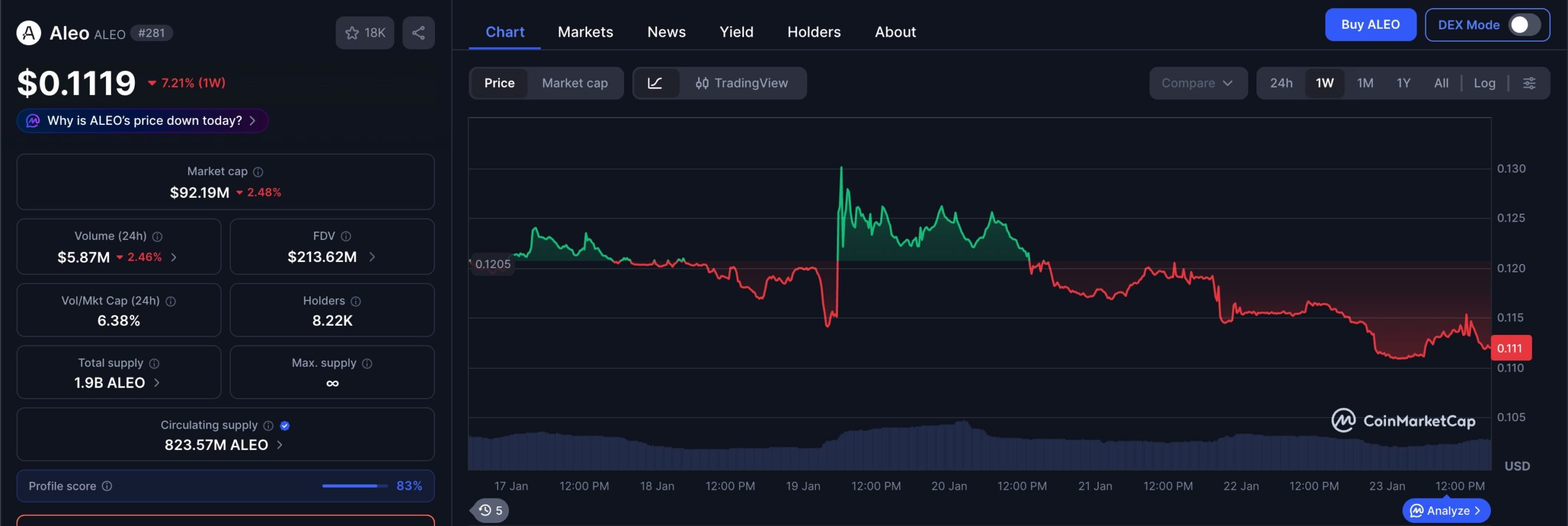
Source: Coinmarketcap
As of late January 2026, Aleo is trading around $0.11 with a circulating supply around 823M ALEO (market data varies slightly by venue, but the range is consistent).
That price context matters because many 2026 forecasts are expressed as “ROI vs current price,” and small absolute moves can look huge in percentage terms when the base is low.
Aleo tokenomics
Aleo’s official tokenomics overview says the circulating supply increases through staking and proving rewards, with the monetary base expected to rise substantially over time (they describe an increase from about 1.5B to over 2.6B across ten years), and inflation declining from ~13.5% in year one to ~1.6% in year ten.
Messari similarly notes an initial supply around 1.50B inflating over time through rewards, with emissions paying validators and provers.
Why this matters for 2026: Even if demand improves, expanding supply can cap upside unless usage, liquidity, and narrative strength outpace emission and unlock pressure.
Aleo price prediction for 2026
CoinCodex’s Long-Term Aleo Prediction (2026-2050) table shows a 2026 trading channel and monthly estimates.
CoinCodex’s 2026 range
CoinCodex states that in 2026, Aleo is anticipated to trade between $0.07699 and $0.3111, with an average annualized price around $0.1297—and it frames the implied return versus its “current rate” as potentially large.
Here’s a simplified view of CoinCodex’s monthly forecast highs (max values) and lows (min values) for select 2026 months, pulled directly from its table:
| Month (2026) | Min | Avg | Max |
| Jan | $0.07829 | $0.08916 | $0.1127 |
| Apr | $0.07699 | $0.08189 | $0.08607 |
| Jun | $0.08445 | $0.08789 | $0.09209 |
| Sep | $0.1018 | $0.1211 | $0.1582 |
| Oct | $0.1639 | $0.2508 | $0.3111 |
| Dec | $0.2479 | $0.2577 | $0.2747 |
A reality check on short-term signals
CoinCodex also publishes nearer-term projections and sentiment indicators (fear/greed, SMA/RSI) and currently labels ALEO sentiment “bearish” in its update, with the forecast pointing to a dip toward ~$0.084 in late February 2026.
That’s important because it shows what many “price prediction” pages hide: forecasts can be bearish in the short term and optimistic later—especially when they’re driven by model-based extrapolation, not inside information.
What could drive ALEO higher in 2026?
This is where we move from what the models say to what might actually change the tape.
Private stablecoins and real payments use-cases
Aleo + Circle is a big narrative unlock. Circle’s announcement says Aleo connected to Circle xReserve and launched USDCx on Aleo testnet, enabling interoperability with USDC across supported chains.
If USDCx (or similar “privacy with compliance hooks”) becomes a real on-chain payment tool—not just a demo—that can change how investors think about Aleo beyond “ZK tech.”
Developer traction and ecosystem maturity
Messari’s Aleo research has repeatedly emphasized improvements in the dev stack (Leo language, AleoVM/AleoBFT upgrades) as critical to scaling usability.
In crypto, price often follows builders—slowly at first, then suddenly.
Exchange access and liquidity growth
Liquidity is a quiet kingmaker. CoinGecko notes ALEO can be traded on centralized exchanges and lists venues where ALEO/USDT has activity (e.g., MEXC, Gate, Coinbase Exchange). Coinbase also states Aleo is available on Coinbase’s centralized exchange.
More credible listings, tighter spreads, and deeper books can make it easier for larger capital to participate—often improving price stability.
What could drag Aleo price down in 2026?
Token emissions and unlock pressure
Aleo’s tokenomics explicitly describe ongoing issuance via validator and prover rewards. If demand doesn’t expand faster than supply, you can get a classic “good tech, sleepy price” year.
Privacy narratives can invite regulatory headwinds
Aleo isn’t a “privacy coin” in the classic Monero price sense, but privacy tech often gets misunderstood—and markets hate uncertainty. If regulators paint with a broad brush, sentiment can suffer.
Adoption gap: tech ≠ usage
Aleo can ship upgrades and partnerships and still fail to translate that into daily active usage. In 2026, the market is getting harsher about this: “show me real users.”
How to use Aleo price predictions
If you’re using a forecasts as part of your research, here’s the healthiest way to do it:
Use forecasts as ranges, not promises
CoinCodex gives a wide 2026 channel ($0.07699 to $0.3111). Treat that as “what the model considers plausible,” not “where price is going.”
Watch catalysts and invalidate fast
If the ecosystem catalysts don’t materialize (e.g., payments integration doesn’t translate into usage), you should update your view. Crypto rewards people who change their mind faster than their ego.
Build scenarios instead of one-number targets
Instead of “Aleo will be $X,” try:
- Bear case: demand flat, supply expands, risk-off macro → price hugs low end of model ranges
- Base case: steady ecosystem progress, normal crypto cycles → mid-range performance
- Bull case: meaningful payments traction + liquidity expansion → price tests the upper bound ranges
Where to buy or exchange Aleo safely
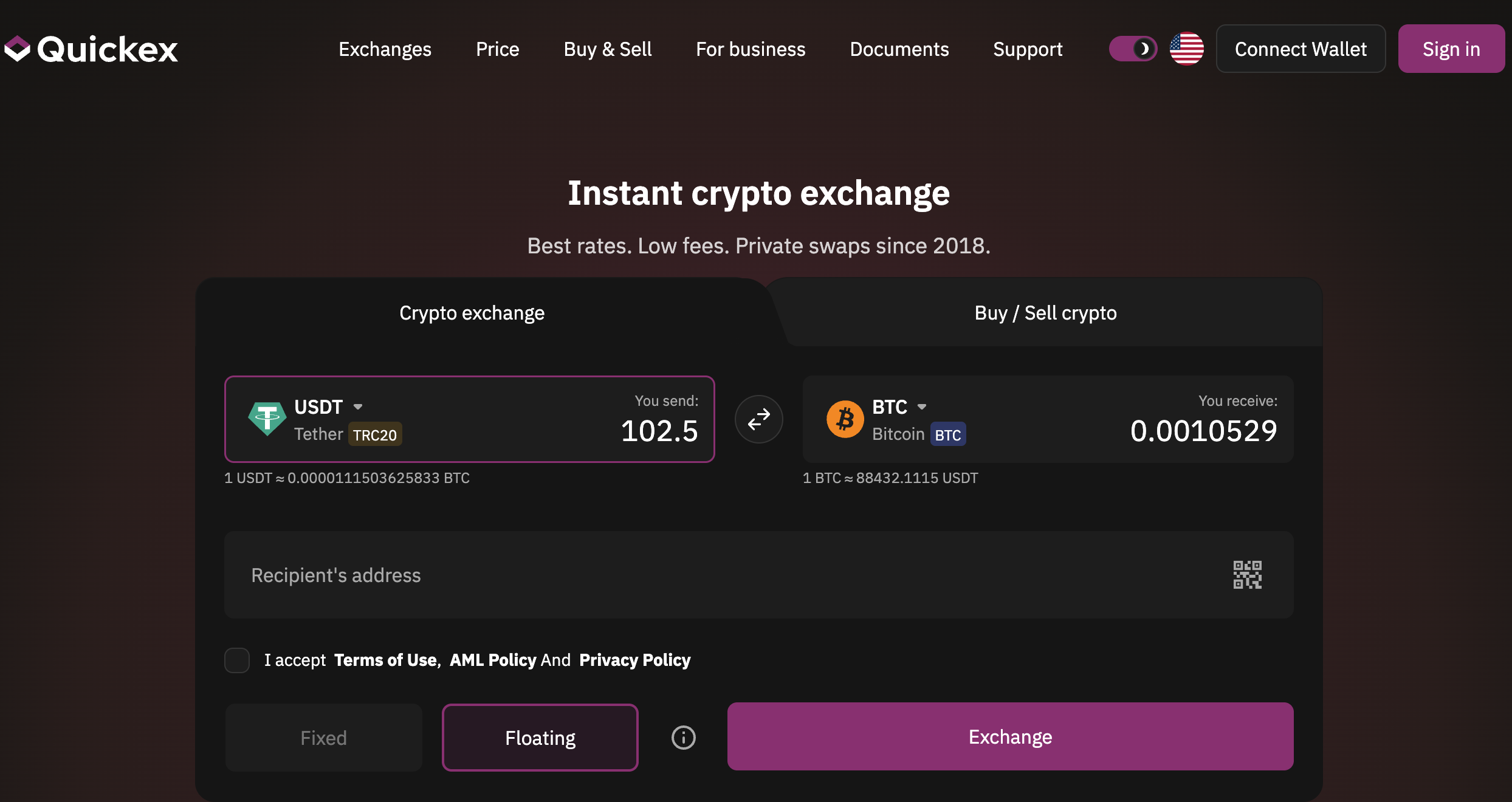
If you’re looking to exchange Aleo or do a basic swap crypto flow:
- Check reputable aggregators for current venues and liquidity; CoinGecko lists active centralized exchange options for ALEO.
- If you want to exchange crypto from something like USDT into ALEO, most users do it via the most liquid listed pair (often ALEO/USDT).
- If you’re starting from BTC price and want to exchange Bitcoin on Quickex, the safest approach is usually BTC to USDT (or fiat) to ALEO on a listed venue, rather than hunting direct pairs.
Always do the boring safety stuff: test withdrawals, confirm networks, and don’t treat a brand-new exchange like a bank.
The bottom line for Aleo price in 2026
- The Aleo price is currently around $0.11, with market data sources showing similar levels.
- CoinCodex’s model projects a wide 2026 trading channel of roughly $0.07699 to $0.3111, with higher potential max values in late 2026 (notably October) per its table.
- Fundamentals that could matter most this year: token emissions/inflation mechanics, ecosystem usage, and payment-focused catalysts like USDCx via Circle xReserve.
If you want a one-line take: 2026 looks like a “prove it” year— ZK privacy narrative is strong, but price will likely hinge on whether that narrative turns into real payment rails and real app usage, not just better whitepapers.