
If you’ve been in crypto for more than five minutes, you already know the vibe: narratives change fast, liquidity comes and goes, and “dead chains” have a weird habit of coming back to life at the worst possible time for people who sold the bottom.
Algorand (ALGO) sits right in that “underrated-but-still-here” category. It’s a Layer-1 built for speed, low fees, and practical real-world use cases. But the token price has also lived through the full crypto emotional spectrum—hype, hangover, and the long “please just do something” stretch.
In this guide, I’ll give you a grounded Algorand price prediction for 2026–2030 using a blend of fundamentals, technical analysis, and market-cycle logic—plus bullish and bearish scenarios (because pretending downside doesn’t exist is how portfolios get haunted).
Not financial advice. Crypto is risky. Use position sizing, risk management, and common sense.
What Is Algorand (ALGO)?
Algorand is a Layer-1 blockchain designed to be fast, scalable, and secure without sacrificing decentralization. Its big promise is simple: a chain that can handle real usage—payments, assets, DeFi, institutional-grade tokenization—without turning into a fee-burning chaos machine.
Core Technology: Pure Proof-of-Stake and Scalability Advantages
Algorand uses a Pure Proof-of-Stake model (PPoS), aiming for rapid confirmations and finality while staying energy-efficient. On Algorand’s official developer portal, the network is described with performance goals like instant finality and fast block times (notably cited as 2.8s blocktime in their developer materials).
That matters because finality isn’t just a buzzword—if you want serious apps (or institutions) to settle value on-chain, you need predictable settlement.
Key Use Cases: DeFi, NFTs, CBDCs, and Real-World Adoption
Algorand has long leaned into “real-world” narratives: tokenized assets, payments, and government/enterprise experiments. For example, Algorand Technologies has published a case-study style page describing the Marshall Islands SOV initiative and why Algorand was selected (speed, scalability, compliance controls, transaction finality).
Algorand also secured a high-profile partnership with FIFA in 2022, with FIFA stating Algorand would become its official blockchain platform and provide a blockchain-supported wallet solution.
Algorand Price History and Key Milestones
ALGO’s price story is basically “early hype, long drawdown, then the fight back.” Understanding that arc helps you avoid the two classic mistakes: (1) assuming the past must repeat exactly, or (2) assuming the past doesn’t matter at all.
From 2019 ICO to All-Time High and Bear Market Declines
According to CoinMarketCap’s Algorand page, ALGO’s all-time high is listed around $3.28 (June 2019), and its all-time low is listed around $0.08761 (September 2023).
That’s a brutal range—and also the reason ALGO still attracts “mean reversion” traders who believe quality Layer-1s can rebound hard during broad risk-on cycles.
Major Partnerships and Ecosystem Developments
Two milestones that kept Algorand on the radar:
- FIFA partnership (2022): This gave Algorand mainstream brand association during a peak Web3 marketing era.
- Staking rewards evolution: Algorand has continued refining incentives and participation mechanics, including newer staking reward frameworks discussed on Algorand’s official site.
Partnerships don’t guarantee token pumps, but they can influence credibility, developer interest, and institutional comfort—all of which tend to matter more during bull cycles.
Algorand Current Price and Market Overview
Source: Coinmarketcap
Let’s anchor this algorand prediction in real numbers—because price forecasts without a starting point are basically fan fiction.
Live ALGO Price, Market Cap, and Trading Volume
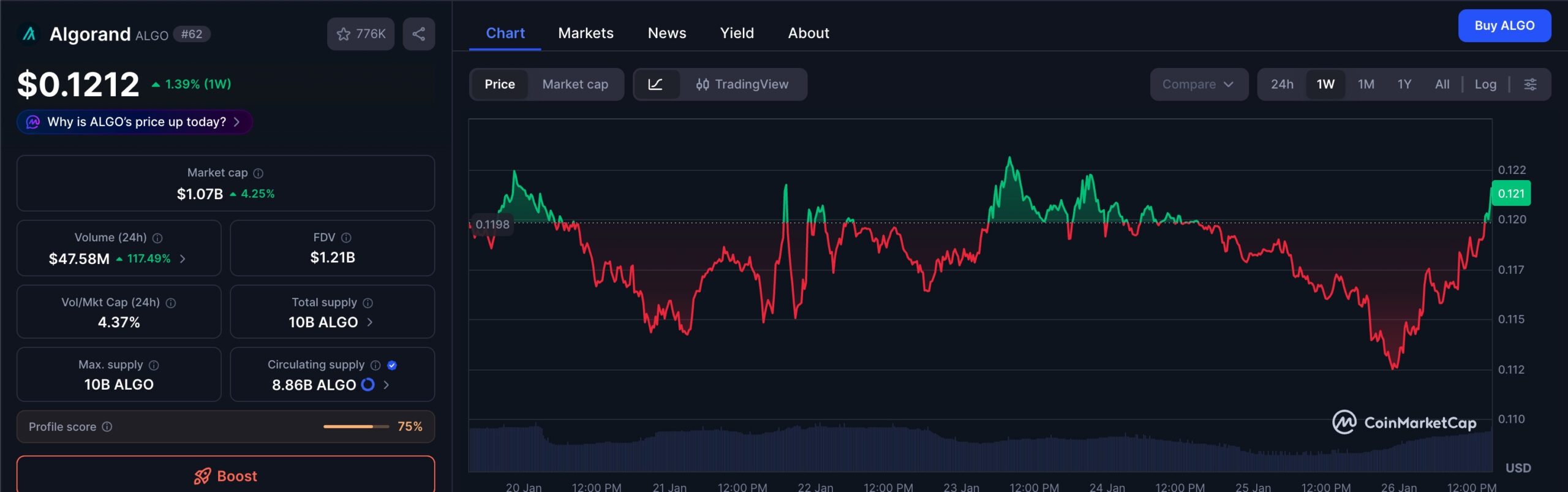
As of late January 2026, CoinMarketCap lists ALGO around $0.1204, with a market cap around $1.067B, and 24h trading volume around $34.38M. Circulating supply is shown near 8.86B ALGO, with a max supply of 10B.
Recent Performance and On-Chain Metrics (TVL, Staking Rates)
On DeFiLlama, Algorand’s “Total Value Locked in DeFi” is shown around $51.42M (with small daily variance).
On the staking side, Algorand’s official staking rewards page lists a current staking rewards rate (displayed as 5.19%at the time referenced).
The same Algorand staking page also notes a minimum threshold (e.g., 30,000 ALGO) for certain solo participation models, while smaller holders may use pools or liquid staking routes.
These metrics matter because they hint at real usage:
- TVL shows how much capital is actually being used in on-chain finance.
- Staking participation can affect circulating supply dynamics and “sell pressure” during rallies.
Algorand (ALGO) Short-Term Price Prediction 2026
Short-term forecasts are always the most fragile—because a single macro headline can turn charts into confetti. So think in ranges and probabilities, not certainty.
ALGO Price Forecast for Q1–Q2 2026
With ALGO around $0.12 in January 2026, a reasonable short-term algo price prediction framework is:
- Base case: $0.10–$0.18 (choppy accumulation with periodic spikes)
- Bull case: $0.20–$0.35 (if broader alt liquidity returns and ALGO catches a narrative bid)
- Bear case: $0.07–$0.10 (if risk markets roll over and ALGO revisits cycle lows)
This is less about “magic numbers” and more about where liquidity tends to cluster: round-number levels, prior breakdown zones, and major moving averages.
Q3–Q4 2026 Outlook and Potential Catalysts
In the second half of 2026, ALGO’s direction will likely depend on two forces:
- Macro + Bitcoin cycle: Historically, Bitcoin’s halving cycle often affects alt liquidity conditions. Research commentary frequently discusses halving-adjacent bull phases, while also noting the relationship isn’t perfectly causal.
- Ecosystem traction: If Algorand grows real usage (tokenization, payments, DeFi), the market has more “fundamental ammo” to justify higher valuations.
So for Q3–Q4 2026:
- Base case: $0.12–$0.25
- Bull case: $0.30–$0.60
- Bear case: $0.06–$0.12
Algorand Price Predictions
Below is a scenario-based algo crypto price prediction outlook—built around market cycles, adoption potential, and tokenomics.
Important: These are scenario ranges, not promises.
Algorand Price Prediction 2026
- Base case: $0.15–$0.35
- Bull case: $0.50–$1.00
- Bear case: $0.05–$0.15
What would push 2026 bullish? A broad alt rally plus renewed attention to fast, low-fee L1s. Also, Algorand’s staking rewards and participation could reduce liquid supply at key moments.
Algorand Price Prediction 2027
- Base case: $0.25–$0.70
- Bull case: $1.00–$2.50
- Bear case: $0.08–$0.25
By 2027, “real use” narratives matter more. If tokenization and institutional pilots scale, ALGO can re-rate. If not, it risks becoming a “trader coin” that pumps mainly on cycle momentum.
Algorand Price Prediction 2028
- Base case: $0.40–$1.20
- Bull case: $2.00–$4.00
- Bear case: $0.12–$0.40
The next Bitcoin halving is widely expected around mid-2028 (exact date depends on block timing).
Halving periods often reshape market psychology—even if the market sometimes “prices it in” early.
Algorand Price Prediction 2029
- Base case: $0.60–$1.80
- Bull case: $3.00–$6.00
- Bear case: $0.20–$0.60
If 2028–2029 resembles past post-halving expansions, higher-beta alts can run hard. ALGO’s upside in 2029 is largely a function of whether it becomes a meaningful infrastructure layer for tokenized assets and payments—not just “another L1.”
Algorand Price Prediction 2030
- Base case: $0.80–$2.50
- Bull case: $5.00–$10.00
- Bear case: $0.25–$0.80
Also note: CoinMarketCap states distribution of the fixed 10B ALGO supply ends in 2030 (per their tokenomics summary), which could become a narrative tailwind if markets interpret it as reduced emissions uncertainty.
If you’re looking for an explicit algo price prediction 2030 range in one sentence:
Base case: $0.80–$2.50; bull case: $5–$10; bear case: $0.25–$0.80.
Year-by-Year Algorand Price Prediction Table
| Year | Bear Case | Base Case | Bull Case | What Would Need to Happen |
| 2026 | $0.05–$0.15 | $0.15–$0.35 | $0.50–$1.00 | Recovery phase: modest ecosystem growth + improved market sentiment |
| 2027 | $0.08–$0.25 | $0.25–$0.70 | $1.00–$2.50 | More TVL + real adoption; ALGO narrative returns as “utility L1” |
| 2028 | $0.12–$0.40 | $0.40–$1.20 | $2.00–$4.00 | Bull cycle tailwinds (halving-era liquidity) + stronger institutional interest |
| 2029 | $0.20–$0.60 | $0.60–$1.80 | $3.00–$6.00 | Peak-cycle behavior: higher risk appetite + ecosystem momentum compounding |
| 2030 | $0.25–$0.80 | $0.80–$2.50 | $5.00–$10.00 | Maturity phase: wider adoption + strong cycle + tokenomics narrative support |
Long-Term Algorand Forecast 2035–2040
Long-range forecasts are inherently fuzzy, but here’s a structured algorand outlook:
- If Algorand becomes a mainstream tokenization/settlement layer: $5–$20+ isn’t crazy over a decade-plus horizon.
- If it remains a niche chain with limited stickiness: ALGO could stagnate below $2 for long stretches.
An algorand prognose into the late 2030s depends less on charts and more on adoption. A realistic algorand prognose 2040 should be scenario-based, not a single-number prophecy.
Technical Analysis: Key Indicators for ALGO
Source: Investing.com
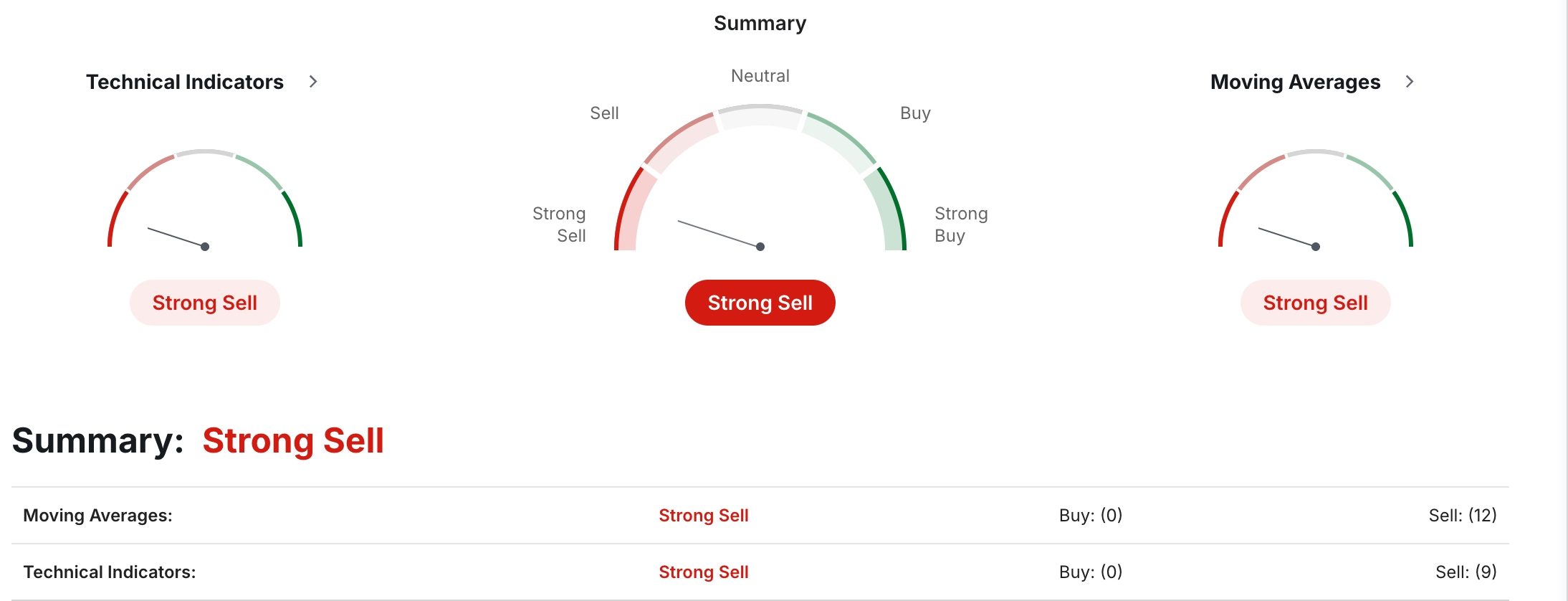
Technical analysis won’t tell you the future—but it does help you spot where traders are likely to behave in predictable ways (breakouts, fakeouts, panic wicks, etc.).
Moving Averages, RSI, and Fibonacci Levels
Key things to watch in 2026–2027:
- 200-day moving average: Often acts like the “line between bull and bear bias.”
- RSI (Relative Strength Index): Useful for identifying overheated pumps or exhaustion during dumps.
- Fibonacci retracements: Traders frequently use Fib levels to target profit-taking zones after major recoveries from lows.
Support/Resistance Zones and Chart Patterns
For ALGO, the most psychologically important zones tend to be:
- $0.10 (round-number + historical chop)
- $0.25–$0.30 (common reclaim zone in many alts)
- $1.00 (major psychological milestone)
- $2–$3+ (upper-cycle areas, including historical extremes)
If ALGO reclaims $1 with strong volume, it often signals broader market risk appetite is back.
On-Chain Indicators: Transaction Volume and Network Activity
On-chain health is the “truth serum” for long-term valuations:
- Rising active addresses + consistent transaction demand can justify higher market caps.
- TVL trends show whether DeFi liquidity is returning. (As of January 2026, DeFiLlama shows Algorand TVL around $51.42M.)
Bullish Factors That Could Drive Algorand Price Higher
Let’s talk catalysts that could make this algo future price story surprising (in a good way).
Technological Edge Over Competitors (Solana, Ethereum L2s)
Algorand’s pitch—fast finality, cheap fees, scalable design—competes with:
- Solana-style high-throughput monoliths
- Ethereum L2 ecosystems (where liquidity often lives)
Algorand’s differentiator is trying to keep the base layer simple, fast, and enterprise-friendly, while still supporting tokenization and smart contracts.
Growing Adoption, Partnerships, and Institutional Interest
Big partnerships don’t automatically pump prices, but they can:
- build credibility,
- attract developers,
- reduce institutional “career risk.”
The FIFA partnership is a notable historical example of mainstream alignment.
Government/sovereign digital currency experiments (like the Marshall Islands SOV narrative) are another example of the kind of “serious use case” Algorand wants to be known for.
Impact of Broader Crypto Bull Cycles and Bitcoin Halving Effects
Bitcoin’s halving on April 19, 2024 is widely documented, and researchers frequently discuss how halving eras can influence broader cycles—even if the relationship is not purely mechanical.
The next halving is typically expected around mid-2028.
If 2028–2029 becomes a strong risk-on period, ALGO can benefit simply by being a liquid, recognizable alt with exchange access.
Risks and Bearish Scenarios for ALGO
Now the part people skip—and then regret skipping.
Competition from Faster Layer-1s and Inflation Concerns
Competition is relentless. If developers and users prefer other chains for liquidity and mindshare, ALGO can lag even in bull markets.
Token distribution also matters. CoinMarketCap notes the supply plan ends in 2030, but until then, the market continues to absorb emissions/unlocks in various forms.
Investors should track circulating supply changes and incentives.
Regulatory Risks and Past Security/Performance Issues
Regulation is a wildcard for all crypto assets—especially anything that could be framed as a security, or that relies heavily on centralized entities for growth.
Also: even if the base chain is robust, ecosystem apps can get hit. A well-known example is the Tinyman exploit in early 2022, where attackers exploited a contract vulnerability and drained assets from pools (an app-layer failure, but still damaging to sentiment).
Macroeconomic Factors and Volatility
ALGO is still a risk asset. If global liquidity tightens, or recession fears spike, alts usually bleed first and recover last.
In bearish macro regimes, the path of least resistance is often down—even for good tech.
Is Algorand (ALGO) a Good Investment in 2026?
This is where we combine everything into a decision framework. Think in terms of thesis + time horizon + risk controls.
Bull Case: Path to $1–$5 with Mass Adoption
The bull thesis:
- Algorand wins real-world tokenization and payments niches.
- Staking participation improves network security and investor yield appeal.
- A broad bull market returns, and ALGO re-rates as “serious infrastructure.”
In that world, an algo coin price prediction of $1–$5 becomes plausible over the 2026–2030 window.
Bear Case: Stagnation Below $0.50
The bear thesis:
- Liquidity continues to concentrate on Ethereum + a handful of ecosystems.
- Algorand adoption grows slowly, TVL stays modest, and narrative mindshare fades.
- ALGO becomes a low-beta “value trap” that pumps briefly but can’t sustain breakouts.
In that case, an algorand coin price prediction staying under $0.50 for long periods is realistic—especially if macro conditions are unfriendly.
Our Price Prediction Methodology (Technical + Fundamental)
Here’s the exact approach used for this algorand price prediction:
- Starting point: current price, market cap, volume, circulating supply.
- On-chain baseline: TVL and ecosystem traction proxies.
- Tokenomics + narrative checkpoints: distribution horizon (2030), staking incentives, and adoption partnerships.
- Cycle logic: halving-era liquidity regimes as a context layer—not a guarantee.
- Scenario ranges: base/bull/bear to reflect uncertainty.
Where to Buy and Exchange ALGO?
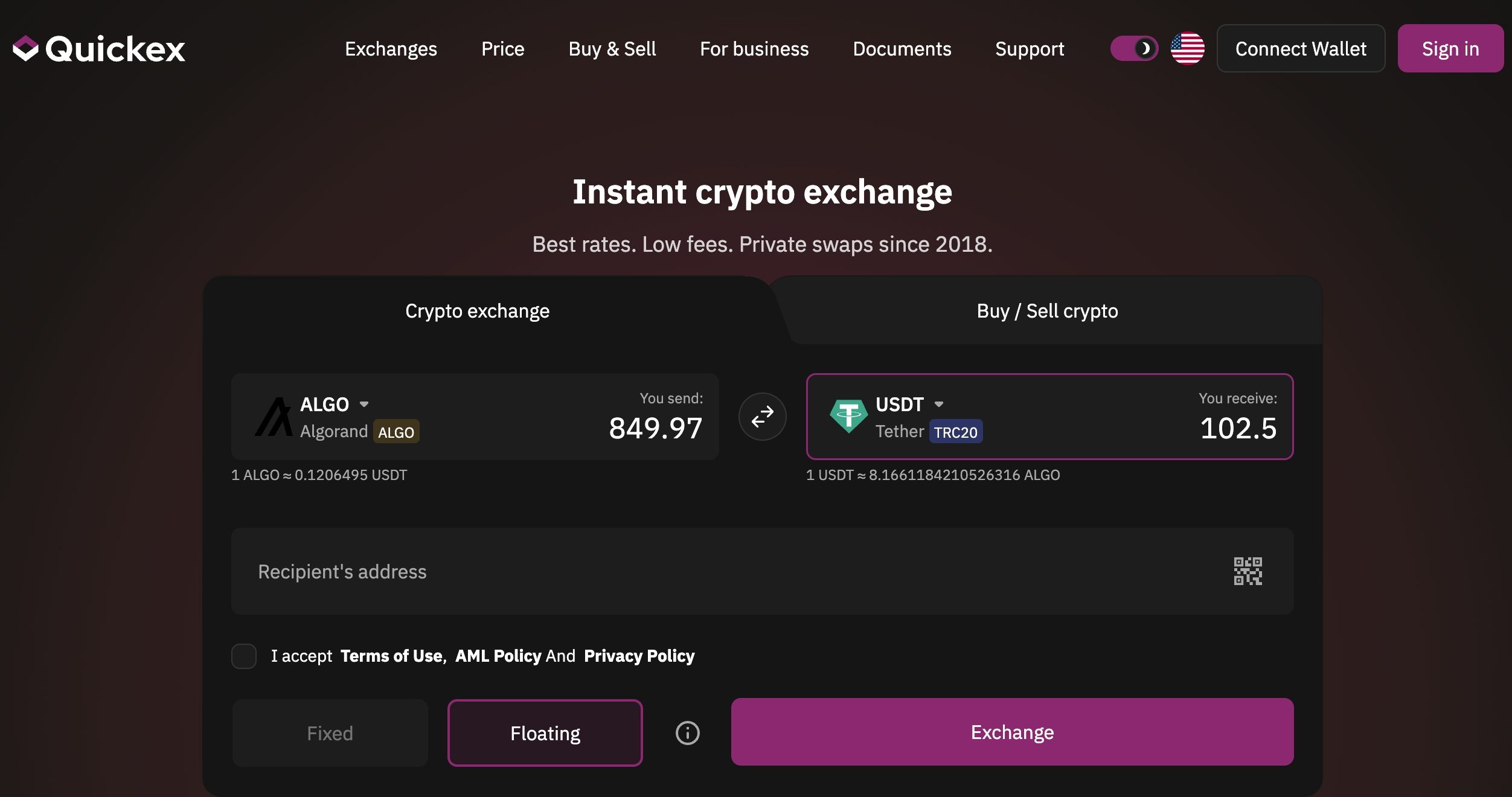
ALGO is commonly available on major centralized exchanges and can also be swapped via instant exchange services.
As an example, you can use Quickex for ALGO to TRX swaps—just make sure you:
- verify fees and exchange rates,
- confirm ALGO network withdrawal/deposit settings,
- check availability in your jurisdiction,
For storage: consider reputable wallets like Metamask (including hardware wallets for long-term holding).
Frequently Asked Questions (FAQ)
Will ALGO Reach $1 or Return to Its All-Time High?
Reaching $1 is far more realistic than revisiting the earliest ATH zone. CoinMarketCap lists ALGO’s ATH around $3.28, which would require a major re-rating plus a strong bull cycle. It’s possible—but it’s not the “default” outcome without major adoption + market expansion.
Is Algorand a Safe Long-Term Investment?
No crypto is “safe.” Algorand is relatively established as a project, but price risk remains high. Also, ecosystem app risks exist (for example, Tinyman’s 2022 exploit showed how app-layer incidents can hurt confidence).
How Does Algorand Compare to Solana or Cardano?
Broadly:
- Solana tends to dominate high-speed consumer crypto narratives and liquidity.
- Cardano emphasizes research-heavy development and a different ecosystem structure.
- Algorand focuses on fast finality, low fees, and real-world tokenization/payment use cases.
Which one “wins” depends on what developers build—and where users and liquidity go.