
If you’re researching an AVAX price prediction for the next few years, you’re not alone. Avalanche has already lived through a full “hype → adoption → bear market → rebuild” cycle, and by February 2026 the market is once again asking a familiar question: is AVAX setting up for the next big run, or is it stuck in a slow grind while newer narratives take the spotlight?
This guide is designed to be practical. We’ll cover what Avalanche is, where AVAX has been, what the network looks like right now (with February 2026 market and on-chain snapshots), and then we’ll map out a realistic range-based Avalanche price prediction for 2026–2030. You’ll also get a year-by-year table, technical analysis checkpoints, and the biggest catalysts and risks that can make forecasts look brilliant or totally wrong.
Crypto predictions are scenarios, not promises. Treat the numbers as “if-then” ranges, and always size risk like the market can humble everyone.
What Is Avalanche (AVAX)?
Avalanche is a Layer-1 blockchain platform built for speed, low latency, and customization. Instead of forcing every app to fight for the same blockspace, Avalanche is designed to scale horizontally, so teams can run dedicated networks (Subnets / “Avalanche L1s”) while still tapping into shared tooling and interoperability.
Avalanche Consensus Mechanism and Subnets Explained
Avalanche uses a multi-chain architecture (X-Chain, P-Chain, C-Chain) and a “family” of consensus designs. The official Avalanche API docs describe Avalanche consensus for the DAG-based X-Chain and Snowman consensus for linear chains like the C-Chain and P-Chain, with typical finality under one second.
Subnets (and, more recently, the “Avalanche L1” framing) matter because they’re Avalanche’s core scaling strategy. Instead of one global chain doing everything, you can create an application-specific chain with its own validator set and execution environment useful for gaming, institutional deployments, or regulated finance. Avalanche’s Builder Hub explains how Subnets were validated by a subset of Primary Network validators and highlights the historical requirement that Primary Network validators fulfill staking requirements (notably 2,000 AVAX) to validate subnets.
Key Advantages: High TPS, Low Fees, and Interoperability
Avalanche’s pitch is speed without sacrificing too much decentralization. The official RPC overview emphasizes high throughput and low latency plus sub-second finality.
Fees are also a key point. Avalanche’s documentation explicitly states that transaction fees are paid in AVAX and burned (destroyed forever).That burn mechanic is important for long-run token economics because it counterbalances emissions from validator rewards.
Interoperability is another pillar. Avalanche Warp Messaging (AWM) was introduced to enable native cross-L1 communication. In technical docs, AWM is described as a primitive for cross-L1 messaging, using BLS multi-signatures and a stake-weighted threshold model so receiving networks can verify messages from source validator sets.
Use Cases: DeFi, Gaming, Institutional Subnets, and Real-World Assets
Avalanche isn’t just “DeFi on an EVM chain.” It has multiple lanes:
- DeFi: Avalanche built early momentum with incentives like Avalanche Rush, which introduced major protocols such as Aave and Curve to Avalanche with liquidity mining rewards.
- Gaming: Dedicated chains reduce congestion and offer predictable fees: key for high-frequency in-game transactions.
- Institutional/Enterprise: Avalanche Evergreen is positioned for finance use cases that want public-chain benefits plus enterprise features like permissioning and compliance tooling. The Evergreen page describes validator/user permissioning, KYC/KYB-style controls, jurisdictional geofencing, custom gas tokens, and more.
- RWAs: Tokenized funds, compliant stablecoins, and settlement rails fit Avalanche’s “custom chain + interoperability” thesis.
All of this feeds into Avalanche crypto price prediction debates: AVAX tends to do best when activity (fees burned, TVL, stablecoin volume, Subnet growth) rises alongside a broader bull market.
Avalanche Price History and Major Milestones
To make a credible AVAX price prediction, you have to respect history. AVAX has already shown it can rally violently and draw down just as hard.
From 2020 Launch to 2021 All-Time High and Bear Market Cycles
Avalanche’s mainnet launch date is well-documented. A 2020 Avalanche announcement stated mainnet would launch on September 21, 2020.
In the 2020–2021 bull market, AVAX became one of the strongest large-cap performers. CoinMarketCap records an all-time high of $146.22 on November 21, 2021.
Then came the familiar crypto pattern: liquidity tightened, risk appetite collapsed, and high-beta assets retraced. CoinMarketCap also shows an all-time low around $2.79 (Dec 31, 2020), a reminder that AVAX can trade at extremes depending on cycle timing.
Key Events: Upgrades, Partnerships, and Subnet Launches
A few milestones shaped Avalanche’s narrative:
- Avalanche Rush (2021): A $180M incentive program aimed at accelerating DeFi adoption and attracting blue-chip protocols.
- AWM (2022 onward): Avalanche Warp Messaging launched to reduce the need for custom bridges between subnets/L1s and to support native cross-network communication.
- Institutional expansion: Evergreen positioning for regulated finance and institutional experimentation.
- Subnet activity scaling: Research has highlighted how activity can shift away from the C-Chain as dedicated L1s grow. For example, a Galaxy report noted that some Avalanche L1s (like DeFi Kingdoms and Dexalot) surpassed the C-Chain in total gas used and transaction count; evidence that Avalanche’s “scale via app-chains” concept can work in practice.
These events matter because AVAX’s long-run valuation isn’t only about “number go up.” It’s about whether Avalanche becomes a durable platform for on-chain finance and consumer apps.
Avalanche Current Price and Market Overview
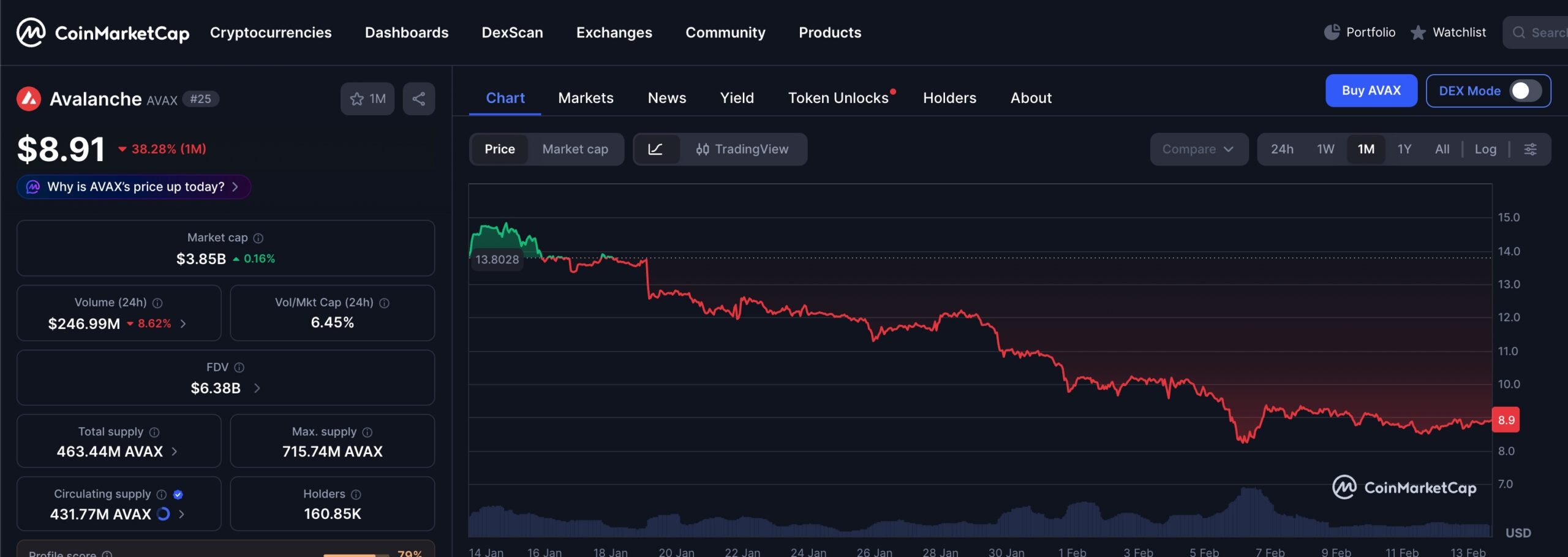
Source: Coinmarketcap
As of February 2026, the broader crypto market sentiment is shaky, and AVAX is trading far below its 2021 peak. That can be discouraging, but it also creates the conditions where asymmetric returns become possible if fundamentals recover and the macro cycle flips.
Live AVAX Price, Market Cap, and Trading Volume
CoinMarketCap shows Avalanche market cap around $3.82B and 24-hour volume around $246.84M at the time of this snapshot. DeFiLlama’s Avalanche chain overview shows AVAX price around $8.86 and market cap around $3.824B.
Token supply context:
- CoinMarketCap lists circulating supply about 431.77M AVAX and max supply about 715.74M.
- Avalanche’s token page describes a capped supply “up to 720M,” plus emissions and burn dynamics.
That slight cap discrepancy is usually a rounding/metadata issue across trackers. But the key point stays the same: supply is capped, emissions exist, and fees are burned.
On-Chain Metrics: TVL, Subnet Activity, and Transaction Volume
On-chain health is where Avalanche gets interesting in 2026. DeFiLlama reports:
- TVL: about $846.89M on Avalanche.
- Stablecoins market cap: about $1.771B, with USDT dominance ~48%.
- DEX volume (24h): about $165.43M; 7d about $1.079B.
- Active addresses (24h): around 671,422; transactions (24h): around 2.76M.
These figures suggest Avalanche remains heavily used (especially for stablecoin activity), even if price action is subdued.
Subnet/L1 activity is harder to summarize in one number, but the broader takeaway is that Avalanche’s scaling model can push volume onto app-specific chains, potentially making “ecosystem activity” bigger than what C-Chain-only dashboards imply.
Recent Sentiment and Fear & Greed Index
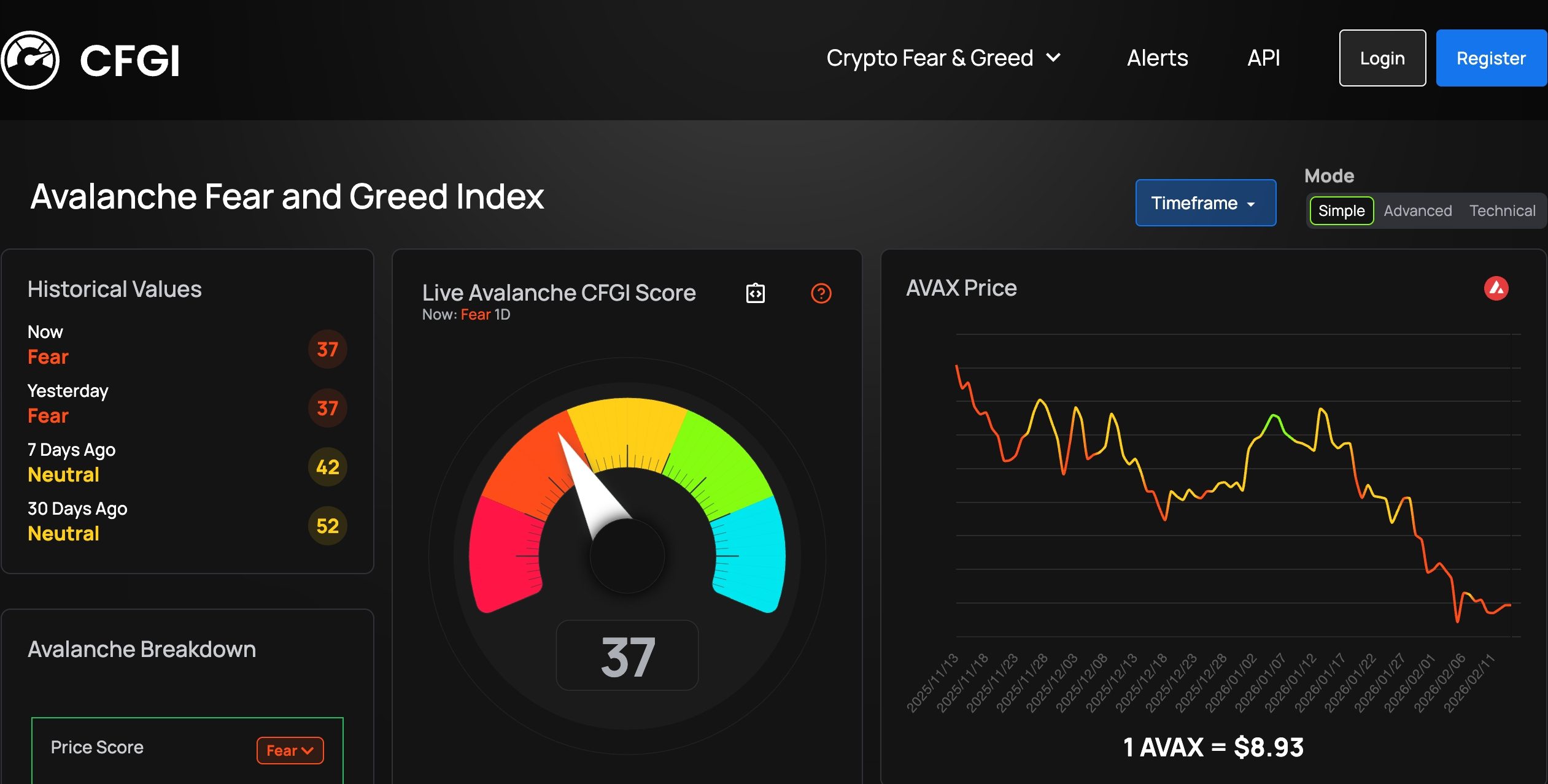
Source: CFGI
February 2026 sentiment is deep in fear territory. CFGI’s Crypto Fear & Greed Index shows “Extreme Fear” with a value around 37 at the time of this snapshot.
This matters for forecasts because extreme fear is often when quality networks get mispriced. That doesn’t mean bottoms are guaranteed, it just means the market is emotionally skewed.
Avalanche (AVAX) Short-Term Price Prediction 2026
Short-term forecasts are mostly about liquidity, sentiment, and technical levels, not long-run tech merit. For 2026, it’s useful to think in quarters.
AVAX Price Forecast for Q1–Q2 2026
Base case for Q1–Q2 2026: choppy range trading.
- If broader crypto stays risk-off (fear/greed remains in extreme fear), AVAX may oscillate between local supports and resistances rather than trend cleanly.
- Using the current zone around ~$8–$9 as an anchor, a conservative working band is $6–$12 for the first half of 2026, with spikes driven by market-wide relief rallies.
Short-term note: when AVAX is far below ATH, it often behaves like a leveraged beta play on Ethereum sentiment and overall altcoin liquidity.
Q3–Q4 2026 Outlook and Near-Term Catalysts
For the second half of 2026, the range widens. Two drivers can change the story fast:
- Ecosystem acceleration: More institutional pilots, Subnet/L1 launches, or “killer apps” that generate sustained fees and stablecoin flows. Evergreen’s positioning is built exactly for that.
- Interoperability + composability: More real use of AWM-style cross-L1 communication can reduce fragmentation and make Avalanche feel like one coherent “internet of chains.”
A reasonable Q3–Q4 2026 scenario range:
- Bear case: $5–$9
- Base case: $8–$18
- Bull case: $15–$30
This is intentionally broad because in crypto, one macro shift can compress a 12-month move into 12 days.
Avalanche Price Prediction 2026–2030 Table
Below is the core AVAX price prediction table. It includes bear/base/bull ranges plus the narrative conditions that would typically justify each scenario. This section also doubles as a quick reference for readers searching AVAX price predictions and Avalanche price prediction 2030.
| Year | Bear Case (Low–High) | Base Case (Low–High) | Bull Case (Low–High) | What would need to be true |
| 2026 | $4–$10 | $8–$25 | $15–$35 | Market stabilizes; steady on-chain activity (TVL/stablecoins) continues |
| 2027 | $6–$14 | $12–$40 | $25–$70 | Clear altcycle; Subnets/L1s grow; interoperability improves (AWM adoption) |
| 2028 | $10–$22 | $20–$75 | $50–$140 | Bull cycle + meaningful consumer/institutional adoption; higher fees burned |
| 2029 | $8–$20 | $18–$60 | $40–$120 | Mid/late-cycle volatility; winners hold share, weak L1s fade |
| 2030 | $12–$30 | $25–$95 | $60–$180 | Avalanche captures durable “app-chain/L1 network” niche; real RWAs & payments scale |
You’ll notice the 2028–2030 bull cases revisit the prior ATH neighborhood (~$146). That’s intentional: in strong cycles, large-cap L1s often retest prior highs if they remain culturally relevant and fundamentally used.
Avalanche Price Prediction 2026
In 2026, AVAX’s job is to survive and re-rate.
- Base case: $8–$25 if market risk appetite gradually returns and Avalanche keeps strong stablecoin/transaction throughput.
- Bull case: $35 if the market flips into a surprise alt rally and Avalanche wins attention through gaming/DeFi growth or new institutional activity.
- Bear case: $4–$10 if macro stays tight and altcoins bleed while activity migrates elsewhere.
Avalanche Price Prediction 2027
2027 is the “narrative selection” year in many cycles: the market decides which L1s matter.
- Base case: $12–$40 if Avalanche’s network-of-networks strategy keeps shipping, and app-specific L1s gain traction.
- Bull case: $25–$70 if Subnet/L1 growth creates a flywheel: more apps → more users → more fees → stronger token narrative.
- Bear case: $6–$14 if competitors (Solana, Ethereum L2s) capture most new users and Avalanche adoption slows.
This is where Avalanche predictions can diverge wildly based on whether builders choose Avalanche for new consumer products.
Avalanche Price Prediction 2028
If 2028 aligns with a broader crypto expansion, AVAX can move fast.
- Base case: $20–$75 if DeFi and stablecoin activity scale and the ecosystem supports high-throughput apps without fee spikes.
- Bull case: $50–$140 if the market enters a true “platform premium” phase and AVAX becomes a top-tier beneficiary.
- Bear case: $10–$22 if macro shocks or regulation causes risk assets to unwind again.
This is also when burn dynamics can become more visible. Avalanche’s docs note fees are burned, and tokenomics include ongoing validator rewards that partially offset burns.
Avalanche Price Prediction 2029
2029 often behaves like a “shakeout year” in cycle models: big volatility, rotation, and survivorship bias.
- Base case: $18–$60 if AVAX consolidates above prior supports, with periodic rallies and deep pullbacks.
- Bull case: $40–$120 if Avalanche retains mindshare and the ecosystem keeps onboarding real users.
- Bear case: $8–$20 if liquidity dries up and the market punishes anything that feels “last cycle.”
Avalanche Price Prediction 2030
Here’s a grounded view:
- Base case: $25–$95 if Avalanche is still one of the key “app-chain” platforms and continues to run stablecoin rails and consumer apps at scale.
- Bull case: $60–$180 if Avalanche becomes a default option for regulated finance deployments (Evergreen-style L1s) while also hosting mass-market games/apps.
- Bear case: $12–$30 if the space consolidates around a few dominant stacks and Avalanche sits in the second tier.
This year is also where the phrase Avalanche crypto prediction becomes less about charts and more about product-market fit.
Long-Term Avalanche Forecast 2035–2040
Long-term forecasting is inherently fuzzy, but you can still build scenarios using a few anchor questions:
- Does Avalanche remain relevant as Ethereum L2s mature?
- Do institutions actually adopt on-chain rails meaningfully (beyond pilots)?
- Does Avalanche’s “many L1s” model avoid fragmentation and keep composability?
Possible long-term ranges:
- Bear case (2035–2040): $15–$60 if AVAX becomes a niche settlement asset with limited growth.
- Base case: $80–$250 if Avalanche remains a top platform for RWAs, payments, and high-throughput apps.
- Bull case: $200–$600+ if a meaningful share of capital markets and consumer apps run on dedicated Avalanche L1s and AVAX accrues a strong “network reserve asset” premium.
If you’re searching AVAX price prediction 2040 or Avalanche price prediction 2040, treat it as scenario planning, not a target. If you want “moon math,” that belongs in the bull case, but portfolio strategy should still assume drawdowns are inevitable.
Technical Analysis: Key Indicators for AVAX
Technical analysis won’t tell you the future, but it does help you avoid emotional trades, especially during high-volatility phases.
Moving Averages, RSI, and Momentum Oscillators
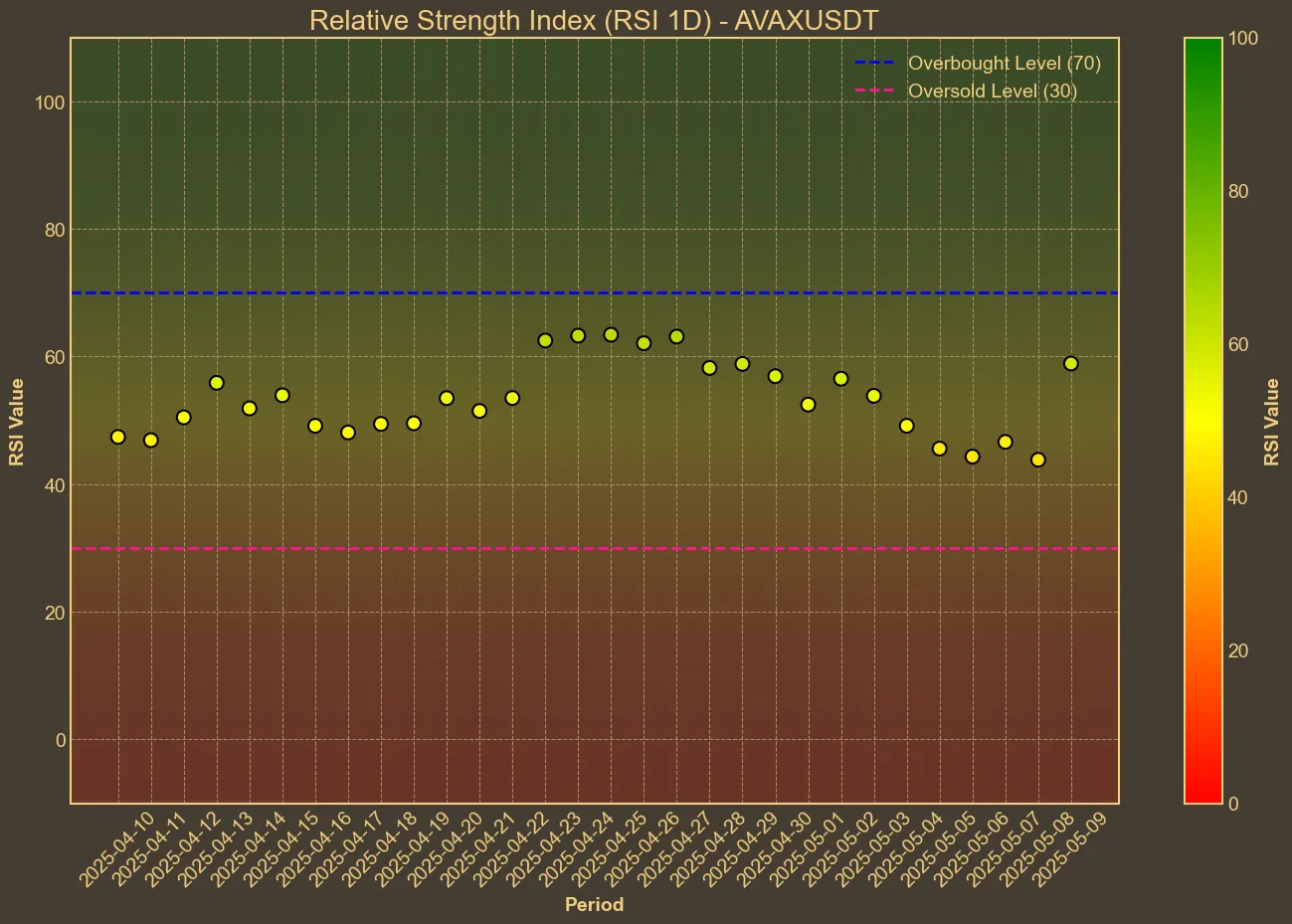
Source: Auric
For AVAX, three TA signals matter most for multi-month forecasts:
- 200-day moving average: A common “regime filter.” When price is above it and it slopes upward, long bias is usually safer.
- RSI (14): Useful for identifying exhaustion. In strong bull trends, RSI can stay elevated longer than people expect. In bear trends, “oversold” can remain oversold.
- Momentum oscillators (MACD / rate of change): Good for spotting early trend shifts if confirmed by volume.
In a depressed market (like February 2026 extreme fear), the “best” signal is often a slow one: higher lows + rising volume + reclaiming major moving averages.
Support/Resistance Levels and Chart Patterns
With AVAX trading around the high single digits in February 2026, psychological levels become obvious:
- $10: first major psychological resistance
- $15–$20: “bull case gateway” where sentiment often flips from disbelief to optimism
- $5–$6: critical downside zone if fear deepens and liquidity dries up
What patterns matter?
- Rounded base / accumulation: suggests patient buyers stepping in.
- Range breakouts: AVAX often moves explosively once a multi-month range breaks.
- Failed breakouts: common in bear markets – watch for traps.
On-Chain Indicators: TVL Trends and Subnet Metrics
On-chain indicators can confirm whether price is moving with real usage.
A quick checklist:
- TVL trend: is DeFi activity growing again? (DeFiLlama shows ~$846.89M TVL in this snapshot.)
- Stablecoins: Avalanche stablecoin market cap (~$1.771B) and USDT dominance (~48%) signal whether Avalanche remains a major value-transfer rail.
- Transactions + active addresses: high activity (hundreds of thousands of active addresses and millions of daily transactions in this snapshot) can be a bullish divergence if price is still lagging.
- Fee burn: higher activity typically means more AVAX burned (even if emissions offset it). Avalanche documentation explicitly confirms fees are burned.
Bullish Factors That Could Drive Avalanche Price Higher
If AVAX is going to outperform from 2026–2030, it will likely be because Avalanche wins in at least one “big” category: institutional adoption, consumer apps, or DeFi scale.
Subnet Expansion and Institutional Adoption
Evergreen is Avalanche’s institutional narrative. It’s positioned as a suite of deployments and tooling where companies can enable permissioning, compliance controls, custom gas tokens, and even gasless transactions.
If regulated institutions adopt on-chain rails in a real way, Avalanche’s “custom chain with compliance knobs” approach could be a competitive advantage, especially compared to one-size-fits-all public chains.
DeFi/Gaming Growth and Avalanche Rush Incentives
Avalanche has a history of using incentives to bootstrap ecosystems. Avalanche Rush explicitly targeted blue-chip DeFi protocols and liquidity mining.
If a new wave of consumer apps or DeFi primitives emerges on Avalanche L1s and those apps create meaningful fee burn and stablecoin flows: AVAX can regain the “high-activity premium” that fueled earlier cycles.
Broader Market Cycles and Bitcoin/Ethereum Correlation
Like most large-cap alts, AVAX is still heavily influenced by the broader cycle. When ETH liquidity expands, EVM ecosystems tend to benefit. When markets go risk-off, AVAX often moves like a high-beta asset.
That’s why the same Avalanche crypto forecast can look “wrong” in the short term but “right” over a full cycle.
Risks and Bearish Scenarios for AVAX
A strong Avalanche coin price prediction has to include what can go wrong because the market will test every weak spot.
Intense Competition from Solana, Ethereum L2s, and Other Layer-1s
Avalanche competes in one of the most crowded arenas in crypto: execution environments.
- Solana competes on speed and consumer apps.
- Ethereum L2s compete on shared liquidity and network effects.
- New modular stacks compete on customization.
Avalanche’s edge is “custom L1s + interoperability,” but it must avoid fragmentation: if liquidity and users get too spread out, the ecosystem can feel less cohesive.
Network Centralization Concerns and Token Inflation
Avalanche uses Proof-of-Stake and requires meaningful stake for validators. Historically, the Primary Network validator requirement cited in docs is substantial (e.g., 2,000 AVAX), which can concentrate validator participation among larger operators.
On token economics: Avalanche’s token docs explain that 360M AVAX was minted at genesis, while new AVAX is minted as validator rewards, and this minting offsets the AVAX burned by fees; they also note AVAX will “almost always remain an inflationary asset” while far from the cap.
That’s not “bad,” but it means the burn narrative is not automatically deflationary in the near term.
Regulatory Risks and Macroeconomic Volatility
Regulation can reshape exchange access, DeFi participation, and institutional onboarding. Meanwhile, macro liquidity cycles (rates, growth scares, risk-on/risk-off regimes) can overwhelm even strong on-chain fundamentals.
The February 2026 “Extreme Fear” backdrop is a reminder: even good networks sell off when markets panic.
Is Avalanche (AVAX) a Good Investment in 2026?
AVAX can be a great bet in the right setup and a painful hold in the wrong setup.
Bull Case: Path to $50–$100 with Mass Subnet Adoption
The bull case is simple:
- Avalanche keeps (or grows) stablecoin dominance on-chain (strong transfer rails).
- More high-activity apps launch on dedicated L1s, creating predictable user experiences.
- Institutions adopt Evergreen-style deployments beyond pilots.
- Macro turns risk-on again.
Under that combination, a base-to-bull transition toward $50+ is plausible over a multi-year horizon, especially if AVAX reclaims its “premium L1” narrative.
Bear Case: Prolonged Stagnation Below $20
The bear case:
- L2s eat the EVM world.
- Subnet fragmentation reduces liquidity and mindshare.
- Institutions move slowly (or choose other stacks).
- Macro remains choppy, and altcoin rallies fade quickly.
In that world, AVAX can stay stuck below $20 for longer than bulls expect, especially if investor attention rotates elsewhere.
Our Prediction Methodology (Technical + Fundamental + On-Chain)
Here’s the framework behind the ranges in this tron-style long forecast (but for AVAX):
- Technical (TA): Identify macro trend regimes (moving averages), momentum shifts, and key S/R levels.
- Fundamental: Evaluate product-market fit (subnets/L1s, interoperability, institutional tooling).
- On-chain: Track TVL, stablecoin market cap, addresses/transactions, and fee burn trends.
- Cycle awareness: AVAX typically amplifies broader market moves, so we weight macro conditions heavily.
If you’re building your own AVAX prediction 2030 model, start with these pillars. It’s more reliable than picking a single “magic number.”
Where to Buy and Exchange AVAX?
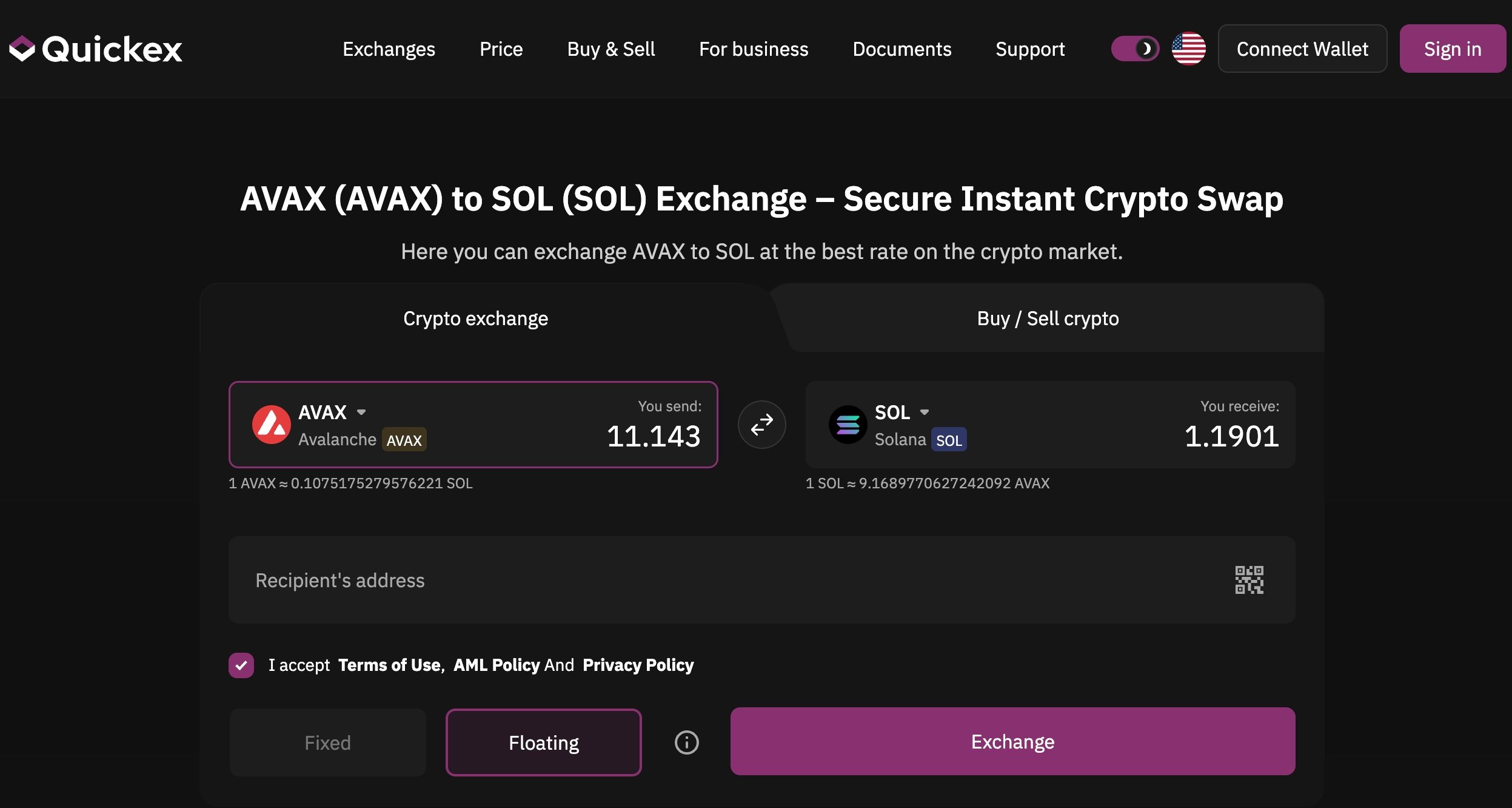
If you plan to buy AVAX, prioritize safety and simplicity:
- Choose a reputable exchange like Quickex (centralized or decentralized) that supports AVAX and your preferred payment method.
- Use a secure wallet if you plan to hold long term. Hardware wallets are usually safest for large amounts.
- Double-check the network (Avalanche C-Chain vs other chains) when withdrawing, wrong networks can lead to lost funds.
How instant exchanges work:
- You select the assets you’re sending and the asset you want (AVAX to SOL).
- The platform quotes a rate (often “floating” or “fixed”).
- You send funds to the provided address.
- After confirmations, AVAX is delivered to your destination address.
Frequently Asked Questions (FAQ)
What Is the Avalanche Price Prediction for 2026?
In this guide’s range-based model, 2026 scenarios center around:
- Bear: $4–$10
- Base: $8–$25
- Bull: $15–$35
Will AVAX Reach $50 or Return to Its All-Time High?
AVAX has already proven it can reach the ~$146 ATH zone in a strong market.
Reclaiming $50–$100 is possible in a future bull cycle, but it likely requires both a macro risk-on environment and visible ecosystem growth (Subnets/L1s, RWAs, DeFi traction).
How Does Avalanche Compare to Solana or Ethereum?
Avalanche’s unique angle is “custom L1s / Subnets + interoperability,” backed by a multi-chain architecture and fast finality.
Solana is more monolithic (one chain experience), while Ethereum leans on L2s. Which wins long term depends on where developers and users go.
What Role Do Subnets Play in Avalanche’s Future?
Subnets (and Avalanche L1s) are the core scaling strategy. They let apps avoid competing for blockspace on one shared chain and can support permissioning/compliance features for enterprise deployments.
Disclaimer: The material in this article is not financial or investment advice. Everything stated here reflects the author's personal view and should not be treated as a recommendation to trade or invest. We make no warranties regarding the accuracy, reliability or completeness of the information presented. Cryptocurrency markets are highly volatile and can move unpredictably. Before committing any funds, every investor, trader or crypto user should study several independent sources and check the regulations that apply in their own jurisdiction.