
By 2026, BNB remains one of the most noticeable crypto assets on the market. The token is used in the Binance ecosystem, in the BNB Chain network and increasingly as a convenient tool for settlements and corporate use. The ecosystem is developing, liquidity is growing, and interest from both users and businesses remains high. At the same time, there are risks — primarily related to Binance and regulators in different countries.
You can exchange BNB quickly and at a clear rate via Quickex — without complex procedures or delays.
What state does BNB enter 2026 in
By the end of 2025, the BNB ecosystem has noticeably strengthened. The network has more liquidity, new tools for businesses and transaction automation, and its real-world use has grown.
One of the important events was the launch of the U stablecoin on BNB Chain. It is backed by major stablecoins and helps aggregate liquidity in DeFi, where assets are often fragmented. Support for gasless transactions and automated operations is planned, which simplifies work for services, trading systems and AI solutions. In 2025, the total volume of stablecoins in the network doubled and exceeded $14 billion — a clear sign of ecosystem growth.
Another important step is the ability to pay for AWS services in BNB. This is no longer just about crypto, but also about real business. Companies and developers can make payments in BNB faster and cheaper than through traditional systems.
Technologically, the network has also advanced significantly. The x402 BNB solution simplifies transactions: confirmation, transferring funds and paying fees are combined into one action. This reduces friction, saves time and simplifies automation of payments, subscriptions, payouts, DAO management and other processes.
On-chain activity has also increased. BNB Chain holds a noticeable share among L1 networks, partly thanks to the growth of decentralized derivatives platforms.
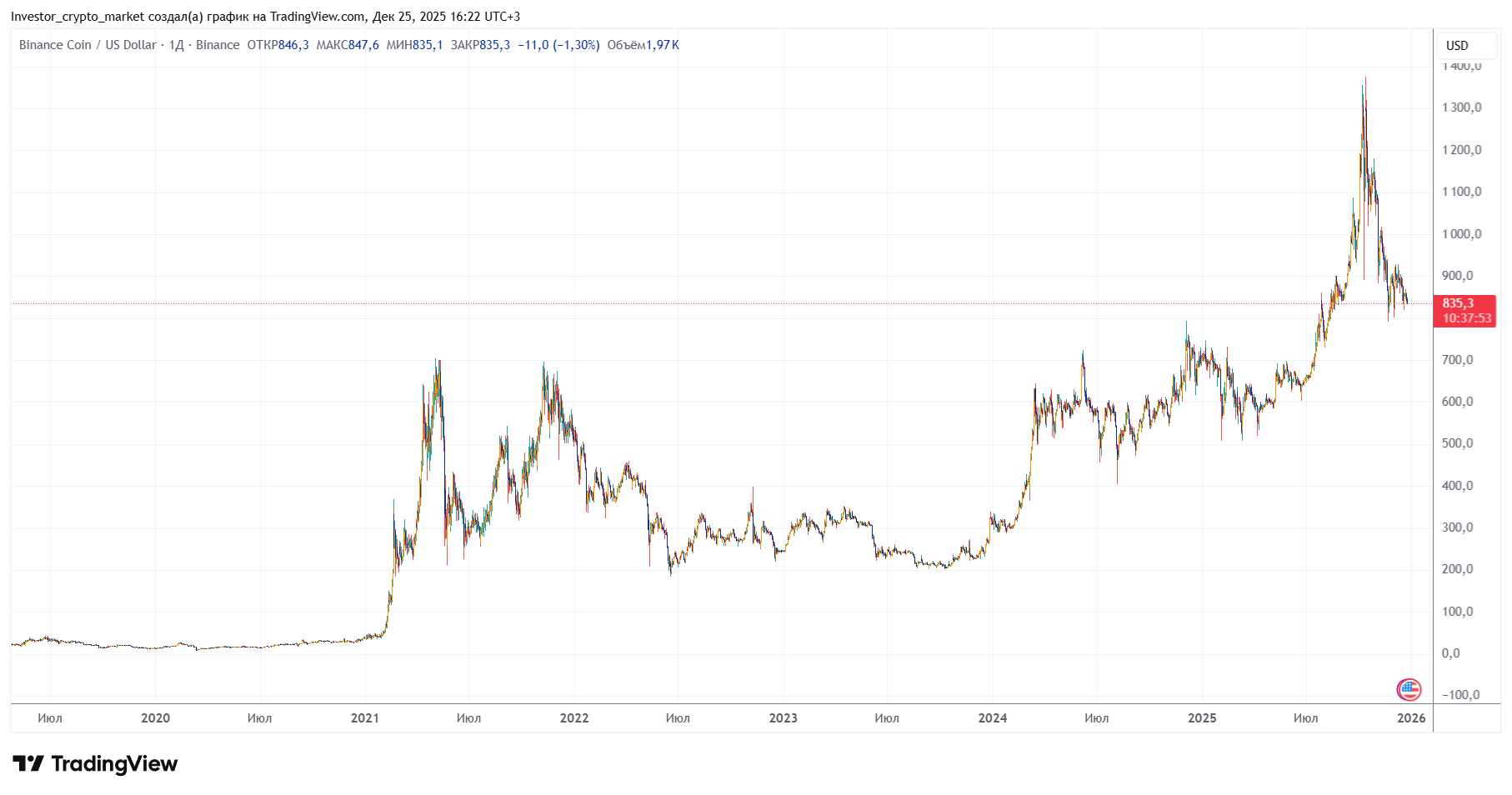
It is convenient to track BNB price dynamics via Quickex — you can quickly check the actual rate without extra tabs and overloaded charts.
Problems and risks around Binance
With all the strong sides of the ecosystem, the other side must also be considered. First of all, this concerns Binance itself.
The company is restructuring its management. Now Binance has two leaders: Richard Teng and co-founder Yi He. Formally, this is an evolution of the management model, but the market sees it as a continuation of the company’s adaptation after challenging regulatory periods.
The second factor is constant attention from regulators. The exchange has to comply with the rules of many jurisdictions at once and maintain a high level of compliance and security with a massive user base. This increases pressure on the business and adds uncertainty.
Therefore, despite strong fundamentals, the market treats BNB cautiously and includes these risks in forecasts.
BNB price forecasts for 2026
Analysts and different platforms provide quite a wide range of expectations. Many algorithmic forecasts and user models suggest that the baseline zone for BNB in 2026 may be around $800–$900, and closer to $950 if the market shows positive dynamics. Forecasts from Binance, OKX and Kraken fall into roughly the same range — around $870–$910.
More optimistic scenarios assume growth towards $1,300–$2,100 if the ecosystem continues to expand, liquidity grows and interest from large players strengthens.
There are also aggressively bullish estimates — up to $3,000–$3,500 and higher. But they rely on an extremely favorable scenario for the entire crypto market and look more speculative.
Conservative models, on the contrary, allow movement in the $392–$676 range in case of a weak market, new regulatory restrictions or ecosystem slowdown.
Comparative table of BNB forecasts for 2026
| Source / type of estimate | Range / value | Forecast context |
|---|---|---|
| CoinCodex and algorithmic models | ~$800–$900 (up to ~$950) | Moderately positive market |
| Binance (user consensus) | ~$870–$900 | Base scenario |
| OKX | ~$880 | Moderate growth |
| Kraken | ~$900–$910 | Conservative model |
| Optimistic analysts | ~$1,300–$2,100 | Ecosystem and demand growth |
| Extremely bullish resources | ~$3,000–$3,500+ | Very strong bull market |
| Conservative technical models | ~$392–$676 | Weak market and risks |
As a result, the most frequently discussed baseline corridor is about $800–$1,000, with the possibility of stronger growth if the market situation is favorable and Binance remains stable.
Overall picture
BNB enters 2026 as a strong infrastructure asset with growing liquidity, an actively developing ecosystem, real-world use cases and technological improvements that simplify network operations. At the same time, risks related to Binance and regulators remain. Because of this, forecasts for BNB range from very cautious to very ambitious. If market conditions are favorable, 2026 may become an important stage for strengthening BNB’s position.
FAQ
Does BNB have fundamental reasons to grow in 2026?
Yes. These include growing network liquidity, active ecosystem development, corporate integrations, stablecoin projects and high on-chain activity.
Can regulators affect the price of BNB in 2026?
Yes. The regulatory agenda around Binance remains one of the main risk factors and can influence price dynamics and market sentiment.
How realistic are scenarios where BNB goes above $2,000?
They are possible, but only if the market is strongly bullish, institutional interest remains high and no serious negative events occur around Binance.
Where is it profitable to exchange cryptocurrency?
Quickex allows you to exchange cryptocurrency quickly, at a clear rate and without unnecessary complications.
Disclaimer: The material in this article is not financial or investment advice. Everything stated here reflects the author's personal view and should not be treated as a recommendation to trade or invest. We make no warranties regarding the accuracy, reliability or completeness of the information presented. Cryptocurrency markets are highly volatile and can move unpredictably. Before committing any funds, every investor, trader or crypto user should study several independent sources and check the regulations that apply in their own jurisdiction.