

If you’re researching a Chainlink price prediction for the next cycle, you’re really asking one question in disguise: Will LINK remain “middleware,” or become the settlement glue for institutions? In February 2026, Chainlink sits in an awkward-but-interesting spot: the network’s footprint keeps expanding across cross-chain messaging and tokenization rails, while the market still treats LINK like a mid-cycle altcoin.
In this guide you’ll get a grounded view of where LINK stands today, what’s actually moving under the hood (CCIP, RWAs, staking), and where prices could land from 2026–2030 under bear/base/bull scenarios.
Disclaimer: This article is for educational purposes only and is not financial advice.
Chainlink Market Analysis
Current LINK Market Performance: Price, ROI, and Ranking
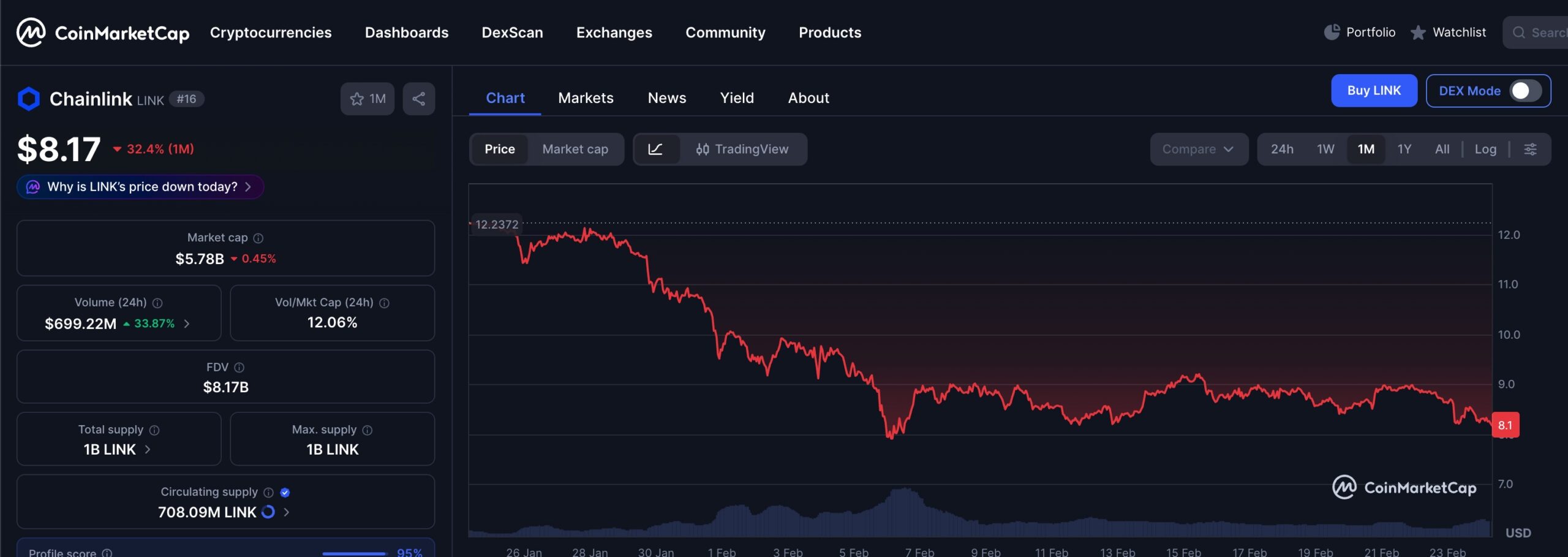
Source: Coinmarketcap
As of late February 2026, Chainlink (LINK) trades around $8.51, with a market cap near $6.02B, 24h volume around $593M, and a CoinMarketCap rank of #16. Circulating supply is roughly 708.09M LINK out of a 1B max supply.
The emotional context matters, too: LINK’s all-time high is about $52.88 (May 2021), meaning price is still far below peak levels, a reminder that “blue chip” doesn’t mean “immune.”
The 2025 Retrospective: How Chainlink Decoupled from the Altcoin Pack
“Decoupling” doesn’t always show up first in price; it shows up in who builds with you and what your network secures.
Two signals from 2025 into early 2026 stand out:
- Chainlink increasingly positioned itself as infrastructure for tokenized finance, not just DeFi price feeds, especially via CCIP and capital-markets messaging initiatives with major institutions.
- The launch of the Chainlink Runtime Environment (CRE) on mainnet (late 2025) was essentially Chainlink saying: “We’re not shipping a feature, we’re shipping an institutional-grade execution environment.”
That’s why you’ll see analysts frame LINK less like a “DeFi token” and more like middleware that’s trying to become unavoidable. Learn the DeFi basics.
Key On-Chain Metrics: Total Value Secured (TVS) and Network Fees
Chainlink tracks big-picture adoption through metrics such as Total Value Secured and Transaction Value Enabled. On its official platform dashboard, Chainlink shows roughly $71.70B TVS and about $28.02T in transaction value enabled, alongside billions of verified messages.
For fees, CCIP’s billing model is explicit: users pay a combined fee (blockchain fee + network fee), and CCIP supports fee payment in LINK and alternative assets (including native gas tokens and wrapped versions).
Why is Chainlink the 2026 Market Leader?
CCIP Adoption: Connecting Global Banks to Public Blockchains
CCIP is Chainlink’s “make or break” product for the institutional narrative. In Chainlink’s own docs, CCIP is a cross-chain messaging protocol secured by decentralized oracle networks (DONs), supporting token transfers, arbitrary messaging, and programmable token transfers.
On the ecosystem side, CCIP metrics show it’s live across dozens of chains and supports many tokens, a sign that it’s moving beyond theory into production plumbing.
Technical Sidebar (CCIP, simplified): Burn & Mint vs. Lock & Mint
If you’ve ever wondered why cross-chain bridges blow up, the answer is usually “asset handling + trust assumptions.” CCIP’s docs outline multiple token-transfer mechanisms under one interface:
- Burn-and-Mint: tokens are burned on the source chain and minted on the destination chain.
- Lock-and-Mint: tokens are locked on the issuing chain and minted on the destination chain.
- Lock-and-Unlock / Burn-and-Unlock: used when the issuing chain is on one side of the transfer, with liquidity management trade-offs.
Why this matters for a LINK price prediction: the more “standardized” and institution-friendly the transfer model becomes, the easier it is for big players to adopt without inventing new security assumptions.
The RWA Explosion: Chainlink’s Role in Tokenizing the $16 Trillion Market
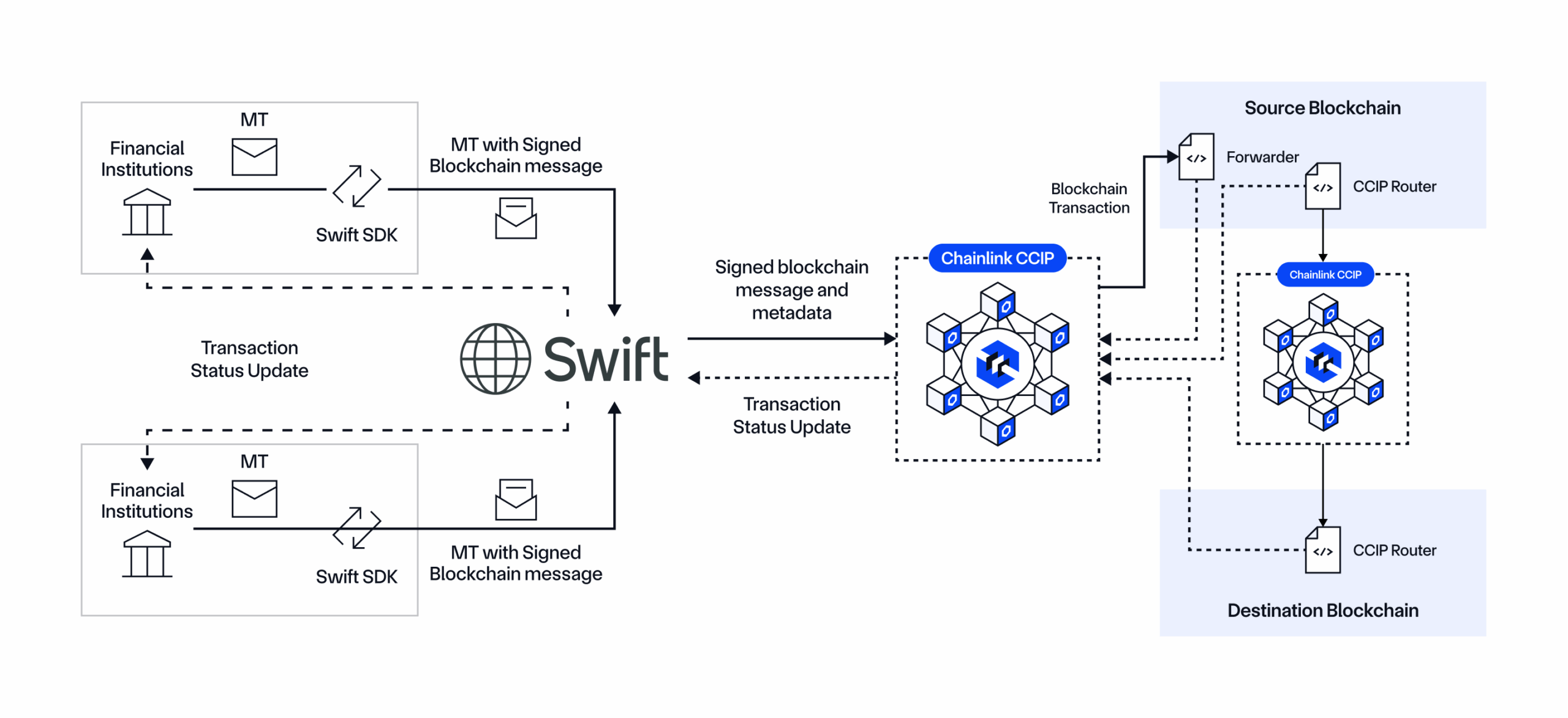
Source: Chainlink Blog
RWAs are the narrative that keeps refusing to die, mostly because the incentives are real. BCG/ADDX have published estimates pointing to $16T tokenization potential by 2030 in some frameworks, while McKinsey offers a more conservative base case (around $2T by 2030, excluding some crypto categories).
Chainlink’s angle here is not “we tokenize assets.” It’s “we make tokenized assets work in the real world,” meaning:
- verified data inputs (pricing, NAVs, corporate actions),
- cross-chain settlement and messaging,
- compliance-friendly workflows for institutions.
This isn’t hypothetical. Swift’s work with Chainlink on connecting financial institutions to public and private chains has been publicly discussed in official announcements and coverage, with multiple institutions involved in pilots and initiatives.
Chainlink Runtime Environment: The New Operating System for Finance
CRE is presented as a runtime environment designed to let institutions run “hybrid” workflows that span public chains, private systems, data, identity, compliance, and cross-chain messaging, without forcing firms to stitch everything together themselves. Chainlink describes CRE as a way to build and deploy high-assurance applications for the next era of onchain finance.
A helpful analogy: CRE is aiming to be the “Java” of the blockchain world. Not because it copies Java, but because it targets the same pain point Java solved in the 1990s: portability + standardization across messy environments.
- Before Java got popular, enterprises had to rewrite the same logic for different systems and platforms. Java’s “write once, run anywhere” vision gave corporate tech teams a common runtime and tooling mindset.
- In crypto and tokenized finance today, institutions face a similar fragmentation problem: different chains, different standards, different bridge models, different compliance requirements, different data provenance assumptions.
CRE’s pitch is essentially: stop reinventing the integration layer.
What CRE tries to standardize
From Chainlink’s descriptions and surrounding research coverage, CRE is meant to orchestrate:
- Cross-chain execution: coordinate actions across multiple chains using standardized messaging rails (think CCIP as the transport).
- Data + identity + compliance hooks: make it possible to plug in trusted data sources and verification steps that institutions require.
- Confidential workflows: Chainlink has also discussed confidential compute efforts, which matter because institutions often can’t run sensitive strategies or client data fully “in public.”
Why CRE changes the LINK valuation conversation
Most tokens live and die by one of two things: hype or fees. Chainlink’s bet is subtler: become so embedded in cross-chain and institutional workflows that LINK becomes the economic backbone for security, services, and settlement assurances.
That doesn’t guarantee price goes up tomorrow. But it does change what “success” looks like:
- Instead of measuring only retail demand, you watch whether institutions keep expanding pilots into production.
- Instead of betting on a single DeFi season, you watch whether tokenized funds, stablecoin rails, and compliance-ready apps become normal.
Chainlink Price Prediction 2026
Q1–Q2 2026 Outlook: Institutional Accumulation vs. Retail Sentiment
Let’s be blunt: early 2026 LINK looks like the kind of chart that tests patience. That’s also why this year is where “value investors” start circling, especially if they believe CRE/CCIP adoption turns into durable demand.
Featured Snippet: 3 Catalysts for 2026
- CCIP expansion + scaling: more chains, more token standards, more production deployments.
- TradFi rails maturing (Swift-style initiatives): more pilots moving toward standardized messaging for tokenized assets.
- Staking + rewards evolution: Chainlink staking v0.2 is live, with the framework designed for future upgrades and potential fee-based rewards over time.
Base case (Q1–Q2 2026): $7–$14
- LINK chops sideways while broader market decides whether 2026 is “risk-on” or “recovery.”
Bull case: $15–$22 - Macro tailwinds + strong CCIP headlines push LINK back into the “large-cap infra” basket.
Bear case: $5–$7 - Altcoin liquidity dries up; LINK revisits prior demand zones.
This is a Chainlink crypto price prediction framework, not a promise. The point is to map what would need to happen for each outcome.
Technical Analysis: Testing the $30 and $52 All-Time High Resistance Levels
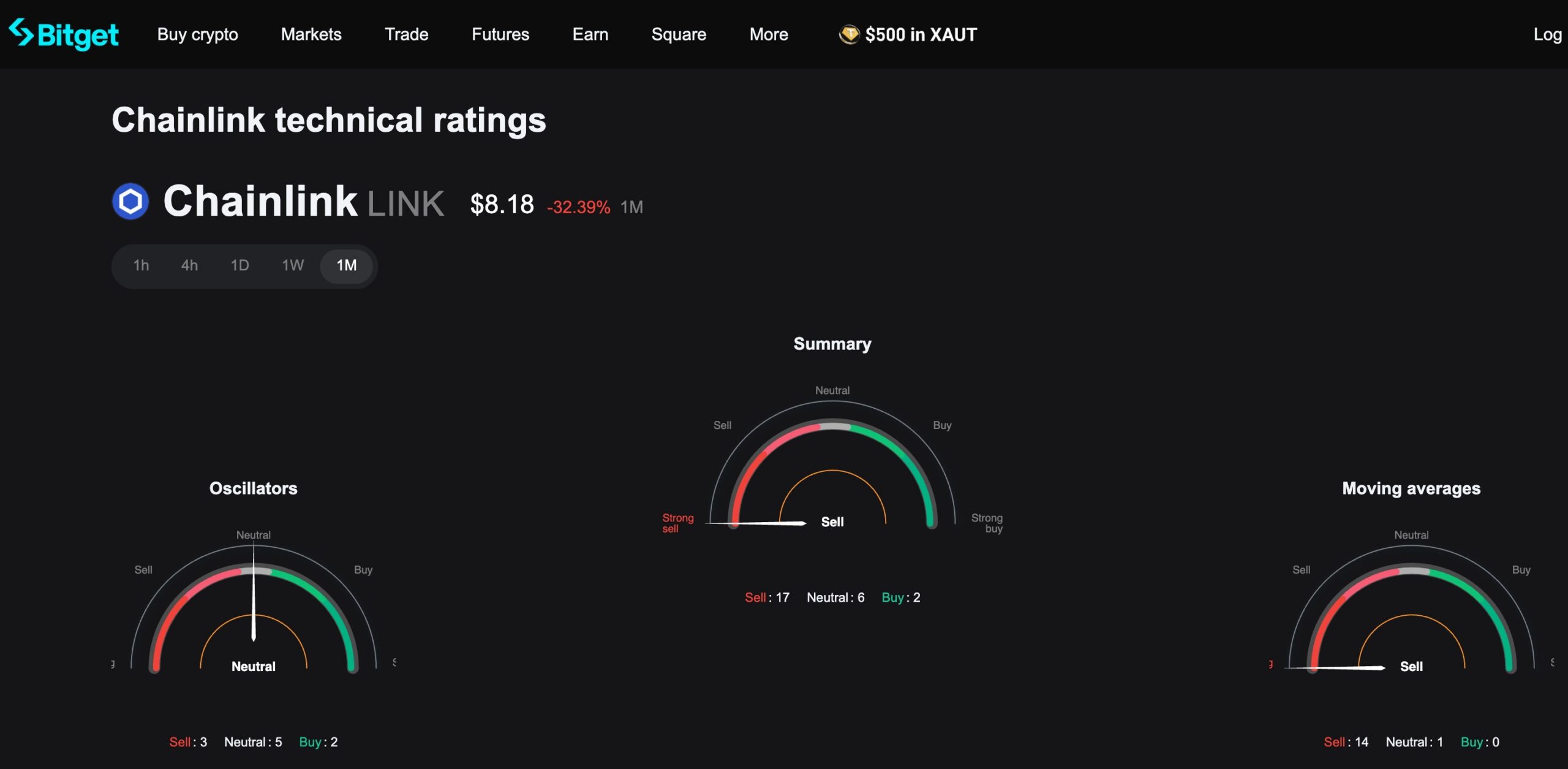
Source: Bitget
From CoinMarketCap’s historical stats, LINK’s ATH is around $52.88, making that zone psychologically massive, more “story” than “line on a chart.”
In a typical cycle structure, major “checkpoint” levels often form below ATH: $20, then $30, where long-term holders lighten up and late bulls start dreaming again. That’s why traders talk about $30 and $52 as key resistance zones: not because the numbers are magical, but because humans trade narratives.
The “Grayscale Effect”: How Institutional ETFs are Impacting LINK Liquidity
Let’s interpret this carefully. As of February 2026, the more concrete institutional “liquidity story” for LINK isn’t a spot ETF headline; it’s regulated venues and research coverage that pull LINK into institutional workflows.
One major example: CME Group launched Chainlink futures (announced as launching Feb 9, 2026), a meaningful step because it creates a regulated derivatives market that some institutions prefer over spot venues.
At the same time, institutional-style research has started framing Chainlink around CRE, CCIP monetization paths, and supply dynamics (for example, Grayscale’s deep dive covers CRE and cross-chain value capture).
For a Chainlink price prediction model, this matters because liquidity isn’t only “more buyers.” It’s also more ways to hold exposure: spot, derivatives, structured products, especially when risk teams get involved.
Chainlink Price Prediction 2027–2029
2027 Forecast: The Impact of Full-Scale Swift and DTCC Integrations
2027 is where the thesis shifts from “pilot season” to “production season.”
Chainlink-related institutional initiatives discussed around Sibos include multiple market infrastructures and large institutions exploring standardized workflows (including corporate actions messaging and tokenization processes).
2027 price ranges (scenario-based):
- Bear: $6–$12 (macro drag + slow adoption)
- Base: $12–$25 (gradual institutional rollout)
- Bull: $25–$45 (clear value capture narratives + crypto bull cycle)
This is where the searches like LINK price prediction and Chainlink prediction spike again, because people will ask whether LINK “missed its moment” or is quietly becoming a toll road.
2028 Prediction: Bitcoin’s Next Cycle and the “Blue Chip” Rotation
2028 is also a Bitcoin halving year, and historically altcoins often lag before rotating hard. If crypto enters a broad expansion phase, LINK tends to benefit from its “infrastructure” reputation, especially if on-chain finance narratives return.
2028 price ranges:
- Bear: $8–$15
- Base: $18–$35
- Bull: $40–$70
In the bull case, LINK isn’t winning because memes are trending. It wins because: cross-chain, tokenization, and oracle assurance become “boring essentials.”
2029 Vision: LINK as the Universal Gas Token for Interoperability
A bolder 2029 vision is LINK becoming a “universal service token” across interoperability, used to pay for and secure cross-chain messaging, data, and execution assurances.
CCIP already supports paying fees in LINK and other assets, with fees composed of blockchain costs plus network fees paid to oracle operators.
2029 price ranges:
- Bear: $10–$20
- Base: $25–$50
- Bull: $60–$90
This is where people could start searching chain LINK price prediction (with the space) and “LINK utility” in the same breath.
Chainlink Price Prediction 2030–2035
Can LINK Hit $100? Realistic Market Cap and Scarcity Projections
Using a circulating supply around 708.09M LINK, the implied market caps are:
| LINK Price Target | Implied Market Cap (approx.) | What it implies |
| $50 | $35.4B | Strong cycle + clear value capture |
| $100 | $70.8B | Chainlink 2030 price prediction bull case becomes plausible |
| $200 | $141.6B | Requires mega-cycle + major institutional standardization |
Now compare that to Ethereum’s historical scale: Ether has approached a ~$600B market cap during peak periods (example: reporting around Aug 2025).
So, could LINK hit $100? The market-cap math says it’s not physically impossible. It’s a question of whether Chainlink becomes a dominant settlement utility rather than “just” an oracle brand. That’s the heart of Chainlink price prediction 2030 and Chainlink prediction 2030 debates.
Chainlink Economics 2.0: Staking Rewards and Sustainable Node Incentives
Chainlink staking v0.2 is explicitly designed to evolve: it introduced an unbonding mechanism, slashing conditions for node operators (for specific secured services), and modular architecture intended to support future services and upgrades.
Two key economic ideas to track into 2030:
- Supply locking: staking caps and broader participation can reduce liquid float during bull phases.
- Fee-based rewards over time: the staking framework explicitly points to “new sources of staking rewards, such as user fee rewards” becoming available later.
This is where LINK crypto price prediction and LINK coin price prediction models should start incorporating usage-driven rewards, not just chart patterns.
2035 Long-Term Outlook
2035 forecasting is basically controlled speculation, but you can still do “structured imagination.”
If tokenization grows anywhere near multi-trillion projections (even the conservative ones), and if cross-chain messaging becomes standardized, then “hybrid smart contracts” (on-chain logic + off-chain data + cross-chain execution) could become normal.
A reasonable Chainlink price prediction 2040 discussion starts here: not with meme narratives, but with whether CRE-style execution environments become the default enterprise pattern for blockchain-based finance.
Competitive Landscape: The “Oracle War”
Chainlink vs. Pyth Network: Speed vs. Security for Institutional Users
Pyth positions itself around real-time market data from 120+ first-party providers, with price feeds verified across 100+ blockchains and options optimized for low latency.
In practice:
- Pyth is compelling for latency-sensitive DeFi and trading apps.
- Chainlink leans into high-assurance data + broader middleware (CCIP, CRE, institutional workflows).
For institutions, the “winner” is often the system that makes audits and risk committees calm down, not the one that looks best in a demo.
Chainlink vs. API3: First-Party Data vs. DONs
API3’s Airnode model emphasizes “first-party oracles,” aiming to let API providers run their own nodes with a “set and forget” approach and disintermediation benefits.
Chainlink’s DON model emphasizes decentralized oracle networks and security guarantees at scale: especially in CCIP, where DONs secure cross-chain messaging.
Why Chainlink’s “Network Effect” is Now Impossible to Replicate
Network effects in this niche aren’t just “users.” They’re:
- integrations,
- institutional relationships,
- standards adoption,
- and risk credibility built through time.
Once CCIP and CRE-style tooling become default in enterprise roadmaps, switching costs rise, even if competitors innovate.
Tokenomics Deep Dive: The Supply Dynamics in 2026
Staking v0.3 and Beyond: Locking Up Supply for Network Security
In February 2026, staking is clearly framed as v0.2, with a total staking cap described as 45,000,000 LINK at launch and design choices intended for future expansion and modular upgrades.
So when people say “v0.3,” treat it as shorthand for “the next evolution” rather than a guaranteed date on a calendar.
Understanding the “Fee Switch”: How Protocol Revenue
Chainlink’s staking documentation makes two important points:
- staking is meant to increase security guarantees for oracle services, and
- future reward sources may include user fees.
In plain English: the “fee switch” narrative is basically, “Will real usage eventually route meaningful rewards to stakers and node operators?” That’s a legitimate long-term driver, but it’s also where you should demand specifics and track actual rollouts.
Inflation vs. Demand: Analyzing the Token Release Schedule
Chainlink’s own circulating supply page states the token release schedule is currently 7% of total supply per year, with total supply capped at 1,000,000,000 LINK.
Whether that behaves like “inflation” depends on demand growth and how much supply gets locked in staking or absorbed via long-term holders. In bull markets, demand can dwarf emissions; in bear markets, emissions can feel like gravity.
Is Chainlink (LINK) a Safe Investment in 2026?
The Bull Case: The “Middleware of the World” Thesis
The bull case is simple:
- CCIP becomes a cross-chain standard,
- CRE becomes the enterprise runtime for hybrid finance,
- staking and fees mature into durable value capture.
If those happen alongside a broad crypto expansion cycle, Chainlink price prediction 2030 models that include $50–$100 scenarios stop looking crazy and start looking… debatable.
The Bear Case: Regulatory Bottlenecks and Potential Tech Obsolescence
The bear case is also simple:
- institutions keep piloting but don’t deploy at scale,
- competitors capture the fastest-growing segments,
- macro stays risk-off and reduces the “infrastructure premium.”
In that world, LINK may remain important tech with mediocre token performance for longer than bulls expect.
How to Properly Store and Stake Your LINK for Maximum Yield
If you stake, use official interfaces and treat phishing like the #1 threat.
Chainlink’s staking page points to the official staking interface and notes staking v0.2 is performed on Ethereum mainnet via self-custodial wallets, with common wallet support (e.g., MetaMask, Coinbase Wallet, WalletConnect) and ETH needed for gas.
Where to Buy and Exchange LINK?
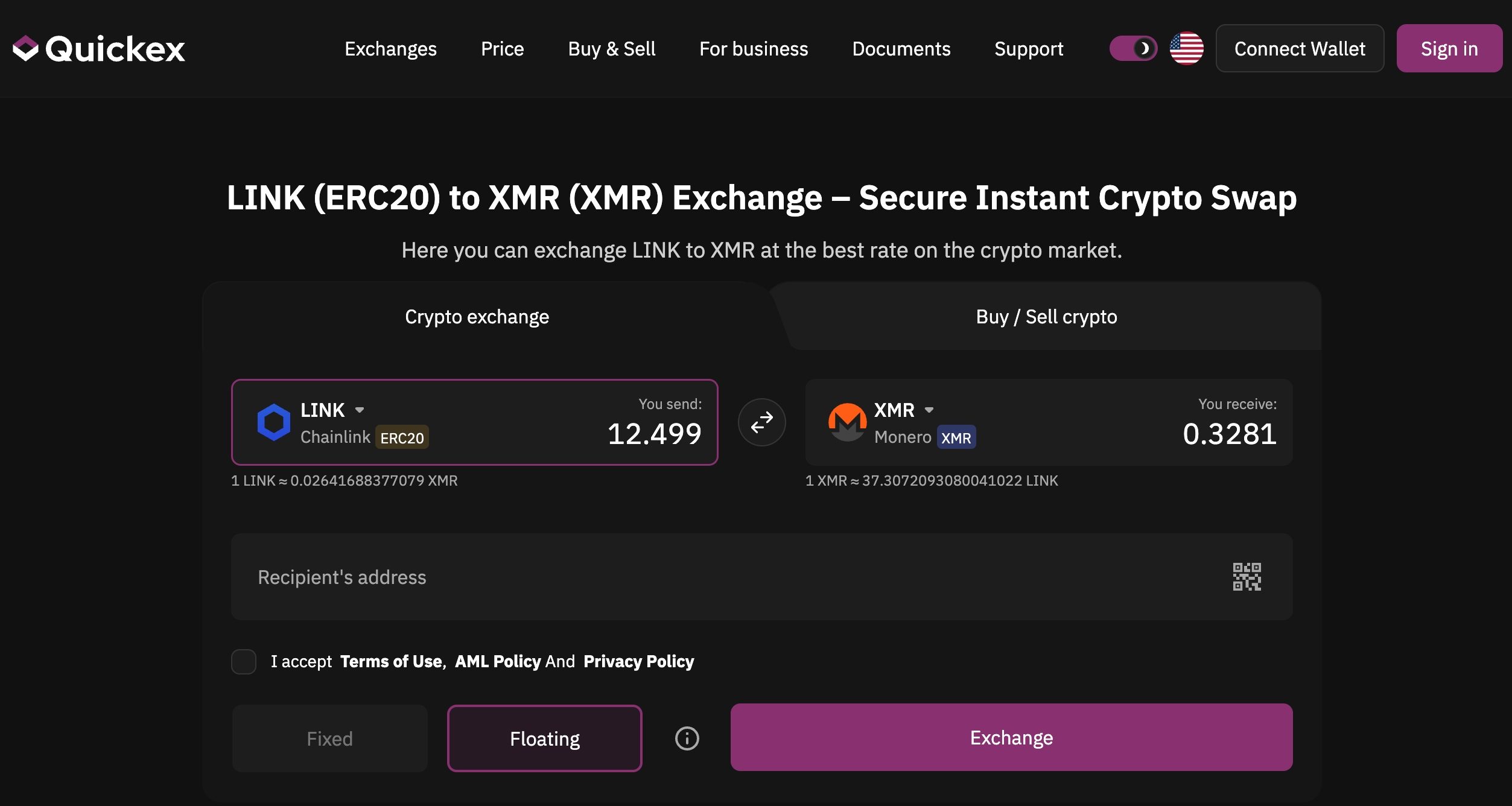
If you want a trustworthy centralized platform, Quickex uses a flow where the service processes the exchange (for example, LINK to XMR) and sends funds to your provided wallet address after completion.
Still: always compare rates, triple-check addresses, and consider doing a small test transaction first, especially when volatility is high.
FAQ: Chainlink (LINK) Price Prediction
What is Chainlink crypto?
Chainlink is a decentralised oracle network that connects smart contracts on any blockchain to real-world data, off-chain computation, and cross-chain interoperability. It is the dominant infrastructure layer for bringing external data — price feeds, weather data, sports scores, RNG, and more — into on-chain applications.
- Founded: 2017 by Sergey Nazarov and Steve Ellis; mainnet launched September 2019.
- Core product: Decentralised oracle networks (DONs) powering DeFi protocols, insurance, gaming, and enterprise applications across 15+ blockchains including Ethereum, Avalanche, Polygon, and BNB Chain.
- LINK token utility: Used to pay node operators for data retrieval and computation services, and staked as collateral by operators to guarantee service reliability.
- CCIP (Cross-Chain Interoperability Protocol): Chainlink’s flagship 2023–2026 product enabling secure token transfers and message passing between any blockchain — the backbone of cross-chain DeFi and institutional tokenisation.
- Market position: Chainlink secures over $17 – $20+ trillion in Total Value Secured (TVS) — more than any other oracle or middleware provider in crypto.
- Fixed supply: 1 billion LINK total; ~626 million (~62%) currently in circulation.
What is the current Chainlink price?
The current Chainlink price trades in the $13 – $18 USD range as of mid-2026 — a significant correction from its all-time high of $52.88 reached in May 2021, and below the local 2024 high of ~$35.
- Current LINK price: ~$13 – $18 USD
- All-time high: $52.88 (May 2021)
- 2024 local high: ~$35 (March 2024)
- Distance from ATH: ~65–75% below peak
- Market cap: ~$8 – $11 billion USD
- Circulating supply: ~626 million LINK out of 1 billion total fixed cap
- Rank: Consistently top 15–20 by market cap; the undisputed #1 oracle protocol by TVS and integrations
Chainlink price prediction: pessimistic, base, and optimistic scenarios
Here’s a full scenario-based Chainlink price prediction across three key time horizons, aggregated from multiple analyst models:
| Horizon | Pessimistic | Base | Optimistic |
|---|---|---|---|
| 2025 (recap) | $9 – $13 | $16 – $28 | $30 – $45 |
| 2026 | $8 – $14 | $18 – $35 | $38 – $60 |
| 2030 | $12 – $22 | $40 – $75 | $85 – $150 |
- Pessimistic drivers: Competing oracle networks (Pyth, API3, RedStone) erode Chainlink’s market share; broader altcoin bear market suppresses LINK price despite strong fundamentals; remaining ~374M LINK unlocks add sell pressure from the team and ecosystem fund.
- Base case drivers: CCIP adoption accelerates among institutional tokenisation projects and cross-chain DeFi; Chainlink’s DATA Streams product gains traction in derivatives markets; crypto market moderately recovers post-2025.
- Optimistic drivers: RWA tokenisation market reaches $10+ trillion and Chainlink becomes the settlement layer for institutional cross-chain transfers; SWIFT, major banks and asset managers adopt CCIP at scale; full crypto bull cycle with LINK reclaiming its ATH territory.
Chainlink price prediction for the next bull run — what do analysts say?
Chainlink’s price prediction for the next bull run is one of the most discussed topics in mid-cap crypto research. LINK has historically outperformed during late-cycle altcoin rallies and is positioned to benefit from multiple macro tailwinds:
- Historical bull run pattern: LINK rose from ~$2 to $52.88 during the 2020–2021 cycle — a 25× move from bear market lows. A proportional move from current lows of ~$10 would place LINK at $250+, though analysts consider $85–$150 a more realistic bull cycle target.
- CCIP as a bull run catalyst: By mid-2026, CCIP has been integrated by SWIFT, ANZ Bank, and multiple asset managers for tokenised bond settlement — real revenue flowing to Chainlink node operators increases LINK demand as a payment and staking token.
- Staking v0.2 and v1.0: Chainlink’s expanded staking programme locks circulating LINK supply into collateral, reducing sell pressure while increasing demand from node operators.
- Analyst consensus bull target range: $55 – $100 in the next confirmed bull cycle (2026–2027 window); more aggressive models cite $120 – $150 if RWA adoption exceeds current projections.
- Key risk: LINK has consistently underperformed Bitcoin and Ethereum in mid-cycle — capital tends to rotate into LINK only in late-stage bull markets.
What will Chainlink be worth in 5 years — and is LINK a good investment?
The Chainlink 5-year price prediction (to 2030) and its investment case rest on a single thesis: will decentralised oracle infrastructure become the critical middleware for a multi-trillion-dollar tokenised asset economy? Here’s a balanced view:
Bull case for LINK
- Unmatched TVS: $17–$20+ trillion in Total Value Secured — Chainlink’s oracles underpin virtually every major DeFi protocol on Ethereum and beyond. No competitor is within an order of magnitude.
- CCIP adoption in 2026: SWIFT’s proof-of-concept using CCIP for interbank messaging is the most significant institutional blockchain adoption signal since Bitcoin ETF approval. Confirmed bank deployments would be a transformative price catalyst.
- RWA tokenisation tailwind: BlackRock, Franklin Templeton, and other asset managers tokenising funds on-chain need reliable price feeds and cross-chain settlement — Chainlink’s core product offering.
- Staking supply lock: As more LINK is staked in Chainlink’s native staking programme, circulating supply decreases — a structural bullish pressure on price.
- 5-year base target: $40 – $75 by 2030; optimistic target $85 – $150 in a full RWA adoption scenario.
Bear case for LINK
- Oracle competition: Pyth Network (Solana-native, sub-second latency), RedStone, and API3 are gaining ground in faster-moving ecosystems where Chainlink’s architecture is slower to deploy.
- Tokenomics overhang: ~374 million LINK (~37% of total supply) remains undistributed from the team and ecosystem fund — ongoing sell pressure potential.
- Institutional adoption lag: SWIFT CCIP pilots have been running since 2022; confirmed production deployments at scale have been slower than bullish timelines projected.
- Price vs. fundamentals disconnect: LINK is 65–75% below ATH despite record TVS — suggesting the market has not yet priced in fundamental growth.
Chainlink market cap, tokenomics, and CCIP adoption in 2026
Understanding Chainlink’s market cap, tokenomics, and CCIP adoption gives the clearest picture of the protocol’s long-term price ceiling:
Market cap & tokenomics
- Current market cap: ~$8 – $11 billion USD (top 15–20 globally).
- Circulating supply: ~626 million LINK (~62% of 1 billion total).
- Fully Diluted Valuation (FDV): ~$13 – $18 billion at current prices.
- Remaining supply: ~374 million LINK held by SmartContract Chainlink Ltd. (team/ecosystem) — released on no public schedule, creating unpredictable dilution risk.
- Staking: Chainlink Staking v0.2 allows community staking with a current pool cap; full v1.0 staking (Economics 2.0) will tie LINK staking rewards to protocol revenue — a key long-term demand driver.
CCIP adoption & TVS in 2026
- Total Value Secured (TVS): Chainlink oracles currently secure over $17 – $20+ trillion in on-chain value — the highest TVS of any oracle network by a factor of 10×+.
- CCIP integrations: By mid-2026, CCIP has been adopted by Aave, Synthetix, Metis, and several tokenisation platforms for cross-chain liquidity and asset transfers.
- SWIFT partnership: SWIFT’s CCIP-based interbank messaging experiment represents the largest traditional finance integration of Chainlink technology — connecting 11,000+ financial institutions to blockchain rails.
- DATA Streams: Low-latency pull-based oracle service targeting derivatives and perpetuals markets — a direct response to Pyth Network competition and a new revenue stream for LINK node operators.
- Future outlook: If CCIP becomes the de facto cross-chain standard for RWA tokenisation, LINK’s role shifts from oracle token to critical financial infrastructure — a re-rating event that could push it well above its 2021 ATH.
Disclaimer — Not Financial Advice. All Chainlink (LINK) price predictions presented in this article are for informational and educational purposes only and do not constitute financial, investment, or trading advice. Cryptocurrency markets are highly volatile; past performance is not indicative of future results. Any investment in LINK or any other digital asset carries significant risk, including the potential loss of your entire principal. Always conduct your own research (DYOR), consult an independent financial advisor, and never invest more than you can afford to lose. QuickEx does not endorse any specific price forecast or investment outcome.
Disclaimer: The material in this article is not financial or investment advice. Everything stated here reflects the author's personal view and should not be treated as a recommendation to trade or invest. We make no warranties regarding the accuracy, reliability or completeness of the information presented. Cryptocurrency markets are highly volatile and can move unpredictably. Before committing any funds, every investor, trader or crypto user should study several independent sources and check the regulations that apply in their own jurisdiction.